12 Mar 2022 | Non categorizzato
Concluding on day two in the splendid setting of Florence’s Palazzo Vecchio with day one at the Theological Faculty of Central Italy was the conference entitled “Vatican Council II and Chiara Lubich’s charism of unity”. With topics ranging from synodality to the commitment to peace and dialogue between individuals and peoples, the event forms part of an extraordinarily topical debate. The great wave of new ecclesial movements which reached a peak under the pontificate of John Paul II certainly originated in the pre-conciliar period. It subsequently found its raison d’être in the Vatican Council, in particular by the value it gave to the Catholic laity, redefining the Church’s presence in the world (Lumen Gentium) and highlighting the centrality of the Word shared in communion (Dei Verbum). The post-conciliar period then saw a qualitative and quantitative explosion of those movements, valued in their inception and developed by Paul VI then applauded and supported by the Polish pope with his magisterium. A story of unity and distinction, particularly in the Church of the second half of the 20th century, which found its maturest expression in the charism of Chiara Lubich, a charism at the service of unity within the Church and of humanity. Testifying to the relevance of the charism at the service of unity, in the complex and at times convulsive moments we are living, the conference was part of the great movement of solidarity with victims of the war in Ukraine and with all people of peace who are working in Ukraine and Russia, Europe and Asia, everywhere. Councillor Alessandro Martini reminded us of this on a day when Florence was hosting an international demonstration for peace. For these reasons, since the Focolare Movement appears to be the first and most widespread ecclesial movement of the conciliar period, an international conference was organised by the Sophia University Institute and the Chiara Lubich Centre to mark the 100th anniversary of the birth of its founder which then had to be postponed twice due to the pandemic. The title was: “The Second Vatican Council and Chiara Lubich’s charism of unity: Dei Verbum and Lumen Gentium“. The venue was the Theological Faculty of Central Italy in Florence on 11 March and the Salone dei Cinquecento at the Palazzo Vecchio on 12 March. The conference was sponsored by the Comune di Firenze, with participation from the Italian Theological Association, the Theological Faculty of Central Italy (FTIC), the Paul VI Institute, the Giorgio La Pira International Student Centre, Città Nuova, the Abbà School and of course the Focolare Movement. The scientific committee was composed of Alessandro Clemenzia (FTIC), Piero Coda (Sophia University Institute), Florence Gillet, João Manoel Motta and Alba Sgariglia from the Chiara Lubich Centre. At the Vatican Council’s closing ceremony, in November 1965, Chiara Lubich summarised in a meaningful prayer what is perhaps the Council’s most striking note, the Church born from the presence of Jesus among his own: “Oh Holy Spirit, make us become, through what you have already suggested in the Council, a living Church: this is our only desire from which everything else will follow”. It is in this spirit that the conference set itself the goal of launching an detailed investigation aimed at understanding, on the one hand, whether and how the Council’s message found a fruitful place of interpretation and development in the experience brought about by the charism at the service of unity; and, on the other hand, whether and how the flowering of ecclesial life promoted by the charism of unity were made possible and propitiated by horizons opened up by Vatican II. Attention was centred in the first stage on Dei Verbum and Lumen Gentium, in order to bring into focus the convergent profiles and the contributions of conciliar doctrine and the inspiration of the charism of unity around the crucial link whereby the Church is born and grows as the historical incarnation, in the breath of the Spirit, of the Word that “became flesh” (Jn 1:14). The conference programme was particularly dense, as often happens when it is the result of serious work of conception and preparation. A river of words that, little by little, took on their full meaning, thanks to the wide-ranging contributions of the scholars. On the first day, Piero Coda, former Dean of the Sophia University Institute spoke on the theme “A chronological and kairological coincidence: a council and a charism. Towards a theological discernment of the correlation between Vatican II and the charism of unity”), Paolo Siniscalco of the University La Sapienza of Rome (“Chiara Lubich at the time of Vatican II”) and the Istrian-Pisan theologian Severino Dianich (“The event of Vatican Council II event: sacrament…of the unity of the whole human race”). Coda highlighted how the charism at the service of unity has made a very decisive contribution to Church history by way of communion based on the crucified, abandoned and risen Christ. Siniscalco, for his part, wisely and with historical accuracy retraced the various stages of Chiara Lubich’s existential adventure before, during, and after the Second Vatican Council. Dianich, on the other hand, with his characteristic clarity and frankness, gave an interpretation of Vatican II as the cradle for a more secular and communitarian reinterpretation of the Gospel. On Saturday 12th, the conference moved to a civic setting after the first session took place in an ecclesial setting, as if to reaffirm the charism’s double operational worthiness at the service of unity. In the prestigious venue of Palazzo Vecchio, in the Sala dei Cinquecento, where a number of Focolare meetings have been held since 1964, and where Chiara Lubich herself received honorary citizenship of Florence in 2000, the current President of the Focolare, Margaret Karram, opened the meeting, stressing the importance of Florence as the venue, in memory of Giorgio La Pira, the saintly mayor, a man of peace and the “living Church”. Back in 1974 Chiara Lubich with Cardinal Benelli founded the Giorgio La Pira International Student Centre named after him, thus creating and inseparable link between his name and the city on the river Arno. Florence as a city of peace, therefore, with special ties with the Middle East from which Margaret Karram originates as a Palestinian with an Israeli passport. “We work to weave relationships of peace everywhere, the most precious good that humanity can have”, said the president of the Focolare Movement. She was echoed by Card. Cardinal Giuseppe Betori who was absent for health reasons but who said in his message: “The experience of dialogue, at all levels, that characterised Chiara Lubich’s life, was based on an evangelical intuition about the relationship between interiority and exteriority, where relationship with the other was the causal and consequential extension of intimate union with God”. As the conference continued in Palazzo Vecchio, Vincenzo Di Pilato (FTP), commenting on Dei Verbum, addressed the theme: “The alphabet to know Christ. The Word of God, a permanent event of salvation in Dei Verbum“. Florence Gillet, from the Chiara Lubich Centre, dealt with a theme on the borderline between history and ecclesiology: ‘The Word of God in Chiara Lubich: the living presence of Christ that generates Church’. This was followed by a round table with Giovanna Porrino (IUS) on “The Word in the life of the Church”, Declan O’Byrne (IUS), “The Word and the Spirit”, Angelo Maffeis (FTIS) on “The Word of God as a principle of unity” and with the evangelical theologian Stefan Tobler (USBL) on “A mysticism of the Word as the way to ecumenism”. This was followed by the third and final session of the conference, dedicated to Lumen Gentium, with an eagerly awaited talk by Bishop Brendan Leahy (Bishop of Limerick, Ireland) on “The Church and the Marian Principle”. The following round table saw interventions from Alessandro Clemenzia (FTIC / IUS), “The Church from the Trinity”, Assunta Steccanella (FTT/TV), “The Messianic People”, Erio Castellucci, Bishop of Modena-Nonantola and Vice-President CEI, “Episcopal Collegiality and Synodality of the Church” and Cristiana Dobner (Discalced Carmelite), “The Charisms in the Mission of the Church”. Finally, the theologian Yvonne Dohna Schlobitten of the Gregorian University spoke on the theme of “An icon of Vatican II ecclesiology”. On 11 and 12 March, the Sala dei Cinquecento, full of warlike symbols in the large paintings on the walls, heard words of peace from La Pira, Bargellini and Lubich, and thus hosted an event that showed how the Church and civil society can bear witness to communion and dialogue, stimulating politics to make peace and peace-building its own goal.
Michele Zanzucchi

2 Mar 2022 | Non categorizzato
Contributions collected by Focolare Movement Emergency Coordination through the non-governmental organisations Azione per un Mondo Unito (AMU) and Azione per Famiglie Nuove (AFN) will go to support assistance activities for the Ukrainian population carried out by Caritas-Spes Ukraine. The actions of war in Ukraine show no sign of stopping, and among the population there are thousands of displaced people fleeing. Many are trying to survive between homes and emergency shelters, where they can receive initial support. 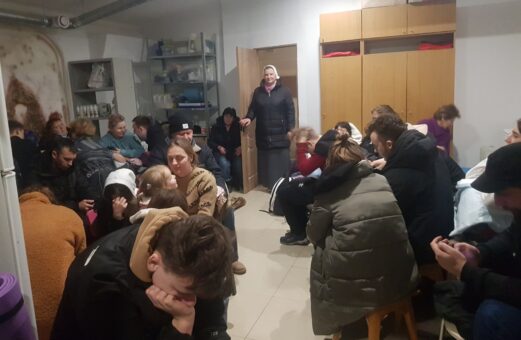 With contributions collected through the appeal launched by Focolare Movement Emergency Coordination, AMU and AFN are firstly supporting the actions of Caritas-Spes Ukraine. The organisation is providing aid to thousands of people forced to abandon their homes and flee to the border, or to take refuge in underground shelters set up in the immediate area where possible. Caritas-Spes Ukraine is committed to offer safe shelter, food, medicine, hygiene products and psychological support for close to 500 displaced mothers with children housed in their centres. More than 2,500 people are also receiving aid through Caritas in the parishes and 14 soup kitchens that remain active in the areas of Kiev, Lutsk, Berdiansk, Kamenets-Podolsky, Zhytomyr, Kharkiv, Lviv, Odessa, Vinnitsa and several cities of the Transcarpathia Region. The images of the war in Ukraine every day in international media, and the testimonies of our contacts on the ground, such as Mira Milavec, a Slovenian focolarina who lives in Ukraine and collaborates with Caritas-Spes, describe the state of emergency of a population under siege. The people are defenceless in the face of the bombing, and they crowd routes to reach the borders, or take refuge in basements or shelters, where makeshift beds have been set up as they wait for a hot meal, drinking water and electricity.
 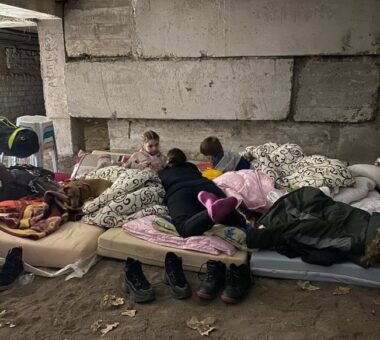 At the border with Poland, the line of desperate people who hope to cross the border is tens of kilometres long. Caritas-Spes in Lviv has organized special aid for mothers who try to escape with children, even very small ones, in their arms. They need everything, especially hot water to prepare meals or change diapers. In Odessa, which is under attack, shelters are being set up, even under the cathedral. The activity is punctuated by the sound of sirens announcing danger arriving or its temporary cease. In Vinnitsa a psychologist is organizing online training sessions for volunteers and operators about providing psychological help in stressful situations such as this. The first has already been attended by more than 120 people. Currently, the fundraising has already reached 100,000 euros, and the first shipment of funds has already been sent. It is being used to support the actions of Caritas-Spes for early aid to Ukrainian families. We are also evaluating the possibility of supporting the costs to take in the many Ukrainian refugees who are arriving in the surrounding countries, such as Slovakia and Poland. They are being welcomed by the generosity of local families who are opening their homes to them. Unfortunately, military activities show no signs of ceasing, and as confirmed by local contacts, needs will only increase. Frequent updates about the aid activity being carried out on the ground are available via the online and social channels of AMU and AFN. To support Ukraine and aid families devastated by the war, donate online on these sites: AMU: amu-it.eu/dona-online-3/ AFN: afnonlus.org/dona/ or through bank transfer to the following accounts: Action for a United World ONLUS (AMU) IBAN: IT 58 S 05018 03200 000011204344 at Banca Popolare Etica SWIFT/BIC: ETICIT22XXX Action for New Families ONLUS (AFN) IBAN: IT 92 J 05018 03200 000016978561 at Banca Popolare Etica SWIFT/BIC: ETICIT22XXX Reference: Ukraine Emergency
26 Feb 2022 | Centro internazionale, Focolari nel Mondo
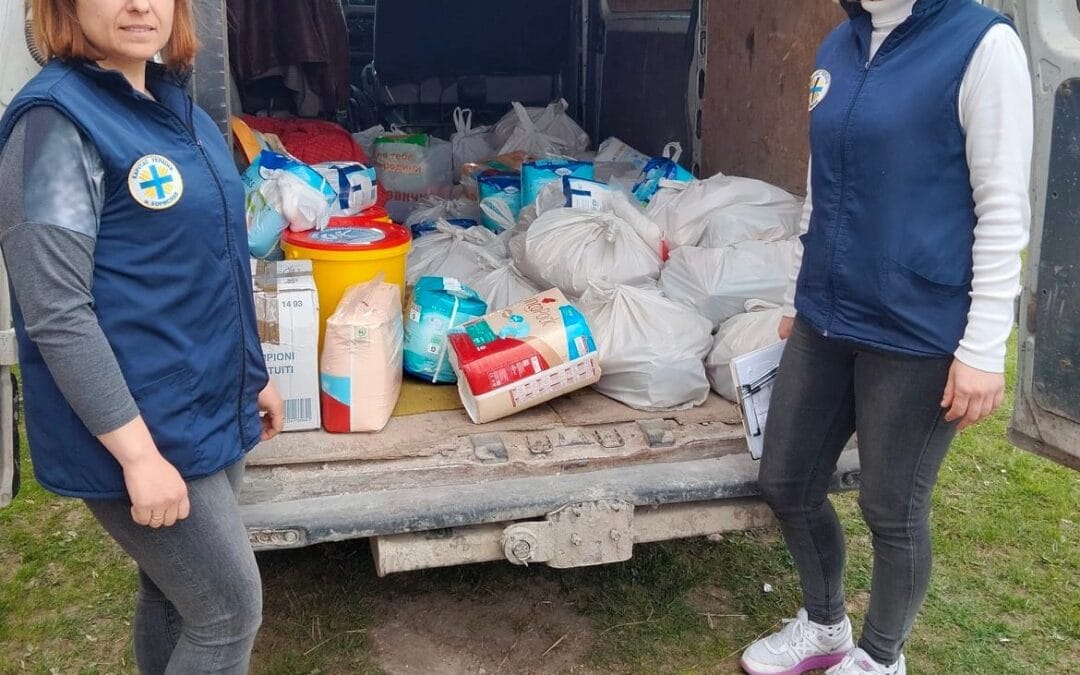
The contributions, collected through the NGOs Azione per un Mondo Unito (AMU) and Azione per Famiglie Nuove (AFN), will be used to provide the people of Ukraine with basic necessities, in collaboration with local Churches.
The Emergency Coordination Team of the Focolare Movement has launched a special fundraising campaign to support the people of Ukraine through the NGOs Azione per un Mondo Unito (AMU) and Azione per Famiglie Nuove (AFN).
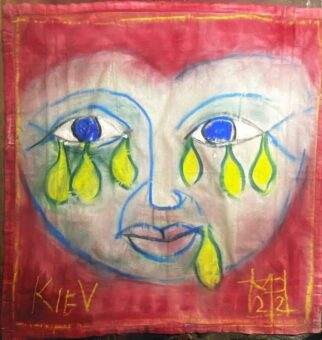
“Kiev” by the painter Michel Pochet
Any donations received will be managed jointly by AMU and AFN to provide essential aid to the Ukrainian people for food, medical care, housing, heating and shelter in various Ukrainian cities, in collaboration with local Churches. Donations can be made online via the following sites: AMU: www.amu-it.eu/dona-online-3/ AFN: www.afnonlus.org/dona/ or by bank transfer to the following accounts:
Azione per un Mondo Unito ETS (AMU) IBAN: IT 58 S 05018 03200 000011204344 at Banca Popolare Etica Codice SWIFT/BIC: ETICIT22XXX
Azione per Famiglie Nuove ETS (AFN) | Banca Etica – filiale 1 di Roma – Agenzia n. 0 | Codice IBAN: IT 92 J 05018 03200 000016978561 | BIC/SWIFT: ETICIT22XXX
Reason for donation: Ukraine Emergency
Tax benefits are available for such donations in many EU countries and in other countries around the world, according to different local regulations. Italian contributors will be able to obtain deductions and allowances from income, according to the rules for non-profit organisations (more…)
9 Nov 2021 | Non categorizzato
Statement by the Focolare Movement on the publication of the book “La Setta Divina” (The Divine Sect) by Ferruccio Pinotti (PIEMME Editions) The Focolare Movement has learned of the publication of the book “La setta divina” (The Divine Sect) by the journalist Ferruccio Pinotti (PIEMME Ed.), released today in Italian bookshops. The book comes at a difficult and crucial time in the history of the Focolare Movement: the transition from the founding period to the post-foundational phase. Throughout the history of the Church, this is a time that has often put to the test religious orders, movements and communities born of charismatic inspiration. Ferruccio Pinotti’s book wants to show that, even in the Focolare Movement, the initial zeal has sometimes led to misinterpretations of Chiara Lubich’s charism and/or to misleading actions. From the documents that Pinotti has obtained and published in the book regarding some of the internal debates within the Focolare Movement, there emerges, nevertheless, a growing awareness among the members of these and other inconsistencies in its history and the need to remedy them. However, the book does not seem to offer an objective and well-considered presentation of this charism, which is recognised by the Catholic Church. It does not take into account the commitment of many thousands of people who, inspired by the life and teachings of the foundress, devote themselves daily and generously throughout the world to creating relationships, healing wounds and overcoming rifts in every sphere of ecclesial and social life, in order to build a more fraternal and united world. We accept without reserve the fact that so much pain has been caused to the people who, in these pages, tell their stories of great suffering, disappointment, deception and abuse endured, and of those who did not wish to make their testimonies public. The Focolare Movement, in the persons of President Margaret Karram and Co-President Jesús Morán, expresses once again its shame and sorrow towards the victims and all those who have been wronged, its closeness and its desire to continue or begin a path of dialogue with them. It reaffirms its commitment to combat all forms of abuse and continue to improve its protection of children and vulnerable adults through ongoing formation of its members and leaders. It repeats its invitation to all those who have facts or stories of abuse to report them to the Commission for the Welfare and Protection of Minors and Vulnerable Adults (CO.BE.TU.) or to their respective Church bodies. Despite the partial, one-sided, sometimes inaccurate or reductive reading of the history, spirituality and activity of the Movement, we see this book as a further incentive in continuing the ongoing processes of conversion and renewal, remaining faithful to the founding charism and to the development of an open, free and critical dialogue within the Movement and with anyone who wishes to fully understand the Movement as it is today and collaborate with it.
Stefania Tanesini
13 May 2020 | Non categorizzato
The exhibition dedicated to Chiara Lubich in her hometown in Italy is enriched with a multilingual virtual tour that will allow visitors from all over the world to visit the exhibition composed of images and documents. May 13th marks the launching on the web , a significant date for Trento and Lubich. “Chiara Lubich Città Mondo“, the exhibition set up at the Gallerie in Trento, the birthplace of the Focolare Foundress, is now transformed and enriched with a virtual tour. The exhibition, closed for a period due to the pandemic and now extended until the beginning of 2021, can also be visited online. (http://mostre.legallerietrento.it/chiaralubich) The exhibition in Trent, which is part of the events linked to the Centenary of Chiara Lubich’s birth, continues in this way to implement the motto of the centenary: “Celebrate to meet with this extension on the web, “. Winding its way through history, life, images and color, it offers an opportunity to ‘meet’ with Lubich, and now the tour extends beyond the Galleries’ exhibition venue , to offer access to visitors from all over the world. Moreover, the date chosen for this launch on the web is no coincidence: on May 13th , 1944 Chiara Lubich’s story intertwined significantly with that of her city. That day when Trent suffered the second heavy bombardment also marked a turning point for the emerging Focolare Movement. Chiara Lubich was among the people displaced from the city towards the Gocciadoro woodland, after the family home was damaged. “I remember that night,” she would write years later, “on the outskirts of the city, lying with the others on the ground, just two words: stars and tears. Stars, because, throughout the night, I saw them all passing over my head; tears, because I was crying, realizing that I could not leave Trento with my loved ones. By then I saw with my companions the movement coming to life: I could not abandon them. And it seemed to me that the Holy Spirit, in order to make me understand His will, suggested words to me that I had studied at school: “Omnia vincit amor[1], Love conquers all”[2] .The next morning, Chiara Lubich informed her parents of her decision to stay in Trento, and soon afterwards, with her first companions, she set up the first focolare. The little house that housed the first focolare is one of the stages on the virtual tour that the visitor takes “Chiara Lubich city world” from the birth of the founder of the Focolare Movement in 1920 to the current worldwide expansion of the Movement. Even in the virtual setting, it is Chiara herself, through images and documents, who “tells her story “: her life as a young teacher, her consecration to God on December 7th, 1943, the growth of the first Focolare community. And then the summer of 1949, the beginning of a period of light for Chiara Lubich from which will flow the charismatic novelty that would give life to a new Work in the Church. Light and colours are the protagonists of the last part of the tour which, through words and images, allows us to know experiences of unity, spaces of fraternity born of the Charism of Lubich which continue to grow and develop in the present day in order to contribute to the fulfillment of what she considered the “testament” of Jesus: “That all may be one” (Jn 17:21). “For that page of the Gospel we were born,” Lubich wrote, “to bring unity in the world, unity with God and unity among all our brothers and sisters”.
”Even though we were aware” – she explained –“ of the divine audaciousness of the program that only God could carry out, kneeling around an altar, we asked Jesus to make his dream come true using us too if it was part of his plans”[3]. A dream also formed on that night of May 13th 1944 when, faced with the collapse of everything, bewilderment, the anguish of the unexpected drama of the moment, among stars and tears, she chose to believe that “Omnia vincit amor, love conquers everything”.
Anna Lisa Innocenti
[1] Virgil, Ecloghe, X, 69 [2] Chiara Lubich, Nascita di una spiritualità, in Michele Zanzucchi, Enzo Maria Fondi, Un popolo nato dal Vangelo, San Paolo, 2003, pp. 9-10. [3] Ibid., p.17
