27 Jul 2018 | Non categorizzato
“The woman of Nazareth, as a homemaker, offers an enormous challenge for us, urging us to set aside a spirituality based on a fascination for the extraordinary in order to find mysticism in our daily routines. From theoretical fantasies to a tangible reality in the simplicity of the everyday… that is where God walks. Ermes Ronchi, Le domande nude del Vangelo (The bare questions of the Gospel), p. 176. “We truly need a home. A home is extremely important… It needs to be kept as most holy Mary kept hers, which hosted no less than Jesus, so she needed to do something in harmony with he who was the Word of God. “It was the beauty of God, it was brilliant, it was glorious, for glory means God’s brilliance. I don’t know if you can imagine, as a way of saying, God as a sun that is setting. Its rays that shine forth are the Word. The Word of God that became flesh is Jesus. So he is truly the glory, the height of beauty, splendor. “And so Mary… in her home… she knew how to keep it well, in a way that hosted Jesus well… Our calling, if it is a Marian calling, is making a home. You can’t understand Mary if you don’t understand a mother at home, beyond being the seat of wisdom, someone who knew how to keep a home.” Chiara Lubich on May 30, 1996, at the inauguration of the Gen house in Loppiano, Italy “A mother is more about intuitions of the heart than speculations of the intellect, more poetry than philosophy. She is quite magnificent and grounded, close to the human heart. “Thus it is so with Mary, mother of mothers, who is the sum of all affection, goodness and mercy, to which all the world’s mothers cannot compare. Mary is peaceful like nature, pure, serene, clear, moderate, beautiful… She is gifted, spirited, tidy, steadfast, rich with hope. “She is too close to us and unpretentious to be contemplated… She brings the divine to earth, like a heavenly plane that gently slopes from a dizzying height of the heavens down to the infinite smallness of creatures.” Chiara Lubich, Disegni di luce (Designs of light), p. 84–85.
26 Jul 2018 | Focolare Worldwide
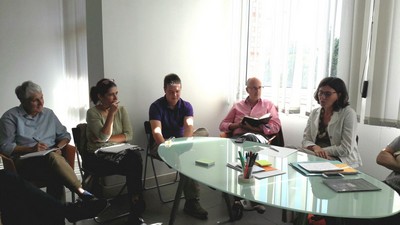
“We had a few special days here at Loppiano,” the organizers write, “special days in the first “school” for pastoral care workers. There were 75 of us from different regions of Italy, as well as some groups from Latin America and Rwanda.” The title chosen for the workshop was Local Church: communion and mission – pastoral care in light of “The Joy of the Gospel.” The workshop took place in the Movement’s international town of Loppiano and was promoted by the Evangelii Gaudium (CEG) Center. It was a formation course as well as a research and study project offered by Sophia University Institute. “We were pleasantly surprised by the effect the proposal had on the participants: both in the deep and mature sharing of ecclesial experiences and in how the spirituality of unity responded to their needs, as well for the spiritual presence of “Jesus the Teacher” which seemed to illumine the pastoral care experience.” The presentations were high quality, prepared in close collaboration and in harmony with one another. The interactive afternoon workshops provided us with methods for implementing the content that was presented in the mornings.” The goal of the workshop was to propose theoretical and practical models to people who are working to make the spirituality of the Focolare “visible and experienced” in the Italian Church, since it is a gift from the Holy Spirit that was given to Chiara Lubich for the whole Church of today.” The course opened with an enriching introduction to the Trinitarian method used at the university in Loppiano, by Msgr Piero Coda, Director of the Institute; and a talk by Cardinal Giuseppe Petrocchi, president of the CEG, titled: Protagonists in the life of diocese and parishes. One of the attendees remarked: “How beautiful the analysis of the new cardinal. Every concept raised smiles and emotions. . . I believe I absorbed a certain human mentality, especially regarding the use of words when proclaiming [the Gospel]. With the excuse of respecting the other’s freedom, I hide and deprive the other of the great gift I’ve been given. The cardinal spoke with force and, in his analysis, you could feel his zeal for the Church and humanity, and the secret for contributing to their renewal.” Other important presentations were given by Archbishop Vincenzo Zani, Secretary of the Congregation for Christian Education, and by Dr Vincenzo Buonomo, rector of the Lateran University. One young man remarked: “Archbishop Zani’s presentation illuminated me a lot. You have to have a program: The Word, placing oneself in the school of ‘Jesus the Teacher,’ living new relationships, expressing the communitarian dimension of the Church, the dimension of dialogue which generates a universal brotherhood.” Other comments; “This school was interesting for rediscovering the value of the incarnated Word in renewing the human structures of the Church.” “Our missionary life passes through a living charity and, therefore, seeing it, others wish to be a part of it.” “Theoretical presentations were both beautiful and exhaustive. Today, the third day, I went through a little crisis, following an examination of conscience because of what I always propose to do and never manage to do. So it was a constructive crisis.” “I really feel that we all need this training, so that our actions will be supported by this knowledge.” The workshop will continue with a second part that will take place in early October at the individual parishes. Gustavo Clariá
26 Jul 2018 | Non categorizzato
“Fifty years after being published, Paul VI’s encyclical Humanae vitae appears entirely different to modern eyes. In 1968 it was a brave document – and as a result controversial– that went against the climate of the time. This was the era of the sexual revolution, which needed certainty of contraception and the possibility of abortion in order to happen. It was also a time when economists spoke of a ‘human bomb’ – the danger of overpopulation that threatened rich countries, which could have decreased their prosperity.” So writes Lucetta Scaraffia in Avvenire, although she concludes that today the world has changed and that the encyclical should be read again with a different perspective: as a “prophetic event.” It was published on July 25, 1968, in the sixth year of Paul VI’s pontificate, and caused a number of conflicting responses.
25 Jul 2018 | Focolare Worldwide
A meeting of bishop members of the Focolare Movement is underway in Seggau, Austria, from July 24th until August 1st. The 64 bishops, including cardinals from the Curia and apostolic nunzios from 31 countries and four continents, will spend several days together in Sytria for an “experience of the Universal Church among bishops,” the Austrian diocese reported. The gathering will be hosted by Bishop Wilhelm Krautwaschl. “The tradition of these bishops meetings was begun decades ago when the foundress of the Focolare Movement, Chiara Lubich (1920-2008), invited several bishops attached to the Movement, to Switzerland during the summer months. It was the deceased bishop of Aquisgrana, Bishop Klaus Hemmerle, to launch and moderate these meetings that were “deliberately private” and held in different places every year. The goal of these gatherings is to “delve more deeply into the charism of unity, to encourage sharing among the bishops on a global level and to spend several days in fraternal communion.” On Saturday, July 28, Bishop Krautwaschl will concelebrate the Mass with his brother bishops at the Basilica of Seckau, “to which all are invited.” In Austria, the Focolare Movement has 1,300 members and more than 20,000 sympathizers. Source: AgenSir
24 Jul 2018 | Non categorizzato
Well aware of the environmental and social crises that our planet faces, hundreds of people around the world have been steadily moving to find creative solutions to these grave problems, putting them in motion in their everyday lives through actions large and small. However, these actions often begin, grow and die totally in isolation. “Together we can do much more” is one of the mottos proposed by Prophetic Economy, a project that aims to create collaborative networks among all those who, in their own context, work to promote human development, independent of age, nationality or beliefs. The main event for Prophetic Economy will land at Castel Gandolfo in Rome from November 2–4. Experts from many fields will be involved, such as Jeffrey Sachs, North American economist and one of the world’s top minds when it comes to economic and sustainability questions; or Luigino Bruni, Italian economist and international coordinator of the Economy of Communion. “The experience is open to all people, organizations and businesses,” says Florencia Locascio, Prophetic Economy’s general coordinator. “All those who propose sustainable and creative solutions to the problem of poverty, inequality and the social and environmental crises that we are living through. We want to identify the changemakers, the innovators, and give them more visibility.” During the event, in addition to workshops, collective activities, networking and panels with renowned international experts, the first-ever Prophetic Practices Award 2018 will be awarded. The competition awards, spotlights and connects existing experiences of a prophetic economy, the many best practices that are already up and running that contribute to the common good. “Teens and the new generations have something important to say, and they already contribute enthusiastically, offering practical examples that are exciting,” explains Paolo Matterazzo, who directs communications for the Community of Nomadelfia. The first three to win the competition will receive a monetary prize and be invited to present their projects during the November event. The top ten will also have the chance to present their best practices. Deadline for the competition is August 1. For more information, see propheticeconomy.org. Source: United World Project
