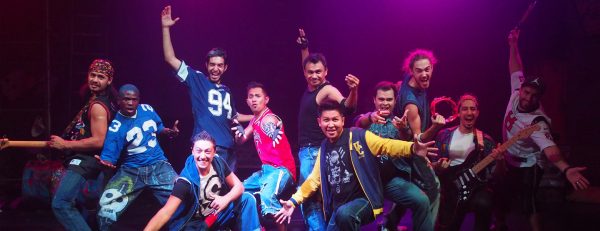
The Genfest is a meeting of youth who want to show the world that universal fraternity, a united world, is an Ideal worth living for. Over the years, the Genfest has become a great festival of ideas, thoughts and actions that inspire thousands of youth to change their life, their future and, finally, the world. Born in 1973 as the brainchild of Chiara Lubich, foundress of the Focolare Movement, the Genfest will reach its 11th edition in 2018 in Manila (Philippines). GEN ROSSO band will perform at the evening music festival on July 7.
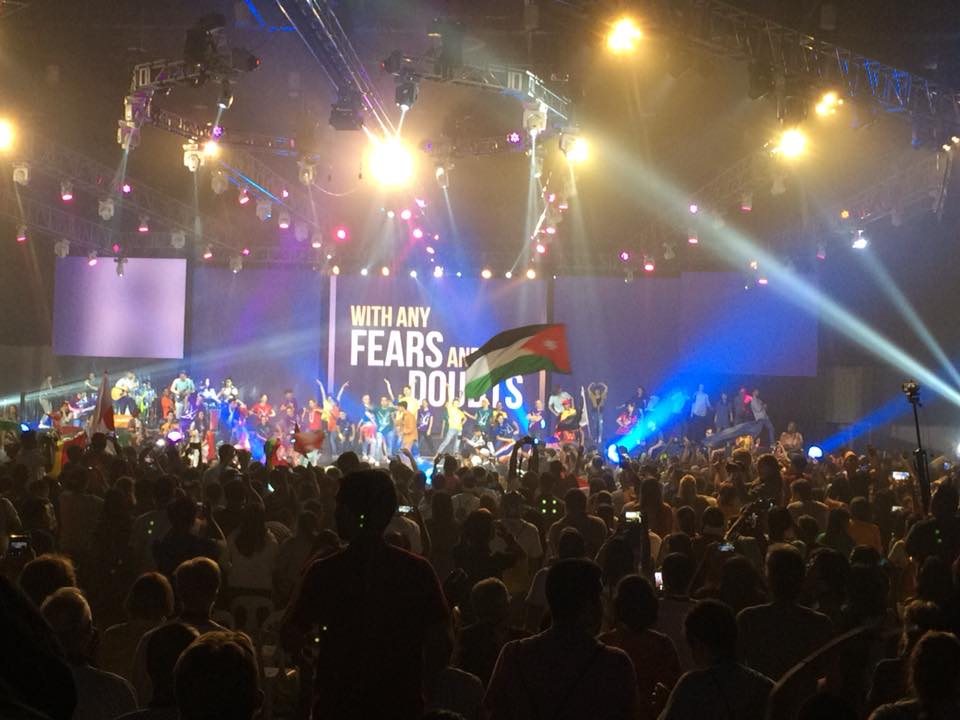
Here we are: Genfest kicked off today in Manila’s World Trade Centre. It’s the main international event, while around 20 national Genfests are taking place in all five continents. The program has one main focus: to overcome every sort of barrier and thus the slogan: “Beyond all borders”. The daring title was chosen by the young people as an answer to the many forms of divisions present in many parts of the world. It’s also the motivation behind all the activities which preceded this moment during the period of preparation. Right from the start, the Genfest has been a collaborative effort; every actor is a main actor. The morning session, which has just concluded, began with videos from several locations showing pre-Genfest activities that have been taking place in twenty south-Asian countries between June 28th and July 5th where hundreds of young people organised social projects for communities. The microphone is passed onto the presenters and the “vloggers” who accompanied the participants in the program. For those born before the mid-1990s, we should specify that the vloggers have had great influence on teenagers and young people through the social media. In recent months, Louis from Burundi, Maria Clara from Brazil and Ceska from the Philippines all have a growing number of followers on Facebook. Powerful testimonies have been shared during the first session of the Genfest, like that of Josef Capacio from San Diego, California and Noah Herrera from Mexicali, Mexico. At a time of political and social imbalance and all kinds of division, they decided to promote peace right beside the wall that divides nations.
Watch interview on Facebook
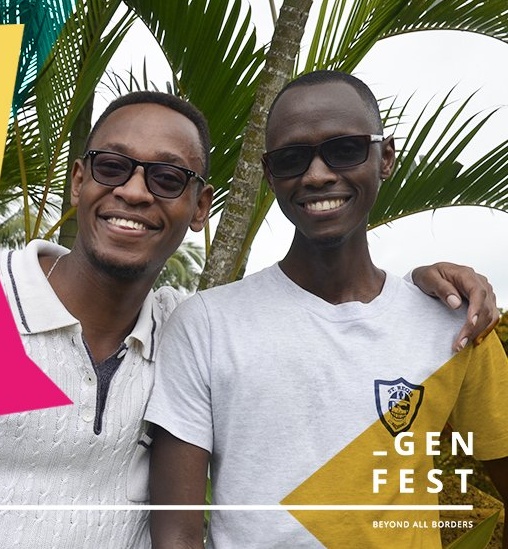
The joint initiative carried out by young people from the United States and Mexico, Noah recounts, allowed us to discover the values, objectives and vision of the world from opposite directions. “We are all equal and we can love our own country as our neighbour’s.” Then, there was the story of Jean Paul Muhanuzi from Burundi, and Egide Nduwayezu from Rwanda. Theirs was the story of a true and growing friendship amidst dramatic conditions. After an assassination attempt on both of them, which left Jean Paul seriously injured, Egide gave up everything to support him during his rehabilitation after spinal surgery. The overcoming of borders in their case led to mutual appreciation of the beauty of different peoples and cultures. Jaime Zayas, from El Salvador, launched the idea from the stage of the need for a change in one’s own “square mile”, as he himself had experienced in his own land within the context of urban violence and mistrust. The strength came from the desire of being peace-builders: “We know that our country has huge problems, but we can change things on a daily basis, building relationships founded on reciprocity.” Tommaso Carriere, Italian and founder of the association, “Not From War,” a project formed by people of peace, showing what war is like and how development brings growth in the form of “fragments of solidarity, little steps that draw people closer and nurture peace. “We recount what we’ve seen in a country afflicted by war and how conflicts only serve to destroy society, undermining hope and the possibility of a better future.” Since 2014, the association promotes summer camps in Jordan where European teenagers visit refugee camps and interact with those who suffer through the consequences of war. The voices of these first days in Manila speak of pathways of life and plans for the future.
After having retraced features of the youth reality in the ‘80s, emerging from the private life following the riots in the squares of different worldwide capital cities, Chiara Lubich explains how the young people “have believed in the possibility of the world’s rebirth and they have rolled up their sleeves in order to give their contribution. They have done so through a wealth of incredible initiatives.” And she continues: “They are present, walking along the different pathways in order to reach the goal of a united world. There is the pathway of unity among races, of unity among peoples; the pathway of development, of unity between the rich and the poor, of unity among generations; the pathway of unity among nations at war, in order to achieve peace; among the faithful of different religions, between people and nature; among persons of different ideologies; the pathway of unity among ethnic minorities, of unity with those who are alone or who suffer in every way. Without being concerned about what people might think of them, they have recognized this pathway in Jesus. ‘I am the way’ (Jn 14:6), Jesus said, and they have followed Him trying to live His doctrine to the letter by putting the Word of God into practice. … Moreover, in whom can young people trust if not in Him? He alone can help them to realize the ideals that they have in their hearts and that they seek to defend. They love freedom; they strive for it; they want it. Who can give them freedom if not Jesus, who said: “If you remain in my word … you will know the truth and the truth will set you free” (Jn 8:31-32). Young people want respect for nature. In many countries, they struggle to save people from self-destruction due to pollution. Who can respond to this desire more than the One who has created nature for human beings? Young people love peace; they want peace. Who can guarantee peace more than the One who said: “Peace I leave with you; my peace I give you; not as the world gives do I give it you” (Jn 14:27). Young people want human rights to be respected. Did Christ not come on earth precisely to announce the Good News to the poor, to proclaim liberty to prisoners, to give sight to the blind and the oppressed back their freedom? (see Lk 4:18). Young people ask for social justice. Where do they find the courage to come face to face with contradictions, misery and hypocrisy, the open wounds of a consumer society, if not in Him who calls blessed “…the hungry and thirsty for justice?” (Mt 5:6). Young people do not love divisions. Who can satisfy them more than the One who sees humanity as one and who came to knock down the barriers between different groups, ethnicity, cultures and peoples? Young people are attracted to non-violence. Where can they find the incarnation of their ideal if not in the One who has told us to love even our enemies, thus bringing non-violence to its extreme consequences? Young people love solidarity and the communion of goods between the rich and the poor. Jesus, who told us to give to whoever asks and not to turn our backs on whoever asks for a loan, is their model of solidarity. Just as the first Christians had understood Jesus’ requirements, so that no one kept any property as his or her own, likewise, young people find all their needs satisfied in Jesus. … Yes, young people with Christ, young people and Christ, the ways and the Way: this is the binomial which can give us true hope. … Go ahead, my dear young people, with total confidence. Go ahead with perseverance. Enlighten people with your actions. Let your faith shine forth before a humanity which often drags on with a life that is mediocre and meaningless. Show it how disunity can be avoided and how unity can be built. Speak out clearly on how this Ideal is not a utopia; indeed, only those who have great ideals make history.” (Extract from: Message by Chiara Lubich at the Genfest, Mollens (Switzerland), 24 March 1987 – Source: www.centrochiaralubich.org)
Pope Francis will be in Bari (Italy) on Saturday, 7 July, for the ecumenical meeting of reflection and prayer with the Patriarchs and Heads of Christian Churches of the Middle East. The event will be introduced by Cardinal Leonardo Sandri, Prefect of the Congregation for the Eastern Churches, and Cardinal Kurt Koch, President of the Pontifical Council for the Promotion of Unity of Christians. “The idea of a meeting like the one to be held in Bari was conceived a long time ago by various people – Cardinal Sandri remarked – different Churches or Patriarchs expressed this desire personally to the Holy Father. In Bari, Pope Francis will be joined in prayer by Bartholomew I, Ecumenical Patriarch of Constantinople and Pope Tawadros II of Alexandria and the entire Africa.” The event, of great ecumenical value in itself and unprecedented in the history of ecumenism, will consist of two moments: the prayer meeting along the seafront promenade together with the faithful, and a moment of reflection and mutual listening between the Holy Father and Heads of the Churches and Ecclesial Communities of the Middle East, where each will contribute with their own standpoints, observations and proposals. The city of Bari is called the “window on the East” since it guards the ancient tomb of St. Nicolas, venerated by Catholics and the Orthodox alike.
Head of Department The director of our sector had for some time seemed like an engine running at full speed. Everybody tried to avoid him. One day, talking with my grandmother, she told me about my grandfather who had gone through a period of physical exhaustion during which he seemed like an unfettered horse. His recovery was facilitated by the calm atmosphere in the family. The next day I gathered my colleagues and proposed to them that we help the boss, trying to listen to him with calm and anticipating his needs. Not everyone agreed, but the majority understood. A few days later the boss confided to us the tragedy that his family was going through. He also thanked us saying: “Because of your help I never lost hope.” C. M. – SpainChange of Course I was 61 years old when I met some young people who were trying to live the Gospel. I was amazed by their harmony and serenity. I had been a sailor and knew well how difficult it can be to live together. This convinced me to want to learn more, so I purchased a copy of the Gospel. Reading it for the first time, I realized I had to change course: It wasn’t enough to be honest in order to feel that all was well with me. I had to love others, excluding no one. This involved a radical change in my way of thinking and acting, beginning with my family. Whereas with people I didn’t know I was all smiles and willing to engage in conversation, whereas at home with them, I spoke little, only when necessary and with an authoritarian tone. G. – ItalyBullying I experienced bullying for myself. When I was a teenager, several students from my school decided to beat up the first red-head who would head towards the toilets. And I happened to be the one. Now I’m a teacher. One day, before class, a student came looking for me in the teacher room. He told me that he had been charged with setting a trap for his best friend, and if he didn’t do it he would receive equal treatment. He was shaking and afraid. During the lesson, I told them what happened to me. I asked my students to tell me what they thought of what I had said and my words were followed by words and long silences. A few days later I learned that the trap was no longer planned on. H. N. – HungaryDad’s Return The news that Dad had returned to Itay with his new wife for a period of vacation had overturned the life of me and my sister. After the separation of our parents years of difficulty followed. From the return to our country with our mother until her death from an incurable disease. The relationship between us sisters was peaceful, but the news of Dad’s arrival brought forth a lot of forgotten feelings and pain. “I don’t want to see him!” was the first impulse. Then a thought: God, our only value, reminded us to love our enemies. The meeting with Dad went well and we tried to love him. A bridge has been built between us. E. R. – Italy