3 Jul 2018 | Focolare Worldwide
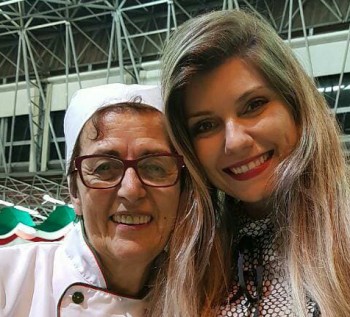
 The Espiga Dourada story shows how dedication to helping the poor can inspire the entrepreneurial spirit. The artiginal bakery has achieved a great deal over the years, overcoming many obstacles and threats in the volatile environment along a major expressway on the outskirts of Brazil’s largest city. Started in 1988 as a bread-making initiative, selling loaves on the roadside, the enterprise was a forerunner of the Economy of Communion project which Chiara Lubich launched from Saõ Paulo in 1991. Espiga immediately embraced the courageous vision and values of this revolutionary new approach to economic activity. «It was during a serious economic crisis,” recalls Espiga pioneer Adriana Valle, originally from Italy, for the past 38 years in Brazil. “Money was scarce, there was rising inflation and high unemployment. In the midst of this situation, we were a group of girls with different talents and skills who got together to start baking bread and selling it from baskets to the drivers passing by the Focolare town “Mariapolis Ginetta” in Vargem Grande Paulista». They did this a few times, but when they suspended production for several days, drivers kept stopping and asking for the “girls with the bread and big smiles”. At this point, they realised it could be a permanent activity, offering work opportunities to local mothers and young people, to help them support their families and their education. There was no clear business plan at this time, but the customers kept growing in number, drawn by the friendly atmosphere. In 1994, the sales activity moved from the pavement to a small roadside store, at the same time as the Economy of Communion Business Park was developing close to the Focolare town. A second sales point was established on the other side of the road, bordering a favela slum, so that the people living there could buy their bread without the danger of crossing the busy highway.
 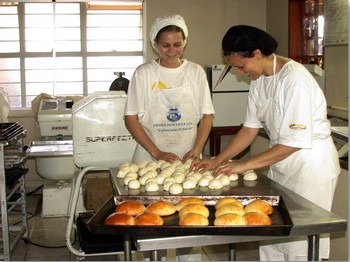 Chiara Lubich chose the names Espiga Dourada I and II for the two shops, with a logo showing a ripe ear of corn shining under the sun. The aim: to offer a welcoming, harmonious and calm environment with a family atmosphere for all who come. From the start, there were those convinced it would fail, people who scorned the possibility of success from such humble beginnings (“how can you hope to achieve anything with just half a sack of flour?”). Others held the faith, and got involved to make it work. For example, two local businessmen were so impressed by the progress made with such flimsy infrastructure, that they decided to contribute financially. This investment came just in time to avoid having to lay off some of the staff, and allowed plans to go ahead to improve and redesign the two locations and to raise the standards of the products on offer. Many customers have spoken of how these two bakeries have had an effect far beyond good-tasting bread. Some travel for kilometres just to experience the “positive energy” they find there as they enjoy their coffee and cake. Some discover the strength to make a new start in their lives, encouraged by the welcome they know they will find there. But it has not all been sweet aromas and smiling faces. The bakeries have been attacked several times. During the last incident, Adriana was ordered to empty the till by a masked gunman. At gunpoint, she found the courage to start talking with him. She told him how worried she was about how things would turn out for him and his gang once they went outside. Her sincere concern and respect disarmed the boys, literally. They even took off their masks and did no harm. And there have been no more incidents since then! Today the bakery and two shops employ 20 part time and 15 young part time workers. They use ten sacks of flour and serve between 1,200 to 1,500 customers each day. For the more affluent weekend customers, they offer a selection of specialist breads, savoury dishes, cakes for special occasions, and their own artisanal ice-cream range. At the same time, they maintain production of high quality, low-price bread for their regular clients from the favelas. As well as creating jobs and working with an attitude of love, a cherished part of Espiga Dourada’s aim is to facilitate interaction between different social categories. Those less advantaged financially feel part of the Espiga family, while those who are better off come back, bringing their own contribution and then thank Espiga because they find they have received far more than they have given. Source: EdC online
2 Jul 2018 | Focolare Worldwide
Isn’t insisting on dialogue actually just caving in to relativism, where you only need good manners in politics without caring about fundamental values? The “Movement of Politics and Policy for Unity (MPPU) is not a political party, but a space for dialogue in parliaments and cities, between all coalitions. It proposes that we reflect on the soul of representation in order to overcome the crisis, through consensus-driven, deliberative democracy. The tool we use is an “elected-electorate pact.” It’s not about good manners; it’s a proven method, one of fraternity, that leaves us free and equal in our diversity. It is possible to rediscover the soul of politics beyond a pragmatism that has no ideals, in order to serve the common good with the “love of loves,” as Focolare’s founder Chiara Lubich taught. We’ve started a series of dialogues about topics that are both lofty and practical. We approach these through reasoning, and certainly not what currently tends to happen, which ranges from insults to all out frontal assault. That’s no longer acceptable. Where does democracy risk – and not just in Italy – losing its soul? Representative democracy is in crisis because of the dominance of globalized finance over the everyday economy and politics itself. Weak parties are easily influenced by one lobby or another. The end of ideologies often coincides with a lack of ideals. What’s needed is a hearty injection of popular participation, in order for citizens and the parties to commit to solving issues such as employment, social justice, peace and disarmament, mitigating risks, standing against mafias and corruption, and preserving the common good and the great cultural and environmental resources we have here in this country. The elected-electorate pact that we have seen in a number of parliaments and councils can bring citizens closer to their institutions and give a soul to a representative democracy, which is enriched by being deliberative and consensus-driven. MPPU has stayed current, addressing issues where there is genuine conflict. What are the most urgent items you would like to take on today? The Movement of Politics and Policy for Unity is above all a fraternal meeting space for people who are active in most of the different political parties. And this is not a problem; it’s enriching. In recent legislation we have made social and civil rights a priority. Now we think that the most urgent issues to face are jobs for young people and fighting poverty. We need to disarm the economy and convert factories that produce weapons to civil uses, especially in a country whose Constitution “repudiates war.” We need integration beyond just welcoming immigrants and their children, without forgetting the importance of security and lawfulness. Are there practical proposals that you are thinking of putting forward? MPPU needs to facilitate, alongside its work in the halls of government and commissions, practical proposals from parliamentary workshops, where different political cultures meet with academics and competent members of civil society. We can promote a series of dialogues in the legislature, both on an idealistic and practical level. Source: MPPU online
2 Jul 2018 | Focolare Worldwide
It’s countdown to the start of the Genfest! (Focolare Youth Festival in July 2018). Together with all the young people present at the Genfest in Manila and those who will follow the event live around the world, we want to be a “Wave of Love” going beyond all barriers in our relationships, when there are misunderstandings and in the great challenges facing our world today. So, here’s a taste of what Gen Verde will be singing in Manila… see you soon! https://www.youtube.com/watch?v=Mh75HR_YI1g&list=UUuSTi05GBlACXtCu4zEY7FQ
1 Jul 2018 | Focolare Worldwide
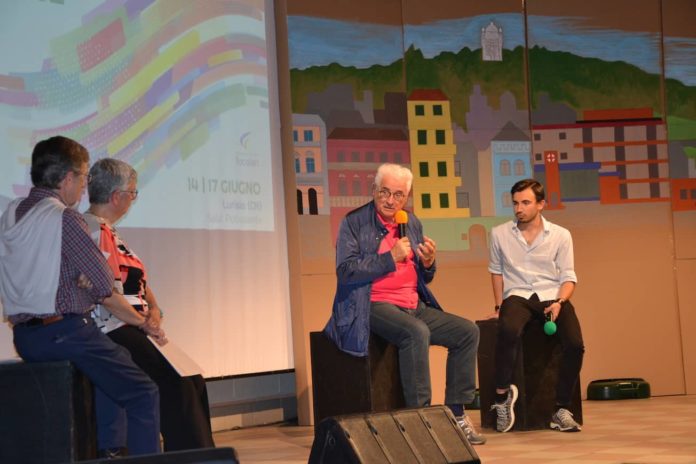
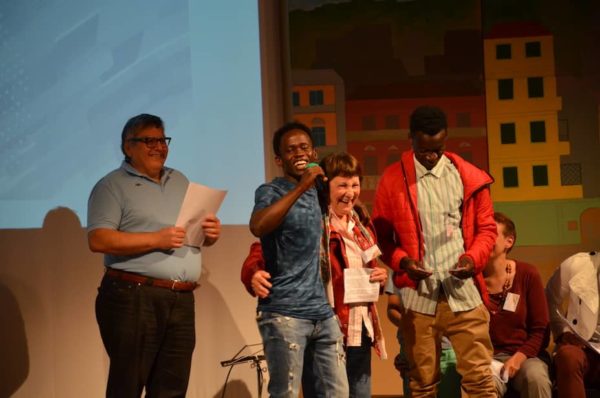 “Visions of light are always beneficial, especially in a world where lights are scarce.” These were the first comments I got from Anna, who declares to be a nonbeliever, at the door of the hall which hosted the first Mariapolis of Piedmont. “Visions of light” was the title of the three days lived by over 200 people of all ages and social classes, coming from different cities of this region. Light that breaks out from moments of spirituality and sharing, and which has enlightened the burning issues of today, such as Europe, immigration, Middle East, and end-of-life and palliative treatments, alternated with programs of relaxation and excursions to regenerate body and soul. And not only all that, against the dark background of public life and economic and political uncertainty, in a climate which makes brotherhood seem like a luxury only for a few, a vision of light also enlightened the life of Bra, a city with a very ancient history, but projected towards the future. Here fraternity elevated to a political category, has been for years written in the Charter of the city. And it did not remain a dead letter. Two adolescents, with the support of power point, demonstrated actively with a slogan, “Let’s colour” the city. There were many initiatives, like whitewashing the walls of the school or the ill-treated walls of the city, the gathering of cigarette butts from the ground, cleaning of weeds, and visits to the elderly in the nursing homes. The purpose was to leave a sign of love everywhere and spread to the others the happiness experienced when the revolution of the Gospel is put into action, following the example of one of the region’s honorary citizens, Chiara Lubich. “The initiatives of these kids,” underlined the Mayor, Bruna Sibille, “have contaminated those who are older, other communities like the Albanese one, workers of the construction sector, groups of the Orthodox faithful together with the head, a group of Romanians and other district realities. Next September– she announced – before school starts, we shall meet to continue working together.” One of the programmatic points at the base of her mandate, which is about to end, was to “boost social cohesion through the idea of the city to that of a city as an inclusive community.” She added: “The boys and girls have been a very important uniting factor towards this goal. This is how the basis is set to give an important sign of how to manage a city and educate the future generations of administrators, in a moment in which there are many negative examples. If one takes care of one’s own city and the common good – she concluded – we will have a safer city and can overcome many evils, which are not always real but virtual, and even more difficult to overcome.”
Carla Cotignoli
