7 Jun 2018 | Non categorizzato
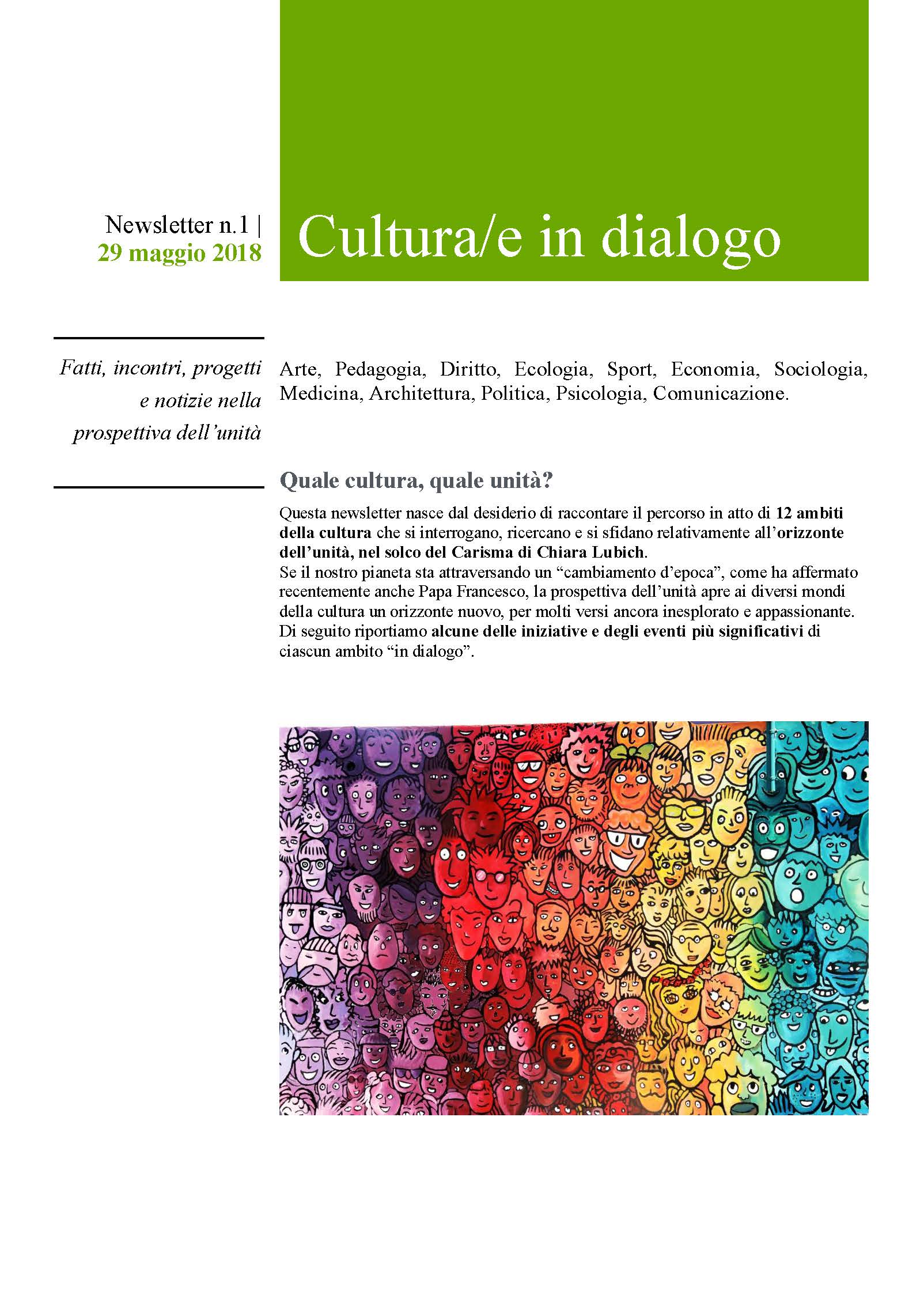 Which culture? What unity? The idea of the newsletter is to tell the story of 12 areas of culture and their journey to seek, question and challenge one another toward a horizon of unity, following Chiara Lubich’s charism. These are Art, Education, Law, Ecology, Sports, Economics, Sociology, Medicine, Architecture, Politics, Psychology and Communication. If our planet is going through a change of era, as Pope Francis recently declared, the point of view of unity opens up new ground for these areas of culture. For many this will be unexplored and fascinating. The first issue features a number of new initiatives and the most significant events occurring in each part of culture that is “in dialogue.” ________________________________________________________ For more information: Centro per il dialogo con la Cultura (Focolare Movement) centrodialogo.cultura@focolare.org tel. +39.06.945407201 – Via Piave, 15 – 00049 Grottaferrata (Roma – Italia) Key contacts: Communion and Law – info@comunionediritto.org Economy of Communion – info@edc-online.org Social-One – info@social-one.org Eco-One – luca.fiorani@gmail.com Dialogues in Architecture – segr.architettura@focolare.org NetOne – netone@net-one.org Political Movement for Unity – info@mppu.org Psychology and Communion info@psy-com.org Health Dialogue Culture – healthdialogueculture@gmail.com Clarté – clarte.international@gmail.com Sportmeet – info@sportmeet.org EDU – pedagogia@focolare.org –
7 Jun 2018 | Non categorizzato
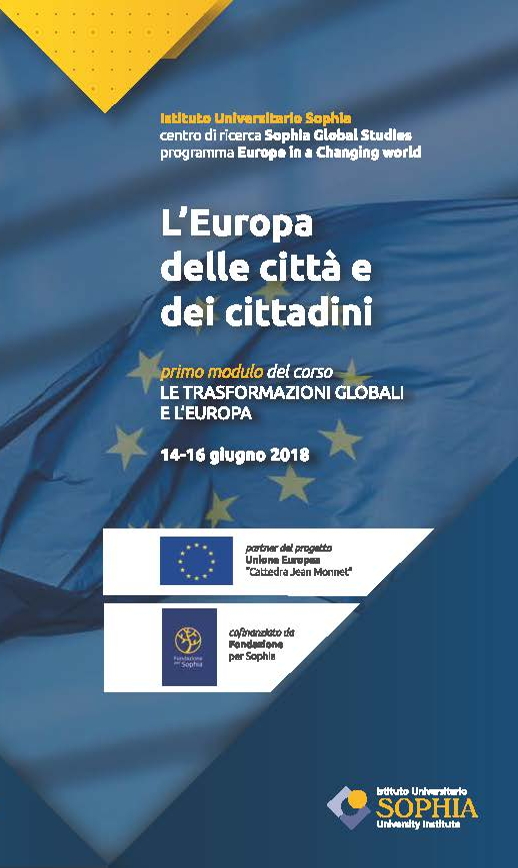 The course will be held from Thursday 14 June to Saturday 16 June 2018 in the Main Hall of the Sophia University Institute, with the opening speech of Prof. Romano Prodi, entitled “Europe today. Which Europe tomorrow?” Co-funded by the Sophia Foundation in partnership with the programme “Jean Monnet Chair” of the European Union, the course aims to analyse the role of the cities as workshops of European integration, and the citizens as protagonists. The lessons will reflect on integration, independence, European citizenship and will introduce the European governance system, with particular focus on the local and regional dimensions. The workshops will be particularly interesting, since the participants will be able to discuss and share competences and experiences in such matters. The key rapporteurs will be Léonce Bekemans of the Padua University, holder of the Chair Jean Monnet ad Personam, and Luc Van den Brande, former President of the Flemish Region and today confidential councillor of the European Commission Presidency, who will expound on “Reaching Out to Citizens,” report presented to President Junker in November 2017, a document which represents the most recent and authoritative analysis on European citizenship. The module will start off othe programme, “Europe in a Changing World,” initiated by the Sophia Global Studies’ Research and Training Centre. “Numerous facts confirm our itinerary, – affirmed Paolo Frizzi, academic coordinator – also the recent visit of Pope Francis to Loppiano, where Sophia is based, underlined the urgency to “trace new paths to be pursued together to give rise to a global civilization of alliance.” Our young Institute was incepted to form leaders who have the capabilities and competencies to face the global challenges and promote dialogue and peace.” The course is open to professionals, scholars, communication administrators and operators, besides teachers of the primary and secondary schools and scholastic directors who may make use of the Teacher’s Card (MIUR 170/2016). There will be 15 scholarships for young people up to 30 years of age. See the complete programme on www.sophiauniversity.org.
6 Jun 2018 | Non categorizzato
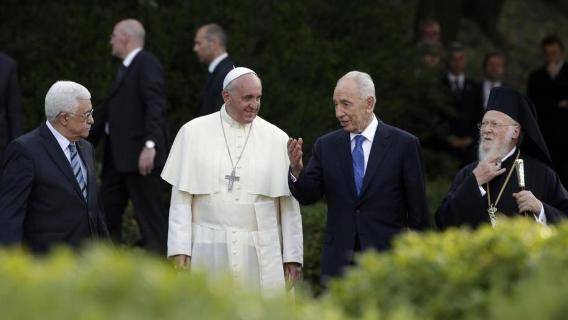
Also this year, the initiative, “A Minute for peace”, is being renewed, and promoted by the Catholic Action International Forum, together with the Italian Catholic Action, the Argentinean Catholic Action and the Justice and Peace of the Argentinean Bishops’ Conference and other entities, on the fourth anniversary of the encounter of Pope Francis with the Israeli President, Shimon Peres, and the Palestinian President, Mahmoud Abbas, that took place in the Vatican Gardens on 8 June 2014. To relaunch the message of peace of that day, the proposal is to stop at 1 pm (in every time zone) on 8 June, for a minute of prayer and silence, alone or in groups. The proposal addresses the faithful and the nonbelievers. “At work, on the road, or at home, all are invited for a minute of prayer “that travels far,” embracing the world. It is a simple way – the promoters affirmed – of remembering that each of us can be instruments of peace each day.”
6 Jun 2018 | Focolare Worldwide
In the Mexico City Focolare, Pope Francis’ invitation to “go forth” can be seen in the face and heard in the voice of Reina Cruz. Originally from El Salvador, she serves a community that shares the Word of Life in difficult situations, just a few kilometers outside the Mexican capital. In the group there are both dealers and users, and those who have decided to befriend them. The focolarine carry the pope’s voice to the periphery, as he has often invited us to, to suburbs that are difficult, poor, made up of millions who, thanks to their work, are able to hear the words of the Gospel for the first time. Reina admits it is not easy. “Going into an environment where 13- and 14-year-old kids practically live without any family, we feel that we can at least bring our presence. Their activity has even spread to more remote areas, such as visiting Xavierian missionaries in the Santa Cruz forest, a visit made even more intense because it was Holy Week and Easter. In these often-forgotten corners of the world, the young women present the Focolare spirituality. By now it has spread to 182 countries in the world, with centers in 87, including Mexico, where there are close to 110,000 members. Setting their sights on befriending their brothers and sisters, which is typical of the movement founded by Chiara Lubich, these Mexican groups have entered into various social environments. They have been encouraged by Pope Francis’ visit to Loppiano on May 10 to continue on the path started by Lubich, a Servant of God. “A dozen of us,” says Reina, “went to visit Santiago de Anaya, Actopan, in the state of Hidalgo, the heart of Mexico.” Without expecting anything in return, not even interest in their spirituality, they have begun working with the Missionaries of the Divine Word. Their one objective is to offer points for the community to reflect on daily: the word of God and its effects on our lives as committed laypeople. The phenomenon of drug dealing and abuse among teens sounded the alarm for members of the Focolare, driving them to listen to difficult experiences and share the Gospel message with kids who live on the street alone. “On May 6, for example, there were two girls aged 14 and 17 who came up to tell us tearfully about how drug use was growing among their friends.” The older one had been thrown out of her mother’s house, Reina remembers, and she was desperate after ties with her mother had been cut. What to do? How to help? For those who follow Chiara Lubich, healing issues and wounds in the family is part of the task of accompanying others. The challenges continually grow in line with a society whose values are ever more fragile, with weak family ties that at times can even be completely absent. As a result, their presence ends up being the only reference point for people who, as they grow, need a ledge to cling to and not risk drowning in drugs or despair. This is why listening is so important, they explain at the Focolare in Mexico City, as is prayer and spiritual meetings to renew lives in God. The goal remains unity, and this is an opportunity to rise from poverty and walk toward dignity. The dialogue with the local priests helps them to act together, avoid divisions, and look at development projects such as an economy of communion. It is a journey taken together with the Virgin Mary, a mother who never abandons her own children, “not even those who are most alone.”
