14 Jun 2017 | Non categorizzato
Škofja Loka
14 Jun 2017 | Non categorizzato
For your commitment to peace, promoting a series of initiatives to convert a weapons factory in the province of Iglesias” (Sardinia, Italy). The missive, dated June 3 addressed the local community of the Focolare Movement, (New Humanities section), for all the endeavours undertaken with Amnesty International, Oxfam, Fondazione Banca Etica, Opal Brescia and Italian Disarmament Network, for the “RVM reconversion” (Multinational Arms-producing Company). The Holy Father said he was “happy to know that you are concretely involved in promoting a dignified employment, as an alternative to the manufacture of arms, in a territory that is still undergoing serious employment crises.” Lastly, he expressed his “solidarity for the commitment in spreading the culture of peace.”
![The dialogue wanted by God]()
13 Jun 2017 | Non categorizzato
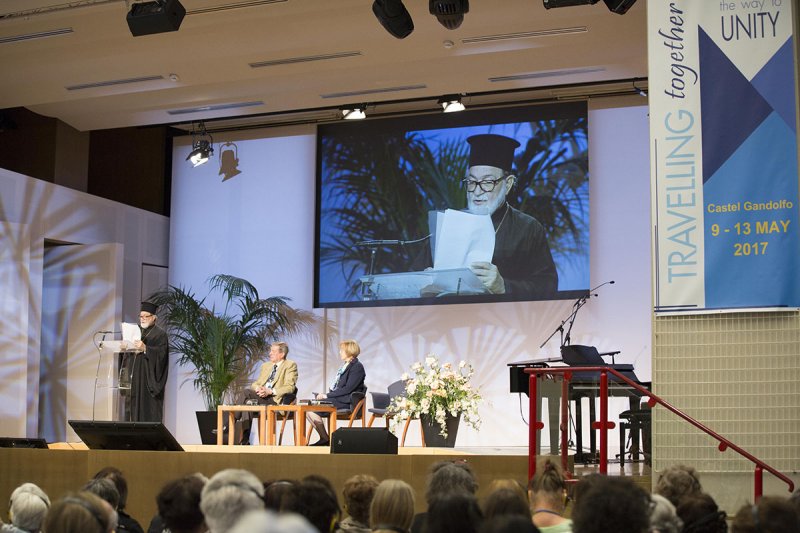 Patriarch Athenagoras and Chiara Lubich, protagonists of unity. Beginning again is never and never has been easy, especially if deep trenches have been dug over time, if certain differences have become cultural, if – to complicate matters – there is even the certainty of being in the right. It wouldn’t be far from the truth to say that this was the situation in the mid-1900s between the Catholic and the Orthodox Church, after centuries, an entire millennium, the separation was nurtured and cultivated. Then…the historic turning point. The celebrated and unforgettable and glorious memories of the initiators of the ‘dialogue of Love’, the great inventors of the dialogue of the people: Athenagoras, Ecumenical Patriarch, and Chiara Lubich, foundress of the Movement of unity. With their humble, serious and willingness, with dedication, love and prayer they were the initiators of a new ecumenical Era; they instructed the peoples, giving them courage, strength, patience, faithfulness, willingness, love and unity. Deep down the solution was simple, and the Patriarch expressed it with the following words: “We lived alone, without brothers, without having sisters for many centuries, like orphans. Why? The brother and sister are the door. There lies the secret!” The unforgettable protagonists of the ‘dialogue of love’, the great inventors of the dialogue of the people met a good 27 times, between 1967 and 1972 when the Patriarch died. There first encounter goes back to June 13th, 1967 when Lubich visited the Ecumenical Patriarchate of Constantinople, even though, until this day, that moment has never been adequately appreciated for its full value. The Patriarch approved and lovingly embraced the seriousness of the charism of Chiara, her mystical spirituality that is a spirituality of the Church, to the point that their encounter was even considered ‘an ecstasy’, and the conviction grew more and more in him that by living the words of Jesus’s Testament could lead us to the same chalice. With these touching words he remarked: ‘For me it would be a day of Paradise.’
  Not much time was needed before the Patriarch declared himself to be a “focolarino” and began to call Lubich by the name of “Tecla,” having discerned in her the same zeal as the isapostolo [equal to the Apostles]. He went on to say: ‘We are thirsty for this spirituality.’ Meanwhile, Chiara was equally touched and to her the Patriarch ‘appeared as an Archangel that struggles and fights to the end for his ideal: a man of God, proven in heroic love and heroic patience’. With her spirituality and marvellous personality, Chiara not only prepared the two principle and most important Bridges: Paul VI and Athenagoras, but she also managed to unite those two Bridges. Through encounters between Orthodox and Catholics, the bond of mutual love mitigated the sorrow of not being able to share the Eucharist; indeed, it made this cross loveable as a contribution of the Christian People to that One Chalice. “The Pope is our leader,” the Patriarch confided to Chiara. “…sometimes I see the Pope ‘in agony,’ because he knows everything that there is of negative in the world. This is why I placed myself one hundred percent at his service. I follow him, I understand him, I love him, I respect him, I admire him.” As a follow-up of this fifty-year journey, I personally proposed to Msgr Piero Coda, president of Sophia University Institute (SUI), the institution of an Ecumenical Chair in recognition of these two extraordinary protagonists of brotherhood among the Orthodox and Catholic Church. My proposal received magnanimous and cordial approval, along with the blessing of Patriarch Bartholomew and the enthusiastic support of Focolare president, Maria Voce. Let us offer from our hearts one great ‘thank you’ like beautiful flowers to Athenagoras and to Chiara who were sent by God, who gave their life above all else to the realization of God’s will: ‘Tthat all be one’, for it will given as a gift of the Holy Spirit.
Metropolitan Gennadios Zervos,
Archbishop of Italy and Malta of the Ecumenical Patriarchate of Constantinople
13 Jun 2017 | Non categorizzato
What can you do? Donate blood. Donate often. This is the slogan chosen by the World Health Organisation for the celebration of the World Blood Donor Day on 14 June. Some of the objectives of the campaign: to encourage all citizens to reinforce the efficiency of healthcare services; involve the authorities in the creation of National programmes to respond to the growing needs; favour the inclusion of transfusion services in emergency situations; guarantee the supply and reach self-sufficiency nationwide; thank the people who donate blood regularly; promote international cooperation; ensure voluntary donation and enhance security and availability of blood.
