27 Apr 2017 | Non categorizzato, Word of
https://www.focolare.org/gb/files/2017/04/201705WoL.mp3
Matthew ends his Gospel with the final events of Jesus’ life on earth. Jesus has risen from the dead, having fulfilled his mission. He had proclaimed God’s healing love for all, reopening the way that leads to fraternity. Matthew sees Jesus as Emmanuel, “God with us,” the one promised by the prophets and awaited by the people of Israel. Before returning to the Father, Jesus gathers together his disciples, the group who had most closely shared in his mission. He entrusts them with continuing his work — a tough assignment! But Jesus reassures them. He will not leave them on their own. Indeed, he promises to be with them every day, to support, accompany and encourage them “to the end of the age.” With his help, they will bear witness to meeting him, to his word and his acts of welcome and mercy toward all. In this way, many others will meet him and together form the new people of God, founded upon the commandment of love. We could say that God’s joy is to be with me, with you, with us every day to the end of our individual lives and to the end of human history. But is that true? Can we really encounter him? In a Word of Life commentary from 1982, Focolare founder Chiara Lubich wrote, “He is around the corner; he is next to me and to you. He hides himself in the poor, the despised, little ones, the sick, the person seeking advice, or deprived of freedom. He is in the ugly and the marginalized … As he said, ‘I was hungry and you gave me food’ (Mt 25:35) … Let’s learn how to find him where he is.” He is in his Word, which, if put into practice, renews our lives. All over the world he is in the Eucharist. He also works through his ministers, the servants of his people. He is present when we are in agreement among us (see Mt 18:20). Our prayer to the Father then becomes more effective, and we find light for our daily decisions. “I am with you always, to the end of the age.” How much hope this promise gives us! It encourages us to find him as we go along our way. Let’s open our hearts, and our arms too, to be welcoming and to share. Let’s do this personally and as communities, in our families and our churches, in our workplaces and on festive occasions, in our civil and religious associations. We will meet Jesus, and he will amaze us with joy and with light, the signs of his presence. If we start each morning thinking, “Today I want to discover where God wants to meet me!” we too will have wonderful experiences like this one shared in Glimpses of Gospel Life: “My husband’s mother deeply cared about her son, even to the point of being jealous. A year ago she was diagnosed with cancer, and her only daughter was not able to give her the level of care and help she needed. “During that time, I went to a summer gathering of the Focolare called a Mariapolis, where I encountered God’s love in a way that changed my life. “The first fruit of this conversion was the decision to ask my mother-in-law to come and live with us, setting aside all my fears about it. The light that had been lit in my heart made me see her with new eyes. Now I knew that it was Jesus in her that I cared for and helped. “To my surprise, she responded to all I did with just as much love. Months of sacrifice went by, but when my mother-in-law passed gently on to the next life, she left us all with a deep sense of peace. “It was around that time that I realized I was pregnant, after nine years of waiting! This child was a tangible sign of God’s love for us.”
Letizia Magri
________________________________________________ Read more: • Lubich, Chiara. “Jesus in our neighbor,” The Art of Loving. New City Press: Hyde Park, New York, 2010, pp. 103-110. • Lubich, Chiara. “The Word that gives life,” Essential Writings. New City Press: Hyde Park, New York, 2007, pp. 120-128.
27 Apr 2017 | Focolare Worldwide
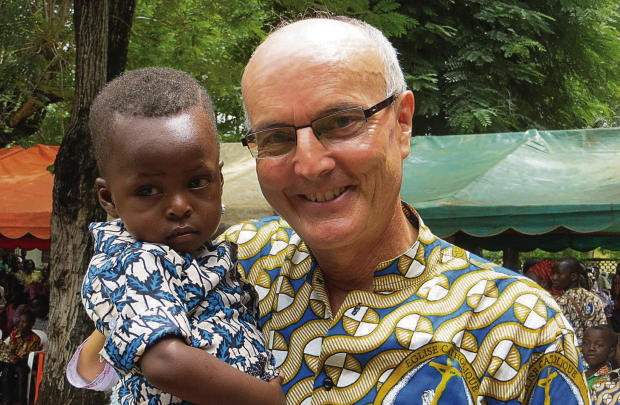
“In 2010 I had been sent to the parish of St Marie, on the outskirts of Man, which is the capital of Ivory Coast. At that time I wasn’t familiar with the culture and traditions of Africa. I was immediately struck by the strength and vitality of the people, despite the great poverty and consequences of the war. Over time I learned to recognize the ancestral fear towards white people. For me, as a priest from Switzerland, it wasn’t so much a matter of providing economic support, but of putting myself in a position of deep listening. What I had to offer was me, my availability, my lack of pretensions. I lived in the Focolare town of Mariapolis Victoria, near Man. From there I travelled every morning on bicycle towards my quarter, on my way to meet people in the shops, offices and along the road. I waved to everyone on my way and stopped now and then to put a stop to some large or small argument. I paid special attention to the children. I talked to them and played with them. If any of them were sick, I’d take them to the infirmary at the Mariapolis. I did the same for their parents and relatives. This is how nearly all the children in the parish came to recognize me and introduce me to the adults. During the feasts I’d go through the quarters with them, to extend my best wishes to the families, Christian and Muslim alike. This also led to friendships with Imams and Evangelical pastors. One day, a boy from the parish approached me. He wanted to do something for the children of the village, although he had previously grown far from the Church because of a misunderstanding. I encouraged them to do small fund-raisers to support their journeys, a gesture of auto-financing that was greatly appreciated by the local bishop. We visited 11 villages in which the young people were trained in visiting the sick and elderly. During the Year of Mercy, with the help of the residents of Mariapolis Victoria, we supported the bishop’s projects in the diocese, sponsoring a meeting of traditional leaders, pastors from the Evangelical Churches and Imams. The campaign for brotherhood among the populations that spread through the region concluded at the Mariapolis. I substituted for the chaplain at the public jail for a while. During the celebrations of the mass, I tried to underscore the importance of living the Gospel. Sometimes I invited others to join me, who shared their testimonies. These masses were celebrated under a roof, in a courtyard, in the midst of a lot of confusion. So, I brought along a loud-speaker, inviting them to use it when they had other events. I later learned that they shared it with the Muslims and that the Imam was touched by their generosity, which he called “typically Christian”. Before my departure, they wanted to hold a send-off feast for me with the director of the jail. They told me: “You always practiced what you preached.”
26 Apr 2017 | Non categorizzato
Only three days remain until the opening of the United World Week with the long awaited International Meeting of Youth for a United World in Loppiano, Italy. Five hundred young people are the starting blocks. “United World Project” is their slogan that will carry them through the race they are spreading by every possible means of communication. They are all directly involved in the project, a network of numberless concrete and courageous gestures that build bridges and open paths of dialogue and solidarity. The main working document of the Meeting, entitled “Universal Brotherhood: An Opportunity for the World” states: “The financial, economic and, above all, cultural crisis the has spread in every country poses epochal questions”. How can a future of justice, freedom and peace be given to all the peoples of the earth? We would like to begin from unity, the unity of the human family and to aim towards a horizon of the universal brotherhood among all peoples. This is our project.” The border that extends from the Gulf of Mexico to the Pacific Ocean, with its 3,169 kilometres of metal barriers and barbed wire and control towers, representation of the broken dreams of many immigrants in search of a better future. In the same vicinity, in Mexicali and in Calexico, a group of young people have believed in a world without walls and have been keeping busy. “We began singing in one of our city parks which is located right next to the border wall. It was a way of offering a bit of relief to the people who were passing through that area. The second step was to go inside the city’s maximum security prison where 4 thousand people are living, to offer them some music and song. After going through a lot of security controls, we were given permission to spend a few hours with 130 inmates inside a big hall. During lunch they told us that our visit was the only one they had received in two years.” The 2016 Worldwide Run4Unity Relay was held right next to the wall. “We wanted to plant our flag along the border wall as a sign of the unity that we’re committed to building with the people living on the other side.”
![Fazenda de la Esperança visit the Focolare]()
25 Apr 2017 | Focolare Worldwide
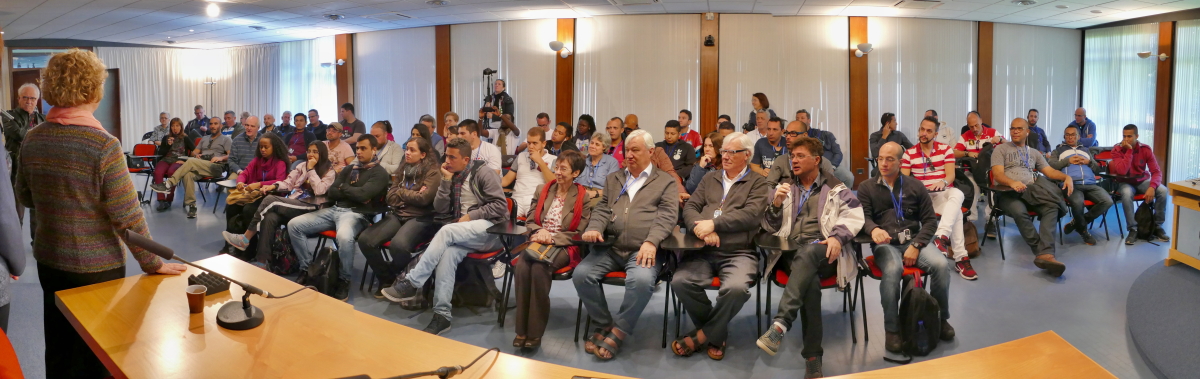 The Focolare has shared a long-standing friendship with Fazenda da Esperança (Farm of Hope) which goes back to the very first farm. It was 1983 when Nelson Giovanelli, a young Brazilian from the city of Guaratinguetà. Inspired by the words of Saint Paul, “I became weak with the weak,” he approached a group of young drug addicts. One of the young people felt drawn in and asked for help in giving up drugs. Many others followed him. Nelson lived Chiara Lubich’s spirituality of unity. He was joined by German Franciscan Friar Hans Stapel who supported his efforts right from the start. The work grew and developed with the support of the “two charisms”, said Pope Benedict XVI during his 2007 visit to the community of Pedrinhas, Brazil – the charism of Chiara Lubich and the charism of poverty of Saint Francis of Assisi. On Sunday, April 23, 2017, a group of 60 young people and adults visited the International Centre of the Focolare Movement in Rocca di Papa, Italy. Most of them were from Brazil, but there were also representatives from other Latin American countries like Uruguay, Argentina, Paraguay and Mexico; Germany and Switzerland; Angola and Mozambique; and Philippines. They were accompanied by 14 founders: Friar Hans Stapel, Nelson Giovanelli Rosendo dos Santos, Lucilene Rosendo, Iraci Leit, and their General Council for Europe.
 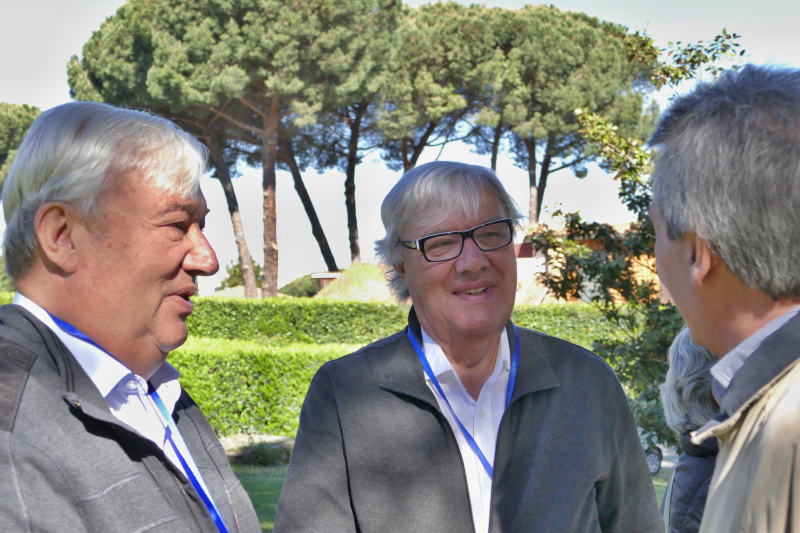 “The purpose of this trip,” Friar Hans explains, “is to make the experience of the Fazenda known in Europe. To offer this alternative assistance to young people who suffer from the slavery of addiction. We’ll also travel to Switzerland, Germany, France, Poland and Portugal – all places where we have Fazendas, and these 60 people will share their testimonies. Among us they found a new life and decided to become missionaries and evangelizers for three months in Europe. They made a great effort to pay for the flight, so that their testimony could be freely-given.” What was the reason for visiting the International Centre of the Focolare? “It was because of everyone’s huge desire to get to know the origins of othe charism that gave the roots to the Fazendas,” says Nelson Giovanelli. He recalled a letter he wrote to Chiara Lubich in 1990, in which he shared with her his calling to love “Jesus Forsaken in the people who have fallen victim to drugs.” Chiara encouraged him to follow the promptings of the Holy Spirit. Currently there are 124 Life Communities around the world. They take in 3,000 young people who are trying to free themselves from drug addiction, through a personal rediscovery of their human dignity and of life values. There are 14 Fazendas in Europe and, during the coming months, another 4 will be opened in France, Poland and Italy.
 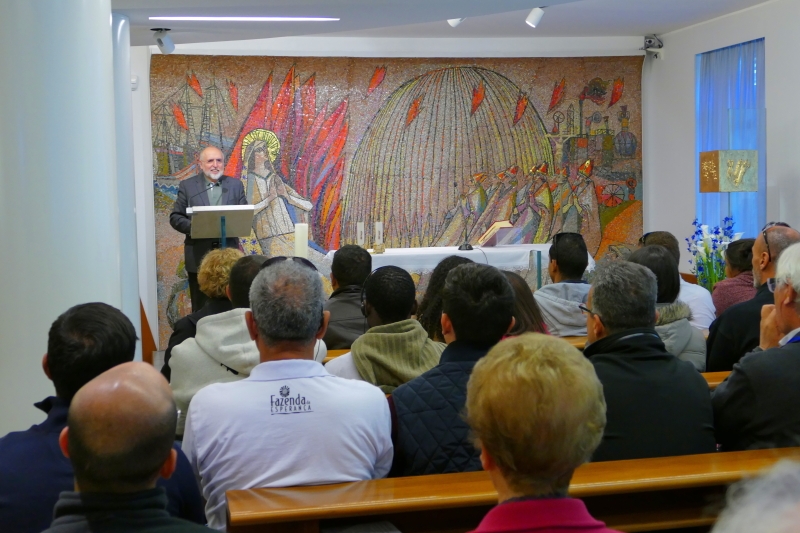 In the Fazendas da Esperanca you have people who voluntarily dedicate themselves with commitment and complete generosity to the service of young people with whom they create the community of the “Family of Hope.” “My father was an alcoholic . . . he didn’t believe in love . . .” says Priscila, a young woman from Argentina. “When I found and got involved as a volunteer at the Fazenda, I regained my relationship with him after 15 years of estrangement. I forgave him and, little by little, he gave up alcohol. For me, forgiveness is everything. It’s the essence of my life: I find God in the love I give away.” The Focolare’s co-president, Jesús Morán, brought greetings from Maria Voce and thanked them for their witness to the Gospel. He augured that they would “always be close to the suffering, to Jesus Forsaken, so that will be one, beginning from the least.” Their stay in Italy will include a visit to the city of Saint Francis and to the international Mariapolis of Loppiano where they will take part in the Pulse Meeting and the annual May 1st Youth Festival.
