The intense three-day event of communion was attended by about 100 participants from 14 European countries (from Portugal toRussia), among which were pioneer entrepreneurs of the Economy of Communion (EoC), young business men and women, students and economists. The organisers recounted: “The convention opened with the exhibition of French painter, Michel Pochet, on ‘God who is Mercy’ – and his works of art acted as the framework of the entire meeting. The paintings of the ‘Good Shepherd’ and the ‘Good Samaritan’ particularly inspired the entrepreneurs to inculcate in their businesses and work places, the essence of what the paintings conveyed.” Right after the event a management student, Federico (Italy), gave his impression: “I came to find out more about the EoC. I was rather standoffish at the start, but in these days I understand what it means to take care of the others, also at work. It is a question of building bridges between people. I learned a lot from all of you. It is very impressive to see that the entrepreneurs of the EoC are altruists, and that you are the ones who take care of the needs of others. I hope to become one of you soon.” These were three days of intense communion, and among the speeches were those of Luca Crivella, a Swiss economist, who gave interesting cues on the EoC, 25 years after its constitution; and Anouk Grevin, Professor of the Nantes University and Sophia University Institute, who spoke about “giving and corporate gratuity, focusing on the ability to “see” through the eyes of mercy, the gift of the work of one’s own colleagues, ‘acknowledging’ and ‘thanking’ them for the free act which no one can buy. He further said that the eyes of mercy are able to place each person in the disposition to give the best of himself, because he feels the other’s trust and is thus able to express himself without fear of making mistakes.” Herbert Lauenroth, an expert in interculture at the Ecumenical Centre of Ottmaring (Augsburg), spoke about mercy applied to economic and political lives. It was the first EoC meeting for a businessman from England, who said: “One thing which you have and can donate to those who fight for a better world, but who may not see the light, is your joy. It is something incredible! A real spiritual capital!.”». And Peter, a youth from Serbia said: «I came, thinking that it would be a waste of time. But I found people who are open, and every dialogue was important for me. I shall take away with me the great benefits of this event.»Prof. Luigino Bruni, world coordinator of the EoC project, recalled the times when Chiara Lubich in Trent with the first group of focolarine, would invite the poor to dine in their house, and would “use the best table cloth and cutlery they had”, and underlined that “our first way of treating poverty, even before giving our profits, is to bring it into our house and into our factories, and love it with ‘beautiful gestures’.”Another challenge targeted “in order to reach the 50th EoC anniversary in a proactive condition,” regards the businesses. “All can see that communion in our companies have to find new and more visible and radical expressions,” he affirmed ,”involving “governance” and above all, property rights. Up to now we have focused on the culture and motivations of the entrepreneurs, but it is ever more evident in an economy of great changes, that the businesses and entrepreneurs do not always coincide.”He also added: “Over the last years, one of the strengths of the EoC along with its resilience is that it has breathed with its entire body. There have not been single persons guiding it, but many active members. The EoC is strong when every worker in the company has the same energy.” In conclusion, Bruni said: “We have become aware that EoC in Europe is still alive after 25 years, and continues to bear fruit and develop in new settings and regions. An important fact is the presence of the first businesses in Russia, and the new business-incubator in Portugal: that Europe we all dream of, from the Atlantic to the Ural mountains. Moreover, it is a youthful and open EoC (many EoC leaders do not come from the Focolare Movement), with the great desire to work for the future.” Photos on Flickr: Photo galleryThe next event is set for 2017 in Belgium.
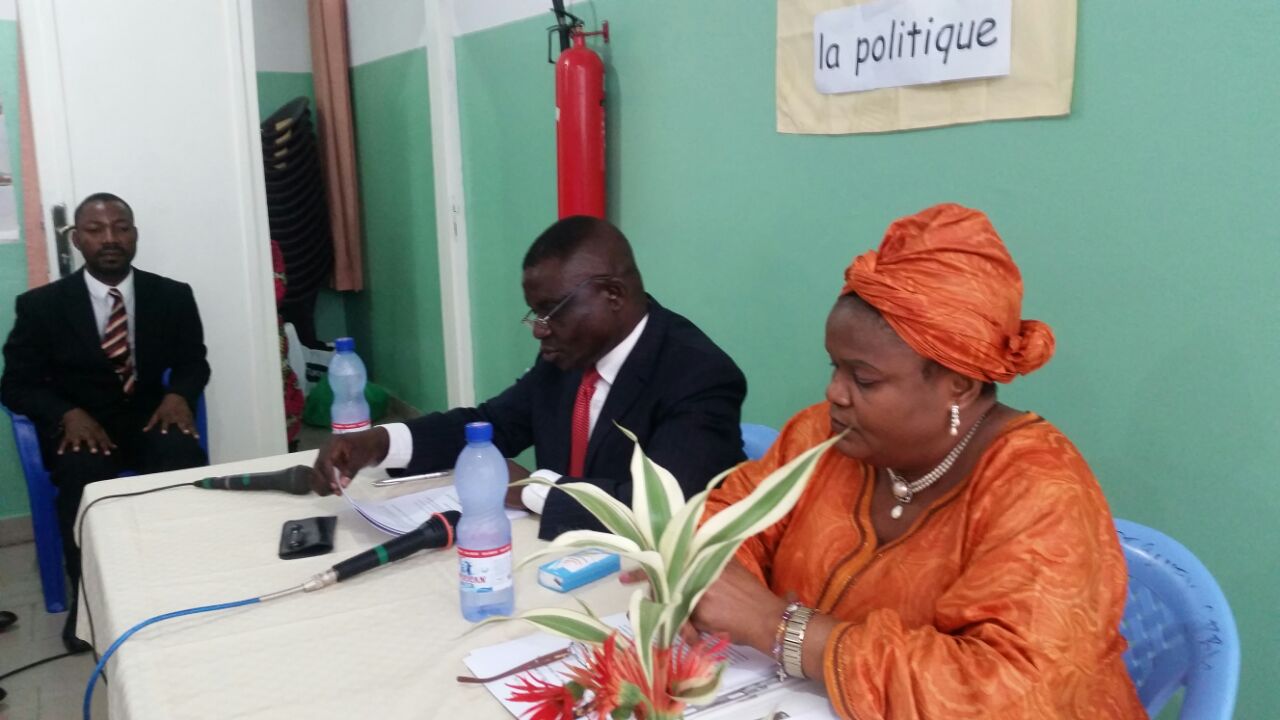
“The Political Movement for Unity has begun in Kinshasa!” With these words Deputy Upira Dieudonné concluded the first meeting of the Political Movement for Unity (PMU) in Kinshasa on Saturday, October 29, 2016. They write: “The current political situation in the RDC is fragile. There are strong political and social tensions. A few months ago, there were violent clashes in which some people died. The powers that be and the opposition sometimes become radicalized.” So how did we reach this day, one could ask. “It was after attending the conference in Rome last June with politicians from around the world. Deputy DieudonnéUpira, national deputy from the opposition in the DRC, and Madam Gorgine Madiko, Honorary Deputy and Member of the National Assembly Office decided to try something in their country.” When they returned from Rome, they deepened their friendship and shared their differing opinions with one another. Now, they dream of forming young people to be leaders in politics. As they said: it’s a matter of “training in the real politics, the politics that is based on values.” Their conversations have convinced them that the first step in such an undertaking in Kingshasa, would be to launch the Political Movement for Unity. “This would allow networking people who are working in the field of politics, to do good through politics,” they suggested.As they organized the event they were also wondering: “Will the people that have been invited have the courage to show up?” Their uncertainty grew as torrential rain began to pour down on Kinshasa on the day of the meeting. Because of the bad road conditions and the poor state of the public transport, most people stay home when it rains! Nevertheless, thirty people responded to their invitation. Among them were deputies and politicians, students, members of citizen movements, lawyers and journalists. The debate provided a platform for deep listening and discussion. “We heard things like: ‘We want to stay in touch with you and have more frequent discussions;’ ‘In front of the loss of values, we need to work at installing positive values in our education system, to train people that can be political leaders tomorrow;’ ‘I feel that if I don’t do something, God will ask me what I did with all that he gave to me;’ ‘We’re young and we expect to learn from our elders. Don’t forget about us’.” Their words reflected the thoughts of the organizers and made the moment of sharing into a sacred moment. During her concluding remarks, Madam Georgina Madiko insisted: “Through our actions we have to be a light in the dark world. We have to show by example. And to those who are surprised by us and ask whether we are doing politics or religion, we’ll answer that politics without values is the ruin of the Nation.” Before leaving one participant suggested: “We should forget about our titles, stay in touch with each other, even if it’s only to ask how we’re doing. I would like each one of us to go home with a list of the participants so that we can all stay in touch with one another.” The next appointment is December 3, 2016. Gustavo Clariá
Bishop Felix Machado is a strong advocate of interreligious dialogue. This is proven by the friendship he has with numerous leaders of various religions, among which is that with the great Hindu scholar, Dr. Kala Acharya. These two speak of and refer to each other as “my brother Felix” and “my sister Kala,” in confirmation of the deep relationship which has led them to consider universal brotherhood as a point in common.How do you explain your propensity for dialogue? «I was raised in a rural and cosmopolitan culture. Vasai, in fact, the current seat of my ministry is also my birthplace. After studying theology in France and the United States, from 1999 to 2008 I served at the Pontifical Council for Interreligious Dialogue in the Vatican. There I acquired many elements on this matter and understood that the key lies in establishing real and authentic relationships with the people who differ from us. Thus, even if I am a leader and scholar or a simple farmer or fisherman, it is my duty as a Christian to see each one as a brother or sister in Christ. True dialogue may arise only from deep listening and acceptance of the other, and then, if necessary, one can offer one’s ideals as a gift. That’s why I appreciate the interreligious work undertaken by the Focolare Movement here in India. It is an action based on authenticity, trust and good will with our Hindu brothers and sisters.»After her journey in India at the start of the year, Maria Voce, President of the Focolare, recounted that you had welcomed her very warmly. «It was my pleasure to welcome her to my diocese of Vasai, and to recall with her the first contacts I had with the Movement through the two focolarine who worked in the Pontifical Council for Interreligious Dialogue. I had been impressed by the great love they put in the most simple jobs they performed. It aroused my interest and I desired to know more about the Focolare, and soon I had the privilege to meet Chiara Lubich. She was simple and direct and believed in unity. She offered the path of unity to humanity, through the church. She remained deeply faithful to it and worked for unity of the human family. I was happy to see how in India the Focolare is bringing ahead this legacy through dialogue among religions, cultures and generations.» In the light of the many challenges the human family has to face in various parts of the world, how vital is it to pursue the path of dialogue? «It is a process that requires time and dedication, and at times dialogue may seem useless when we encounter episodes of violence, poverty and social discrimination. But it is not so. Personally I try to draw inspiration from Pope John XXIII, who used to kneel in prayer after a long and difficult day saying: “Lord, I’ve done my best. This is Your Church, now it is you in command.” As human beings it is our duty to be similar to Christ in loving, forgiving and continuing to believe in universal brotherhood also, and above all when all seems inadequate to resolve the current problems. We must remember that we cannot impose our idea of time on God.» Interview by Annabel D’Souza
The city of Como has risen to the headlines because of the notable influx of refugees that have been forced by barbed wire walls to divert their routes across Switzerland, as they travel to the countries of northern Europe in search of fortune, or reunion with their family members that arrived before them. The distance is very short, but the many border controls are rigorously imposed. There is a growing number of men, women, children and unaccompanied minors who are camped out waiting for an opportunity to evade border inspections. Bishop Coletti asked everyone to accept the challenge of welcoming, directing his appeal especially to the Church community that it might put into practice the Acts of Mercy during the Jubilee of Mercy which is an occasion for sharing and growth. “We took it as an appeal to us,” say the members of the local Focolare community, “and we immediately got to work, offering our services to the Diocesan Caritas that is on the front lines in organizing the assistance effort. There was a huge response from our community network that also includes people who are close to us: relatives, friends and acquaintances. We collected food, blankets and other basic necessities. We took turns covering the work schedule, providing showers and meals, distributing food, cooking and cleaning. In the evenings we serve up to five hundred meals. The faces we meet are disoriented, frightened, grateful and, at times, suspiscious. It’s hard to communicate with people who speak a foreign language. But just being there, tired and sweaty, offering a plate of food with a smile, trying to understand from their gesturing whether our guests are happy with the meal – makes us feel like we’re part of one big family.” One person from the meal service writes: “I was struck by the faith, the intensity of the Coptic Christians as they prayed before and after the meal.” And then: “In the eyes of our refugee brothers who we accompany to the showers and serve at table, we see Jesus who responds to us: ‘It’s Me!” Then; “After an evening of serving, when we meet with the other volunteers to share our experiences, your heart is bursting with emotions and positive resolutions.” On the patronal feast of the city of Como it was a special afternoon in the crowded basilica, with the bishop and civil authorities, with the full participation of Eritrean, Ethiopian and Somali Christian refugees, along with a representation of 500 volunteers. “The Gospel reading about the Final Judgement, in Italian, English and Tigrinya was very moving,” they reported. “Colomban Missionary Father Claudio, who belongs to our community and spent more than 30 years in those countries and knows their languages, has been working for weeks in the camps. The bishop entrusted their spiritual wellbeing to him, placing his very basilica at the complete disposal of the refugees. Jesus came to visit us today in these refugee brothers and sisters. And we want not only to accept Him, but to respond into the future in concrete ways.” Source:Movimento dei Focolari Italia

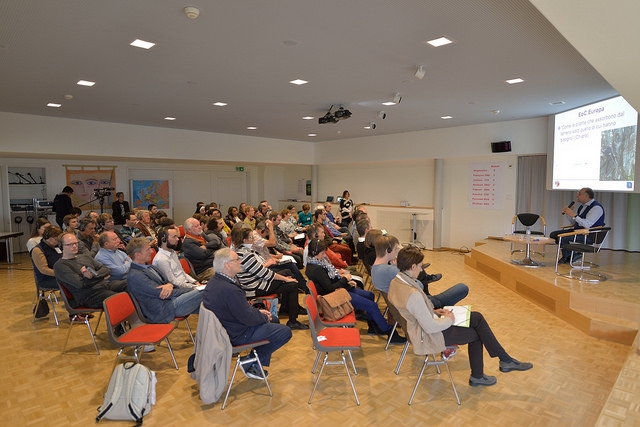
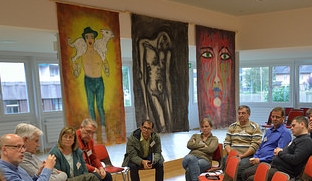
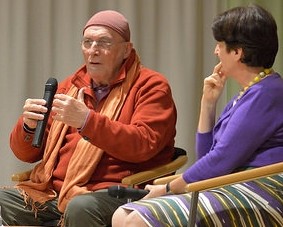 The intense three-day event of communion was attended by about 100 participants from 14 European countries (from Portugal to Russia), among which were pioneer entrepreneurs of the Economy of Communion (EoC), young business men and women, students and economists. The organisers recounted: “The convention opened with the exhibition of French painter, Michel Pochet, on ‘God who is Mercy’ – and his works of art acted as the framework of the entire meeting. The paintings of the ‘Good Shepherd’ and the ‘Good Samaritan’ particularly inspired the entrepreneurs to inculcate in their businesses and work places, the essence of what the paintings conveyed.” Right after the event a management student, Federico (Italy), gave his impression: “I came to find out more about the EoC. I was rather standoffish at the start, but in these days I understand what it means to take care of the others, also at work. It is a question of building bridges between people. I learned a lot from all of you. It is very impressive to see that the entrepreneurs of the EoC are altruists, and that you are the ones who take care of the needs of others. I hope to become one of you soon.”
 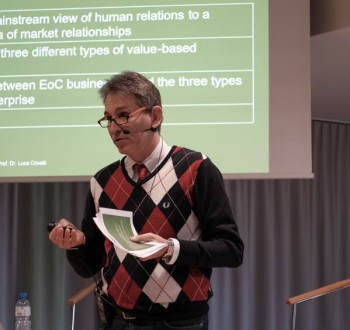 These were three days of intense communion, and among the speeches were those of Luca Crivella, a Swiss economist, who gave interesting cues on the EoC, 25 years after its constitution; and Anouk Grevin, Professor of the Nantes University and Sophia University Institute, who spoke about “giving and corporate gratuity, focusing on the ability to “see” through the eyes of mercy, the gift of the work of one’s own colleagues, ‘acknowledging’ and ‘thanking’ them for the free act which no one can buy. He further said that the eyes of mercy are able to place each person in the disposition to give the best of himself, because he feels the other’s trust and is thus able to express himself without fear of making mistakes.” Herbert Lauenroth, an expert in interculture at the Ecumenical Centre of Ottmaring (Augsburg), spoke about mercy applied to economic and political lives. It was the first EoC meeting for a businessman from England, who said: “One thing which you have and can donate to those who fight for a better world, but who may not see the light, is your joy. It is something incredible! A real spiritual capital!.”». And Peter, a youth from Serbia said: «I came, thinking that it would be a waste of time. But I found people who are open, and every dialogue was important for me. I shall take away with me the great benefits of this event.»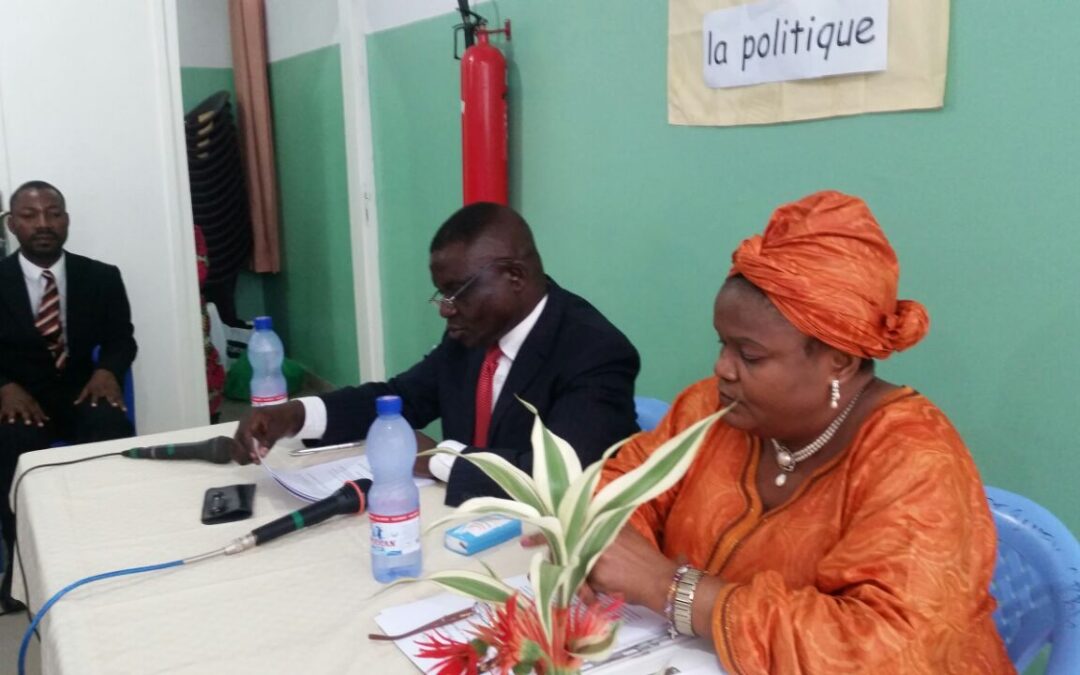
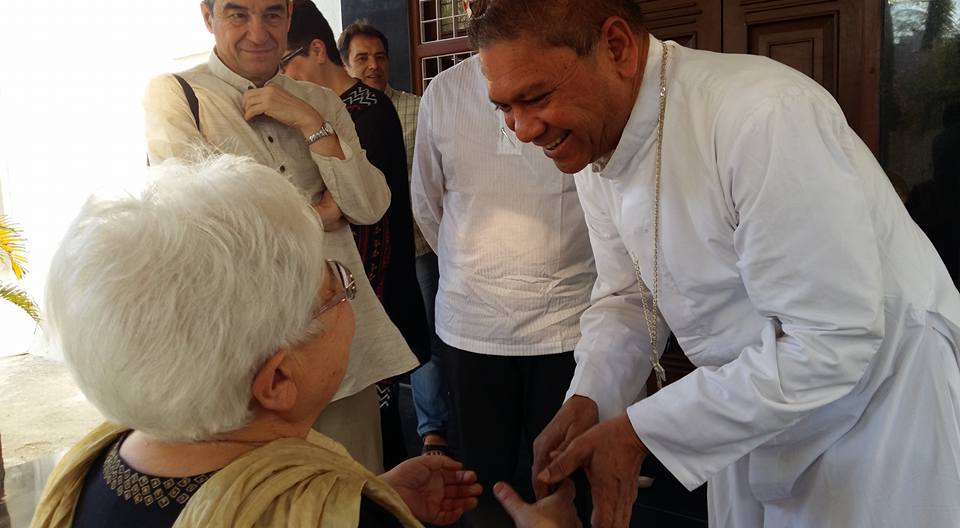
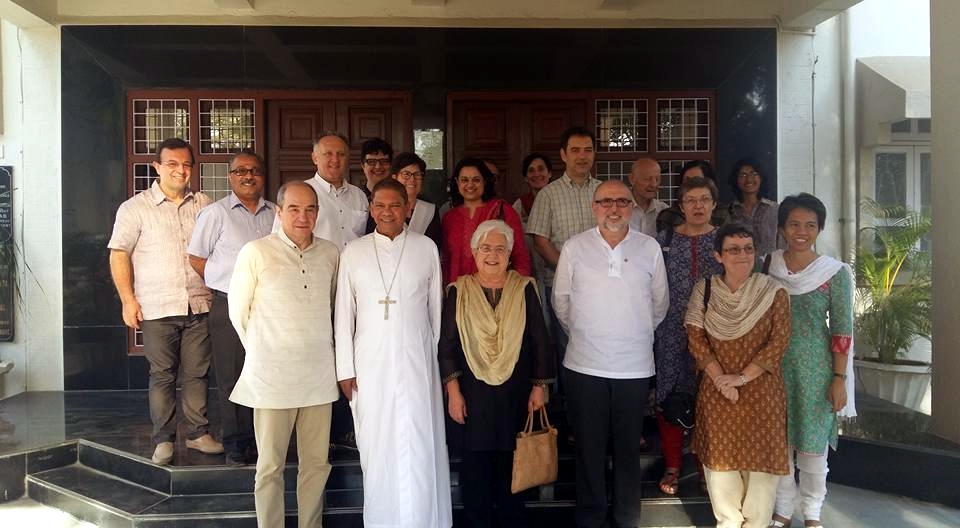 Bishop Felix Machado is a strong advocate of interreligious dialogue. This is proven by the friendship he has with numerous leaders of various religions, among which is that with the great Hindu scholar, Dr. Kala Acharya. These two speak of and refer to each other as “my brother Felix” and “my sister Kala,” in confirmation of the deep relationship which has led them to consider universal brotherhood as a point in common. How do you explain your propensity for dialogue? «I was raised in a rural and cosmopolitan culture. Vasai, in fact, the current seat of my ministry is also my birthplace. After studying theology in France and the United States, from 1999 to 2008 I served at the Pontifical Council for Interreligious Dialogue in the Vatican. There I acquired many elements on this matter and understood that the key lies in establishing real and authentic relationships with the people who differ from us. Thus, even if I am a leader and scholar or a simple farmer or fisherman, it is my duty as a Christian to see each one as a brother or sister in Christ. True dialogue may arise only from deep listening and acceptance of the other, and then, if necessary, one can offer one’s ideals as a gift. That’s why I appreciate the interreligious work undertaken by the Focolare Movement here in India. It is an action based on authenticity, trust and good will with our Hindu brothers and sisters.»
 The city of Como has risen to the headlines because of the notable influx of refugees that have been forced by barbed wire walls to divert their routes across