From 7- 17 September for Latin America, North America and Oceania
From 28 September – 8 October for Africa, Asia and the Middle East
From 15 – 23 October for Europe
Around a hundred participants will attend every session (Castel Gandolfo Mariapolis Centre, Rome), with a program partly in common and another part with various themes based on the demands and needs of each geographic area. The themes to be discussed will range from enculturation in Africa to the emergency of refugees and dialogue with Islam in Europe; other topics will focus on the challenges in Latin America, Asia, the Middle East, North America and Oceania in the social and ecclesiastic fields, from the perspectives of the family, the new generations, ecumenical and interreligious dialogue, and many other themes.
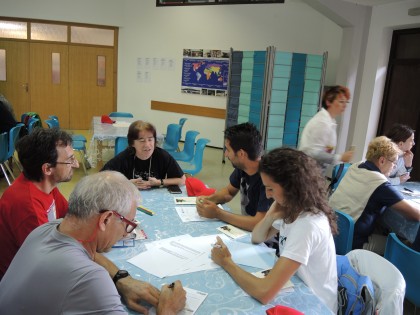
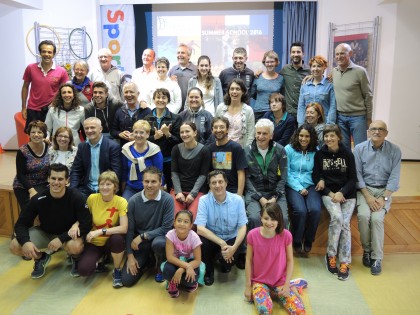
“Sport and Nature” was the title chosen for the 2016 Summer School organized by Sportmeet which gathered sport players from around the world to reflect on the environmental crisis and the specific contribution that sport could make to developing an authentic ecological conscience. Sport holds a great potential for creating friendship among peoples and with the Creation. It also has important educational value when practiced in the name of altruism and reciprocity. Eighty-three people attended the summer school: players at a variety of levels, ages and disciplines, leaders, physical education teachers and professional trainers, as well as others involved in sport as recreation. Paolo Cipolli, international coordinator of Sportmeet, presented the past and present history of the project. His presented had been preceded by numerous greetings from the public authorities who were present including Vice-Mayor Križevci Tomislav Katanović, Vice-President of the City Councill and ex-federal handball instructor, Ivan Pal, Deputy Minister off Science, Training and Sport, Hrvoje Šlezak from the Swiss Embassy in Croatia, Stefan Estermann, Second Secretary to the Italian Ambassador in Croatia whose greetings were given by Anna Lisa Gasparini and Zdenko Horvat. During the three-day course experts and instructors offered their reflections on the theme: “Sport and Nature: A Discovery, Resource and Challenge”. Andrea Ceciliani from the University of Bologna offered an exciting hand-on workshop. Mirna Andrijasević from Zagabria University presented “Sport in Nature: A Lifestyle.” Ivan Prskalo from Zagabria University presented Ecology and Chinesiology in Križevci presented an entertaining hands-on workshop on traditional Croatian games. Andrea Ceciliani from University of Bologna presented “Outdoor Education” showing how to hold school in the open, which was accompanied by a lively hands-on workshop. There were also school trips to Mount Kalnik and to Lake Čabraj along with an evening for sharing best practices with the Sportmeet Network, which included a telephone link-up with Rio de Janeiro and Belgrade. The last day began with a video conference that had been held by Focolare foundress Chiara Lubich at the United Nations in 1986 on the theme of Fraternity Among People and Nations. This was followed by a long and lively discussion with all the participants, and it helped design the plans for the upcoming Summer School in Barcelona, Spain, June 2017. Source: Sportmeet online
That clock tower on Amatrice church indicating 3:36 am is a powerful image for what happened this night. That minute was the last minute for many victims, it will be a minute forever remembered because it is written in the flesh and hearts of their families. And it will be remembered by our country, whose recent history is also a series of clocks stopped forever by the violence of men and of the earth. I will also remember it forever, because this cry of the earth also reached the house of my parents in Roccafluvione, around twenty kilometres from Arquata del Tronto, where I am visiting them. It was a long night of fear, suffering and thoughts for Amatrice, Arquata, Accumuli, towns of my childhood, close to where my grandparents come from, villages where I would accompany my father as he went about his business selling chickens. And then there were thoughts, thoughts we never have, because you can only have them on these terrible nights. I thought about all the time that clock had measured right up until 3.36. It stopped there, dead, but it was only one dimension of time which the Greeks called ‘kronos’: the surface, the soil of time. In the world there is our managed time, domesticated, constructed, which live by. But beneath it there is a another time: the time of the earth. This non-human time, and at times inhuman, and commands the time of men, mothers and children. And I thought that we are not the masters of this other time, which is deeper, abysmal, primitive, which doesn’t follow our path, and at times is against the paths of those who walk above. On such momentous nights we become aware of this different time, on which we walk and build our homes, and that we are ‘grass of the field’, watered and nourished by the sky, but also swallowed up by the earth. The earth, the real one and not the romantic and naive one of ideologies, is both mother and stepmother. The hummus generates man but also turns him back into dust, sometimes in a good way at the right time, but other times it is bad, and too soon, with a so much suffering. Biblical humanism knows this very well, but for this has fought a lot with the pagan cults of local peoples who wanted to make a divinity of the earth and its nature: the power of the earth has always fascinated men who have tried to ‘buy’ it with magic and sacrifices. Whilst I tried in vain to go back to sleep, I thought about the tremendous books of Job and Qohelet, which you can understand on such nights. Those books tell us that no God, not even the real one, can control the earth, because He too, once he entered into human history, became a victim of the mysterious freedom of his creation. God cannot even explain to us why children die squashed beneath the ancient pillars of our towns. He can’t explain it to us because if he knew why he would be a monstrous idol. God, who today looks on the land of the three As – Arquata, Accumuli and Amatrice – can only ask himself the same questions as us: he can cry out, remain silent, cry together with us. He can perhaps remind us with the words of the Bible that all is vanity of vanities: everything is breath, wind, mist, waste, nothing, ephemeral. Vanity in Hebrew is written Habel, the same word as Abel, the brother killed by Kane. Everything is vanity, everything is an infinite Abel: the world is full of victims. This we know. We know it, we forget it too often. These terrible nights and days make us remember. * 1 Kings 19:11
We can bring all things as a gift to God, if we learn how to rejoice with those who rejoice and toweep with those who weep, transforming each pain into love. The setting of these words is the Christian community in Corinth. It was extremely lively, full of initiative, animated by groups linked to different charismatic leaders. This also gave rise to tensions among individuals and groups, to divisions, personality cults, the desire to dominate. Paul intervened decisively and reminded everyone that, in the richness and variety of gifts and leaders belonging to the community, something much deeper bound them in unity: belonging to God. Once more the great Christian proclamation rings out: God is with us, and we are not lost, orphaned, abandoned to ourselves, but, as God’s children, we are God’s. As a true Father God cares for each one, without letting us lack anything we need for our good. Indeed, God is superabundant in love and in giving, as Paul affirms: ‘The world, life, death, the present, the future—all belong to you!’ God has even given us his Son, Jesus. What huge trust on God’s part in giving each thing into our hands! How often instead have we abused his gifts! We have believed ourselves to be the lords of creation to the point of plundering and despoiling it, lords of our brothers and sisters to the point of enslaving and slaughtering them, lords of our own lives to the point of wasting them in narcissism and self- destruction. God’s huge gift – ‘All belong to you’ – asks for gratitude. Often we complain about what we don’t have and we only turn to God to ask. Why don’t we look around and discover the beauty and the goodness surrounding us? Why don’t we say thank you to God for what he gives us each day? This ‘All belong to you’ is also a responsibility. It demands our attention, our tenderness, our care for all that has been entrusted to us: the whole world and every human being, the same care that Jesus has for us (‘you belong to Christ’), the same care that the Father has for Jesus (‘Christ belongs to God’). We ought to know how to rejoice with those who rejoice and to weep with those who weep, ready to gather up every groan, division, pain, violence, as something that belongs to us, so as to share it, to the point of transforming it into love. Everything has been given to us so that we bring it to Christ, that is, to the fullness of life, and to God, that is, to its final goal, giving back the dignity and the deepest meaning that belong to each thing and to each person. One day in the summer of 1949, Chiara Lubich sensed such a unity with Christ that she felt bound to him as a bride to her Spouse. This led her to think of the dowry she would bring, and she understood that it should be the whole of creation! On his side, he would bring her as his inheritance the whole of Paradise. She remembered then the words of the psalm: ‘Ask of me, and I will make the nations your heritage, and the ends of the earth your possession.’ (Ps 2:8) And she commented: ‘And we believed and we asked and He gave us all things that we may bring them to Him and He will give us Heaven: we the created, He the Uncreated.’ Towards the end of her life, speaking of the Movement to which she had given life and in which she saw herself reflected, Chiara Lubich wrote: ‘What, just now, would be my last wish? I wish that the Work of Mary [that is, the Focolare Movement], at the end of the ages, when it will be waiting, united, to appear before Jesus forsaken and risen, may be able to repeat to him, making its own the words of the Belgian theologian Jacques Leclercq, words I always find moving: “On your day, my God, I shall come to you…. I shall come to you, my God … with my wildest dream: to bring you the world in my arms.” ’1Fabio Ciardi1 Essential Writings, (London and New York: New City and New City Press, 2007), p. 369.
“While taking a short break, contemplating the immensity of the universe, the extraordinary beauty and power of nature, my mind rose spontaneously to the Creator of it all, to a new sort of understanding of God’s immensity. (…) I saw that he is so great, so great, so great that it seemed impossible he should think of us. This impression of God’s immensity stayed with me for several days. To pray, ‘Hallowed be thy name’, or ‘Glory be to the Father and to the Son and to the Holy Spirit’, is different for me now: it has become a need of the heart. … We are on a journey. When people travel, they are already thinking about the surroundings they will be in on their arrival, the landscape, the city; they are getting ready. We should do the same. Will we praise God up there? Then let’s start praising him right now, letting our hearts cry out to him with all our love… Let’s praise him with words and in our hearts. We can take this opportunity to enliven some of the prayers we say daily which have this purpose. Let’s glorify him also with our whole being. As we know, the more we become nothing (modelling ourselves on Jesus Forsaken, who reduced himself to nothing) the more we cry out with our lives that God is everything, and so we praise him, we glorify him and adore him. During the day let’s find many opportunities to adore God and praise him. Let’s do so during our meditation, or when visiting a church, or at Mass. Let’s praise him beyond nature or in the depths of our hearts. Above all, let’s live dead to ourselves and alive to the will of God, to love for our brothers and sisters. May we too be, as Elizabeth of the Trinity used to say, a living praise of his Glory. In this way we shall experience a bit of paradise, and make up for the indifference to God in many hearts living in the world today.”

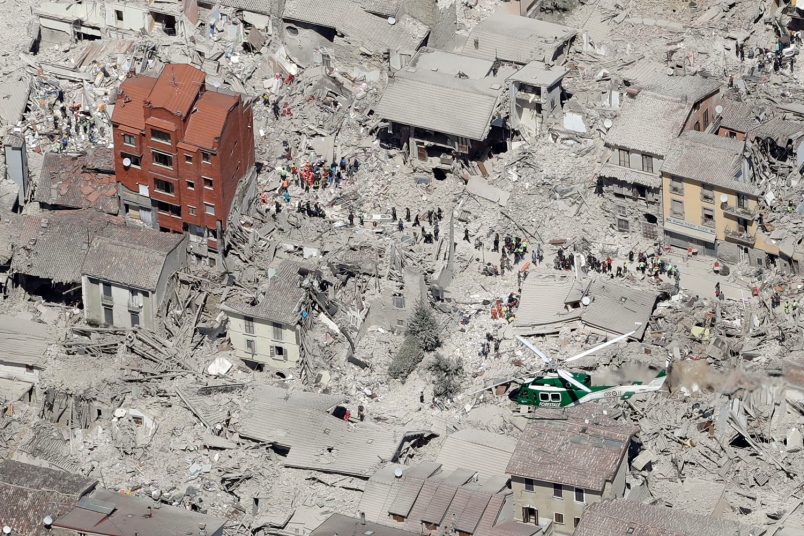
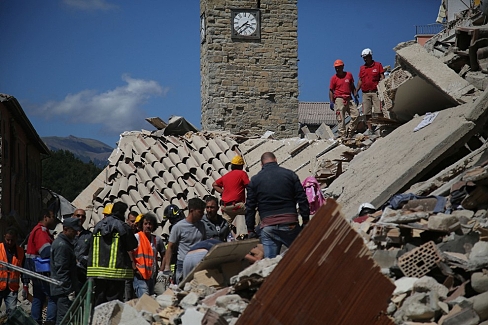 That clock tower on Amatrice church indicating 3:36 am is a powerful image for what happened this night. That minute was the last minute for many victims, it will be a minute forever remembered because it is written in the flesh and hearts of their families. And it will be remembered by our country, whose recent history is also a series of clocks stopped forever by the violence of men and of the earth. I will also remember it forever, because this cry of the earth also reached the house of my parents in Roccafluvione, around twenty kilometres from Arquata del Tronto, where I am visiting them. It was a long night of fear, suffering and thoughts for Amatrice, Arquata, Accumuli, towns of my childhood, close to where my grandparents come from, villages where I would accompany my father as he went about his business selling chickens. And then there were thoughts, thoughts we never have, because you can only have them on these terrible nights. I thought about all the time that clock had measured right up until 3.36. It stopped there, dead, but it was only one dimension of time which the Greeks called ‘kronos’: the surface, the soil of time. In the world there is our managed time, domesticated, constructed, which live by. But beneath it there is a another time: the time of the earth. This non-human time, and at times inhuman, and commands the time of men, mothers and children. And I thought that we are not the masters of this other time, which is deeper, abysmal, primitive, which doesn’t follow our path, and at times is against the paths of those who walk above. On such momentous nights we become aware of this different time, on which we walk and build our homes, and that we are ‘grass of the field’, watered and nourished by the sky, but also swallowed up by the earth.