24 Oct 2022 | Non categorizzato
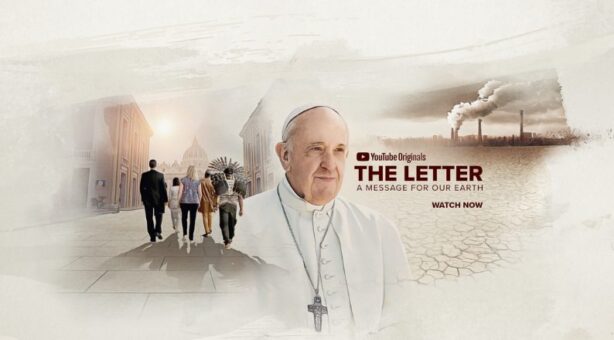
On Oct. 4, 2022, the docufilm “The Letter,” created by the Laudato Si’ Movement, was presented at the Vatican. It offers a perspective of how to act for the good of our “common home” and is now available for free on Youtube Originals in 12 languages. Arouna Kandé is a young Senegalese student born in a small village who used to work on a farm with goats and chickens but because of the gradual destruction of the environment the young Muslim was forced to leave the village. The young man explains how rising sea levels in the coastal town of Saint-Louis have already forced thousands of people to leave their homes. “My family in Senegal,” he says, “has done nothing to cause the drought in our village or the flooding in the city. We are being affected by the choices made by other people. However, the future is coming, it is mine, and I will make good use of it.” In the docufilm “The Letter,” presented by the Laudato Si’ Movement, of which the Focolare Movement is a partner, Arouna Kandé’s story is intertwined with the stories of Brazilian indigenous chief Cacique Odair Dadá Borari, 14-year-old Indian activist Ridhima Pandey, the Asners – an American couple, both marine biologists, and Irish woman Lorna Gold, all of whom are extremely active in safeguarding the environment. With a personalised letter leaving the Vatican and being delivered to each of them, a journey begins through their own lives until they return to the Vatican where Pope Francis engages in a dialogue with them in an atmosphere of intimate confidence and deep listening. Finally, the action moves to Assisi, to places made famous by St. Francis. There, Cardinal Raniero Cantalamessa offers a unique perspective for understanding the Franciscan roots of the message behind the Encyclical Letter Laudato Si’, dedicated by Pope Francis to care of the common home. The film was presented at the Vatican on 4 October, on the feast of the saint of Assisi, in the presence of its protagonists, director Nicolas Brown and his team along with the producers. In the Synod Hall, Arouna Kandé explained the importance of raising awareness of these issues. He spoke of schools being washed away by the waters and hundreds of boys having nowhere dry to rest, forced to sleep on their feet for days. The boy told of moving to a coastal town where the sea level is rising. He has not given up: he is now a university student and is setting up a new NGO to lead the next era of sustainable development in his country. Arouna is thus witnessing to the thousands of people who have firsthand experience of the climate crisis and have the knowledge to solve it. Ridhima Pandey, a 14-year-old Indian high school student, who has also participated in demonstrations to hold governments accountable for their climate action. She founded an NGO to help young women become climate activists. Ridhima said that future generations of young people will be the ones who suffer from global land abuse and neglect. “Our generation – the young people – is and will be the most vulnerable.” “The Letter” is a film to be watched in families, communities and schools because the message each of the protagonists receives is directed to every person on the planet enabling us to realise that we can all do our small or large part to care for “our common home” as Pope Francis calls it in Laudato Si’. The film will be available on Youtube Originals on 2 November 2022 in 12 different languages.
Carlos Mana
https://www.youtube.com/watch?v=Rps9bs85BII
10 Oct 2022 | Senza categoria
The deep personal encounter with God in prayer redefines our entire existence. Recognising Him as the author of grace gives us the opportunity of loving as children, of losing ourselves in His gaze, until we become living prayer. … As we know, our spirituality is both personal and communitarian. It leads us to extend our love vertically, as people say nowadays, towards God, and horizontally towards our neighbors. And keeping the balance between these two loves is what leads us to holiness. For some of us it’s easier to develop the horizontal dimension of love – and so there is the tendency, at times, to engage in constant activities – rather than developing the vertical dimension. It’s true that we usually direct all that we do to God – we love others for him, we work for him, we suffer for him, we pray to him. But if it is true that by continually “making ourselves one” with our neighbors we have often reached the point of loving them with our hearts too, can we be just as certain that we love God not only with our will, but also with our heart? At the end of our lives, we won’t be able to present ourselves to God together with others, with the community; we’ll be alone. Can we be sure that in that moment all the love stored up in our hearts during our lifetime will spontaneously pour out, as it should do, to the one we ought to have always loved, the one we will meet …and who will judge us? … That moment will come for us too, and keeping it in mind, we should try from now on to improve our relationship with God as much as possible. … In fact, we can love God as servants do, doing all that the master wants, without speaking to him at all. Or we can love him like children, with all our heart, full of the Holy Spirit, filled with love and trust in our Father. This kind of trusting relationship leads us to speak with him often, sharing all our concerns, our resolutions and our plans. We experience the trust and the divine desire that makes us eagerly look forward to the time which is only for him and be in contact with him in a deep way. This is prayer, true prayer! We have to aim at this, to the point that we become living prayers. The theologian, Evdokimov, said something beautiful about prayer. He said: “It’s not enough to say prayers; one must become prayer, be prayer, grow into being a living prayer.”¹ Grow into being a living prayer, be prayer, as Jesus wants, since he said: “Pray always”². I believe that the hearts of many of us contain a real wealth of divine love that can transform our lives into authentic prayer, that can make us grow as a living prayer. We only need to make use of it at the right moment. So, during this period, let’s make the commitment to speak often with God, even in the midst of our activities. Let’s try to improve in this. Saying “for you” before every action already transforms it into prayer. But that’s not enough. Let’s start to have an ongoing dialogue with him, whenever possible. Only in this way, at the end of our life, will our love for God fall from our lips in words similar to those of the saints. …
Chiara Lubich
(Chiara Lubich, Conversazioni, Cittá Nuova 2919, pag. 551-553)
1. P. Evdokimov, Ortodossia, in Aforismi e citazioni cristiane, cit. p. 153. 2. Cf. Lc 21, 36.
https://youtu.be/TqJCVMkF2xs
3 Oct 2022 | Senza categoria
15 projects selected for the Seed Funding Program, a micro-financing programme that supports and encourages significant and promising integral ecology initiatives worldwide. The Focolare Movement, FaithInvest and MundellEarth support the project.. Today the world is facing a complex social and environmental crisis, and people are mostly eager to find solutions to deal concretely with this problem. Acting for the good of our “common home”, as Pope Francis likes to call the earth, listening to “the cry of the poor, of the planet and of the new generations”. The Focolare Movement has also decided to play its part and has realised to be responsible for studying in depth the problems afflicting the world and to engage itself in concrete actions. With this desire to find strategies from an integrated approach, the Seed Funding Program (SFP) was born in partnership with FaithInvest and MundellEarth. The SFP is a micro-financing programme that aims to sustain and encourage significant and promising initiatives in different parts of the world towards the realization of local ecological plans within the Focolare communities to journey together towards an integral ecology. From the Philippines to Argentina, of the 33 projects that responded to the call, 15 were selected to receive the funding and develop their work with environmental and social aspects in their communities. The projects are youth-led, with intergenerational efforts, placed in their local communities, oriented towards integral ecology and motivated by spiritual values. During the SFP Kickoff meeting that took place on September 3rd, all the participants were able to be inspired by each other’s projects – from recyclable carpentry cooperatives to the integral formation of the youth. A great moment of sharing was also attended by Catherine Devitt (Faith Plans Programme Manager of FaithInvest) John Mundell (President of MundellEarth) and Etienne Kenfack (Focolare Movement Advisor for the ‘Physical Life and Nature’ aspect).
Ana Clara Giovani and Bianca Carvalho
Here are the projects Get to know more here: https://www.new-humanity.org/es/project/seed-funding-program/
10 Sep 2022 | Non categorizzato
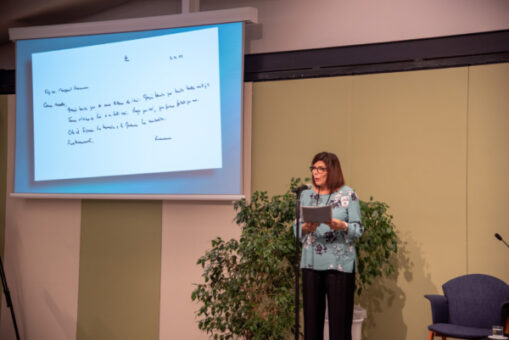
In addition to the joy of being together again in person after the pandemic, an unexpected and affectionate greeting from Pope Francis has arrived to those with overall responsibility for the Focolare Movement around the world, who are meeting from 10th to 23rd September. “I am grateful for so much good news. I am close to you personally, and to all of you. I assure you of my prayers, please pray for me too.” These were the Pope’s words in reply to a letter from Margaret Karram, President of the Focolare Movement, with which she chose to open the meeting of those responsible for the Focolare Movement in the world, together with its General Council. The President told the 104 people at the meeting that a few days ago she had felt urged to write to the Pope, to thank him for his constant closeness to her and to the Movement, hoping to give him joy. In her letter dated 6th September, among other things, she told the Pope: ‘A year and seven months have passed since I was elected President, and I confide in you that it has been a very demanding time with many challenges to be faced and many decisions to be made. I have understood more and more your words referring to the ‘pruning’ which is necessary for growth and, as I renewed my choice to embrace Jesus crucified and forsaken in this pruning, I perceived that I became more humble, I felt greater hope, and that my unity with you, Your Holiness, was ever stronger, together with the certainty that God is at work. At the same time, I witnessed a great fruitfulness and, in individuals and communities, I witnessed steps in spiritual growth being taken. I also saw greater care for the ‘least,’ and many tangible actions to help those who suffer the most’. Margaret concluded by assuring the Pope of the prayers of everyone in the Movement. She was very surprised when the following day she received this handwritten reply from Pope Francis:
7.9.22
Ms Margaret Karram My dear sister, Thank you very much for your letter to me yesterday. I am grateful for so much good news. I am close to you personally, and to all of you. I assure you of my prayers, please pray for me too. May the Lord bless you and may Mary protect you. Fraternally, Francis 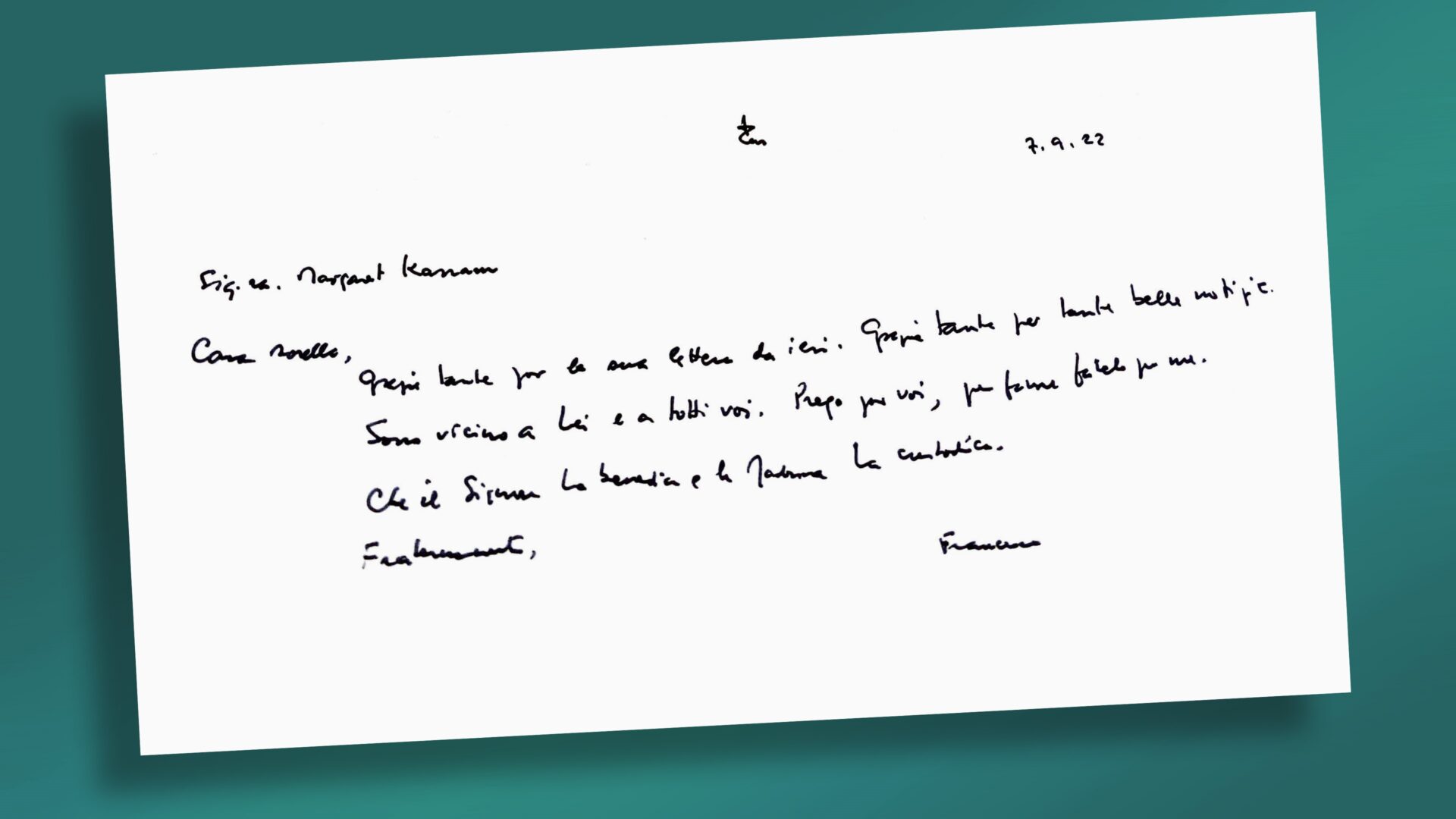
5 Sep 2022 | Non categorizzato
On 2 June 2000, the first conference on ‘Communication and Unity’ was held, in which Chiara Lubich presented to those attending, the model of the ‘great communicator’: Jesus in the moment of his forsakenness, the mediator between humanity and God. She then listed the guiding principles of communications inspired by the charism of unity. It is unthinkable that a new communication be imposed from above, by some international agency or institution. It will come rather from the experience of communicators who have God-Love as a model for communication and as a paradigm for professional relations. Guiding principles of our communication—And indeed it is God-Love that those of us who are involved in communication seek to draw upon. They have developed out of their daily experience an original way of communicating. We present it here as a small contribution to the body of research being developed today. The first thought: for them communication is essential. The effort to live the gospel in everyday life, the experience of the Word of Life, has always been indissolubly united with communicating it, describing the various steps and the results, since it is a law that we love others as ourselves. They believe that what is not communicated is lost. So life generates light, both for those who speak and for those who listen, and it seems the experience is fixed in eternity. They have almost a vocation for communication. The second thought: to communicate, we feel the need “to make ourselves one” as we say, with the one who is listening A third thought: emphasize the positive. It has always been our way to put what is good into light, out of a conviction that it is infinitely more constructive to point out what is good, dwelling on the good and positive aspects, than to stop at the negative, even though whoever is in a position of responsibility has the duty at the proper moment to point out errors, shortcomings and failures. Finally: the person matters, not the media, which are merely an instrument. Bringing about unity first of all requires the indispensable means, which is the person, St. Paul’s new self, who has welcomed the mandate of Christ to be leaven, salt, light of the world.
Chiara Lubich
(Chiara Lubich, Essential Writings, New City Press, New York, and New City London 2007 p. 295-296)
