1 Sep 2022 | Non categorizzato
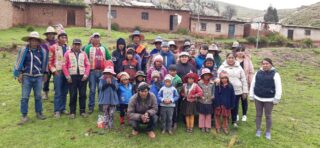
As part of the programme of activities for United World Week 2022, the preparation team from Cochabamba (Bolivia), in coordination with the ‘Casa de los Niños’ in the same city, organised a visit to the rural community of Carpani 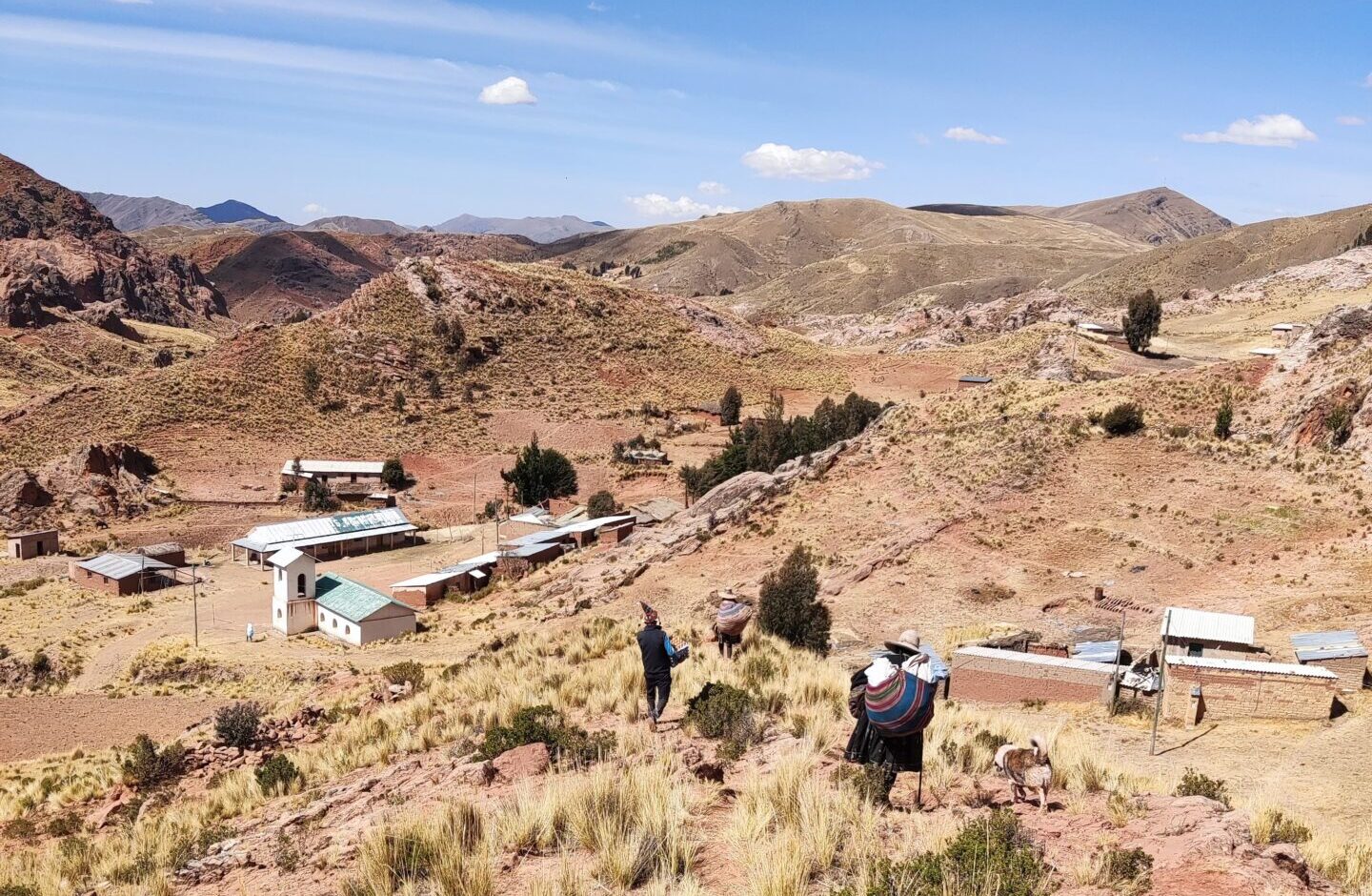 Carpani is a small town of 250 inhabitants, located in the Bolivian highlands (3,900 metres above sea level), between the departments of Cochabamba and Oruro. The invitation to visit the village was addressed to young people in particular but also to anyone else who was interested in joining. To get to the small town of Carpani (135 km from Cochabamba), we travelled for three hours on a mostly tarmaced road along an uphill mountain path. We then continued on a dirt track for about 15 km, and finally we followed a minor diversion, on a small road, to reach the village of brick and adobe clay houses nestled in the mountains. “The preparatory phase of the trip involved getting various goods, such as food and school materials for the small school which has just one multi-grade class,” says Aristide, head of the ‘Casa de los Niños’ (www.lacasadelosninos.it). Unfortunately, it has been neglected by local and national authorities who even withdrew the teacher’s salary but it has been receiving support from the ‘Casa de los Niños’ for many years – which also takes its inspiration from the charism of Unity – which tries to meet some of the many needs of the small population, sustained by a meagre production of potatoes and by grazing its small flocks of sheep.” Thanks to the support of the Focolare Movement community in Cochabamba, it has been possible to meet a large part of the needs that the Carpani community leader had told them about in advance.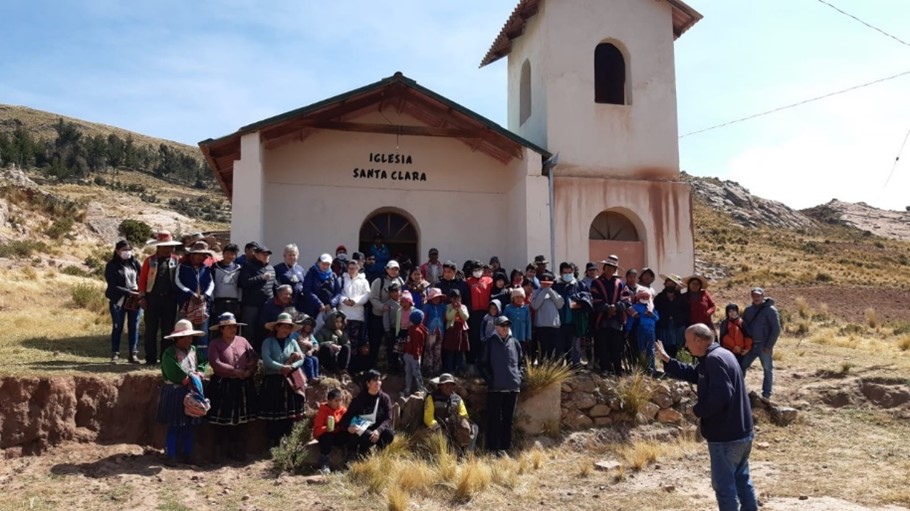
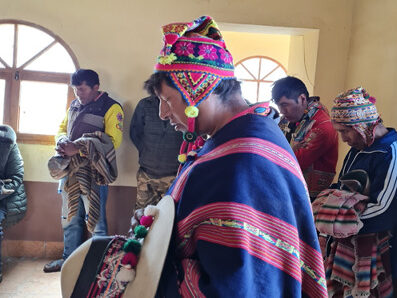 “The programme prepared for the day of the visit,” continued Silvana Verdún, “was very simple: community prayer in the small chapel, in the region’s native language of Quechua, although everyone also understands and speaks Spanish, followed by a moment of dialogue with the villagers, divided into groups of men, women and children.” “It was an experience of great mutual giving, and we all felt like brothers and sisters listening to each other and supporting each other, in the same simplicity and human warmth that characterises these people, as pure of heart as the sky and as untouched as the mountains that surround them,” said Franc Moura. The finishing touch to the community meeting was unmissable – the moment for sharing an outdoor lunch. We prepared a communal table with all the dishes that each participant had brought, and they offered us the fruit of their labour: “potatoes a la wathia”. This is a cooking technique typically found in rural communities, which consists of digging a hole in the ground, the depth of which depends on the amount of food to be cooked; the cavity and the boulders extracted are heated with embers of firewood and charcoal. Once the right temperature is reached, the food is placed inside the hole and covered by the hot clods for a certain amount of time. These were beautiful moments that are etched in our hearts. A family from Cochabamba, on their first trip to Carpani, wrote: “We had an unforgettable experience as a family. When we returned home we sat down to talk about it and the conclusion we drew was one of absolute happiness. We were very happy to meet all of you volunteers and the community of Carpani. It was a real blessing and we would like to continue participating in other activities. Thank you for the opportunity”. The ‘united world’ also advances in little Carpani!
By Orlando José Zurita Vilte – Bolivia (from Ciudad Nueva Interamericana) Foto: © Franc Moura
29 Aug 2022 | Non categorizzato
“In his first ‘Angelus’ message in Rome on 17th March 2013, Pope Francis said: “We don’t hear Jesus speaking words of contempt, or condemnation, but only words of love and mercy.” In fact, mercy and forgiveness are characteristic Christian virtues that we can practice every day with all the brothers and sisters we meet. What makes mercy so powerful that it triumphs over justice (cf. Lk. 1:54)? And why does Jesus consider this virtue so important that he makes it a condition for personal salvation? As Pope John Paul II clearly explained, mercy is “an indispensable dimension of love; it is, as it were, love’s second name.”[1] … This theme is found again in the prayer of the Our Father: “Forgive us our trespasses as we forgive those who trespass against us.” We could say that there is a law written in heaven in which our sins our remitted to the extent that we forgive our brothers and sisters. The theme of mercy and forgiveness pervades the entire Gospel. Actually, Jesus’ goal is what he revealed to us in his final prayer the night before his passion: to unite all people, to make all humanity one big family whose model is the Trinity. The whole of his teaching tends to give us, through his love, the tool for achieving this exceptional fellowship among ourselves and with God. And mercy is the utmost expression of love, of charity, that which completes it, which makes it perfect. Let’s try, then, in all our relationships, to live this love for others in the form of mercy! Mercy is a love that welcomes every neighbour, especially the poor and needy. It is a boundless, abundant, universal, and concrete love. It is a love which encourages reciprocity, which is the ultimate goal of mercy, without which there would be only justice, which serves to create equality, but not fraternity. People often talk about denying forgiveness to those who have committed serious crimes; revenge is called for more than justice. But once every attempt has been made to compensate for the damage done, we must make way for forgiveness, which is the only way to heal the personal and social trauma produced by wrongdoing. “Forgive and you will be forgiven” (Lk. 6:37). Therefore, if we have been offended or treated unjustly in any way, let’s forgive and we will be forgiven. Let’s be first to show kindness and compassion! Even if it seems difficult and requires great courage, let’s ask ourselves, in front of every neighbour: what would his or her mother do? This thought can help us to understand and live in accordance with the heart of God.
Chiara Lubich
(Chiara Lubich, in Parole di Vita, [Words of Life] Città Nuova, 2017, pp. 632/4) [1] John Paul II, Dives in Misericordia, n. 7
26 Aug 2022 | Non categorizzato
The eleventh Assembly of the World Council of Churches runs from 31 August to 8 September 2022 in Karlsruhe, Germany. The Focolare Movement has long been linked to the WCC by ties of friendship and collaboration, which continue in this latest Assembly. In a world torn apart by conflicts, afflicted by a pandemic which has widened inequalities, overwhelmed by an unprecedented climate crisis, characterized by scientific and technological innovations which often create new disparities between people and regions of the world, does it make any sense to speak of unity? And, if so, what contribution can Christians make to achieve it? These fundamental questions will be at the heart of the 11th Assembly of the World Council of Churches, taking place at Karlsruhr, Germany from 31 August to 8 September 2022. The Assembly, the highest governing body of the World Council of Churches, is normally convened every eight years. 352 Churches now belong to the WCC, in 110 countries, representing around 500 million Christians. The Assembly will gather around 4,000 participants from all around the world. Unity, for Christians, is the fulfilment of Jesus’ prayer “that they may all be one” (John 17:21). Words which inspire confidence in the Assembly’s title: “Christ’s love moves the world to reconciliation and unity”. The work of the Assembly springs from reflecting on the great challenges of the planet which have revealed such vulnerability, as well as ethnic, economic and social divisions and injustices. But which have also highlighted the interdependence of individuals and peoples; the responsibility we have towards others in a world in which no-one can save themselves on their own. In this context, the Christian Churches are gathering together for prayer and celebration, for reflection and action. It’s an opportunity to deepen their commitment to dialogue, visible unity and common testimony. Alongside the official delegates’ program are around 100 workshops and stands hosted by various Churches, Communities and Institutions, including the Focolare Movement sharing its own wide-ranging experience of dialogue. The Focolare stand will be supported throughout the Assembly by the team of “Centro Uno” (which coordinates the ecumenical activity of the Focolare internationally), with Focolare members from Germany, Switzerland, Ireland and Romania. On 5 September at 17:00, they will host a workshop on “Dialogue as a lifestyle: methodology and practice”, offering an experience of dialogue between Christians of different Churches, and between Christians and Muslims. A dialogue involving maximum respect of each one’s identity, prioritizing the engagement of theory with life. The World Council of Churches came into being on 23 August 1948, originally with 147 member Churches. Its principal aim to enable dialogue as the way and characteristic of authentic Christian life. The Focolare Movement’s links with the WCC go back to 1967 when Swiss Reformed theologian Lukas Vischer invited Chiara Lubich to Geneva. On her third visit, in 2002, Chiara also visited the WCC’s Ecumenical Institute at Bossey. WCC General Secretary Rev. Prof. Ioan Sauca has, on more than one occasion, referred to the importance to the Institute of that meeting with Chiara Lubich and her clarity in addressing the often challenging relationship between identity and unity.
Anna Lisa Innocenti
22 Aug 2022 | Non categorizzato
Professor Giuseppe Argiolas has offered his resignation as Rector of the Sophia University Institute “for personal reasons”. The present Vice Rector, Professor Declan O’Byrne has been appointed as Acting Rector and will serve in this capacity until the natural end of the mandate, January 2024. The Vice Chancellor, Margaret Karram, President of the Focolare Movement, has written to the academic community of the Institute saying: “I ask you all to collaborate fully with Professor Declan O’Byrne, who has accepted the role assigned to him by the Congregation for Catholic Education, so that the Sophia University Institute can continue its service of teaching, research and cultural engagement with due professional diligence. I am grateful to Professor Argiolas for his commitment and for the work he has done to develop Sophia, especially during these difficult times of the pandemic, 2020-2022. I entrust to the responsibility of the whole academic body the good outcome of this new academic year”. The teachers and staff at Sophia are united to the Vice Chancellor in thanking Professor Argiolas for his dedicated commitment at the service of the Institute.
22 Aug 2022 | Non categorizzato
During the Fourth World Youth Day, held in Santiago de Compostela (Spain) in 1989, Chiara Lubich gave a talk entitled “Jesus is the way”. We have chosen an extract from it in which she invited everyone to set in motion the transforming power of love as Jesus himself did. He was God’s Son, he was love, and he came to earth out of love. He lived for love, spreading love, giving love, bringing the law of love and he died for love. Then he rose from the dead and ascended to heaven, fulfilling his plan of love. Everything was for love: love for you, love for me, love for everyone. We could say then that the way Jesus followed has a name: love. And we, who want to follow him, must walk along this way – the way of love. Love! Some of you might ask yourselves: what kind of love did Jesus have in his heart? Out of what kind of love did he act? What kind of love did he leave here on earth? The love that Jesus lived and brought on earth is a special and unique love. It is not the kind of love that you might imagine. It is not philanthropy; nor is it simply solidarity or kindness. It is not purely friendship or affection (like the love a boy can have for a girl, or a mother for her son); nor is it only non-violence. It is something exceptional, indeed, divine: it is the same ardent love that burns in God. Jesus has given us a flame of that infinite fire, a ray of that immense sun. It is something extraordinary. We do not think about this very often, but if we were to take it seriously, it would make us strong. … We must make this love become fruitful. How? By loving.
Chiara Lubich
(Chiara Lubich, L’amore al fratello, [Love of Neighbour] Città Nuova, 2012, pp. 50-51)
