12 Aug 2022 | Non categorizzato
The Fifth Halki Summit took place in Turkey from 8th-12th June 2022. Sustaining the future of the planet together was the title of the meeting organised by the Ecumenical Patriarchate of Constantinople together with the Sophia University Institute, Loppiano (Florence, Italy). https://www.youtube.com/watch?v=tJ6ZGgiT7YU&list=PL9YsVtizqrYsxCVExqFc_vvuzCKyNbr43&index=1
22 Jun 2022 | Non categorizzato
“We are commited to verifying the ecological sustainability of our structures and activities … We are dedicated to the creation of greater environmental awareness that will lead to more sustainable lifestyles.” Ecological conversion was one of the goals set by the Focolare Movement in the 2021 General Assembly. In response to this urgent need, the Focolare EcoPlan was initiated. “The Focolare Movement is deeply committed to ecological conversion through concrete actions and by fostering dialogue with all for the protection of our planet,” said Margaret Karram, at the opening of the fifth Halki Summit a few days ago. “Stimulated by our General Assembly at the beginning of 2021, we have decided to take courageous action through the creation of an ecological plan within our communities to bring about change and make our lives and our activities more sustainable.” 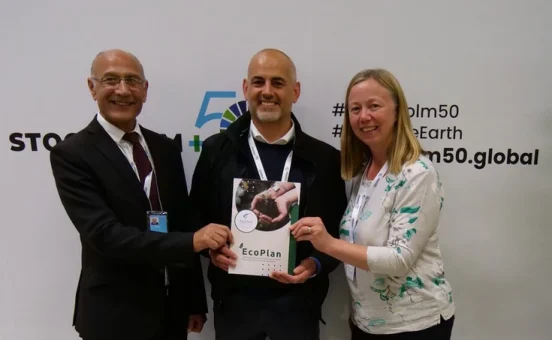 In fact, on 3 June 2022 in Stockholm, acting on behalf of all its communities, the Focolare Movement was able to present its own document – Focolare EcoPlan – which demonstrates its commitment to the environment. The presentation of EcoPlan was motivated by the spirituality that has given life to the Movement. It was officially handed over to Iyad Abu Moghli from Jordan, UNEP Senior Principal Advisor and director of the Faith for Earth Initiative, who said that the EcoPlan is “an ambitious and comprehensive ecological approach.”
Download PDF
Carlos Mana
https://youtu.be/B9SSOE_yzxk
21 Jun 2022 | Non categorizzato
On 20 June 2022 a conference was held in Rome on ‘The Identity of Movements and New Communities on the Synodal Path of the Church’ promoted by the Pontifical Lateran University and the Sophia University Institute. Increasing and deepening dialogue between hierarchical and charismatic gifts, between the institutional Church, Movements and New Communities. Cardinal Marc Ouellet’s wish is that these times, characterised by the synodal journey, may bring about a broader awareness of the charisms present in all the ecclesial communities. These words of the Prefect of the Congregation for Bishops and President of the Pontifical Commission for Latin America express the important stage in the conference “The Identity of Movements and New Communities on the Synodal Path of the Church” held yesterday at the Pontifical Lateran University and promoted jointly with the Sophia University Institute. At the centre of highly qualified speeches were the journey and open questions on these new expressions of the Spirit that require up-to-date answers which measure up to a continuously and rapidly changing world. Card. Kevin Farrell, Prefect of the Dicastery for the Laity, Family and Life, identified four areas of challenge that this journey presents today: dynamic fidelity to the charism, unity, synodality and missionary spirit: “The new perspectives that the Holy Spirit opens up before us always present themselves as challenges, something that does not leave us in peace because the Spirit is dynamism, it is creativity, it is life”.
How, then, is it possible to carry out an updating that has to be done in multiple environments: formation of members, evangelisation activities, activities to help and heal society’s deepest wounds? The variety and complementarity of responses and contributions offered by representatives of the Movements and New Communities provided a panorama on the current status of these ecclesial realities. Margaret Karram, president of the Focolare Movement, stressed how “In these times when the whole Church is moving towards a synodal approach, we are called to take a step further: to walk together, united, not just within our own realities, but together with everyone”. It is only by networking, by being a gift for the Church and humanity that the Movements will also discover their own identity in a new way. Mary Healy, professor of Sacred Scripture (Sacred Heart Major Seminary in Detroit, USA) highlighted formation, evangelisation and the primacy of the charismatic dimension as the three main fruits that Movements and New Communities have been bearing since the Second Vatican Council: gifts brought to the Church and humanity, founded on a personal and communitarian encounter with Christ. Speaking about “The Ecclesial Movements and New Communities in the current kairos of the synodal process”, Mons. Piero Coda, theologian and Secretary General of the International Theological Commission and lecturer at Sophia University Institute, highlighted a challenge that is still open: the provisional nature of the configuration of these ecclesial realities with regard to their recognition in the canonical order. The care of the Church in this phase provides a foretaste, in the current dynamic ecclesiological context, to new and more mature arrangements’. The session on “Foundation, Development and Incarnation of the Charism” was then entrusted with providing a representation of the Movements and New Communities. Moysés Louro de Azevedo Filho, Founder and General Moderator of the Shalom Catholic Community, presented the spirit and aims of this ecclesial expression that is “the bearer of a charism summed up in the word spoken by Jesus when he met the disciples in the Upper Room: “Shalom”, towards communitarian holiness”. Daniela Martucci, vice-president of the Comunità Nuovi Orizzonti highlighted the heart of its charism: listening to the cry of Jesus Crucified and forsaken in the poor, the least and the discarded as well as the cry of love of the God-Man who continues to repeat: “love one another as I have loved you”. Iraci Silva Leite emphasised the centrality of the Word of God that guides the experience of the “Fazenda da Esperança”, a Word that “unites us, particularly in our efforts to live love among ourselves and to give those who suffer the presence of Jesus”. Michel-Bernard De Vregille of the Emmanuel Community touched on the theme of crises that ecclesial realities have encountered and continue to encounter: “There is often the risk of wanting to set charism and institution against each other,” he said. “However, the torch of the hierarchical and institutional Church and the torch of the charism are made to meet together and become a bright and beautiful flame illuminating the world with the presence of the Risen Lord”. For the aspect of incarnation, Prof. Luigino Bruni, an economist, focused on the ‘narrative’ challenge of charisms born in a historical period often recounted in ways that are typical of the founding period. “Updating is needed together with the charism,” he said, “without losing touch with the charism’s fundamental core. A new narrative potential will come from the pluralism of languages, from various experiences, from the dialogue between people with different sensitivities: young people and adults, academics and ordinary people, Church and movements, etc.” In the afternoon, work focused on how charisms can and should develop all aspects of the life of members and communities, from the spiritual to the organisational, by including members of different vocations, to formation, to the administration of assets and all forms of responsibility and governance. Prof. Elena Di Bernardo, Professor of Canon Law (Institutum Utriusque luris, Pontifical Lateran University) offered a highly qualified excursus on the relations between theology and canon law, as they have been realised and evolved over time. ‘It must be assumed that the identity in itself of a Movement or ecclesial reality,’ she observed, ‘is fully acquired when all the charismatic aspects constituting it have received adequate juridical configuration’. At the close of the proceedings, the report by Dr Linda Ghisoni, Undersecretary of the Dicastery for the Laity, Family and Life, entitled “Laity today in the ecclesiology of communion”, highlighted two polarities to which attention must be given: person-institution and praxis-statutes. With regard to the former, she observed that ‘the institution, Movement or new community, will be preserved if its original charism, its proper purposes in which prayer and apostolate are combined, and, above all, will be preserved if the good of the persons who make it up is safeguarded. The latter can never be an alternative to the good of the institution!” Stressing how experience painfully teaches us that whenever the ‘good name’ of the community has been preserved by sacrificing individual persons and their rights, aberrations have been committed that are detrimental to the institution as a whole. He concluded: ‘The person at the centre, always, constitutes an investment in the community or movement. The other polarity instead concerns practice and statutes: if it is true that ‘life undoubtedly anticipates every normative definition’, it is also true that any legalism or demonisation of law must be avoided, which ‘far from being a necessary evil to be endured by drawing up a list of articles, constitutes a path of freedom for all: for all members and for those who are personally called upon to be its guarantors, particularly for those who hold positions of government, at all levels’.
Stefania Tanesini
13 Jun 2022 | Non categorizzato
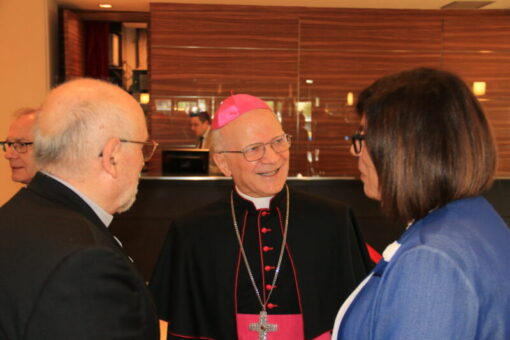
The Fifth Halki Summit, was held in Istanbul, Turkiye. Four days of talks and discussion on care for the environment for the future of the planet. At the end of the fifth Halki Summit, entitled “Sustaining the Future of the Planet Together,” we said our goodbyes in an atmosphere of warmth and friendship. The international, interdisciplinary meeting was organized jointly by the Ecumenical Patriarchate of Constantinople (Istanbul) and the Sophia University Institute, Loppiano (Italy). It was inspired by the prophetic teaching of Patriarch Bartholomew and Pope Francis and all agreed that it was an event of the Holy Spirit. Not by chance, the Summit was held in the week between the two dates of Pentecost in our respective Churches. The sincere communication and mutual attentiveness, as well as the open exchange of ecclesial approaches and reflections, led us to discover that we are at a decisive turning point for the future of the human family, in which each person has a responsible part to play. The challenge or opportunity to which we are called is that of developing a shared ecological ethos. As artisans of peace and fraternity, we wish to implement good practices in every sphere, whether educational or pastoral, social, economic or political. We committed ourselves to work on interdisciplinary pathways for the formation of new paradigms that can interpret and transform reality and overcome the culture of waste. It became clear that effective action can only be achieved through non-elitist education, in which the Churches are actively engaged. At the end, all participants wished to make an appeal “to the Churches and those who care about our common home”. We hope not to leave this event behind us as a beautiful memory, but instead, starting from our own conversion, nourished by evangelical wisdom, to work together for real change in the capacity to care. “Ecological culture”, Pope Francis reminds us, “Cannot be reduced to a series of urgent and partial responses to the immediate problems of pollution, environmental decay and the depletion of natural resources. There needs to be a distinctive way of looking at things, a way of thinking, policies, an educational programme, a lifestyle and a spirituality which together generate resistance to the assault of the technocratic paradigm. Otherwise, even the best ecological initiatives can find themselves caught up in the same globalized logic. To seek only a technical remedy to each environmental problem which comes up is to separate what is in reality interconnected and to mask the true and deepest problems of the global system” (Laudato Si’, no. 111).
Vincenzo Di Pilato (Photo: Alfonso Zamuner, Noemi Sanches e Nikos Papachristou)
9 Jun 2022 | Non categorizzato
The 5th Halki Summit jointly organized by the Patriarchate of Constantinople and the Sophia University Institute began on 8th June, 2022, in Turkey. We had a dream… 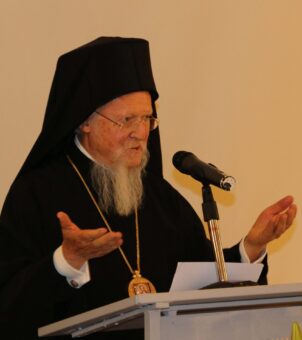 Yes, it was January 2019 and a delegation from the Sophia University Institute (IUS) visited the Ecumenical Patriarch Bartholomew in the Phanar, the historic Greek quarter of present-day Istanbul (Turkey). We were also welcomed very warmly by Metropolitan Elpidophoros of Bursa, then Abbot of the Monastery of the Holy Trinity on the island of Halki and Professor of the Theological School of the University of Thessaloniki (he became Archbishop of America the following May). We experienced a deep communion with him which gave rise to the desire to organize together a Summer School in Halki with Catholic and Orthodox students and teachers, on the theme of ecology, so dear to both the sister Churches of Rome and Constantinople. The pandemic delayed it but today that dream has come true.
 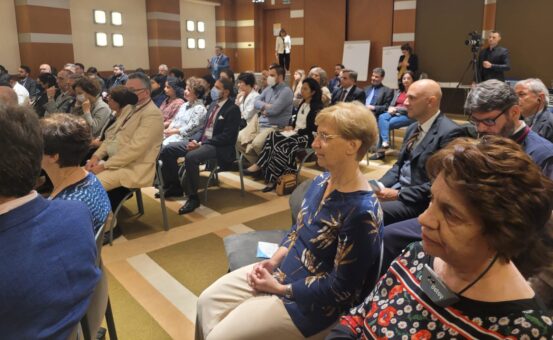 It is 6.30 pm on Wednesday, 8th June, 2022 and we are once again in the “queen of cities”, as the beautiful city of Constantinople was called, with good reason. Patriarch Bartholomew gave a passionate and informative greeting to participants, students and teachers from all continents and with very varied interdisciplinary and ecumenical experiences. The audience included Msgr. Marek Solczynski, the new Apostolic Nuncio to Turkey, Msgr. Vincenzo Zani, Secretary of the Congregation for Catholic Education, Archbishop Elpidophoros and Margaret Karram, President of the Focolare Movement and Vice-Chancellor of the IUS. “Everything is in a relationship of love” said Margaret Karram, recalling the destiny of unity embedded in the universe, that today more than ever, man and woman are called to promote with bold, prophetic action and thought. The title of the fifth Halki Summit organized jointly by the Patriarchate of Constantinople and the IUS, which began on Wednesday, 8th June, is a clear indication of this: “Sustaining the future of the planet together”. It is no coincidence that Patriarch Bartholomew emphasized two words from this title: “future” and “together”. The first refers to the strong intergenerational bond inherent in respect for the environment in which we live; the second to the mandatory interdisciplinary approach to be taken in the face of the vastness and complexity of ecological problems. He said, “It becomes evident that only a cooperative and collective response by religious leaders, scientists, political authorities, educational institutions and financial organizations will be able to effectively address these imperative issues of our time”.
 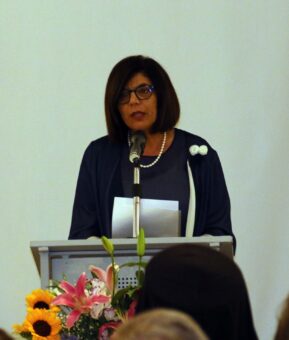 At the end of his speech, he referred to two concepts very dear to Orthodox theology and spirituality: “Eucharist” (in the sense of “thanksgiving” for the gift of creation) and “asceticism” (understood as “self-control” of consumerist passions). However, the Patriarch invited us to consider these concepts not simply in a liturgical or monastic sense, but as different ways of speaking about communion. “And this is where the vision of our brother Pope Francis,” he admitted with emotion, “coincides with the vision of the world that we have proposed and promulgated for over thirty years. We are both convinced that what we do to our world, ‘we do to the least of our brothers and sisters’ (Mt.25:40), just as what we do to others we do to God himself (cf. Mt.25:45). It is no coincidence that immediately after publishing the encyclical on the environment Laudato Sì, the next encyclical of Pope Francis was Fratelli Tutti”. There are many joint statements by the Pope and the Patriarch, together with the Archbishop of Canterbury, on the urgency of environmental sustainability, on social impact and on the importance of global cooperation. This is also what Pope Francis writes in Laudato Sì: “When we fail to acknowledge as part of reality the worth of a poor person, a human embryo, a person with disabilities … it becomes difficult to hear the cry of nature itself, everything is connected. (no. 117) The Patriarch clarifies the same concept, putting it in context: “Connections between us and the entire creation of God, between our faith and our action, between our theology and our spirituality, between what we say and what we do; between science and religion, between our convictions and every discipline; between our sacramental communion and our social conscience; between our generation and future generations, between our two churches, but also with other churches and other communities of faith”. Yes, everything is connected by a bond that only mutual love between people can make visible to every man and woman on this wonderful planet earth.
Vincenzo Di Pilato (Foto: Alfonso Zamuner)
