1 Oct 2018 | Focolare Worldwide
More than 1,200 cadavers have been recovered following an earthquake and tsunami that hit the island of Sulawesi. The Vatican is reporting that “1, 203 bodies have been recovered, but some have not yet been found or identified,” says Insan Nurrohman, vice president of Aksi Cepat Tanggap, one of the principal Indonesian NGOs. Rescue workers are labouring around the clock. Managing to remove people who are still alive is very delicate work. “The government is sending in bulldozers to clear the areas,” says Matteo Amogoni, who is in charge of Caritas Italy for Indonesia and Philippines, “but there is also the problem of no electricity and petrol. At the Angelus, Pope Francis said: “I pray for the deceased, who are unfortunately many, for the wounded and for those who have lost home and work. May the Lord console those who have survived and provide those involved in the rescue effort with strength.”
30 Sep 2018 | Non categorizzato
“You who have gone through so many seasons are the living testimony of constancy in adversity, but also of the gift of prophecy that reminds the young generations that the care and protection of the ones who preceded them are gratifying and appreciated by God, and that they cry out to God when they are disregarded.” When Pope Francis spoke these words last September 24th, he was speaking to the elderly audience in front of him in the Cathedral of Saint James in Riga (Republic of Latvia). But he was also speaking to the elderly of the whole world, in view of the international day dedicated to them on October 1st. “You that have spent yourselves, body and soul, that have given your life in the pursuit of freedom for your country, are now often left feeling that you have been forgotten. Although it sounds paradoxical in today’s world, in the name of freedom, free people subject the elderly to solitude, ostracism, lack of resources, esclusion and even misery. […] You that have gone through many seasons, never forget that you are the roots of a people.”
30 Sep 2018 | Non categorizzato
Hope I never would have thought that our parents would separate. But when it happened, and we were faced with an uncertain future that was completely unknown and the fact that life would never be the same again, I began having many sad and confused thoughts. We three brothers stayed with our Mum,“Our super-Mum,” as we called her. But everything was different. Even though we never had problems at school before, now we were beginning to have them. As soon as we noticed it, we began trying to give her some joy. Living with Papa wasn’t easy, but ever since we were small, our parents and grandparents had taught us not to judge. One of our nicest times together is when we gather to pray, asking God to accomplish his plan for each one of us. J. P. L. – Colombia Difficult Student Many years ago a particularly difficult student arrived in my class, because of some family problem. Since he had violent outbursts, some of the other parents protested with the director. Faced with the possibility that he might be expelled, I obtained permiission to take him into my personal care, advising my colleagues of the situation and receiving help from the students.Simultaneously, a family of friends made contact with his parents to help them until their situation was worked out. A long time later I returned to that city, which I hadn’t been to in many years. I saw my student again, now all grown and turned into the proud father of a family. T. M. – Italy Cake One of our neighbors was opposed to the restructuring work we were doing on our little house, expressing objections that were obviously unjustified. Tired of receiving his letters and protestations, my husband consulted a lawyer with the thought of bringing a case against him. But then, as we talked abou it, we decided on another path which seemed to be suggested by our heart. We would try to create a bridge between us and him. I baked a cake and we went to see him. He asked: “How did you ever know that today was our daughter’s birthday?” The expected clash had been transformed into an encounter. A few days later they visited us and now we have some new friends. M. – Spain The Wall Seven years of marriage had not led to the desired union of our hearts. Sand and discouraged, we thought that the reason was immaturity and incomptability of character. In this atmosphere we were led to judge and the wall of non-communication between us had grown higher and higher. Moreover, we were also burdened with feelings of guilt for not having been able to convey to our children the love that a husband and wife should give witness to. When we had already given up, some friends sho live the Gospel helped us to break down that wall. Also, there were signals coming from my wife that made me very hopeful. We learned to accept one another, to say sorry when we failed, to see look upon each other as a gift and to consider our failures as an opportunity to begin again. Helped by the friendship and prayers of others, we could feel that God loved us and had kept our family going. L. – Italy
28 Sep 2018 | Non categorizzato
 “Whatever you did to one of the least of these brothers and sisters of mine, you did it to me” (Mt 26:40). This sentence from the Gospel is the most definitive word on what a human being is. This definition is no less scandalous than Jesus declaring himself Son of God. In the name of their personal freedom, identity and uniqueness, human beings think that they have a right to contest the fact that they are so identified with Jesus Christ. Human beings want to be loved for themselves, for who they are, and not to be degraded as some sort of mask for Jesus. Human beings fear that the “bit more” of love that they receive out of love for Jesus might not take them into account, might rob them of the love they need and desire for themselves. But who could neglect their neighbours while trying to love Jesus in them (and in this way also neglect Jesus)? And who could claim that acknowledging the presence of Jesus in others means diminishing their human dignity; in that case they have not understood the presence of Jesus in their neighbours. Since Jesus has identified himself with humankind – God himself who is Love – he has also identified himself with every individual human being. But love is never an affirmation of oneself that consumes and annihilates others. It’s something that gives of itself, and, in its self-giving, provides others with the freedom to be themselves. Jesus never leaves me alone. He is on my side, he accepts me just as I am, and whatever concerns me, also concerns Him. I remain myself. Indeed, I become my fullest self precisely because I never remain alone. The mystery of Christ is the mystery of every human being. What does this mean for the people I meet, and what does it mean for me and my life? For what regards other people, it means that I am never dealing merely with a link in the chain, a cog in the wheel, or just a number in the huge numbers of people that exist. Each time I look upon a human face, I meet God in his unconditioned state, I encounter that voice that still declares over the face of every human being, what was said of Jesus during the Transfiguration on that mountaintop: “This is my beloved son!” (Mk 9:7). There are no exceptions… A human cannot rob itself of its ultimate reality. Whether he is a criminal or a scoundrel, I can never again write him off as a lost case. I encounter Christ in every person not because the person is good or deserving, not even because he or she draws upon the divine light in their personal lives, but because God has irrevocably adopted them as his own sons and daughters. Certainly the human being is immense because of the Divine life that he and she have let into their souls because of their personal choice to believe, which took place in baptism in the name of Jesus. Belonging to Jesus is something “automatic.” When a person is born, Christ has already assumed into himself that person’s living and dying, fault and self-inflicted wounds: everything is assumed into the life and death of Christ who gave his life for each one of us. This is why we encounter Jesus in every human being. And we encounter him in a particular way in the least, in those who seem to be farthest from Him, in the people in whom his face seems to be most overshadowed. Why? Because on the cross, during his abandonment by God, even becoming sin (2 Cor 5:21), Jesus identified himself with what is farthest from God, what seems most opposed to God. [It is only by] discovering Christ in our neighbours and giving to each of them that human love with which you turn towards every neighbour, with an indivisible love that is therefore directed to Christ himself, that will enable every neighbour to discover his and her own identity with Jesus, their own nearness to Jesus, being completely assumed by Him.” (From “Offene Weltformel”, by Klaus Hemmerle, Neue Stadt, 1970)
27 Sep 2018 | Focolare Worldwide
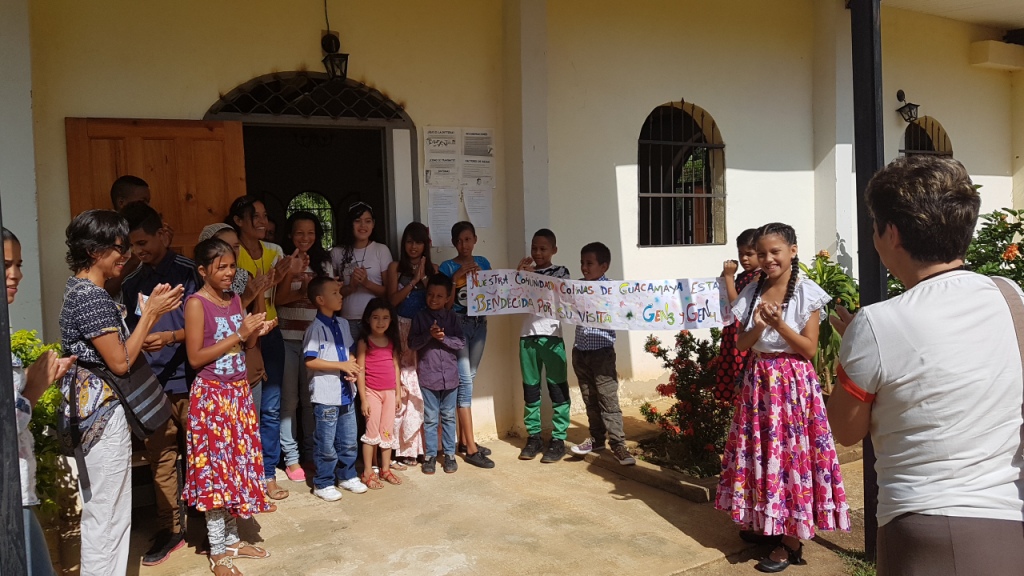
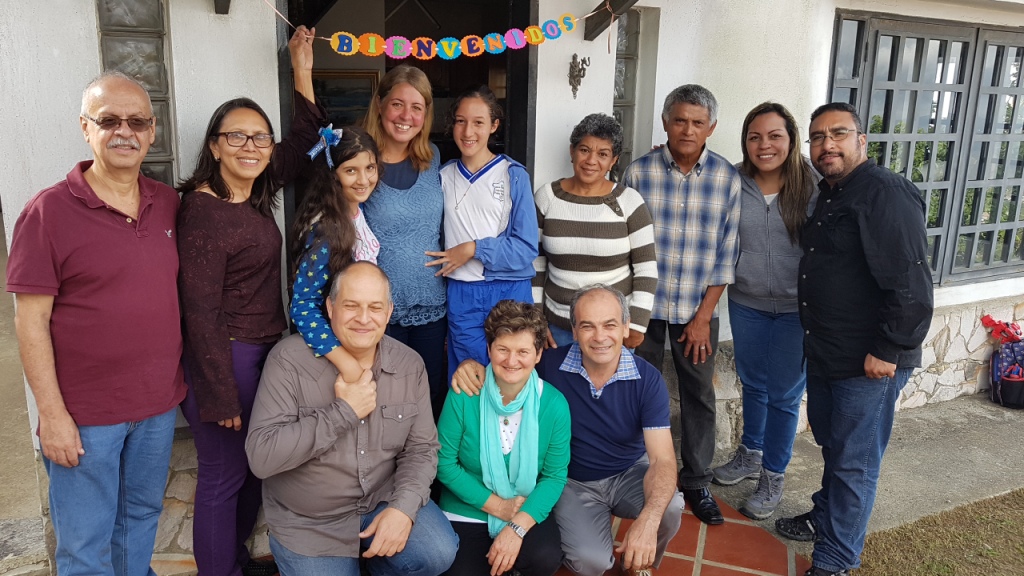 Families scattered, poverty, extreme insecurity, rising costs, lack of food, public transport, electricity and running water…an entire country in crisis that seemed to be expressed in the prayer of Grace before the first supper that Agostino and Marisa shared in the land of Venezuela: “Lord, thank you that we were able to find this food to share.” “We had planned a meeting with families, first at the Mariapolis Centre near Caracas and, then, in Valencia and Maracaibo. Emeris and Oscar accompanied us and allowed us to participate in their life.” Agostino and Marisa had lived for many years in Santo Domingo, and now they find themselves re-living their experience of poverty, suffering and separation from relatives that forced them to emigrate. It was the same experience of thousands and thousands of Italians who had fled in the aftermath of the Second World War. They had boarded ships with luggage made of cardboard. “For decades the Venezuelan people have welcomed immigrants and now finds itself also forced to emigrate. From wealth and security to extreme insecurity. They said: ‘We were well-off, surrounded by abundance, but we never knew until now how precious it all was. The crisis is the greatest blessing for people and nations, because it leads to progress. Creativity is born from despair as day is born from a dark night, said Albert Einstein in 1931.’ “It took courage to hear those words,” that were spoken in a video produced by the Focolare’s New Families Movement. The families asked to see it again the next day. They told us: ‘You had lived in Santo Domingo and in Cuba so that you could help us here today.’ This economic crisis opened our eyes to the needs of our neighbors.”
 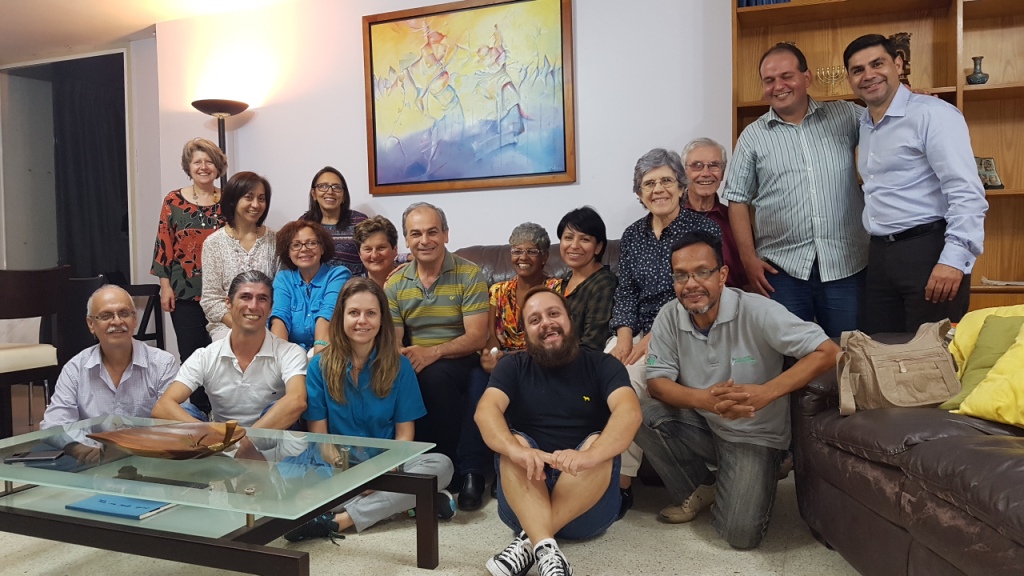 We had a tight schedule in Caracas as the visit went on: “conversations, lunches and dinners with families. They took turns coming to Emeris’ and Oscar’s home. We shared an experience with them that had proven fundamental for us. Having to decide where to live and having completely different ways of thinking, one night, we made a pact to embrace the other’s desires as our own. It suddenly appeared as an unexpected solution that contained all the elements that were important for each of us, but it was novel, a fruit of mutual love.” They recounted: “Many families have a car, but it’s becoming more and more difficult to repair maintain them, both because of the cost and the lack of professional mechanics who are fleeing the country. And the worn out tires are a big problem. A few days later we bought two of the four tires, using the money we had saved for groceries. We put them on the car and were able to keep travelling.” Two hours from Caracas the people of Valencia were suffering lack of water and the difficulty in transport. “In a rural town, Guacamaya, we met the community that had first been in touch with Ofelia who was forced to leave. They decided to find a way to carry on without having to leave their home” There were also quite a few young people “like sponges absorbing everything.” Two days later the trip to Maracaibo was in jeopardy because of the inspection stops on the roadway. But everything went well. Without electric current everything was more difficult: the terrible heat and the impossibility of turning on the air-conditioners, the lack of internet and entire programmes that just had to be cancelled. The night we were supposed to return to the city, so a supper was awaiting us with two families, that night at another family and breakfast with still another family in order not to be a financial burden on anyone. On the way, the road was blocked by a group of demonstrators which forced us to turn around. The family that took us in didn’t have anything for supper. We took some pasta out of our suitcases and cooked ourselves. It was a very beautiful evening. Incredibly, there was electric power that allowed us to sleep that night. The next day, arriving in Maracaibo, we learned that there was no electricity and the change in programme came as quite a relief for everyone.” They also recounted: “”On the morning of the meeting with the community, public transport was scarce and there were long queues for refuelling. The family that had organized everything arrived after quite a long adventure. Their daughter had proposed that they pray for a vehicle that would take them the rest of the way and, shortly afterwards, a car stopped and offered them a ride.” This too is Venezuela.
