A request for help for a young man from Cameroon in Ravenna, northern Italy, sets in motion a network of solidarity and inspires solutions and opportunities for other migrants in the city. A young man from Cameroon arrives in Italy from France. He has been assured a job in the city of Ravenna, northern Italy. However, upon arrival, he discovers that the job promised to him does not exist. With no financial support, his only accommodation is a sleeping bag. At night he sleeps on the grass beside some churches. His name is Bienvenue which means welcome. Amu (Action for a United World) – an NGO inspired by the Focolare Movement and works to help peoples and individuals in difficulty, informs the local Focolare community about this person. “One day we arranged to meet Bienvenue at the train station,” Nazzareno and Vincenzo tell us, from the local Focolare community. “We told him we’d be holding a copy of the magazine Città nuova. Bienvenue recognised us immediately and there was an immediate and strong understanding between us. From everything he told us we understood that he really needed help”. After listening to Bienvenue for a long time, the two friends decided to accompany him to the public dormitory where he would get more dignified accommodation, a hot meal and access to a bathroom. With the help of some other friends over the next few days, Bienvenue managed to find several jobs, albeit short term and irregular, and was welcomed into a family home. “Nevertheless, the accommodation and work arrangements were only temporary,” Nazzareno and Vincenzo told us. ‘We stayed in contact with him in the hope that an opportunity would present itself, and met up with him periodically.” One day, Vincenzo contacted a friend of his who owns a small flat, where he himself had stayed when he first arrived in Ravenna some time ago. He took the opportunity to ask if the flat might be available for Bienvenue to rent. Vincenzo had been a good tenant and offered to act as guarantor, ensuring the rent would be paid regularly. The friend agreed. “Bienvenue was overjoyed to finally have a stable place to live”, the two friends said, “but unfortunately, after about a week, he lost his job. Putting all our trust in God, we did not lose heart”. After a few days, Vincenzo telephoned a group of friends- four brothers who owned a company in the electrical sector. ‘They immediately and generously agreed to hire our friend after a trial period. We decided to visit him at the end of the first week, and took with us another friend we had just met, a young woman from Angola who had been living in Italy for four years and was looking for accommodation and work. Great was the emotion we all felt at this meeting that made us feel like brothers of Bienvenue and our new friend. Nazzareno and Vincenzo lived this experience with great courage which gave them the impetus to care for the people that life puts beside them and who need everything. “In the following days, we met a group of Salesian religious. The bishop had entrusted them with a parish. During the blessing of the houses by the parish priest, a tradition in the run-up to Easter, they had met several people who were non-Italian and looking for work. To be able to stay in Italy they needed to find employment otherwise their residence permits would not be extended. So we approached some entrepreneurs who were preparing to open the summer work season near the sea and needed workers the region attracts a lot of tourists. Providence was not slow in coming, and we were able to offer a job interview on the beach establishments to three people the Salesians had introduced to us. And so, day after day, we go forward with this spirit of welcome and social integration, knowing that nothing done out of love is small”.
“Called to unity – Towards an ecology of relationships” was the title of the online workshop promoted by the Together for Europe (TFE) network. Representatives of various Churches, Movements and Communities organized the event, with the aim of highlighting one of the “7 Yeses” of the journey together: the “Yes to creation”. The challenges for the protection of creation and an integral ecology are growing exponentially throughout the world and the Together for Europe network dedicated an entire day to this theme during a recent online workshop. Professionals and Christians from various Churches belonging to different Movements, from 9 European countries, spoke at the Seminar entitled: “Called to unity – Towards an ecology of relationships”. It was an engaging “journey”, in which in an atmosphere of growing convergence, the speakers presented their research and their commitment to environmental protection, then entering into dialogue with the approximately 130 people present in the “virtual room”. The experiences already ongoing in many places and the encouraging good practices, easily imitated, highlighted the desire and commitment to respect and preserve creation for future generations. This was a bond of unity that is strengthened among Christians and connects everyone with others. The heart of this event was: to deepen one of the “7 Yeses” to which the Together for Europe network committed during the Stuttgart Congress in 2007. A “Yes to creation, defending nature and the environment, gifts of God to be protected with respectful commitment for future generations”. Prof. Nicolaos Asproulis, Deputy Director of the Academy of Theological Studies of Volos (Greece) was one of the speakers who explored the theme of an Ecology of Relations from different angles, saying, “Nothing, no creature exists outside of relationship, every being is inconceivable without communion” Stefania Papa, Professor at the University of Campania, introducing the day had highlighted the “‘logic of relational harmony‘ that frees us from selfishness by promoting the first and most essential form of ecology”.Gerhard Pross, moderator of the network, said: “For many of our movements the theme of ecology has great value and today we connect it with our charism of unity, of relationships.” It is about reaching a holistic vision of our relationship with nature, with creation and with its creator. In summary, we could also call it “ecology of the heart”, summarized Pross, citing the writer Johannes Hartl. The seminar was part of a project supported by the European Union “DialogUE” Project. Workshops provided the opportunity for an intense exchange of testimonies and experiences of people from various Churches and then the European Green Deal document was presented. This is an ambitious project, in which the European Union has developed some of the strictest environmental standards in the world. The contents of the Webinar and the responses of the participants to the questionnaires related to this event will help to develop a KIT with concrete suggestions for the European Union. On 16th October 2024 it will be presented to the European Institutions in Brussels (Belgium), together with the results of the previous workshops on communication and social policies, held in 2023 and likewise co-funded by the European Union. More information is available on the website: Together4Europe | A European Network of Christians, to Unite People and Cultures. All the speakers’ interventions can be accessed here: Our common Yes to the protection of creation | Together4Europe
Maria Wienken, International Secretariat of Together for Europe
Journalists, teachers, communication experts: an international workshop on the synodal path“What Communication for Synodality?” This was the title of a webinar on 7 March live on Youtube, born after a long discussion among communication experts. A synodal path started last year with monthly meetings. Thus on the initiative of NetOne, the international network of communicators of the Focolare Movement, the idea of the webinar was developed. During the first session of the Synod last October, Pope Francis had asked the participants to ‘fast from’ the word. “Real communication has a rhythm to be respected with a time to be silent and a time to speak,” said Bishop Brendan Leahy, a member of the Synod Assembly who joined the webinar from Limerick in Ireland. “Synodality involves asceticism, the ability to look inside ourselves and offer the ‘distilled wine”, using the right words not empty words that lead to gossip. I think the Pope is inviting us above all to imitate Mary, in her contemplation”. “A synodal Church is essentially a Church of communion which becomes real when there is a communication of each one’s gifts,” said Msgr. Piero Coda, secretary of the International Theological Commission, who also spoke at the event. “It’s important to focus on the quality of communication: not giving opinionated answers but discovering the real questions that dwell in society so as to be able to give prophetic answers”. Bishop Coda’s words were echoed by Thierry Bonaventura, communications manager of the General Secretariat of the Synod when he said: “Communication forms the basis of any human relationship. God is communication, He communicates Himself, He is dialogue between the Persons of the Trinity. All the issues that emerged during the first session of the Synod last October are linked to the theme of relationality. Communication permeated the Synod even if there was a preference for communicating rather than thinking about communication”. This was followed by a speech from Argentina’s Isabel Gatti, NetOne’s international coordinator: “From the theory of communication, it is possible to offer keys to interpretation so that the philosophical and theological concepts of synodality can improve our ecclesial practices on an individual level as well as on a more social level”. “Our Church can be a family if, like Jesus and Mary, we take on the pains of suffering humanity that today has so many faces connected with communication – social polarisations, wars, social inequalities”. An example of a synodal path is the reform of Vatican communication. “The Pope desires an outward looking Church where there is a place for everyone,” says Msgr. Lucio Adrian Ruiz, secretary of the Dicastery for Communication. “This implies communication that on the one hand embraces all the new technologies and on the other hand does not forget any of the old ones because no one must remain excluded. Then there is the experience of the digital Synod, a missionary process to go and bring Jesus’ caress, his proclamation to people who do not live in the Church’s institutions”. Space was then given to artificial intelligence. How does it affect us in our profession as communicators? “The answer can be given in three words: knowledge, creativity and responsibility,” said Giovanni Tridente, Director of Communications at the Pontifical University of the Holy Cross linked up from Rome. “We need to know about this technological innovation in order to understand how to use it. It must be used creatively to improve our lives and it must be used responsibility, also from an ethical point of view, to make people aware and free to form their own opinions”. Finally, the speech by Liliane Mugombozi, a journalist from the Democratic Republic of Congo: ‘When we communicate we are giving something of ourselves, our view of the world, the values we believe in, our fears, our sorrows, but also our achievements, our victories, our doubts, our hopes, our deepest questions. An act of communication can be a gift that encourages people to meet together, that creates contexts of dialogue and trust even in difficult situations, and to walk together. An Amhara (Ethiopia) proverb says that ‘when spiderwebs join together, they can even trap a lion’. Finally, space for dialogue and questions, experiences and impressions. There was a desire to convey and experience more incisive and sincere communication. This webinar is only the beginning of a journey of synodality and communication For info: net4synodcom@gmail.com
The 40th Ecumenical Conference of Bishops friends of the Focolare Movement which took place in the historic city of Augsburg in Germany, ended on Friday, 1st March. There were 60 participants from 26 nations, representing 29 Christian Churches. “Dare to be One. A call from Jesus to live the future, now” was the title and even more the essence of the meeting.1518 -In Augsburg (Germany), the Roman Cardinal Caetano, a famous Thomist theologian and the Augustinian monk Martin Luther, professor of Sacred Scripture at the University of Wittenberg (Germany) had a discussion about Luther’s 95 theses on indulgences. There was no convergence. They couldn’t agree. In fear for his life Luther fled during the night. 1530 -The Diet of the Holy Roman Empire led Emperor Charles V to Augsburg, intending to reunite the divided Protestants and Catholics. For the occasion, Philip Melanchthon, a theologian friend of Luther, prepared the Augsburg Confession, a confession of faith intended to bring everyone together. The attempt failed. 1555 – During a further Diet in Augsburg, a Religious Peace was signed which ensured coexistence between Catholics and Lutherans. Each Prince of the Empire established which confession would be followed in his territory, a decision summed up in the Latin expression cuius regio eius religio (whose realm, their religion) 1650 – After the bloody Thirty Years’ War, which also affected Augsburg, freedom of religious expression and the equality of Protestants and Catholics in all public offices were sanctioned. The Festival of Peace was born and is still celebrated every 8th August. It was in Augsburg, a place soaked in history, that, at the invitation of the local Catholic Bishop Bertram Meier, the 40th Ecumenical Conference of Bishops friends of the Focolare Movement took place from 27th February to 1st March. Sixty Bishops from 26 nations participated, belonging to all the great families of Churches: Orthodox, Eastern Orthodox Churches, Anglicans, Methodists, Evangelicals, Reformed, Catholics of the Latin, Armenian and Byzantine rites. It was the highest number and most universal representation of participants so far, something that stood out for the Mayor of the city, Eva Weber, when she received the Bishops in the City Hall. From the very beginning, the relationship between these Bishops, including two women Bishops of Churches born from the Reformation, was striking. Every Church was welcomed as it is. A simple spirit of fraternity permeated the days, without disregarding the still existing wounds and points of disagreement. Everything was underpinned by that pact of mutual love that has characterized these Conferences from the beginning and that the Bishops solemnly renewed this year too, promising to share each other’s joys and crosses. This gave rise to what some of the participants described as an original kind of ecumenical synodality. “Dare to Be One. A call from Jesus to live the future, now” was the bold motto of the conference and, even more, of the journey in which the President and Co-President of the Focolare, Margaret Karram and Jesús Morán also participated. There were three main themes, each illustrated by experiences: receptive ecumenism as an ecumenical methodology that leads to learning from each other; the common call to witness the Gospel in a divided world in search of peace; Jesus crucified and forsaken as a way to face the night of the world and respond to it in a generative way. One more date: 31st October, 1999. 25 years have passed since the Lutheran World Federation and the Catholic Church signed the “Joint Declaration on the Doctrine of Justification” in Augsburg, recognizing that, on this key point of dissent in the 16th century, there is no longer reason for separation. An Ecumenical Prayer Service commemorated the historic event in the place where the signature took place: the evangelical church of Sant’Anna. The next day a round table explored its impact. The Rev. Ismael Noko, then Secretary General of the Lutheran World Federation, illustrated the humble and tenacious path that made the signing possible and saw the subsequent accession of three other World Communions (Methodist, Reformed and Anglican). Dr. Ernst Öffner, then Regional Evangelical Bishop of Augsburg, told how he had worked with the Catholic Bishop at the time, to involve the local people and that whole city had celebrated. Catholic Bishop Bertram Meier talked about the challenges and opportunities of the journey that we now face. The current threats to peace and justice were very present throughout the conference. In this regard, the video message on the situation in the Holy Land from Card. Pizzaballa was very important. Against this background, two realities gave particular hope: the development of the ecumenical network “Together for Europe” which involves about 300 Movements and communities of various Churches, and the visit to the Ecumenical little town of Ottmaring (Germany) where for 56 years Catholics and Lutherans of different Movements have given a testimony of unity in diversity, a path that is not always easy and in which new developments have been born from every crisis. For the future, the aim is to develop the local networks, to connect everyone through regular online events and through newsletters, in view of a future international meeting in two or three years.
The Chiara Lubich Centre, in collaboration with the Italian Ministry of Education and Merit, the Fondazione Museo Storico del Trentino and New Humanity, declares the fourth edition of the national competition “One city is not enough – Chiara Lubich, citizen of the world” open. Participants invited to submit entries by 22 April 2024. An opportunity for reflection and in-depth study in the area of values underlying human relations, acceptance of diversity, development of new technologies and study. This is the objective of the National Competition entitled “One city is not enough. Chiara Lubich, citizen of the world”. Promoted by the Chiara Lubich Centre in collaboration with the Ministry of Education and Merit, the Fondazione Museo Storico del Trentino and New Humanity of the Focolare Movement, the competition is now in its fourth year and once again aims to underline the value of the Chiara Lubich’s message (born in Trent 1920 – died in Rocca di Papa 2008), founder of the Focolare Movement. Considered one of the most important personalities of spirituality and thought of the 20th century, the promoter of a culture of unity and fraternity among peoples, Chiara Lubich anticipated many of the themes that are attracting worldwide attention today. For this reason, the competition dedicated to her, seeks to be a path for the new generations, one to be followed with creativity and commitment, to deepen their understanding of her thought and her life experience. The competition, which has attracted numerous participants in previous years, is open to all primary and secondary school students in Italy, including those attending Italian institutes abroad, who can participate in the initiative with complete expressive autonomy, either as individuals, as a group or as a class. Participants will be able to submit a written, graphic, plastic or multimedia piece of work, choosing one of the thematic areas described in the invitation for entries, their proposals should try to highlight the consonance between Chiara Lubich’s thought and action, since the second half of the 20th century, and the goals brought to the world’s attention by the UN 2030 Agenda for Sustainable Development. Entries must be submitted by 22 April 2024 according to the indications, and awards will be presented to the winners at an official ceremony to be held on 17 May 2024, from 10.30 a.m. to 12.30 p.m. in the Auditorium at the headquarters of the International Centre of the Focolare Movement. For more information, to download the invitation for entries and details about the entry requirements and procedures, please visit the Ministry of Education’s webpage (https://www.miur.gov.it/web/guest/-/concorso-nazionale-una-citta-non-basta-chiara-lubich-cittadina-del-mondo-quarta-edizione-anno-scolastico-2023-2024) or www.chiaralubich.org

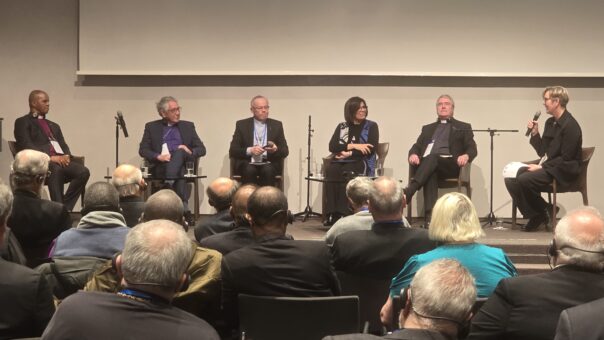
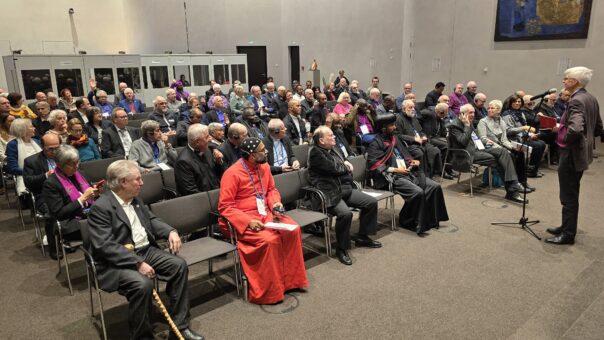 It was in Augsburg, a place soaked in history, that, at the invitation of the local Catholic Bishop Bertram Meier, the 40th Ecumenical Conference of Bishops friends of the Focolare Movement took place from 27th February to 1st March. Sixty Bishops from 26 nations participated, belonging to all the great families of Churches: Orthodox, Eastern Orthodox Churches, Anglicans, Methodists, Evangelicals, Reformed, Catholics of the Latin, Armenian and Byzantine rites. It was the highest number and most universal representation of participants so far, something that stood out for the Mayor of the city, Eva Weber, when she received the Bishops in the City Hall. From the very beginning, the relationship between these Bishops, including two women Bishops of Churches born from the Reformation, was striking. Every Church was welcomed as it is. A simple spirit of fraternity permeated the days, without disregarding the still existing wounds and points of disagreement. Everything was underpinned by that pact of mutual love that has characterized these Conferences from the beginning and that the Bishops solemnly renewed this year too, promising to share each other’s joys and crosses. This gave rise to what some of the participants described as an original kind of ecumenical synodality.