In recent months, Pakistan has been hit by floods that have claimed many lives and destroyed much infrastructure. The Emergency Coordination of the Focolare Movement, through AMU (Action for a United World) and AFN (Action New Families), took immediate action to ensure initial assistance and basic needs were met. The floods’ destructive force caused extensive damage to communities in Pakistan affected, which began to be unleashed on this territory as early as mid-June 2022, bringing a third of the country to its knees. Many consequences still affect the population today. For this reason, the Emergency Coordination of the Focolare Movement, with AMU and AFN, upon learning of the emergency, launched a fundraiser to support the provision of food parcels, clothing and sanitary products to about 500 families in the localities of Nowshera in northern Pakistan; Tando-Alla-Yar and Kotri in Sindh; Sangar in southern Pakistan; and other localities still being assessed. Many have mobilised to respond to initial requests for help and to assess the most urgent needs on the ground. In the face of the ever-increasing number of displaced people, aid shipments were organised in the first few weeks and continue to this day. Despite precarious transportation, most of these families have already been reached. In addition, some members of the Focolare Movement on the ground are directly involved not only in the preparation and distribution of parcels, but also in providing medical care for those who need treatment and medicine to fight primarily typhoid, dengue, cholera and malaria. “On October 16, 2022, we went to a village in Haji Hafiz Shah Goth, about an hour’s drive from the city of Kotri, and set up a medical camp there,” says Fabian Clive, a member of the Focolare community in Karachi. “The doctors there examined 200 people including children, women and men. Most people do not have the opportunity to have regular medical check-ups, either because they are quite expensive or because they do not have access to the city. “Our goal is to set up medical camps in the different areas of Sindh that have not yet had this kind of assistance. There is a widespread call to responsibility and a great willingness to make a contribution.” The situation remains alarming even some weeks later. As water levels drop, the enormous severity of the devastation, compounded by malnutrition and disease, has emerged. The needs of the communities are increasing, changing every day. So carrying out response actions, continuing to embrace this country, is a shared goal. If you too would like to contribute to the Focolare Movement’s Emergency Coordination for Pakistan fundraiser, you can donate at the following:
Contributions for this made to the two current accounts will be handled jointly by AMU and AFN. Tax benefits are available for donations in many European Union countries and others around the world, in accordance with local regulations. Italian taxpayers will be able to obtain deductions and deductions from income according to the regulations governing non-profit organisations, up to 10% of income and to a limit of €70,000.00 annually, excluding donations made in cash.
Going to meet your neighbours, loving them completely, often means retracing your steps, even when you think you are in the right. It means putting your weapons away and preferring acts of kindness.Dad’s return For work reasons, my husband had been away for a whole week which meant that I had to manage four children at home on my own, as due to Covid-19 the schools were closed. In a discontented way, I kept thinking: “Was it right for him to take on so much?” Anxiety started to build up inside me which I knew would burst out when he came back. At a certain point, however, I noticed that our youngest child was carefully preparing a drawing to give to her father when he came home. That kind gesture made me think and it was a real examination of conscience for me: “What about me? How will I welcome him? Will I attack him with my recriminations, listing all the burdens I have had to bear?” That child’s drawing was an opportunity to change direction and to decide, together with the children who were enthusiastic about the idea, to welcome their father with a party, preparing good things to eat and decorating the house. When my husband arrived, he was taken by surprise. Tired, but happy to be home, he said: “You don’t know what it means for me to have a family like this!” (M.S. – Hungary) Healing relationships Years ago my relationship with a neighbour broke down. My efforts to reconcile with him were futile. Recently, I realized that the feast day of the Saint after which he is named was coming up and I had an idea. But first, since he had moved, I had to do some research to track him down. The morning of his name day, a little nervously, I went to his house with a basket of gifts. His wife answered the door with a cordial welcome, “Look who it is! I’m sorry, I didn’t recognize you at first” and she called her husband. I was wondering how he would react. But I could never have imagined his huge embrace as he said: “What a gift you have given me by coming to visit! I was mean to you, but you know, sometimes I can’t control my temper!” In the living room, we had a friendly conversation for about two hours. And when it was time to leave, he offered me some produce from his fields. I thanked God for this meeting that brought joy to us both: only He could instil in me the courage to dare and to believe in the good that is hidden deep in the heart of every person. (E.B. – Italy)
Compiled by Maria Grazia Berretta
(taken from The Gospel of the Day, New City, year VIII, n.2, September-October 2022)
The Second Vatican Council opened on 11th October, 1962.Sixty years later, we reflect on this historic and exceptional event in the life of the Church. “The Council now beginning rises in the Church like daybreak, a forerunner of the most splendid light. It is now only dawn. And already at the first announcement of the rising day, how much sweetness fills out heart.” These are the words spoken by Pope John XXIII on 11th October, 1962 at the conclusion of the solemn celebration in St. Peter’s Basilica, which ushered in a new era. Sixty years have passed since the opening of the Second Vatican Council, an ecumenical Council, that was universal, and a moment of great communion to face, in the light of the Gospel, the new questions posed by history and to respond to the needs of the world. The work of the Council, subsequently continued by Paul VI, lasted until December 1965. Just a month before the closure of this conciliar event Chiara Lubich, Founder of the Focolare Movement, wrote: “Oh! Holy Spirit, through what you have already suggested in the Council, make us become, a living Church: this is our only desire and everything else serves for this”[1]. These words are the fruit of the growing fervour that already animated the Movements and the new pre-conciliar Ecclesial Communities; an indelible sign of that “hermeneutical circularity which, by virtue of the action of the Holy Spirit in the mission of the Church, is established between the magisterium of a Council like Vatican II and the inspiration of a charism, like that of unity”[2]. But today, how should we view this anniversary? Vincenzo Di Pilato, Professor of Fundamental Theology at the Faculty of Theology of Puglia (Italy), tells us about it. Professor Di Pilato, what dreams inspired the desire to hold this Council? On 25th January, 1959, the last day of the Week of Prayer for Christian Unity, starting from the firm decision to convene a universal Council, Pope John XXIII tried to explain his intentions using terms that have become highly significant today, such as: updating, signs of the times, reform, mercy, unity. In the months before the opening of the Council, the Pope expected it to be an epiphany of the Lord (cf. Ex. ap. Sacrae Laudis, 6th January, 1962), which would lead Rome to become a new Bethlehem. As the Magi once did, the Bishops of the whole world would come to worship Jesus in the midst of his Church. Roncalli dreamed of a synodal Church, a Church leaving “the closed enclosure of its Upper Room” (10th June, 1962); a “Church of all, especially of the poor” (11th September, 1962) because the “purpose” of the Council coincided with that of the Incarnation and Redemption, or “the union of heaven and earth… in all forms of social life” (4th October, 1962). Why pause to reflect on this recurrence today? It is not an event like any other, but an indispensable occasion for a renewed awareness before a time of special graces. The Church, perhaps a little overburdened by her two thousand years, is encouraged to return to “dreaming”, that is, to relive that event again today, in the Spirit of the Risen One, with the certainty that He is here and will be “until the end of the world” (Mt 28: 20). What could the synodal process undertaken by Pope Francis mean other than to perpetuate Pentecost at all times and in all places? Moreover, in the period before and, above all, after the Council, the growing vitality of new Movements, such as the Focolare Movement and other aggregations of the faithful and Ecclesial Communities, have fostered a greater understanding of the principle of co-essentiality between the institutional dimension and the charismatic dimension of the Church. It is important to remember this synergy of the Spirit which ensures that the Church is never left alone in the face of the immense challenges that arise from time to time on the journey of history. In a word: the Church is the place of fraternity where the Kingdom of God begins, whose boundaries go far beyond those of the Church herself. Is the “co-responsibility” of the laity in the Church, a word attributable to the Council, still an open path… Yes, it is certainly a discourse in the making and is equivalent to recognizing the fundamental equality of all the baptized; to reviewing the relationship between priests and laity; to appreciating the circularity of vocations; to putting in place all the structures of communion and forms of synodality that are already possible; to focusing on episcopal collegiality and in the presbytery itself (between the clergy and the bishop); to discovering the co-essentiality of ministries and charisms; to promoting full reciprocity between men and women in the Church; to engaging in ecumenical and interreligious dialogue; to opening up an authentic relationship of dialogue with the surrounding world, with culture and cultures, to valuing capacity and willingness to listen, that familiarity with Christ gives us and refines in us; to promoting new attempts to give life to small lively local communities. In a word: to allowing Christ to emerge not only in what we say, but in the relationships we build with each other and at all levels.
Maria Grazia Berretta
[1][1] C. Lubich, Una nuova Pentecoste, from her diary, 11 November 1965, in La Chiesa, edited by B. Leahy and H. Blaumeiser, Città Nuova, Rome 2018, p. 69.[2]Piero Coda, on the occasion of the Convention “The Second Vatican Council and the Charism of Unity of Chiara Lubich”, Florence, 11-12th March 2022.
To be authentic witnesses without ever giving up.Living the Gospel in our daily lives requires us to put aside our fears and go beyond our limits and convictions; trusting in the gifts that God has given us because it is there that our strength lies.No hard feelings The Mass had ended. While Don Carlo, our parish priest, was giving a special blessing to one of the parishioners who had celebrated his 90th birthday that day, I was intent on taking some photographs of the occasion. His sister, who had come from French-speaking Switzerland, was also present at the ceremony. As I left the church, I approached her and asked for her mobile number so I could send her the whole set of photos. She gladly gave it to me, thanking me. Later, while I was out, she rang my house. My husband answered the call and on my return, he said to me: “Why are you talking to her despite everything she did to us?” He was referring to old disagreements between that lady and us. The response that came to me was “Why not? I don’t want to leave this world with a grudge against someone! The truth is that we are all brothers and sisters even if sometimes we forget it.” My husband did not reply, but I saw that it made him think. (Loredana – Switzerland) The exam I live in Florence with four other friends, also university students who, like me, wish to live their lives according to the example given by Jesus. The apartment where we live is very humid and to warm up we use a wood-burning stove. This is not the only difficulty which however becomes an incentive to really love each other. For example, I was preparing for an exam with a colleague who had very different study routines and methods to me. I thought of giving up and suggesting that we study separately. But when I talked about it to the others, they advised me to persevere, to try to understand my classmate better. I realized that I should continue to love him. There were still plenty of tense and discouraging moments but he told me that he liked coming to study with us because he felt there was a different atmosphere. In the end, the exam went well and he wanted to celebrate in a pizza restaurant, not only with me, but with all of us. He said, “We passed the exam because of the way we loved one another but also because of the understanding of your friends”. (Gioacchino – Italy)
Compiled by Maria Grazia Berretta
(taken from The Gospel of the Day, New City, year VIII, n.2, September-October 2022)

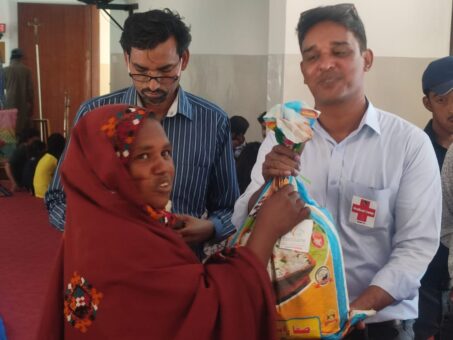
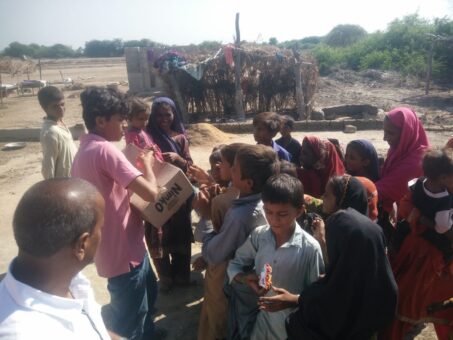 Many consequences still affect the population today. For this reason, the Emergency Coordination of the Focolare Movement, with AMU and AFN, upon learning of the emergency, launched a fundraiser to support the provision of food parcels, clothing and sanitary products to about 500 families in the localities of Nowshera in northern Pakistan; Tando-Alla-Yar and Kotri in Sindh; Sangar in southern Pakistan; and other localities still being assessed. Many have mobilised to respond to initial requests for help and to assess the most urgent needs on the ground. In the face of the ever-increasing number of displaced people, aid shipments were organised in the first few weeks and continue to this day. Despite precarious transportation, most of these families have already been reached. In addition, some members of the Focolare Movement on the ground are directly involved not only in the preparation and distribution of parcels, but also in providing medical care for those who need treatment and medicine to fight primarily typhoid, dengue, cholera and malaria. “On October 16, 2022, we went to a village in Haji Hafiz Shah Goth, about an hour’s drive from the city of Kotri, and set up a medical camp there,” says Fabian Clive, a member of the Focolare community in Karachi.