
“Living Peace”, a peace education project promoting a culture of peace and fraternity, began in 2012. It involves more than 1,000,000 young people, teenagers and children from 130 countries around the world and is inspired by Chiara Lubich’s “Art of Loving”. On 5 February 2022 an online event on Living Peace International’s Youtube channel will celebrate its 10th anniversary. “I was teaching in an American school in Cairo, Egypt, and the idea of contributing to peace and culture developed: it seemed a way of responding to the many challenges in the Middle East.” This is how Carlos Palma, focolarino and teacher, creator of the “Living Peace” project, begins the story. The initiative started on 5 February 2012 with the aim of promoting a culture of peace, fraternity and solidarity. Today, after 10 years, this peace education pathway has developed all over the world. It is promoted by the AMU Association Onlus – Action for a United World, in partnership with Teens4Unity and New Humanity. More than 80 international organisations and more than 1000 schools and groups take part in it, involving more than one million children and young people. 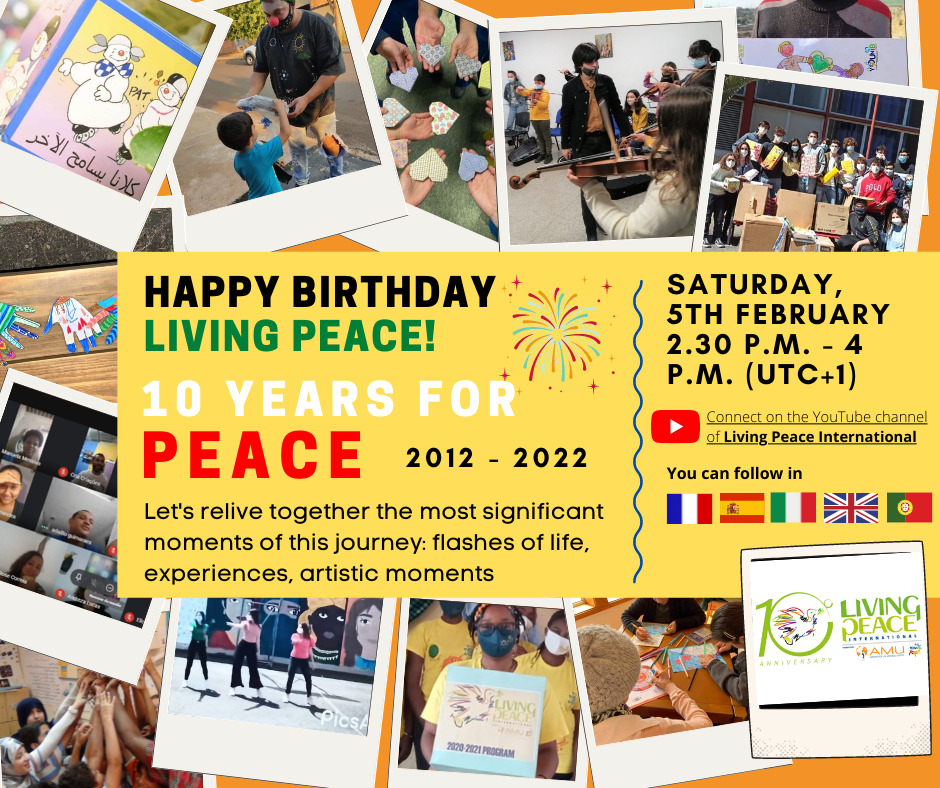 On 5 February from 2.30 pm to 4.00 pm (UTC+1) on the YouTube channel of “Living Peace International” there will be an online event translated in English, Spanish, Portuguese, French and Italian, to mark the tenth anniversary of the project. The “Dice of Peace” lies at the heart of the “Living Peace” project. There are no numbers on the faces of this dice but phrases that suggest ways of building peaceful relationships between all. The dice was inspired by the points of “The Art of Loving”, which Chiara Lubich had proposed to the children of the Focolare Movement many years ago. She too used a dice to explain these ideas.
 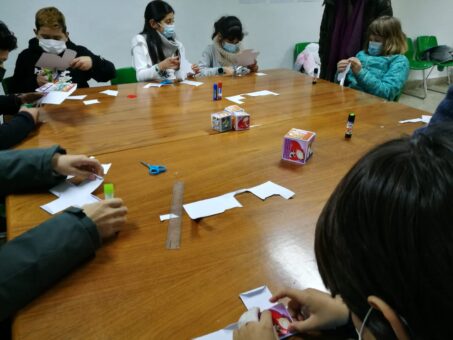 “Time Out” is also offered as part of this project: at 12 noon every day, in every time zone, thousands of people take a moment to be silent, to reflect and to pray for peace. Initially, this project seemed most suited to primary schools but it soon spread to secondary schools and reached universities, youth movements, associations, foundations, prisons, religious communities and art centres, etc. What does peace education mean? The UNESCO Constitution states: “Since wars begin in the minds of men, it is in the minds of men that the defences of peace must be constructed.” Educating for peace is not just another discipline to learn, but rather it means making every educational environment an instrument of peace, a pathway that tries to develop creativity and autonomy in children in dealing with problems and conflicts and learning to dialogue. Educating for peace, therefore, means promoting concrete actions for peace and reconciliation, starting from schools and reaching as many educational environments as possible. “In 2013 I was appointed ambassador for peace by the Universal Circle of Ambassadors for Peace in France and Switzerland,” says Carlos Palma. “Two years later the idea emerged to also appoint young ambassadors for peace ranging from 6 to 25 years old. Today there are 600 young ambassadors in the world who carry the ‘Dice of Peace”’ everywhere. They are protagonists of the most varied activities in many different areas. This project has also become a subject of study in some universities. Thanks to the young ambassadors, the ‘Dice of Peace’ has been created in braille for the participants who are blind. In addition, they have devised the” Peace Got Talent” programme which takes its cue from the television series known in various parts of the world. This gives space to young talented people to promote peace. Then came the pandemic. But in spite of this,” concludes Carlos Palma, “young people have continued and continue in a thousand ways, through the web and social networks, to promote peace and fraternity.” For more information, see this link.
Lorenzo Russo

Great work and continue helping provide awareness in the international global network society