23 May 2022 | Non categorizzato
In this text, Chiara Lubich tells how the pact of mutual love with her first companions led them to experience the presence of Jesus in their midst. We too can have the same experience on condition that mutual love is the foundation. “On one occasion, … I was asked how we understood for the first time that Jesus was present in the midst of two or more united in his name. To answer this question in complete faithfulness to the Holy Spirit, I began by describing what came before that in our history. It was when, for example, we might have been killed by the bombings at any time and we, first focolarine, asked ourselves if there was a will of God that was especially pleasing to him so that we could live it at least during the last days of our life. I spoke of how Jesus’ new commandment was the answer – the commandment of mutual love, based on the measure of the love of Jesus, who gave his life for us. I spoke about the pact that followed: “I am ready to die for you,” “I am ready to die for you,” but then, of course, I explained at length what happened afterwards. Do you remember? We felt that our life had taken a qualitative leap forward, as if a net had lifted us higher; and for the first time, we experienced a peace we had never felt before. This is what we said and what we always say. We experienced a light that gave full meaning to all that concerned us. We had a new and steadfast will in the place of our own which was often so inconsistent in keeping resolutions. We felt a fresh, rare, effervescent joy, and a new, very lively, ardour and zeal… I explained how we had wondered, in those moments, what might have been the cause of all this. And how we understood that, in that moment, Jesus had come into our midst spiritually because we were united in his name, that is, in his love. Our peace, light, ardour, and joy, and so on, were signs of this. In fact, when he is present, there are all these effects; otherwise, there’s no point in fooling ourselves, he is not present. Therefore, I concluded, we understood that he was in our midst when we were able to experience his presence. In fact, believing in his presence isn’t only a matter of faith, believing because he said so. No, if Jesus is among us, we feel that he is present. We can experience this. This is what is so beautiful and great about this particular presence of his, to which we are called.”
Chiara Lubich
(Chiara Lubich, Conversazioni, Città Nuova, 2019, pp. 580/1)
21 May 2022 | Non categorizzato
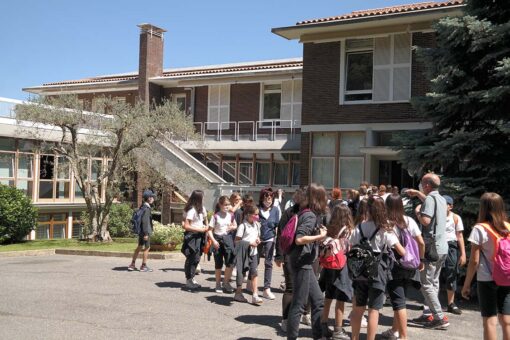
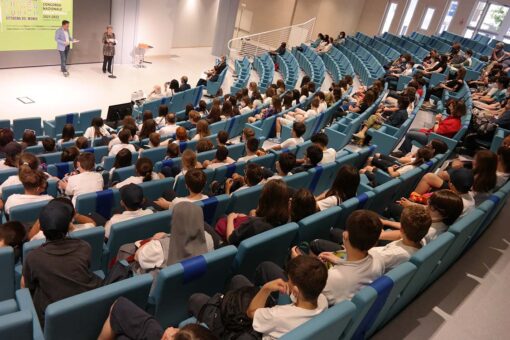
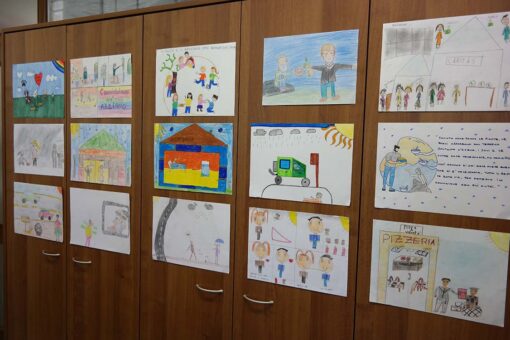
The prizes and some commendations for the Schools Competition, held for the second time, have been awarded. This year over 3,000 students from 144 classes took part. On Thursday, 19th May, the award ceremony for the Italian National Competition “One city is not enough, Chiara Lubich Citizen of the world” was held for the second time. The Competition was organized by the Chiara Lubich Centre in collaboration with the Italian Ministry of Education, the Historical Museum Foundation of Trent and the Focolare’s New Humanity Movement.
© CSC Audiovisivi
© CSC Audiovisivi
© CSC Audiovisivi
Lorenzo Russo
18 May 2022 | Non categorizzato
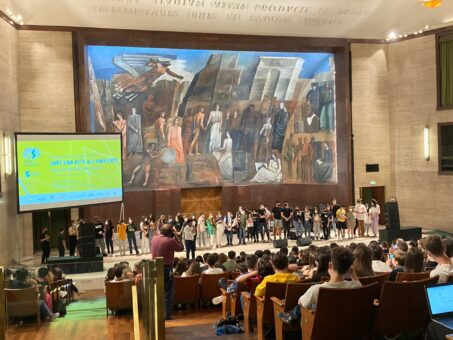
The culmination of a whole year’s activity for the planet, the “A Network for the Environment” event in May 2022, welcomed a hall full of students, together with other colleagues linked online around the world. Over 500 youth filled the splendid Aula Magna of Rome’s ‘Sapienza’ University on Friday 13 May 2022, to celebrate the conclusion of this academic year’s (2021-22) action for the “A Network to Protect the Environment” project. 10 institutes of higher education in the Lazio region of Italy sent representatives, with many other students from different parts of Italy and the world participating online, to review the fruits of their combined efforts. Throughout the year no less than 8,000 students from 89 schools in Italy and 12 other countries, accessed formation in energy saving. They were invited to sign a pact and 200 actions of personal energy saving were recorded. These actions were sponsored by relatives (at 0.10 cents per action), through the DPSAR App, raising money for several solidarity projects in areas of poverty and environmental damage due to climate change. A planetary perspective prompted by simple daily life. We spoke to project coordinator Andrea Conte, a specialist in Astrophysics and teacher of Mathematics and Physics at the Liceo Classico of Pescara, Italy. What do you mean by a “network” for the environment? This program of formation in environmental protection was first developed in Rome in 2008 by educationalist Elena Pace, a member of the Nuove Vie per un Mondo Unito (New Ways for a United World) Association. The original name of the project was “Giving to Protect the Environment” The introduction of the word “network” came about in 2019 and helped take the project to the next level. Each individual class continues to organize activities but is no longer on its own. Each pupil, with their classmates and the support of their family members, continues to act in favour of the Earth, but is now part of a network of many schools doing the same thing. We began by linking up schools within Italy and this network is already spreading beyond. Has radical change been brought about by any of these actions? The natural creativity of the students makes itself felt. One school in Rome, Italy, for example, decided to completely exclude the use of plastic bottles. But they opted for a scientific method to achieve this goal by inventing a form of “plasticometer” to weigh all the single-use plastic in the school. And every time someone discarded an empty plastic bottle, they made a commitment to use a re-usable water bottle or flask in future. Almost immediately they noticed a reduction in the weight of plastic waste, and in a remarkably short time it was reduced to zero. A real revolution. Why do you think interest in ecology is growing amongst today’s youth? Ecology is not something new. Climate change has been talked about for decades. But today’s youth are feeling the effects of a society in continual evolution and are noticing the need to act decisively. As well as continual bad news about the worsening situation, there is also increased awareness, as seen in projects run by local administrations, by individual citizens, by schools etc. Through this, our sense of citizenship grows, the desire to be well-informed and active in helping our own planet to become a healthier place. What is your main message to students today? I am lucky enough to teach a subject I am passionate about and in which I believe. This is truly a great gift. When I was at high school, there weren’t the same resourses available as now, and I’m happy to be able to introduce them to my students. I myself only began to realise the challenges our planet is suffering when I was in university studying astronomy and astrophysics. When you’re detached from the earth’s surface and turn your gaze to the universe out there, it’s then you contemplate the fragility of the Earth. So I always make this comparison to my students, telling them it’s when we detach ourselves from ourselves and turn towards the others that we truly realise how much each of us has to give, each one in our diversity.
Maria Grazia Berretta
17 May 2022 | Non categorizzato
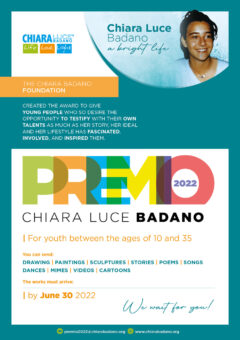
A youth competition dedicated to the young girl from Sassello, Italy, beatified in 2010. The jury, headed by Chiara Luce’s mother, Maria Teresa Badano, will vote on artistic submissions in two age categories: 10-16 years and 17-35 years. The award ceremony will be held on 29 October in Sassello. Applications are open for the Chiara Luce Badano Prize, dedicated to the young girl from Sassello, Italy who was beatified in 2010. The competition invites young people from 10 to 35 years of age, to express through the arts how they have been inspired by encountering Chiara Luce, whose brief life is an example to thousands of young people around the world today. A young woman in love with God. Chiara Luce Badano was 17 when she was diagnosed with a bone tumour, but the infinite love for God was stronger for her. “For you, Jesus. If you want it, I want it too!” She got to know the Focolare Movement while still in primary school, and became one of the Gen (young generation of the Focolare Movement). She didn’t so much speak about Jesus to others, as communicate Him with her life. She used to say, “I don’t need to speak about Jesus, but I must give Jesus through how I behave”. She had received a letter from Focolare founder, Chiara Lubich, proposing, ‘Chiara Luce is the name I thought of for you. Do you like it? It is the light of the Ideal that conquers the world…’ Chiara Luce left this earth on 7 October 1990, at the age of 19, with these last words, “Be happy, Mamma, because I am”, the culmination of suffering lived in the radiant light of faith. In 2018 the Chiara Badano Foundation unveiled the “Chiara Luce Badano Prize”, to promote artistic works inspired by the life and existential model of Chiara Luce, in order to sustain and spread awareness of who she is and her story, and propose her as a model of life for many other young people. Young artists can express all their creativity through visual arts, poetry, story-telling, songs, dance and other forms. All entries must reach the jury by 30 June, as indicated by the rules and directions contained in the prize regulations. The highly qualified jury members, headed by mamma Maria Teresa Badano, will vote on two age categories: 10-16 years and 17-35 years. The 2022 prize will be awarded on 29 October in Sassello during the annual liturgical celebration, when the winning artistic work will be displayed or performed. Full information on the Prize is available on the Chiara Badano Foundation website, where you can also find details of the life of Chiara Luce, known around the world, through video, witness testimonies and photographs. There is a detailed list of the ever growing number of publications covering her life and the Ideal of Chiara Lubich which Blessed Chiara Luce made her own.
Lorenzo Russo
16 May 2022 | Non categorizzato
The new commandment of Jesus, love of one’s neighbour, is what the Word of Life suggests to us for the month of May 2022. It is a journey in which we can progress every day and where we find the fullness of Jesus’ message. “The whole of the Law is summarized in a single command: Love your neighbour as yourself” (Gal. 5:14 JB) This sentence comes from St Paul the Apostle. It is brief, precise, explicit and truly wonderful. It tells us that love of neighbour must be the basis and constant inspiration of the Christian way of life. For the Apostle, the fulfilment of the Law lies in practicing this command. The Law, in fact, speaks of not committing adultery, not killing, not stealing, not coveting…. And we know that those who love do not do these things. Those who love do not kill or steal, etc. Those who love, however, do not merely avoid evil. They are open to others; they desire good and accomplish it; they give of themselves, going so far as to give their very lives for their neighbour. For this reason, Paul writes that, when we love our neighbour, we are not merely observing a single command because — “the whole of the Law” is summarized in it. … If the whole of the Law is summed up in love of neighbour, the other commandments should be seen as means to enlighten and guide us in finding the way to love others in the often complex situations of life. We become aware of God’s purpose in giving us the other commandments, of his will as expressed in. them. He wants us to be obedient, chaste, mortified in our passions, meek, merciful, poor and so on, in order to better fulfil the commandment of love.
Chiara Lubich
(Chiara Lubich, in Parole di Vita, Città Nuova, 2017, pp. 263/4)
