
27 Apr 2022 | Non categorizzato
The “dare to care” theme will once again be the focus of this year’s United World Week on May 1–8, 2022. It’s an opportunity not to be missed throughout the regions. 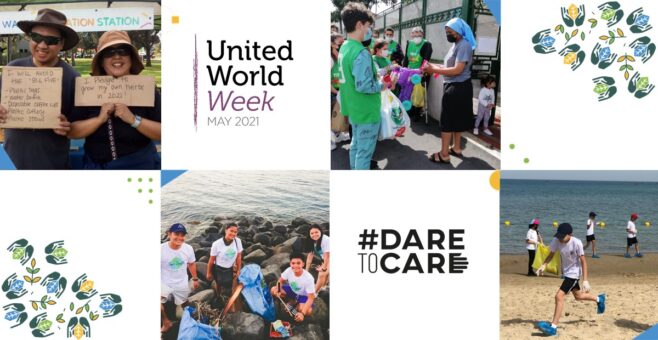 It’s time! We are a few days away from the United World Week 2022, which this year will see thousands of people of all ages, races and creeds involved all over the world. When thinking about this event, typically what comes to mind immediately are young people, large gatherings or events. Yet United World Week is much, much more, because it is not just about young people. Throughout the year there is a wealth of life, with all the different generations of the Focolare Movement and others who work together for universal brotherhood.
 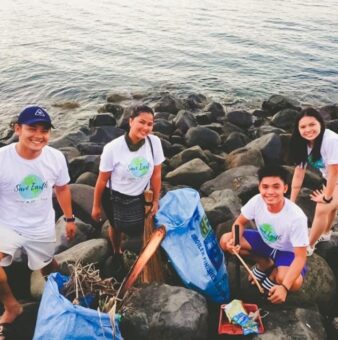 Almost 27 years ago, the Youth for a United World proposed to dedicate one week a year to engage public opinion more actively in the journey towards a united world. I remember the comments, in those days of May in 1995 during the Genfest, trying to figure out what that idea was, what we could do in the year that followed. The answer came in the following weeks and, as always, it came from life itself. The invitation was, and still is, quite specific. The 25 years of history, from the first United World Week in 1996 to the most recent one in 2021, have confirmed this. The first thing to do is to deepen and keep up all the activities that the Focolare communities carry out with courage, and in some cases even silently, to support the journey towards unity in the most diverse contexts. This includes in neighbourhoods, schools, workplaces – situations of fragility and neglect.
 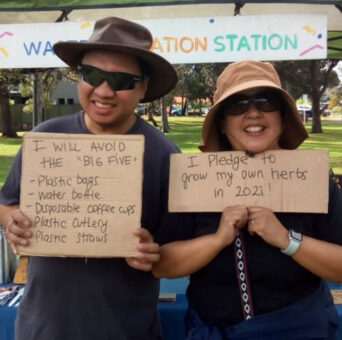 The campaign targets cities, institutions and the media to promote unity and peace at every level, together with all people who are inspired by the same principles and objectives. It is not just young people, but together with those who are older, with the involvement of families, professionals, committed adults, politicians… united by the values of universal brotherhood. Together, by being inclusive, with wide-ranging actions that change and improve the social fabric, we can have a greater impact on world opinion. David Sassoli (1956–2022), the recently deceased former president of the European Parliament, had this to say to Youth for a United World at last year’s United World Week: “I believe that this is a work of civil education that in some way should concern us. It concerns us politicians and institutions, but also of course all the important world of European association. I believe that you in particular are in a privileged position, because you have already defined not only that it is important to take care of others, but also to take care in order to improve the living conditions of others.” This is the care that the world needs. Even in this very special year, on every continent, it has not gone lacking. “Caring for others is an act of courage,” says Jomery Nery, a young Brazilian tax lawyer who is also the director of operations for Anpecom (the Portuguese national association of the Economy of Communion). From Anpecom comes an initiative called Supera (a program for overcoming economic vulnerability). Jomery describes it this way: “Throughout the year we receive messages, emails and other communications from people who need help to eat, to build a house because they live in cardboard housing, for rent, to study or to start a business. Supera is a campaign to collect money, which is then used to help people in need.” It’s a “cure” directed towards fragile situations. In Belfast, too, the capital of Northern Ireland, they have taken this on seriously. For close to four years the city has been hosting an initiative that you could say was both ecological and social, which also takes place in the same way in other parts of the world. It’s called the Repair Café, that is, a bar for repairs, where volunteers are available to fix broken objects that people bring. As they do, they spend a nice morning together. The Repair Café is a real experience, both for the volunteers who fix things and for the people who decide to invest their time and bring an object to be fixed rather than throwing it away. Their motivations behind this are the most diverse, from concern about climate change, to the wish to see a fond object work once more. And with that excuse, relationships and ties are woven, and the strength to face daily challenges is found. In Lecce, Italy, a community made up of families, young people, professionals, artists, together with associations and the parish, works to redevelop a neighbourhood that has become marginalised, difficult and colourless from many points of view. “The first idea was to make the wall of the oratory more joyful and colourful,” says Don Gerardo. “That’s where the idea of the first mural came from, and people truly appreciated it.” Slowly, thanks to word of mouth, and to the young writers present in the area, artists from many parts of the world arrived to beautify the buildings of the Stadio district. With them came photographers, tourists and local administrators who were drawn by the true works of art that these murals represent. Everything is the result of a fraternity that has been created between the artists and the inhabitants of the neighbourhood. It has triggered a virtuous change that everyone feels part of – a true project to help those most in need, which has included activities for economic, environmental and social redevelopment. It is stories like these that give a soul to United World Week. These communities of active people who put themselves on the line will find a showcase from May 1–7, 2022 in many events around the world, both virtual and in person, that will do nothing more than collect and show the life that exists in the various regions. The title once again be #Dare to Care – the same “care” that can still make people repeat what Chiara Lubich said about United World Week in 2002: “It is always something a bit special. It is one of the initiatives that is most in keeping with the charism.”
Paolo Balduzzi
27 Apr 2022 | Non categorizzato
Together for a New Africa (T4NA) is a training course conceived and implemented by young people from several African countries. It aims to teach responsible and participatory government and to equip students to face the key challenges of their continent by promoting and developing a culture of unity. Adelard Kananira told us about this experience of training, tutoring and networking and gave some examples of the results so far. Playing an active role in society and making choices that contribute to the common good of all, right there, where people live. This is the dream of Together for a New Africa, which, involving many young people, intends to rethink a new African leadership, capable of dealing with the multiple challenges of each individual country. Adelard Kananira, a young Burundian, who has lived in Italy for five years and is one of the organizers of the various T4NA Summer Schools, told us about it. After graduating from Sophia University, he works for the Secretariat of the Political Movement for Unity. Adelard, how did T4NA start? Together for a new Africa is a project that was born at Sophia university. And it came from Sophia university African students who thought from the experience they were having, what can they give back to their continent in the light of the culture of unity. They sat together, then they thought they put ideas together and they come up with this project and the first summer school was in 2018 in one of the little towns of the Focolare Movement, Mariapolis Piero which is in Nairobi (Kenya) and is where subsequent meetings also took place. What is the core of this project? Together for a new Africa is a project that was born at Sophia university. And it came from Sophia university African students who thought from the experience they were having, what can they give back to their continent. Initially we did not have a lot of resources and since Africa is very big and presents thousands of faces, we started with some countries of the Eastern Africa, hoping to eventually reach everyone. I remember that during the first Summer Schools, some participants didn’t even want to talk to each other. There were difficulties that led to saying: “We don’t know each other, how can we go ahead?” But surprisingly after spending time together we noticed how, little by little, all the barriers between cultures and tribes disappeared. We have actually witnessed this personal growth, as a group and as one immense continent. What are the results of this project? We can really testify that after three years of summer schools and training courses, there are a lot of results. We have seen some participants go into politics, become activists and leaders and do a lot of things for their communities. They have received many awards and in some countries they have joined hands with other associations to respond to the many emergencies. This not only gives us hope, but shows that the project is growing. And we are proud of it. What are the next steps? Today we concluded our first cycle of 3 years of training course which was amazing. And now we are going to the second cycle, which is going to start at the end of this year. And it will move from seven countries to 14 countries. It’s a challenge. We recognize that, but our dream was and is the whole of Africa. This step ahead is showing us that we can succeed because the young people have taken it on board as their own project and together we can go ahead.
Maria Grazia Berretta
https://www.youtube.com/watch?v=qoNkU2PI5Qo&t=108s
25 Apr 2022 | Non categorizzato
“Go into all the world and proclaim the good news to the whole creation.” This is the word of life that we are trying to put into practice during April 2022. Chiara Lubich’s words also encourage us to be witnesses of the Gospel. How can we bear witness to Jesus? By living the new life he brought on earth, which is the life of love, and by showing others its fruits. With every neighbour I meet, I have to follow the promptings of the Holy Spirit who helps me to “make myself one” with them and to serve them as perfectly as possible. The Spirit gives me the strength I need to love my neighbours even if, in some way, they are my enemies. It is the Spirit who enriches my heart with mercy, enabling me to forgive and understand their needs. It is the Spirit who makes me zealous in communicating, at the right time, all the beautiful things I most treasure in my soul… The love of Jesus is revealed and passed on to others through my love. It is like a magnifying glass that concentrates the rays of the sun. When you hold a magnifying glass over some straw, the concentration of the sun’s rays causes the temperature to rise and the straw catches fire. If instead we simply put the straw in the sun, it does not catch fire. The same can be true for people. They might seem to be indifferent to religion but sometimes – because this is what God wants – when they are in contact with someone who participates in God’s love, they “catch fire” because that person is like a magnifying glass that concentrates the rays, giving them fire and light. With and through this love of God in our hearts, we can reach further and further, and share our discovery with many other people:
Chiara Lubich
(Chiara Lubich in [Words of Life], Città Nuova, 2017, pages 691/2)
22 Apr 2022 | Non categorizzato
An empty tomb, a light that illuminates the world and in its trail, we can build bridges of true unity. Heike Vesper, Enno Dijkema and Mervat Kelli, focolarini from different Christian Churches, tell us about Easter. “Easter is the centre of the Christian faith, it is the mystery of Salvation. Without Easter there is no Christianity. Jesus became incarnate to save us. All Christians believe in the same Jesus Christ who died and rose again.” These are the words that Mervat Kelli, an Orthodox focolarina from Syria, used to indicate to us the fertile ground where nothing ends but everything begins; the tangible space where we can meet, share and be enveloped by the light of the Resurrection. This is the ecumenical meaning of Easter, the inheritance that Christ leaves us. “It’s a time to adore him,” says Enno Dijkema, a Catholic focolarino from Holland. “Jesus,” he continues, “loves us to the point of abandonment to the Father, even unto death. He gives everything! I can safely entrust to him all my miseries, my limitations and everyone’s suffering. There is no darkness that is not overcome by the light of his love.” Heike Vesper, a German focolarina from the Lutheran Church, says that Easter means that Jesus Forsaken “has healed our relationship with the Father. In his cry, in his ‘why’” she says, “I find all my ‘whys’ and my anxieties.” Every resurrection is preceded by a period of waiting, the time to wait as Mary did, under the cross, without knowing what to do. There is the silence and the darkness of Holy Saturday before the dawn of Sunday arrives with the fire, the liturgy of light and the renewal of baptism”. Easter is a time of great communion with one’s brothers and sisters, rooted in an attitude of forgiveness. As Mervat says, “In the Syrian Orthodox Church to which I belong, Easter is called ‘the great feast’. The preparation begins at the beginning of Lent with the consecration of the oil of reconciliation. At the end of the liturgy, each member of the faithful dips a piece of cotton wool in the consecrated oil and goes towards, one by one, to ask for their forgiveness – bringing his or her own and receiving theirs in turn. They draw a small cross on their foreheads and say: ‘I forgive you with all my heart, let this oil be the sign of my forgiveness. I ask you to forgive me.'” The various traditions and the different forms of liturgy represent a great richness, and being able to live them together, as often happens in the Focolare Movement, highlights “the immensity of God Love” as Heike says. She continues, “For some time now, I’ve been living in a community with Catholics, and it is precisely these liturgies that we try to live together if the timetable of the celebrations allows it. So, almost every year on Good Friday we go together first to the Lutheran church and then to the Catholic church. The same thing at Easter.” “For me this is the first Easter in Italy,” says Enno, “but in Holland I have been able to attend the Good Friday service with the Protestant member of my focolare. It was good to do that.” Mervat, who according to the Julian calendar is preparing to celebrate the Orthodox Easter on 24th April this year, has been in Italy for some years now and has the joy of participating in all the services of the Catholic Church with other focolarine. She feels this is a wonderful opportunity: “We still have different dates, but we have the same faith, the same hope, the same Love of God the Father, the Son and the Holy Spirit. We all have the same commandment: love one another as I have loved you. This is the key that opens the door to unity.”
Maria Grazia Berretta
21 Apr 2022 | Non categorizzato
The Gospel speaks of God’s love. Sowing seeds that carry this proclamation and choosing to live it out is an expression of the beautiful, fruitful freedom we have been given. Condominium meeting When notice of the condominium meeting arrived, my first thought was to find an excuse and avoid this commitment. My youngest son, hearing me complain about these meetings that I thought were useless, objected. “But Dad, it’s an opportunity to make the whole building a family!” I hadn’t thought of that. But how could I turn that meeting into something beautiful and new? With the help of everyone in the house, we came up with a guessing game for the tenants’ names, their number of children, type of work… Then we made a plan to set up visits and dinners, plus a list of birthdays and other celebrations. The more ideas came up, the more I looked forward to the meeting. And it was a real party. My wife had prepared sweets, the children had prepared cards to set up visits, and our daughter, who was good at drawing, had prepared diplomas and prizes for the winners. Never had the condominium meeting seemed so short as that evening. A different air was beginning to circulate in the building. M., Italy Dolls After Dad’s death, thinking that Mom could no longer live alone, the question went around us children: “Will we be forced to put Mom in a nursing home?” My family lives in an apartment that is too small to house her. But my wife and I decided to trust in God’s providence, and with this in mind we rented for Mom the apartment next to ours, which in the meantime had become available. It seemed like a gamble, but the arrival of our kids’ grandmother enriched their lives and ours. She was very good at making fabric dolls and started giving them as gifts to those who had children. Then a person from the parish saw this and appreciated them, setting up a market where she could sell them along with other sewing items. Today, Mom’s home has become a small craft centre and a school for those with free time. We are happy to see her joyful and practically rejuvenated in feeling useful. H., France The wallet I was visiting my mother in the small town where she lives. I don’t know why, but before passing by, I felt the urge to have a cappuccino at the bar. Spotting a wallet on the floor in front of the cashier, I asked the cashier whose it was. She questioned the customers present, but the wallet did not belong to any of them. Upon examining the contents, the owner’s name was an acquaintance of my mother’s, so through her I could get it to him. The cashier knew my mother, so she trusted me with the wallet. Not far from the bar I saw the owner. I greeted him, we exchanged a few words and then I asked him if he had his wallet with him. When he realized he didn’t have it, I showed it to him. When I left him, he couldn’t stop thanking me. Later, thinking back to that sudden urge to stop by the bar, I realized that sometimes, unknowingly, we become instruments for doing good. M., Slovakia
Edited by Maria Grazia Berretta
From “Il Vangelo del Giorno”, Città Nuova, year VIII, n.2, March–April 2022.
