17 Mar 2022 | Non categorizzato
A cultural exchange project breaks down the barriers between Haitian migrants and the community of La Romana in the Dominican Republic. The Dominican Republic is a country in the middle of the Caribbean Sea that shares the territory of the island of Hispaniola with Haiti. Historically, it has a cultural value for the entire American continent, since it was there that Christopher Columbus landed on his first voyage. Both countries share cultural and historical roots, but also have contrasts that have separated them for centuries. Haiti is the poorest country in the Americas. Political instability and internal violence have caused thousands of people to migrate to other countries. Every year thousands of migrants cross the border from Haiti to the Dominican Republic in search of a better future, creating tensions between the two nations. “It is estimated that there are about 2 million Haitians in the Dominican Republic. They come mainly to work in the cultivation of sugar cane, because there are several sugar factories here, “says Modesto Herrera, a doctor who is part of the Focolare community in the Dominican Republic. Although there is mutual exchange between these neighbouring peoples, there are also latent tensions and discrimination against Haitians living in the Dominican Republic. One of the biggest barriers is language, because in the Dominican Republic the language is Spanish, while in Haiti Creole is spoken. A few years ago, the Focolare community of La Romana began a project that aims to create bonds of fraternity with Haitian migrants living in neighbouring cities. “We work in the parish where there is a “Batey”, a rural community of sugarcane workers, mainly made up of Haitians,” says Sandra Benitez, a businesswoman. Although many had never visited the Batey because it is a remote area of the city, a group of young people and other members of the community decided to break down the barrier that has divided them for years and began to visit it. They gradually discovered that the Haitian community needed to be integrated into society. La Romana is known for its textile industry. “We saw the potential of young people and decided to work in the textile sector,” says Cristian Salvador Roa, who teaches sewing to the Haitian community. He adds: “It gives me great satisfaction to see that young men no longer wasting their youth, but becoming productive and who start to make the most of their lives by doing something productive.” “The best testimony we can give is that, given the barrier of language, the barrier of social bias, when that barrier is broken, we discover the great wealth that can be found in a culture or that can be found in sharing our human condition with others,” concludes Concepción Serrano, an industrial engineer.
Clara Ramirez
https://www.youtube.com/watch?v=UeyGvKnZJAs&list=PL9YsVtizqrYsxCVExqFc_vvuzCKyNbr43&index=4
14 Mar 2022 | Non categorizzato
Everything passes, even life. Only the Gospel will remain forever, since it is not subject to the passage of time. Today, 14 March 2022, 14 years after Chiara Lubich’s death, we publish this text in which she hands over the Gospel to those who follow her on the path of unity. It is an invitation to live the Word in all our daily activities. A thought constantly comes to mind: “Leave only the Gospel to those who follow you. If you do so, the Ideal of unity will remain. It is obvious that in the time in which you and the others are living, there have been useful concepts, phrases, and slogans that have made the Gospel relevant and applicable in modern times, but these thoughts, these sayings, these almost ‘words of life’, will pass away. When unity among Christians is almost achieved, ecumenism will no longer be a distant goal. When a certain degree of unity has been reached in the world, there will no longer be talk of a global person as an ideal to be pursued. When the predominantly atheistic world is permeated by the reality of God, atheism will no longer be so prominent. The spirituality of unity itself, which is now a medicine for our times, once having achieved its purpose, it will be placed alongside all the others arising from the various charisms given by God to the Church down the centuries. What remains and will always remain is the Gospel, which does not suffer the passage of time: “Heaven and earth will pass away, but my words will not pass away” (Mt 24, 35). This means all of Jesus’ words. I feel that we must certainly adapt ourselves with all our might to the times in which we live, following the particular inspirations that God gives us to bring about and cultivate the kingdom of God in ourselves and in those entrusted to us. But we must do all this knowing that life is transitory, knowing that there is eternal Life announced by Jesus in his Gospel. We must put in second place in our hearts all ideas and ways of doing things that are useful but not purely evangelical, and constantly renew our faith in the Gospel, which does not pass away.
Chiara Lubich
(Chiara Lubich, in La Parola di Dio, [The Word of God] Città Nuova 2011, pp. 112-113)
9 Mar 2022 | Non categorizzato
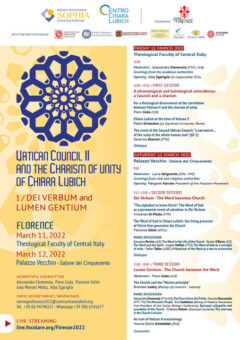
On 11th -12th March 2022, a Conference entitled “The Second Vatican Council and the charism of the Unity of Chiara Lubich” will be held in the heart of Florence (Italy). It is being jointly organized by the Chiara Lubich Center and the Sophia University Institute and can be followed via live streaming in Italian and English. On 11th-12th March 2022, Florence, the cradle of the Renaissance, will host a Conference entitled The Second Vatican Council and the Charism of Unity of Chiara Lubich. Starting with a careful analysis of the conciliar event, the aim is to go to the heart of this itinerary, a moment, that was fixed in history and continued over time. They will be two full days that, thanks to the presence of numerous personalities and experts, will open up a journey of investigation and study, outlining the vital link between the charism of the foundress of the Focolare and Vatican II. There will be three important sessions: A chronological and kairological coincidence: a Council and a charism; The Word becomes Church; The Church becomes Word. Vincenzo Di Pilato, Professor of Fundamental Theology at the Faculty of Theology of Puglia, and Florence Gillet of the Chiara Lubich Center, theologian and expert on the founder of the Focolare, are speakers at this Conference. We asked them about the event. Prof. Di Pilato, what, in particular, will this Conference highlight ? Originally, the conference was part of the centenary celebrations for the birth of Chiara Lubich (1920-2020). However, due to the global health emergency it was postponed until now. The objective was and remains, to probe the productive reciprocity between the charism of unity and the two Constitutions promulgated by the Second Vatican Council, on the Revelation of God and on the Church: Dei Verbum and Lumen gentium. How much have the two documents found a fertile place of interpretation and development in the ecclesial experience aroused by the charism of unity? And vice versa: how much was the flowering of ecclesial life promoted by the charism of unity made possible precisely by the horizon opened by the extraordinary event of the Council? These are the basic questions that will accompany the dialogue between the participants. It should be remembered, however, that it was Vatican II who reiterated this essential unity between hierarchical gifts and charismatic gifts (cf. Lumen gentium, no. 4). Both John Paul II and Benedict XVI went so far as to speak of the “coessentiality” of these gifts, while recently Pope Francis stressed how the action of the Holy Spirit produces “harmony” between the different gifts, recalling charismatic aggregations to missionary openness and synodality. Dr. Gillet, what questions led you to organize this conference? One may wonder if it is too daring to parallel two such different events. What relationship could there be between an ecumenical Council that saw 3,000 bishops and great theologians intervene with prophetic visions for the Church and a charism given to a young woman twenty years earlier, from which a worldwide Movement was born? To answer this, let us first note the harmony in their origin: the Holy Spirit who wanted to speak to the world on the threshold of the third millennium. Then these are two ongoing events that must increasingly fertilize each other: the Second Vatican Council has not yet been fully received, even if its reception is now significantly in progress in the synodal process desired by Pope Francis. The Holy Spirit still has surprises in store. The charism of unity has also yet to reveal all its potential. It must be translated into life in the people of God. In short, it is only at the beginning as the Pope also said during his visit to Loppiano in 2018. Prof. Di Pilato, how can we reread Chiara Lubich’s charism of unity in the light of what is happening in the world today? If the pandemic seemed to be the deadly context in which the conference should initially have been held, the decision to postpone it suddenly catapulted us into another, no less dramatic scenario. In this sense, the paradigmatic experience of Chiara Lubich and her first companions in Trento, during the Second World War, offers us a key to interpreting the conference. Everyone is aware of the role that the Word of God assumed for those young women at a time marked by the collapse of the ideals with which they had grown up. The light that emerged from the pages of that little book of the Gospel that they carried with them during the bombings, guided them to heal physical and existential wounds, to inspire millions of people in the world and to involve them in the realization of God’s dream: universal brotherhood, “that all may be one”. And it was the Word of God translated into social commitment on behalf of the poor and the most needy that generated a living Church, as their Bishop of that time was able to confirm, with amazement and great joy. Even today, while everything seems to collapse again under the blows of a short-sighted and forgetful policy, there is nothing left in our hands but the Word of Life, the only thing capable of regenerating the Church. And it is on this witness of life that the Church can become for the whole world, an authoritative Word of peace and unity. To follow the event via live streaming: https://live.focolare.org/firenze2022.
Maria Grazia Berretta
Press Release Program bochure
7 Mar 2022 | Non categorizzato
The Word of Life for March 2022 invites us to put into practice a phrase we recite every day in the Our Father: “Forgive us our trespasses as we forgive those who trespass against us”. But how can we forgive? Forgive. Always forgive. Forgiveness is not forgetfulness, which often means reluctance to face a situation. Forgiveness is not a sign of weakness, whereby we ignore an injustice we have suffered out of fear of the stronger person who committed it. Forgiveness does not mean saying that something serious is just a trifle or that something evil is good. Forgiveness is not indifference. Forgiveness is a conscious act of will, and therefore, a free act. It consists in accepting our neighbours as they are, despite the wrong done to us, just as God accepts us sinners, despite our faults. Forgiveness consists in not responding to an injury with another injury, but in doing what Paul says: “Do not be overcome by evil but overcome evil with good.”[1] Forgiveness consists in offering the person who has wronged you the opportunity of a new relationship with you. It makes it possible for both of you to start over again and to experience a future in which evil does not have the last word. … You should act this way, first of all, towards those who share your faith – in your family, at work, at school, or in your community, if you belong to one. And you know that even people who live in the same household often hurt one another because of differences in personality, nervous tension, or other causes. Therefore, you must remember that only a constantly renewed attitude of forgiveness can maintain peace and unity among everyone. You will always tend to think about other people’s faults, to remember their past, to wish they were different from the way they are. Instead, you should develop the habit of seeing them with new eyes, of seeing them as new people, accepting them always and immediately and just as they are, even if they do not repent or change. You may say: “But that’s hard!” And you are right. However, this is the beauty of Christianity. In fact, it is not by chance that are you following a God who, as he was dying on the cross, asked his Father to forgive those who had caused his death. Take heart! Start living like this. I assure you that you will experience peace and joy that you have never known before.
Chiara Lubich
(Chiara Lubich, in Parole di Vita, [Words of Life] Città Nuova, 2017, pp. 218-219) [1] Rom 12:21.
4 Mar 2022 | Non categorizzato
Living next door to one another and being strangers. This is what often happens. All it takes is courage and simple actions to begin to really get to know one another. This is what the Scariolo family did. “Meeting other people is mutually enriching – beyond cultures, religions and ideologies. When we do this, we discover that the other person was created as a gift of love for us and we for them.” These are the words used by Adriana and Francesco Scariolo, Swiss focolarini, who have been married for 42 years, to describe a particularly enriching experience they had a few months ago. “We live in Canton Ticino, in the Italian part of Switzerland, and for a year and a half we have been living in a building that consists of thirteen flats. In the days leading up to Christmas 2021, we thought we could go door-to-door to share Christmas greetings. The surprise and gratitude of all the neighbours was great: ‘I was the first tenant to come to live in this building and this has never happened before – it’s the first time someone has come to wish us well at Christmas,’ said one of them. ‘We are Muslims, but we want to wish you a Merry Christmas too,’ added another. We also distributed an invitation to everyone to celebrate the end of the year in our home and to wish them a Happy 2022. So on 29 December we held an aperitif-dinner with three families, one Muslim and two Christian, one Evangelical and one Catholic, respecting safety regulations and wearing masks. It was a nice occasion when everyone got to know one other quite spontaneously. ‘It’s good to know that there are neighbours to help out, to say hello to,’ said the husband of the Muslim woman. ‘It makes us feel less alone.’” Is this something you have done before? “Yes, it’s not the first time we’ve tried to create relationships with other people in apartment blocks. It all started many years ago when we heard about the ‘neighbours’ party’, an initiative proposed to give people a chance to meet each other. We realised that we also needed a bit of courage and imagination to do our part, so we tried. The first thing we did was to take advantage of the new year and put a greeting card in the letter boxes, then, depending on people’s reaction and by making more friends, we organised a lunch in the garden all together before the summer. Then we left that block of flats for a 7-year volunteer programme working abroad. When we came back, since we are in this new building, we wanted to keep up the tradition.” What surprised you about their reactions? “Seeing their smiling faces. They didn’t expect it, especially in such a sensitive period because of the pandemic. It also seemed like a gift to be able to end the last days of 2021 with a moment of socialising after so much isolation, a sign that gives hope and does not dampen the desire to love others and build fraternal relationships. On 2 January 2022, we were waiting for other families who had said they would like to come to us. Due to the social distancing, it was not possible to host them at the same time as the others. Some were affected by covid and therefore could not come, but the dinner with them is only postponed until better times.” What does it mean for you to meet your brother or sister? “It means reaching out to today’s humanity through simple, everyday gestures of love. For example, helping the neighbour who sometimes has problems with the TV, listening to the couple who have just had a baby, breaking down the walls of indifference and anonymity that the pandemic has increased because they are obstacles to relationships. Jesus’ phrase “Whatever you do to one of my least brothers, you do to me” challenges us. So every neighbour is really the person God puts next to us to be welcomed and loved. And who is closer than our neighbours?”
Maria Grazia Berretta
