3 Mar 2022 | Non categorizzato
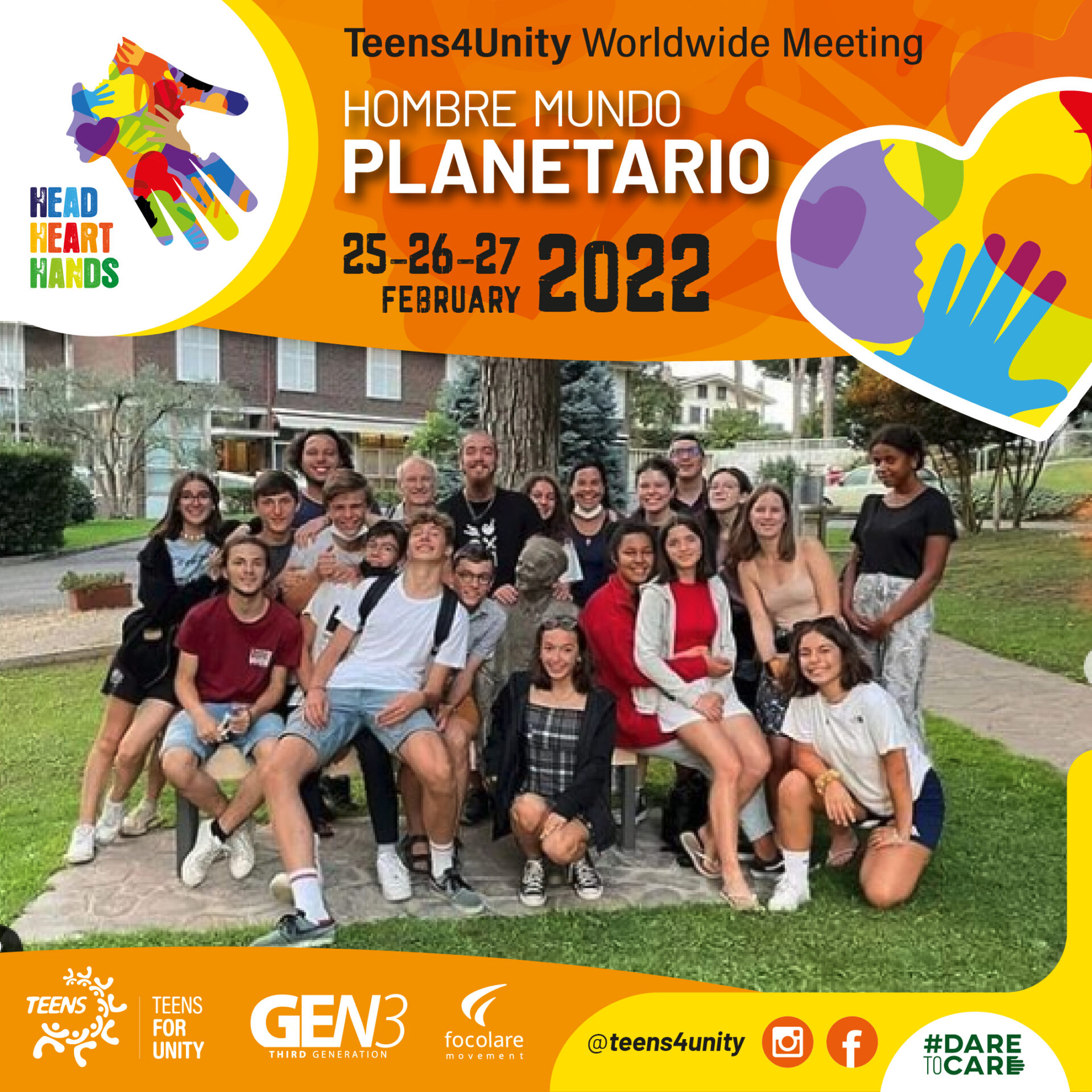
From 25 to 27 February 2022 over 3000 young people witnessed universal fraternity developing active citizenship through local and global actions, committing to the great challenges facing the planet, from peace to environment and the fight against hunger and poverty.  The desire to be together, meeting to build peace, live universal fraternity, take action for the environment and the weakest in society. In the three days from 25 to 27 February the Gen3 who are the adolescents of the Focolare Movement experienced the planetary workshop known as Hombre Mundo. More than 3,000 young people from more than 600 locations around the world took part in concrete actions and were connected through an online videoconference to bear witness to a united world. They were also able to share videos and photos of their experiences through teens4unity social networks. There were numerous messages of peace and solidarity including one from the Gen3 of Siberia, from the city of Krasnojarsk in Russia who sent a message during their Hombre Mundo to say: “we are living for Peace”. A message filled with hope, especially during these days of conflict between Russia and Ukraine. The programme of the planetary workshop was divided into three stages.
  25 February: Our way of life is the art of loving: how have we lived this and can we live it during the pandemic? How can we carrying on loving in the virtual world of social media? “We have understood,” said Samira from Congo, “that we have to accept one another despite our differences, which are of enormous richness. It’s a way of promoting values whilst simultaneously banishing anti-values.” And Élise from France: “in one meeting we were really struck by certain statistics concerning infant mortality around the world, mainly due to the lack of drinking water. So we organised a concert to raise funds to drill a well in Cambodia that would provide clean water for a dozen families for life”. On 26 February, the young people strengthened their commitment to integral ecology and the “Zero Hunger” Objective, to improve protection of the planet in an effective way and drastically reduce hunger and poverty until they disappear. One of the experiences shared was from the Gen3 in Austria for a reforestation project. “The money invested in the tree project was raised during the Fair Play tournament held in Vienna,” they explained. The theme was ‘Fair Play against Climate Change’. About 120 players and 100 helpers took part that day. With the money we raised, we were able to buy around 1,500 trees”. The 27 February was dedicated to the beauty of the encounter between peoples and the common commitment to build a world of peace and unity. A worldwide live videoconference connection enabled over 3,000 young people from 600 different connection points to meet and pray for peace. Then many experiences of peace and unity despite the many difficulties were shared. Like that of a girl in Myanmar, which is going through a very difficult political situation with many families having to leave their homes and take refuge in reception centres. She really wanted to be able to do something for them. “So I made myself available to help the refugees who had been taken in by the church. Even though I was tired, I believed that God was with me, looking at me and giving me the strength to carry on and help others. Now I can say that it was a wonderful and beautiful time for me. It was unforgettable.” In Lebanon, Maria Sfeir, Ambassador of Peace from the Middle East, together with Fouad Sfeir, told how they had “incorporated the culture of peace, educating our children and raising them with good values such as love and giving to build a better society, in an environment of non-violence and justice”. Among the many talks there was also Gen Rosso who were connected from the Italian island of Lampedusa, famous for welcoming migrants: “We are here in Lampedusa to support the wonderful people who welcome those forced to leave their land because of war, hunger and violence. Lampedusa is an island of fraternity, an open port, with people who look towards the horizon and jump into the sea to reach and save those at the mercy of the waves. Lampedusa: lamp, luminous beacon that signals land. Land that means home. From here we want to say: let us always keep the doors of our hearts wide open”. Margaret Karram, president of the Focolare Movement, then gave a message: “You have built the building site with your testimony of life”. (…) Don’t feel alone, know that the Movement throughout the world is with you and supports you. (…) I too often feel powerless in the face of the evil in the world: wars, injustice, the destruction of nature. In these moments it helps me to talk to God. It gives me strength and courage to know that He is with us. The certainty of his love warms my heart, makes me able to love, to forgive, to hold out my hand to build unity with those I meet every day. I feel that only in this way can I be a little artisan of peace”.
Lorenzo Russo
1 Mar 2022 | Non categorizzato
The 2021-2023 Synod convened by Pope Francis is an opportunity to listen to and dialogue with others; a moment to rediscover the true identity of the Church, the “universality” from the beginning. The pathway involves all the dioceses of the world, including the Holy Land. “As we set out on this journey, we are more aware than ever that together, as disciples of Christ on this earth which is his home, we are all called to be his witnesses. Let us remember that his greatest desire is that we are one.” (cf. Jn 17). This is what we read in the letter of 26 January 2022 sent by the Catholic Ordinaries to the heads of the Christian Churches in the Holy Land regarding the 2021-23 Synod which has been convened by Pope Francis and is entitled “For a Synodal Church: communion, participation, mission”. Pierbattista Pizzaballa, the Latin Patriarch of Jerusalem, signed the letter which had the explicit aim of informing and involving brothers and sisters in various local ecclesial communities about the synodal journey that has begun in the Holy Land. He underlined the importance of listening to each other in order to grow closer together on this fraternal journey. Reference was made to the missionary nature of a “universal” Church, in Jerusalem, in particular. During a meeting held on 9 November 2021 after the opening of the Synodal Pathway, the Patriarch had spoken about this with the ecclesial movements and new communities present in the Holy Land. “Our Church, the Church of Jerusalem, began life in the Upper Room at Pentecost, and, even then, it was both local and universal (…) especially in recent years, it has been enriched by many more charisms. For this reason, your presence here is not only a gift and a sign of God’s providence (…), but it is also a contribution to the fulfilment of what God, the Lord, desires.” The participants all listened to each other and spoke of their own experiences. The valuable help of the Patriarch enabled them to better understand how to approach the Synod at a local level. Answering various questions, Mgr Pizzaballa shared his thoughts on synodality which “is a style – he said – a way of being, in the Church, but also outside the Church. It is an attitude. Listening and dialogue are expressions of this (…)”. The movements and new communities – says the Patriarch- need to work in “cross platforms”, going to the heart of the experience of “communion” of the universal Church, the experience that, more than others, seems really difficult to live in the Holy Land. “By communion I mean the awareness of belonging, of having freely received this gift, of having a life that is ‘inserted’ into other lives (…). All this stems from the experience of the encounter with Jesus. (…) after having met the Lord and experienced salvation, you understand that this experience becomes complete and profound, when it is shared in a community (…). This letter sent by the Catholic Ordinaries to the heads of the various Christian Churches in the Holy Land renewed a deep longing in many people and opened up new horizons by underlining the desire to grow in fraternity and be enriched by the wisdom of others. The hope of the Synodal Journey is that we should all experience ‘being together’ in the atmosphere similar to a shared meal where the group not only embraces suffering together but wants to immediately speak of the joys that life offers. It would be like the disciples’ journey to Emmaus. Although they were disappointed and sad, they walked together and, in communion, supported each other until the Risen Lord came to them. An opportunity not to be missed, to recognise him in our midst.
Maria Grazia Berretta
28 Feb 2022 | Non categorizzato
Encountering the Gospel today means finding the living Word of God. Chiara Lubich, through her experience with the first community of the Movement in Trent, makes us appreciate the effects of putting the Gospel into practice. If God speaks to us, how can we not welcome his Word? In the Bible there are 1,153 instances when God repeats the invitation to listen to him. It is the same invitation that the Father extended to the disciples when the Word, his Son, came to live among us. He said: “Listen to him.”[1] The listening that the Bible speaks about, however, is done more with our hearts than with our ears. It means adhering completely to what God tells us, making it our own, obeying him with the same trust as children who abandon themselves into their mother’s arms, letting her carry them. … In this, we hear an echo of Jesus’ teaching when he calls blessed those who hear the Word of God and obey it, [2] and also when he acknowledges as his mother, his brothers and sisters, all those who hear his Word and put it into practice.[3] Jesus said that a person who listens well to the Word is the one who puts it into practice, thus giving a firm foundation to their life, like building a house on rock.[4] In every one of his Words, Jesus expresses all his love for us. Let’s incarnate his Word in our lives and make it our own. If we put it into practice, we will experience the enormous potential for life it brings forth both within in and around us. Let’s fall in love with the Gospel to the point of allowing it to transform us and overflow onto others. This is our way to love Jesus in return. It will no longer be we who live, but Christ will be formed in us. We will experience first-hand what it means to be freed from ourselves, from our limitations and all the things that tie us down. Moreover, we will see the revolution of love that Jesus, now free to live within us, will bring about in society around us. This was our experience at the beginning of the Movement in Trent, during World War II, when we often had to run to the air-raid shelters, taking with us only a small copy of the Gospels. We opened it and read it and, due to a particular grace of God, I believe, those words, which we had heard so many times before, shone out for us with a totally new light. These were Words of life, words that could be transformed into life. … We witnessed the growth of a living community around us, which after only a few months numbered some five hundred people. All this was the fruit of our living contact with the Word, which was constant, dynamic, moment by moment. We were “inebriated” with the Word; we could say that the Word lived us. We would ask one another: “Are you living the Word?” “Are you a living Word?” And that would be enough to increase our swiftness in living it. We should go back to living as we did then. The Gospel is always relevant. It’s up to us to believe in it and experience it.
Chiara Lubich
(Chiara Lubich, in Parole di Vita, [Words of Life] Città Nuova, 2017, pp. 789-791) [1] Mt 17:5. [2] See Lk 11:28. [3] See Lk 8:20-21. [4] See Mt 7:24.
24 Feb 2022 | Non categorizzato
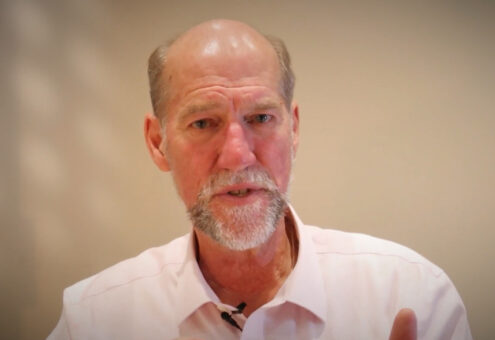
The role of faith communities in limiting climate change and building the future is one of potential, yet humility. Martin Palmer discusses the Faith Plans programme, as well as Focolare’s role. The United Nations Climate Change Conference (COP 26) in Glasgow concluded in November 2021. Martin Palmer, former Secretary General of the Alliance of Religions and Conservation and current CEO of FaithInvest, helps us uncover the potential that faith communities have in limiting climate change and the role that Focolare can play in this context. Martin is an international expert on major religious traditions and cultures, the author of more than 20 books on religious and environmental issues. He is a regular contributor to the BBC and is a lay preacher in the Church of England.
What is the specific role of faith communities in the face of such an unprecedented ecological crisis?
The great faiths are not only sources of ancient spiritual wisdom. They are also among the most important actors on the planet. Without the educational, medical, welfare and charitable work of faith communities through schools, hospitals, youth work, welfare agencies, etc., civil society would collapse in a matter of weeks. 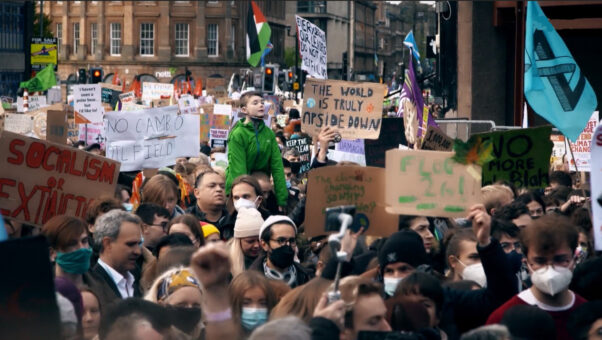 So while the spiritual aspect is vital because it gives us the broader perspective of time, space and meaning, if we ignore our role as stakeholders in building our future, we end up standing on the sidelines, shouting and hoping someone will listen.
An active role for faith communities in driving change is important. Have you noticed a change in attitude in recent years?
I see a huge shift. For the first time, all the major religious environmental groups – like GreenFaith, Eco-Sikh, Daoist Ecological Temple Network, Hazon (the largest Jewish environmental group) and of course now the Vatican through the Laudato Si’ Movement and the Focolare – are working together side by side, bringing the wonderful pluralism of different beliefs, values and networks together, especially through the Faith Plans program.
In October 2021, on the feast of St. Francis of Assisi, Pope Francis and other religious leaders – including Archbishop of Canterbury Justin Welby and Ecumenical Patriarch of Constantinople Bartholomew – issued a call on climate change and a public commitment to create plans for the environment. Why is it important to make a plan?
For faiths to be truly effective, we need not only the wonderful words and wisdom drawn from the great spiritual currents, but we also need to know where they could be architects of change. That means knowing how extensive their role in education is in each place or country, how many clinics and hospitals they have, where their investments are, how much land they own, what range of professional expertise there is in the faith community and so on.
What do you see as the specific contribution of the Focolare in bringing about this ecological conversion?
The role of the Focolare is unique. Not only are you a large organization of laypeople in one of the most hierarchical faiths in the world, you are an inspiration that goes far beyond your members. For decades you have worked through the Economy of Communion on the life and work realities of faith in market practice. Creating new models and initiatives seems to come naturally to you. Your style of sharing what you do is an inspiration. You have decades of interfaith work and a depth and integrity not easily found in the often-superficial interfaith world. Your connections to other faiths show a joy in pluralism not often found in religious organisations of the scale and impact that the Focolare has. Finally, you seem to have already engaged some of the most charismatic, highly motivated, skilled and caring people in the world, who are already active.
Nino Puglisi for cittanuova.it
23 Feb 2022 | Non categorizzato
From 25th to 27th February 2022, “Hombre Mundo”, a global project, conceived and implemented by young people as a way to reach universal fraternity, will take place. Local and global actions to foster knowledge between different cultures and religions, develop active citizenship, show the commitment of teenagers to overcoming the major challenges of the planet, from environment to the elimination of hunger and poverty. 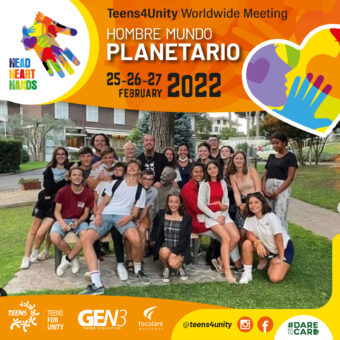 Claire Mulimbi, a Gen 3 (the 10 to 17 year olds of the Focolare Movement) who lives in the Democratic Republic of Congo, was one of the organizers of a two day “Hombre Mundo” event in September 2021. She said, “We understood that we have to accept each other, despite our differences, which can actually turn out to enrich us. It is a way to promote true values and ban false values. It was a very nice experience of sharing cultures through songs, dances, poems and guessing games. Experts came to teach us about ecology and then we planted some trees”. “Hombre Mundo” is a project that involves thousands of boys and girls of the Focolare Movement all over the world. The aim is to learn about universal brotherhood, getting to know young people of the same age from other cultures and religions, discovering and sharing the riches of each people, working together for the major challenges of the planet. But “Hombre Mundo” is not only an opportunity for getting to know one another, it is also based on concrete actions to develop active citizenship for the common good of the communities to which the teenagers belong or by twinning with others. “Hombre Mundo” therefore includes actions at local and global levels alongside international events, such as the one to be held from 25th-27th February 2022. The first “Hombre Mundo” workshop took place in 2014 in Argentina, then in 2017, three were held in Eastern Europe (in Croatia, Serbia and Poland): these were international “laboratory” type workshops, to get to know, love and respect the homeland of others as one’s own. The program is designed and carried out by the young people, from the choice of themes to be addressed to the experiences to be shared, to the lyrics of the songs. This edition should have had two central events, in Kenya and in Ivory Coast and many local events in many countries of the world. For the first time, however, due to the pandemic, it will be completely online . The internet was a great help in the preparation. Gašper Jošt, a Gen 3 from Slovenia said: “We split into smaller groups according to time zone and language. From Slovenia, we met up with Malta and Ireland. We wrote a song together. Miha wrote the lyrics and Anja wrote the melody. Through it, we want to encourage people to continue building a more beautiful world and to say that as long as there is even one person trying, they will encourage others and bring them hope”. The Gen 3 from all over the world have also initiated various concrete actions in order to live out and spread a culture of giving and sharing. For example, useful educational material was sent to the young people of some countries of central-eastern Africa, Vietnam, Indonesia and Myanmar. In India, on the other hand, funds were allocated to prevent child labour, to build safe places where children can participate in activities to regain their self-esteem, socialize with others and develop their talents. Becoming more and more “world” men and women, that is people with a heart open to all humanity, with its riches and its challenges, is the goal of this year’s three days. Each day a theme will be explored. They will start from personal life and then broaden their gaze around the communities in which they live and then to the whole planet. February 25th will be dedicated to the lifestyle that characterizes these young people: the art of loving proposed by Chiara Lubich will be at the centre of their reflections and testimonies, with particular reference to the time in which we are living: how can we live it during the pandemic? How can we continue to love in the virtual world and social media? On the second day, the focus will be on integral ecology and the involvement of the Gen 3 for the “Zero Hunger” Goal, the second of the 17 United Nations Sustainable Development Goals for 2030. On the third day the title will be, “May all be one” and the attention will focus on the beauty of peoples coming together and their common commitment to build a world of peace and unity. Our two international bands will also participate in the 2022 “Hombre Mundo”. Gen Verde will give a percussion workshop that will involve 60 boys and girls from the inter-American region and Gen Rosso will give a concert for peace on 26th February at 12:30 (Italian time), live from the Italian island of Lampedusa, famous for welcoming migrants. Before the concert, at 12 noon (Greenwich Mean Time) there will be a worldwide link-up to pray, all together, for peace. Granville from Bangalore (India) told us, “Every person on planet Earth is endowed with aspects, faculties, abilities and skills that make them a unique work of art. Therefore, whenever we stand side by side, supported by a spirit of unity, we compose an amazing art gallery. What does “Hombre Mundo” mean to me? I believe one word perfectly answers this question: unity. There can be no unity without love. Love is the bridge over the abyss of division. Love breaks down the walls that fragment us and love unite us. It is only through love for my neighbour that I can do my part to create a world in which each of us, works of art, come together to create a synergistic art gallery”. For more information visit teen4unity.org
Lorenzo Russo