17 Dec 2021 | Non categorizzato
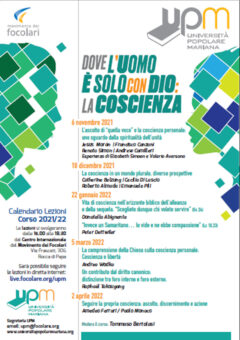
The cycle of lessons of the new course of the Popular Marian University (UPM) of the Focolare Movement was inaugurated on 6 November 2021. This year the title is, “Where man is alone with God: conscience”. Catherine Belzung, neuroscientist and Emanuele Pili, lecturer, will give the second lesson. Here they answer some questions. “Conscience is the most secret core and sanctuary of a man. There he is alone with God, Whose voice echoes in his depths.” These words from the Pastoral Constitution Gaudium et Spes inspire the title of the new course of the UPM (Popular Marian University) of the Focolare designed for the 2021-2022 academic year: “Where man is alone with God: conscience”. On 6th November, during the first lesson of this cycle, Renata Simon, co-responsible for the aspect of Wisdom and Study of the Focolare Movement, described moral conscience as a “holy” space. She said, “Conscience does not close man into an impenetrable solitude, as in an isolated cell, but opens him to the call of God”. Analyzing the theme in its various forms and in the context of the spirituality of unity, reflecting on the ability to act according to the responsibility of each person to enter into dialogue with themselves and with this voice, are just some of the objectives that this course aims to achieve. Catherine Belzung, a neuroscientist and Professor of the “Imaging & Brain” Department of the François Rabelais University of Tours (France) and Emanuele Pili, Adjunct Professor of the Department of Theology, Philosophy and Human Sciences of the Sophia University Institute, agree that this is a great challenge, especially in today’s world. They are both speakers for the second lesson which will take place on 18th December, on the topic: Consciousness in a pluralistic world, different perspectives. The lesson will deal with psychological aspects in relation to moral conscience, introducing the question of freedom and its possible conditioning, which will be examined more closely in the third lesson. “Each of us finds ourselves having to choose according to values and we find this in various disciplinary perspectives”, explains Catherine Belzung. “What often varies are the concepts and the language used. In neuroscience we speak of ‘decision making mechanisms’, in other fields of ‘moral conscience’. We must engage in dialogue to understand if the various words used correspond to a common concept”. Are we neurologically conditioned in acting or are we free? Catherine Belzung affirms, “We are completely free people”. Some research has been misinterpreted and identifies man as a puppet in the hands of his own genetic material, of his own brain. In reality, we are not determined by our biology”. Understanding what hinders listening to oneself and listening to God’s voice in a noisy reality like the one in which we live, seems to be the real question. According to Emanuele Pili, “The time in which we live is so noisy and frenetic, that at times it is like having a suffocating hood around our most intimate and authentic desires. The pervasiveness and omnipresence of technology change the very process through which personal identity is formed. Therefore, there is a real challenge to listen to our most inner part which is not easy to deal with”. How can we get out of this impasse? Emanuele Pili continues, “I believe the point lies in finding a way to pierce the hood that tends to hinder the possibility of returning to ourselves. I think that a lot has to do with the rediscovery, also helped by the experience of the pandemic, of real and simple relationships, lived in their corporeal and emotional dimensions, capable of leaving aside superficiality and mediocrity (…) Rediscovering our interiority and the desire that animates it, is the serious (…), game of everday life. Perhaps, today, piercing the hood that prevents us from accessing our interiority also, and above all, involves knowing how to listen to this cry, which is sometimes mute or stifled, of which for example younger people are, in good and in bad, the most lively and effective testimony”.
Maria Grazia Berretta
Poster in PDF
17 Dec 2021 | Non categorizzato
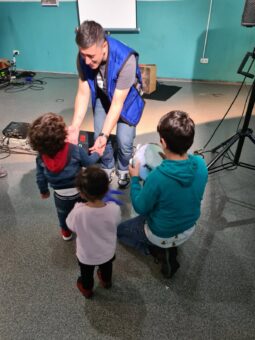
The international band, “ Gen Rosso”, travelled to the Balkans. There, thousands of migrants live though tragic situations as they try to reach Europe in search of a better future. This journey inspired Gen Rosso’s Christmas concert, entitled “Refugee”, which will be streamed for free. 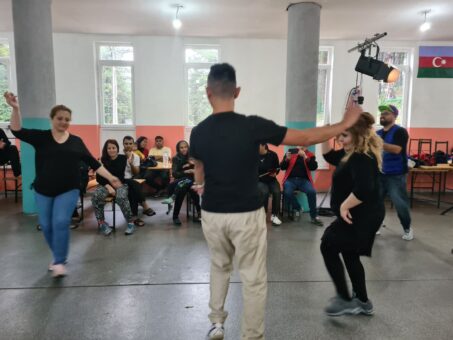 “We are tired, very tired of living in these conditions, but today we have rediscovered and experienced joy”. These are the words of Mariam, visibly moved, in thanking the international group Gen Rosso at the refugee camp in Bosnia, after a day spent together. Mariam is Iranian and together with other migrants she lives in that refugee camp because she is looking for a better future, where there are no wars, hatred or persecutions. Thousands of refugees like her are stuck in the cold, the freezing cold, in the so-called “Balkan route”, with the hope of reaching Europe.
 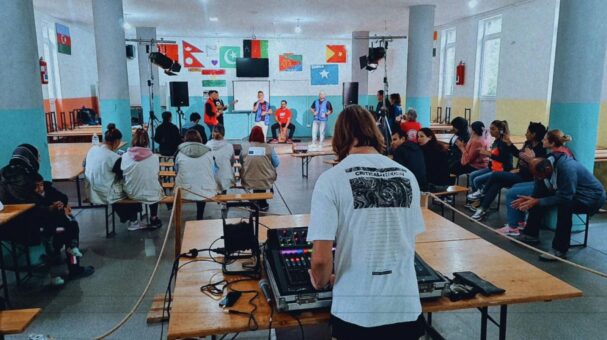 Gen Rosso went to Bosnia in October 2021 to bring relief and hope to these migrants through art, music and dance. They went to a refugee camp run by the Jesuit Refugee Service (JRS) which provides essential accommodation and aid to asylum seekers and migrants attempting to cross the Croatian border. The Band told us, “We didn’t have the slightest idea of who or what we would meet but we wanted these people, who find themselves painfully wandering for years, to experience fraternity”. Migrants need not only food and clothing but also moments of welcome and serenity. At the beginning, “we found ourselves under the questioning and somewhat suspicious gaze of families who kept their distance. It was not easy to start with people from different cultures and traditions, accustomed to indifference and hostility”. It was the children who broke the ice. They were attracted by Ygor playing a Brazilian tambourine and wanted to try. Little by little everyone gathered courage. Michele, lead singer of the Band, said, “Who knows what these children have experienced and what they carry in their hearts. A nice atmosphere was created right away. The fact that the children were present, with their immediacy and simplicity, helped a lot”. Thus began the first dialogues. What is your name? Where are you from? And mistrust gave way to trust. The Band said, “We had planned to divide into small groups, but we understood that they all wanted to stay together and after a long time, to celebrate, with songs and dances of individuals and groups, according to their own traditions. When some mothers wanted to show us a typical dance, they left their babies in our arms, with the trust that is usually given to brothers”. Helânio shared this experience, “A refugee with a wounded leg grabbed my drum, his eyes were shining, it was almost his only way of expressing himself. I was happy to give him this opportunity”. Raymund, one of the dancers, shared, “A woman asked if she could dance. She could feel that someone appreciated her. I understood what it meant to go towards them through music, which can rebuild people’s souls; it was evident in their shining eyes, that they were happy”. It was an unforgettable experience, that has inspired the upcoming Christmas concert that Gen Rosso have entitled “Refugee”. It will take place on 18th December 2021, at 21:00 (UTC + 1), at the Loppiano auditorium. You can buy tickets here or at the auditorium. It will be streamed free on the public.la web platform. It will be an evening specially dedicated to bringing relief, peace and hope to all those who find themselves in situations of suffering and hardship.
Lorenzo Russo
16 Dec 2021 | Non categorizzato
Mary, after welcoming the power of the Most High, hurried to her kinswoman Elizabeth, her heart full of joy. This is the first missionary action by the Mother of God after she pronounced her “yes”. She goes out towards another person bearing good news. Christmas is a time we too can bring this same good news to the world with a generous heart. The puddle We’ve reached a stage in our family where my children seem to have lost any sense of proportion and respect, all in the name of personal freedom. One day I walked out of the house to try to calm down and avoid reacting sharply to them. As I often do, I started reciting the rosary. That got me thinking of Mary. She too was a wife and mother. She had silently pondered everything in her heart, including her pain and sufferings. This prayer and reflection began to break through my negativity, bringing me some peace and the strength to go back home and try to introduce some of that serenity there too. As I was walking back towards the house, I noticed the sky reflected in a puddle. That’s what I felt like: a puddle which can reflect a part of the heavens. And that image was all I needed to find new joy once more. (F.A. – Albania) Together My husband and I had agreed that he would stay at home after work to be with our son John, who has Downs Syndrome, so that I could attend a regular parish meeting which was really important to me. After a while, however, I noticed that taking it in turns so often to care for our son seemed to be having a negative impact on his behaviour. So one evening I decided to miss the meeting in order to stay in with him. When he realised that the three of us would be staying at home together, his challenging behaviour improved greatly. As I got supper ready, he came to tell me, “I’m sorry I’ve been naughty, Mom. Let’s start again.” He was referring to something he’d done the day before and I knew he meant “Let’s start to love each other again”. I was pleased he was aware of what he’d done wrong. My husband heard his apology too, and family harmony was restored all round. We had a really lovely evening together. When John went to bed that night, we both saw how happy he was. (R.S. – USA) In hospital I’m a volunteer hospital visitor. One morning I went to greet one of the older patients and asked if he’d like to receive the Eucharist. He shook his head laughing and replied, “It’s a very long time since I last received Communion…”. Undeterred, I suggested perhaps he’d like to say a few prayers, to which he responded, “Yes, OK, but you’ll have to help me, because I’ve forgotten them all!” I started, and he repeated after me, phrase by phrase. When we’d finished, he turned to me with a smile and said, “That was very moving”. It showed me never to be put off by appearances. We parted company with the warmest of greetings. (Umberto – Italy)
Selected by Maria Grazia Berretta
(from Il Vangelo del Giorno, Città Nuova, year VII, n. 4, November-December 2021) Foto © Joachim Schwind – CSC Audiovisivi
15 Dec 2021 | Non categorizzato
For more than 25 years John and Julia Mundell have worked for the protection of the environment. Their company, Mundell and Associates, began repairing damage and reversing trends of hazardous waste in Indianapolis. Nowadays, their work is known all over the United States and in other countries. Working to preserve the earth is for them a vocation to build unity and an answer to preserve our common home for the next generations. https://vimeo.com/651033127
14 Dec 2021 | Non categorizzato
At the beginning of 2021, following the General Assembly of the Focolare Movement, the Abba School (the Study Centre of the Movement) started off again with a new organization. To find out more, we interviewed its Coordinator, Mgr. Piero Coda, first Dean of the Sophia University Institute in Loppiano (Italy) and recently appointed by Pope Francis as Secretary General of the International Theological Commission. You were in the first group that Chiara Lubich invited to form the “Abba School”. What are the objectives of this Study Centre? What was your intellectual and spiritual experience in contact with her thought and life? It was most certainly a special gift from God to find myself at the beginning of this experience with Bishop Klaus Hemmerle, as early as 1989, before the Abba School officially began in 1990. From the beginning, the purpose that Chiara entrusted to this unique Study Centre was to study and explore the theological, cultural and social implications of the charism of unity. But first of all share the experience of living the Gospel of Jesus in the light that springs from the charism. This is so important, that one of the last things  that Chiara said to the Abba School in 2004 was this: “Be a cenacle of holiness!” This is the gift and aim of the Abba School: to learn to live our life, including the way we think, in that space to which we come through the presence of the Risen Jesus alive among his people, that place which is the life of God, the bosom of the Father. In accordance with the Gospel and the faith of the Church, Chiara teaches us that this life is the very life of the Most Holy Trinity, not only in Heaven, but among us: “on earth as in Heaven”. For me it was and continues to be a unique experience. I could describe it with the words of the first letter of John: “my eyes have seen, my hands have touched, my ears have heard … the Word of life”. The senses of your soul are turned on and experience the light of Jesus Forsaken and Risen, through which to look at reality in a new way. In this way, more than before, theology has become dynamic and fascinating for me. At the same time, since there are experts in all disciplines in the Abba School, who strive to live unity even when they share their thinking, the horizon of “inter & trans-disciplines” has opened up. What I mean by this is the discovery of the root and the common goal of all forms of knowledge which are called to dialogue with each other in a very practical way. The theology in which I engage has been extraordinarily enriched in this dialogue, conducted not only at an interpersonal level, but also at the level of relationship between the disciplines. The Abba School has recently undergone further development. You became its Coordinator in March 2021. Can you tell us in what this development consists? The Abba School has existed for over thirty years and during this time it has developed in a very rich way. Over time, almost 50 people have been part of it and until 2004, Chiara was always present with a fundamental role. Then, groups related to the various disciplines grew up around the various members: psychology, sociology, politics, economics, natural sciences, art, dialogue … at the moment these groups involve over 300 people around the world. In conjunction with the General Assembly of the Focolare and as the fruit of a whole journey of community discernment, we realized that in recent years, the “flower” of the Abba School has blossomed in “four petals” and so we tried to give these a homogeneous and at the same time distinct, configuration, which recognizes and promotes this development at the service of the mission of the Movement. One “petal”, (about fifteen people), is made up of those who are called to continue the specific study of the charismatic and cultural significance of the event of ‘49 as a special expression of the charism of unity in the experience lived by Chiara, Foco (Igino Giordani), the first focolarini and then gradually by all those who participate in the charism. We conserve a precious testimony of this event of grace, written by Chiara herself. A second “petal” is the one engaged in the transmission of this patrimony of light and doctrine to the new generations: a group of 27 young scholars, with different disciplinary skills, from all over the world. A third “petal” is made up of those who have been members of the Abba School and continue to be part of it (29 people), with a view to carrying out research projects inspired by the charism and at the service of the Movement, based on their respective skills and experience. Finally, the fourth “petal” is that of international groups according to different disciplines. What projects do you have in mind for the future? We have some projects in mind and are discerning together which ones to undertake and in what way. There are already some interesting things on the horizon. The first is that of giving shape to a “lexicon” of the life of unity: a kind of “guidebook” in which the main ideas emerging from the charism of unity are presented in a universal way, enriched by the light of the experience so far. A second thing is to offer a contribution, starting from the uniqueness of the charism, to the synodal journey of the Church that Pope Francis has recently launched. We believe that there is something important here: in 1949, Chiara said that the “Soul”, this new subject, both personal and communitarian, which is born from the Pact of Unity, is “presented as Church” and is welcomed into the bosom of the Trinity. The Synod, in fact, is the expression of the Church that walks side by side with everyone, starting with the poorest and most rejected and all those in whom we recognize the face and cry of Jesus Forsaken. Then there is the great anthropological theme that challenges our time: in particular, the relationship between people and especially between male and female and between different cultures. And finally, the relationship between religions: a sign of the times and a specific purpose of the charism of unity. A member of the Focolare might ask, how can I participate in the Abba School? The whole Movement is Abba School! Chiara once said, the Movement was born as a school. In the Abba School, and therefore in the Movement, it is a question of placing oneself in the particular school into which God led Chiara, Foco and the first focolarini, in particular in ‘49. The commitment, therefore, is that the Abba School is not a house with closed doors: it is full of open windows and doors, so that everyone can participate. For example, we are having an experience in Loppiano in offering some insights regarding how to participate in this light for everyone. It is extremely positive: also because this light, when it reaches people in different situations, with different skills and different sensitivities, arouses joy and creativity. The Abba School is not a one-way reality: in the sense that it starts only from the light that is offered. No! The light goes out and returns enriched by the experience, by the questions, by the solutions that the life of Chiara’s people acquires and contributes. So, it is a virtuous circle, which must be effectively activated and promoted more and more.
Carlos Mana
