13 Dec 2021 | Non categorizzato
Every year, as we await Christmas, we hear the invitation to “prepare the way for the Lord”. (cf Is. 40:3. God, who has always shown a burning desire to be with his children, comes “to dwell among us.” In this passage Chiara Lubich suggests how to prepare for his coming and to open our hearts to Jesus who is to be born. We ourselves often feel the desire to meet Jesus, to have him at our side as our travelling companion in life, to be filled with his light. In order for him to enter our lives, however, we must first remove the obstacles. It is no longer a question of paving the way, but of opening our hearts to him. Jesus himself names some of the barriers that close off our hearts: “theft, murder, adultery, greed, malice, deceit, licentiousness, envy, blasphemy, pride…”. (Mk 7:21-22). Sometimes it is resentment towards relatives or friends, racial prejudice, indifference to the needs of those close to us or lack of attention and love in the family… (…) How can we concretely prepare the way of the Lord? By asking for his forgiveness each time that we have put up a barrier that prevents us from being in communion with him. This sincere gesture of humility and truth allows us to stand before him as we are, acknowledging our fragility, our mistakes, and our sins. This is an act of trust by which we accept his fatherly love, which is “merciful… and abounding in kindness” (Ps 103:8). It expresses our earnest desire to improve and to begin again. Then at night, before going to sleep, we might stop for a moment to take stock and see how we did and ask for God’s forgiveness. If we are Catholic, when we gather to celebrate the Eucharist we can be more aware and fervent in the expression of contrition repeated at the beginning of the liturgy. It is the moment when together as a community we ask for forgiveness for our sins. Then individual confession, the sacrament of God’ forgiveness can be of enormous help. It is a moment of encounter with the Lord when we can hand over to him all our mistakes. We leave confession with the certainty that we have been saved and made new, and we experience the joy that comes from discovering that we are true children of God. And God himself, through his forgiveness, is the one who removes every obstacle, who “makes straight the highway” and establishes a bond of love with each one of us again.
Chiara Lubich
(Chiara Lubich, in Parole di Vita, edited by Fabio Ciardi, Cittá Nuova, 2017, p. 766-768)
10 Dec 2021 | Non categorizzato
The beatification process of Alberto Michelotti and Carlo Grisolia completed its diocesan phase on 8 October 2021. Their story tells of a shared journey in true friendship. How can we become “saints together”? It’s not easy. It takes time, for sure, and above all a commitment to travel in the same direction, focussing on the same source of light. This is the story of Alberto Michelotti (Genoa, 1958 – Monte Argentera, 1980) and Carlo Grisolia (Bologna, 1960 – Genoa, 1980), two young Italians, very different in many ways but linked by a great friendship and a shared desire to keep God at the centre of their lives. The charism and ideal of the Focolare Movement drew them both and forged true sharing and fraternity between them. They both departed this life in 1980, just 40 days apart: Albert in a mountain climbing accident, Carlo in hospital of a tumour. These two friends are united in a shared process of canonization, launched in 2005 by Cardinal Tarcisio Bertone, Archbishop of Genoa. The diocesan phase just concluded on 8 October 2021. So who are these two young men? Alberto was a natural leader and a “winner”. But his leadership was always in the spirit of service, attentive to those around him, especially the most needy and the youth. Born and raised with his family in the port of Genoa in northern Italy, he attended the parish of St Sebastian with his parents. He was active in many aspects of parish life, including Catholic Action and later, through Rev Fr Mario Terrile, he encountered the spirituality of Chiara Lubich. He was overwhelmed by this. During the Focolare’s summer Mariapolis meeting in 1977, Alberto embraced the ‘good news’ which transformed his life for ever, the reality of “God who is Love”. The same year he became an active member of the Gen Movement, the “new generation” of the Focolare. Here he met Carlo and found a profound unity, overcoming the barriers caused by their very differing characters. Carlo was a shy and poetic young man. A student of agronomy, he loved reading, playing the guitar and writing songs. He was a dreamer, quite unlike the mountain-climbing, rational, mathematical engineering student, Alberto. And yet they shared a great desire to communicate the Gospel ideal of a united world with joy and enthusiasm. And to put into practice Jesus’ message “Where two or more are united in my name, I am in their midst” (Matthew 18:15-20). Carlo had known the Focolare since childhood through his parents. He drew from the spirituality the ‘strategy’ of “becoming saints together”. When Chiara Lubich launched this invitation to the youth, Carlo took it to heart, at the time his family transferred to Genoa. The Focolare founder called Carlo ‘Vir’, meaning “true person, strong person”, and Carlo took this as a guiding principle for his life, drawing his strength from Jesus, the only possible source of energy, as he wrote in one of his songs: “Breathe in the air the love which comes from the new sun which opens up on you”. The friendship between these two young men lasted just 3 years. But the sharing and understanding of their own life experiences indicate a maturity beyond their years. In their quest for authentic Love, they each discovered purity as an instrument to achieve true freedom. And they shared this ideal with their friends. We can see reflections of their deepest thoughts in letters they wrote, long before social media was available. “This is likely to be your military service year”, Alberto wrote in a letter to Carlo on his 19th birthday. “New difficulties and new joys. A bit like today which began with a beautiful blue sky and now by 4 in the afternoon has transformed into wintery grey. But anyway we know that beyond the clouds the sun is surely there”. Alberto and Carlo mirrored one another, recognising each other’s joys and fears, struggles and successes. Trusting in the Love that can achieve everything, they were ready to live the Gospel passage: “No-one has greater love than to give their life for their friends” (John 15:13). Alberto lost his life in the Cuneo mountains on 18 August 1980. He fell during a climb along a glacial gully in the Maritime Alps. Carlo was not able to attend the funeral. Two days earlier, he had been admitted for tests after some episodes of fainting and paralysis of the limbs. The results were unequivocal. The doctor did not hide the seriousness of the situation from Carlo and he was immediately rushed into hospital with advanced cancer. While there, he was told of Alberto’s fatal accident. Only 40 days would separate the two friends before they were reunited in eternity. From his hospital bed, in his last days, Carlo greeted all his visitors with a huge smile, despite being so weak. “I know where I’m going,” he said to a nurse, “I’m going to meet one of my friends who left us a few days ago in a mountain accident”. Carlo felt Alberto’s presence beside him as he looked to his own “leap into God”, as he described it to his mother in hospital. He made that leap into eternity and the home of the Father on 29 September 1980. Today, 40 years on, the ties of friendship between Alberto and Carlo seem as strong as ever as they move into a new and quite extraordinary phase. Never before in the history of the Church have two distinct processes of beatification been considered alongside each other and for two friends. Of course, they cannot be declared blessed or saints until two miracles through their intercession have been verified. But given that they are being prayed to together, they can only be “saints together”. This indicates that a spiritual friendship can be a pathway to holiness. In their lives we perceive the fulfilment of that phrase “thy kingdom come … on earth as in heaven” and such true joy, fruit of a prophetic inspiration expressed by Chiara: “I pray you will become saints, great saints, and soon. In this way, I’m sure you’ll find true happiness”[1].
Maria Grazia Berretta
[1] Chiara Lubich’s message to “GEN”, Anno XV (1981), n. 4, p. 2-3
8 Dec 2021 | Non categorizzato
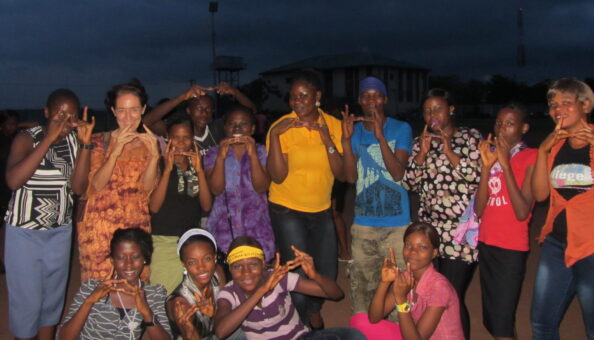
Always ready, always available, close to everyone and at the same time able to see the global perspective. A Councillor at the International Centre of the Focolare Movement since 2014, she left this earth on 5th December.
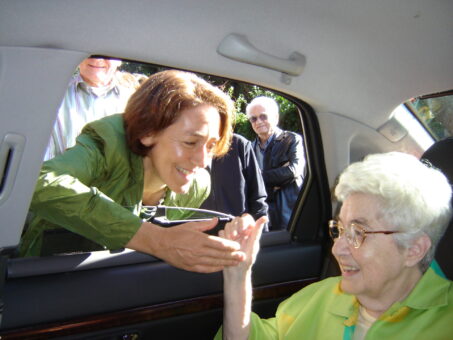
Friederike Koller with the Focolare founder Chiara Lubich
Friederike with young people in Nigeria
Anna Lisa Innocenti and Stefania Tanesini
6 Dec 2021 | Non categorizzato
We are in the liturgical season of Advent. So, a time of waiting, of preparation for Christmas, a time for being alert and praying. But how can we do this? Here too, we are helped by circumstances, by the brothers and sisters who fill our days: the love we can give will be our prayer, welcomed by Heaven. “Be alert and pray” (…). these few words hold the key to facing the most dramatic events in life, but also the inevitable trials of every day. However, we are immersed in the frenetic and all-consuming pace of modern life, so how can we possibly avoid being lulled to sleep by many “siren songs”? And yet these words of the Gospel are meant for us too… Even in times like these, Jesus cannot ask us to do something that is beyond our capabilities. Along with this exhortation, he must necessarily show us how to live in accordance with his word. So then, how can we stay awake and be on our guard? How can we always have a prayerful attitude? We might have made every effort to shut out everything and everyone as a means of self-defence. But that is not right, and it is not long before we realise that, sooner or later, we have to give in. The path to take can be found in the Gospel and in human experience itself. When you love someone, your heart is watchful, always waiting for that person. Every minute that passes is spent for that person’s sake, watching and waiting. A person who loves is watchful. Being watchful is characteristic of love. … This is the attitude of those who love Jesus. They do everything for his sake. They find him every moment in the simple expressions of his will, and they will meet him solemnly on the day he comes. … The smile we give, the task we carry out, the car we drive, the meal we prepare, the activity we are organizing, the tears we shed for one of our brothers or sisters who is suffering; the instrument we play, the article or letter we write, the happy event we share cheerfully, the dress to be cleaned… If we do all these things out of love, they can all become a prayer. To be alert and pray always, we need to be anchored in love, to love God’s will and every neighbour he puts beside us. Today, I really want to love. So, I will be alert and pray at all times.
Chiara Lubich
(Chiara Lubich, in Parole di Vita, [Words of Life] edited by Fabio Ciardi, Opere di Chiara Lubich, Città Nuova, 2017, pp. 634-636)
3 Dec 2021 | Non categorizzato
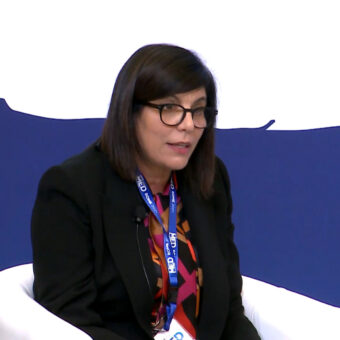
“Planting seeds of peace and seeing them blossom”. Margaret Karram’s words during the forum for dialogue entitled “Seeds of hope against prophets of doom: a partnership between Religion and Government for a new policy on Mediterranean unity” at the Rome MED 2021 organised by the Italian Ministry of Foreign Affairs and International Cooperation and ISPI (Italian Institute for International Political Studies). “I believe that government policies in the Mediterranean region should create a political environment conducive to pluralism and equal citizenship”. These were the words with which Margaret Karram, President of the Focolare Movement, addressed the seventh edition of Rome MED 2021 (Mediterranean Dialogues) in Rome (Italy) on 3 December 2021. “I think that religions,” she continued, “can also be part of the solution, by offering and promoting a different narrative. (…) Each of us has our own narrative, and we have to listen, understand and respect the other person’s narrative”. The event, which took place in Rome from 2 to 4 December 2021, is the annual high-profile initiative promoted by the Italian Ministry of Foreign Affairs and International Cooperation and ISPI (Italian Institute for International Political Studies). It brings together politicians, academics, entrepreneurs, religious leaders and NGOs to discuss opportunities offered by the Mediterranean and how to address the many crises across and around the Mediterranean. Margaret Karram’s speech was part of a panel discussion entitled “Seeds of hope against prophets of doom: a partnership between religion and government for a new policy on Mediterranean unity”. The discussion, moderated by Fabio Petito (Head of the Religions and International Relations Programme at ISPI) and Fadi Daou (Co-founder of the Adyan Foundation), was attended by Marina Sereni (Deputy Minister for Foreign Affairs and International Cooperation in Italy), Noemi di Segni (President of the Union of Italian Jewish Communities), Azza Karam (Secretary General of Religions for Peace), Monsignor Miroslaw Wachowski (Under-Secretary for Relations with States of the Holy See) and Haya Aliadoua (Advisor to the Secretary General of the World Muslim League). The panel’s reflection on the crisis of disunity that for some time now and for various reasons has affected the shores of the Mediterranean, the scene of clashes between various cultures, moved the debate along and simultaneously left space for possible initiatives and greater involvement from religious leaders and communities in public life to promote new pathways towards fraternity and peace. “Just yesterday,” said Margaret Karram, “Pope Francis having recently arrived in Cyprus, stressed that the ‘mare nostrum‘ – as the Romans called it – is ‘the sea of all those peoples who border it, in order to be connected, not divided’[1]. I believe this is the Mediterranean area’s true identity”. Thinking of the Mediterranean not as one continuous crisis but as an opportunity to work in an effective way, Karram continued: “As Focolare we have been present in the Mediterranean region for over 50 years. Bringing interreligious commitment into daily life, helping people with their needs in concrete ways, is the lesson we have learned and which we strongly value; I believe that high level strategies don’t have such a profound impact”. Speaking of concrete initiatives the Focolare President presented a number of examples and testimonies from Lebanon to Syria that demonstrate the importance of putting the person at the centre and taking care of relationships and diversity, and underline the part that religions can play in this field. “Love and caring for every human being are the core of this message,” she concluded. “Religions have the natural ability to network and draw people into a space where we can plant seeds of peace, seeds of hope, and see them flourish”.
Maria Grazia Berretta
[1] Pope Francis, Meeting with the authorities, civil society and the diplomatic corps – “Ceremonial Hall” of the Presidential Palace in Nicosia (Cyprus), 2 December 2021. Cfr. https://www.vatican.va/content/francesco/en/speeches/2021/december/documents/20211202-cipro-autorita.html
