
16 May 2021 | Non categorizzato
Running from 16 to 25 May 2021 more than 1 billion people worldwide will participate in the event to show how it is still possible to do something for the planet.  On 9 May, the last day of United World Week, the Focolare’s Youth for a United World launched a new campaign for the coming year 2021-2022: #daretocare for people and planet, which proposes “ecological conversion” through initiatives that involve associations, organizations, institutions but also through our simple everyday actions, to break the cycle of violence, exploitation and selfishness so typical of the culture of waste. The Focolare Movement is a partner of the Global Catholic Climate Movement and collaborates with associations, organizations, institutions, movements of different Churches and various religions and cultures for the care of the planet. A global network of people who are passionate about caring for the planet. Last year on the 5th anniversary of the encyclical on the environment Pope Francis launched Laudato Si’ Week. At the end of the week, Francis proclaimed a Special Year Laudato Si’ to develop the encyclical on ecology, and declaring the next “Laudato Si’ Week” from 16 to 25 May 2021 which coincides with the sixth anniversary (24 May) of the encyclical. The event is organised by the Dicastery for Promoting Integral Human Development together with Renova, CIDSE, Caritas Internationalis, Jesuits – Society of Jesus, International Union of Superiors General, GPIC – General Curia of Franciscans OFM, the Union of Superiors General (USG) and facilitated by the Global Catholic Climate Movement in collaboration with about 150 Catholic organisations including the Focolare. The aim is to bring about ecological conversion through dialogue and an event is being planned which will present testimonies from religious leaders from countries around the world, including those devastated by the COVID-19 pandemic, such as India, the United States and the Philippines. Laudato Si’ Week will also serve as a platform to plan further action for the next decade, ahead of the UN Conference on Biodiversity (COP15), the 26th UN Climate Change Conference (COP26). “Laudato Si’ Week” will have a rich programme of actions, webinars and testimonies to encourage dialogue, the exchange of views and to propose concrete actions for the planet. The theme is “for we know that things can change” (Laudato Si’ 13) to shine light on the hope around the world that something can still be done to turn things around. The Week will also showcase the transformative impact of ‘Laudato Si’ on global education and will include the ‘Songs for Creation’ festival, the global day of action and the launch of the ‘Laudato Si’ Platform of Initiatives. Every global event will be simultaneously translated into English, Spanish, Italian, Portuguese, Polish and French. Leaders of various religions from around the world, world-renowned speakers and authors, and more than a billion people will come together to celebrate the conclusion of the Special Year Laudato Si’ at the end of this month. “At a time when the cry of the earth and the cry of the poor are becoming increasingly intense, ‘Laudato Si’ Week’ offers the perfect opportunity to take care of our common home,” says Tomás Insua, Executive Director of the Global Catholic Climate Movement. “The clock is ticking. Everyone is invited and enthusiastic about participating in celebration and action, through local activities, online events and much more”.
Lorenzo Russo
14 May 2021 | Non categorizzato
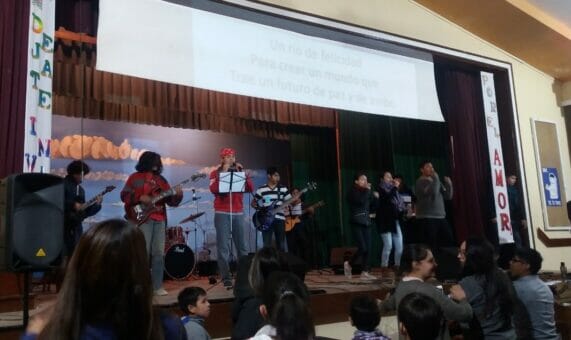
For Oscar, whose passion is singing and music, it was hard to accept the news that he might become deaf. But with the help of Focolare young people in Bolivia, a new adventure began that helped him overcome his challenges. In 2014 I went through a difficult time, to the point of thinking about suicide. It all started one morning when I woke up with a strong buzzing in my head. As the days went by, the buzzing became unbearable. Was I going crazy? One day when I couldn’t stand the noise anymore, and I went to the emergency room. The doctor explained that the buzzing would remain forever – in fact, that I would become deaf. This was very hard for me to take! I tried to deal with the situation decisively, but, at times, my despair seemed to win out. I asked the Focolare community for help, and I believe it was their prayers that saved me. One afternoon, I was able to accept this situation and found the strength to move forward. Continuing to fight for my wife Carminia and our six children became a worthy goal. I began to get used to the buzzing, and as I thought of the forsaken Jesus, I saw myself as similar to him, close to him. Every morning I would greet him with a “Hi, Jesus.” It was a beautiful time. It may sound strange, but it was precisely in that pain that I felt God’s presence closest! After many medical consultations and medications, my condition stabilized. The buzzing continues, however. One evening I thought, the time will come when I will no longer be able to sing or play music. It was difficult to accept, but I said another “yes” to God. I did put some conditions on it though: “I accept that I will no longer sing on this earth, but I ask to be part of your choir in heaven.” We were living in El Alto, in La Paz, the capital of Bolivia, at an altitude of 4,150 meters. The doctors advised me to move to a city that wasn’t as high. In 2015, we moved to Cochabamba (2,500 meters). The local Focolare community welcomed us with open arms. It was an opportunity to get to know the Gen – the young people in the Focolare – better. With them, a musical adventure began that I never imagined. Despite already having given up my dream of continuing to sing, I found myself amid the energy and life of the Gen, and it became music. One young man suggested that I organize a music group. I was happy, but worried about my hearing, which by then was not working as well as before. But the energy of Gen, my experience with youth music groups, as well as the instruments we had in our family (four of our children are musicians) convinced me. One day we got a drum set as a gift, and it was a big party. The young people had a lot of talent. Some sang well, others played instruments with passion, and some were computer and sound geniuses. So we played at six events organized by the Focolare. How wonderful to see the young people so happy, and the adults catching their liveliness! God, in the end, did not let himself be outdone in goodness, because I was able to keep singing. I continue to do so.
Óscar Condori, Bolivia
12 May 2021 | Non categorizzato
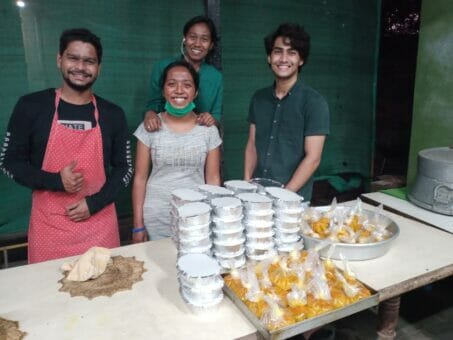
From the sharing of material goods to offering spiritual and emotional support, all efforts seem a drop in the ocean of the Covid-19 tragedy in India. Yet local communities continue to go ahead with faith in God and mutual trust. 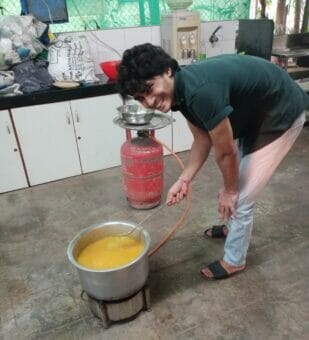 “It has been exactly one week since we tested positive. We are not looking up any information on the Internet and we are not allowing ourselves to watch the news or complain about anything. We are taking it one day at a time. Getting better. Your prayers, messages, good wishes and food full of warmth have continued to give us strength and we can feel the closeness and support of each and every one of you. We continue to offer thanks for the smallest blessings we have been given.” This WhatsApp message shared by a family from the Focolare community in Mumbai has been a ray of hope and courage in these dark times. Not a day goes by without receiving news of the death of colleagues, friends and sometimes even family members. This is in addition to the constant reminders through all the media of collapsing systems and families unable to assure dignity for their sick or deceased loved ones. With a population of 1.3 billion people, a high rate of cases was expected in India. For a whole year, until last April, the country managed to curb the spread through various measures, from strict lockdowns to contact tracing and mass vaccinations. But now the situation is worsening daily, as the virus mutates in various parts of the country and the public health system struggles to keep up with an unprecedented demand for medicines, oxygen and ventilators. During the pandemic, the Focolare community has worked tirelessly and relaunched a nationwide communion of goods to show solidarity and offer financial help to those who have lost their jobs or need funds for daily provisions. The Focolare’s Udisha project in India has been able to reach out to nearly 80 families in some of Mumbai’s low-income communities, providing them with food, medicine, school fees, books, house rent, electricity bills, etc. Amidst the raging second wave, some young people continue their work for the #DaretoCare project by serving home-cooked meals to the homeless once a fortnight. With the aim of saving lives, much of the effort and energy of the Focolare communities is now focused on health care. When an urgent request came from the Holy Family Hospital in Mumbai for oxygen concentrators for their 160-bed Covid ward, the community quickly found sponsors for two machines and is now looking for more. As the second wave continues to hammer home its full force, the Focolare families have felt the need to support each other more closely and have begun to connect daily to pray together for half an hour, finding much needed support in the pain, helplessness and even loneliness of some. As in the early days of the Movement, when the community in Trent (Italy) discovered that God is Love even in the raging of the Second World War, online prayer with the Indian community is becoming a powerful way of expressing their being one family, all equal and united in God’s love.
Annabel Dsouza from Mumbai, India
10 May 2021 | Non categorizzato
Our love needs to be continuously revived by acts of love which are always more perfect, always more sincere. Chiara Lubich compares love for neighbour to a fire that is fuelled by love, to show our commitment to God and to our neighbour. Undoubtedly, we want to focus with greater conviction on our Ideal, which is all there, in mutual love. We want to strengthen our unity and do all in our power to spread it as far as possible. … Because fire—and it is a matter of fire—does not burn unless it is continually fed with wood or straw and so on. Similarly, our love needs to be continually revived by acts of love that are ever more perfect and sincere. And this is necessary not only for people who are at the beginning of the spiritual life or half way through it. Even people who have strived to practice charity for years and years can fall into a type of “routine” charity which loses the splendour and warmth of the flames, and slowly diminishes, becoming more and more hidden beneath the ashes. This is the case, for example, when in our daily lives, we no longer spontaneously declare unity with our brothers and sisters. This is the case when we notice that our charity loses its impact, its power to irradiate decreases, we are of little use to the Kingdom of God, there are fewer fruits: we have become lukewarm. For this reason, therefore, we must remind ourselves to enkindle the fire continually, to return again and again to being alive to love. Yes, because God doesn’t like those who are lukewarm, not at all: “… You are neither cold nor hot. I wish that you were either cold or hot. 16 So, because you are lukewarm, and neither cold nor hot, I am about to spit you out of my mouth. (Rev 3:15-16). This is terrible. It shows the urgency of always returning to being “hot”, to having a truly fervent charity. Let’s go ahead then: let’s ask ourselves often: have we thrown wood on the fire? Is our love shallow or ardent? Have we used every opportunity to express our fervour to God and to our neighbour? Let’s … remember only these words: not lukewarm but ardent.
Chiara Lubich
(Taken from a telephone conference call, Rocca di Papa, February 28th 1991)
7 May 2021 | Non categorizzato
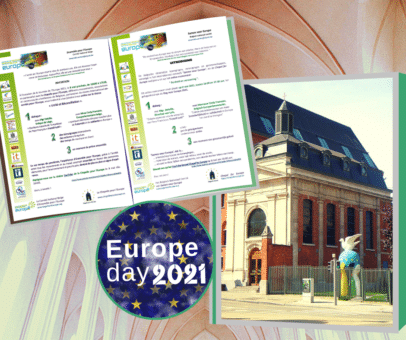
For the past twenty-two years “Together for Europe” has been bringing together more than 300 Christian Communities and Movements of different Churches – including the Focolare Movement – spread throughout the continent. There will also be many initiatives this year from 7 to 9 May. 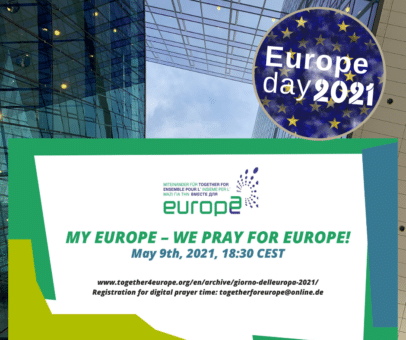 Sunday 9 May is Europe Day, an event that aims to highlight how peace and unity are indispensable for Europe. The date marks the anniversary of the historic Schuman declaration made public in 1950 on the occasion of the speech by the French parliamentarian, one of the founding fathers of the European Union. This is the context for the “Together for Europe” initiative, a reality that for twenty-two years has been bringing together more than 300 Christian Communities and Movements of different Churches, including the Focolare Movement. “Together for Europe” aims to respond to the need for a “culture of reciprocity” where different individuals and people can welcome, get to know and reconcile with one another, and learn to value and support each other. Major European events have been staged over the years – taking place in Stuttgart (Germany) in 2004 and 2007, then simultaneously in 152 cities around the continent in 2012 with a focus on Brussels (Belgium) and in 2016 in a central square in Munich/Bavaria (Germany). From 7 to 9 May 2021, ‘Together for Europe’ will be presented as a series of events taking place in Austria, Croatia, Slovakia, Slovenia, Hungary, France, Germany, Belgium, the Czech Republic, Switzerland and Italy. Among the various initiatives is the European prayer on 9 May entitled “My Europe: 45 minutes for Europe” where young people will meet online and animate an event with music, short reflections and prayer groups (in English). Young people and adults are also coming together from different European countries to make short video clips explaining their vision of a united Europe. In the Chapel for Europe in Brussels, Belgium several Movements of “Together for Europe” are preparing for an event which will be broadcast online on 8 May 2021 from 16:00 to 17:30 on the theme of “unity and reconciliation”. Also on 8 May, the young people of the Focolare Movement, as part of United World Week, whose theme this year is “dare to care”, will hold a webinar exploring the Christian roots of “care” with Canon John McLuckie, Rector of the Scottish Episcopal Church and 14 young people from 4 different Communities and 7 European countries. In Italy there will be a rich online symposium “For the Earth and People” exploring the link between integral ecology and a fair economy in contributing to building the “common home”. Starting with Graz, the Austrian group will network with Croatia, Slovakia, Slovenia, Hungary and Italy to get to know each other better and deepen a conversation that unites us all. At the conference in France, Jean-Dominique Giuliani, President of the Robert Schuman Foundation, will speak on the theme of “Europe: what reasons for hope? ” How did the idea of a Europe Day come about? Where is the soul of Europe? What is Europe telling us today? These are some of the questions and topics that will be discussed in a video session in the Netherlands on 9 May. Germany, the Czech Republic and Switzerland will also be joining other events celebrating Europe. The aim is to take up the important challenges facing the continent of Europe, putting to good use the charisms of the Communities and Movements for the good of humanity, through multiple initiatives in favour of reconciliation and peace, the protection of life and creation, a fair economy, solidarity with the poor and the marginalised, the family, the good of our cities and fraternity within Europe.
Lorenzo Russo
