18 Apr 2020 | Non categorizzato
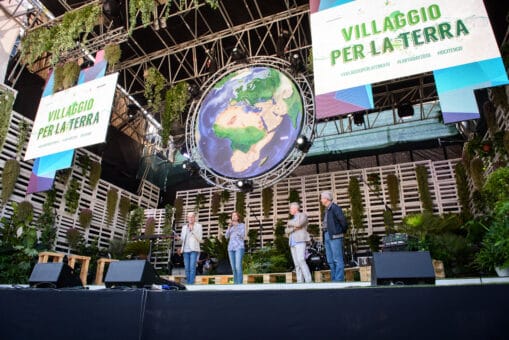
In Italy the “Villaggio per la Terra” (Village for the Earth) event is transformed into a multimedia marathon.  Everything is connected. The 50th Anniversary of Earth Day, celebrated on 22 April, cannot be viewed in isolation from the coronavirus pandemic challenging humanity. At the time of this year’s Earth Day, the current health emergency is giving rise to a global community demanding different economic and social models which are fairer than before. This Earth Day coincides with the 5th anniversary of Pope Francis’ encyclical Laudato Si on the theme of integral ecology. Events in 193 countries will be hosted online. In Italy, the Villaggio per la Terra, traditionally held at Villa Borghese in Rome, is being transformed into a multimedia marathon live on Rai Play and reports on other broadcast platforms. We spoke with President of Earth Day Italy, Pierluigi Sassi. The 50th anniversary of Earth Day is taking place as humanity faces the coronavirus challenge which is forcing us to review our priorities, values and objectives … Today, more than ever, we feel the urgent need to change the economic and social model which has governed development for decades. We want to give a message of hope, to offer a perspective which focuses on the person and the need to respect the planet. We’ve raised awareness about these subjects in the world, reinforced by Pope Francis’ Encyclical Laudato Si expounding the principle of integral ecology. There is a new sensitivity to this topic in the world, but it has to transfer into action. The coronavirus makes the need for this change even stronger.
VILLAGGIO PER LA TERRA, Earth Day Italia, Villa Borghese, Roma 21 April 2018
© Lorenzo Gobbi/Smile Vision Srls
Claudia Di Lorenzi
16 Apr 2020 | Non categorizzato
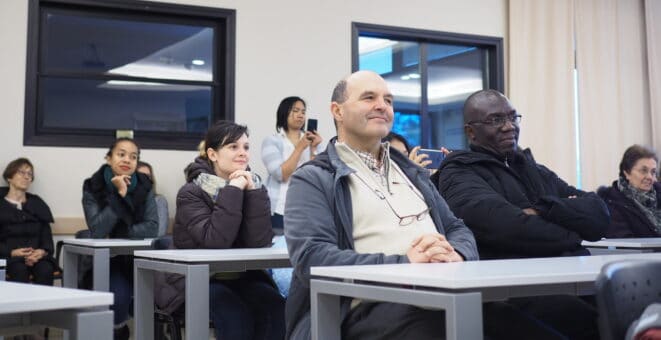
How the idea of creating the Sophia University Institute came about, and how it has developed to date, showing the cultural scope of Chiara Lubich’s charism of unity The Sophia University Institute was born from a Christian spiritual heritage that is in constant dialogue with the principles upon which various civilizations flourished and developed. It is located in Loppiano, Italy, a Focolare little city that since its founding in 1964 has trained families, young people and adults in a Gospel-based lifestyle. 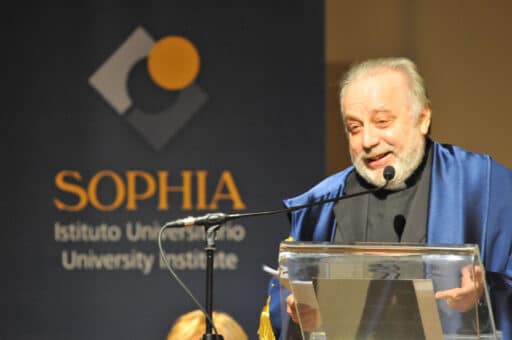 Professor Piero Coda, Dean of Sophia from its birth until last February, explains how the project has developed over the years. How did Chiara Lubich come up with the idea of creating a university? The idea has been there since the beginning. This was confirmed in 2008 at Sophia, when Fr. Casimiro Bonetti, the Capuchin who was with Chiara in the early 1940s, inaugurated the university. It is in the DNA of the charism of unity, because it is a charism that unleashes a culture: a tangible vision of the human person and the world. In concrete terms, its start came after the Abbà School’s breakthrough in the 1990s, when together with Chiara they began to study the cultural scope of the charism by drawing from the heritage of light from Paradise ’49. When did Sophia start? How did it develop? The initial stage of the university was the Superior Institute of Culture, which was aimed at the youth of the Focolare Movement (Gen). It was inaugurated on 15 August 2001 by Chiara with a speech that constitutes its Magna Carta. In 2005, given the success of the experiment and at the urging of cultural critics such as Stefano Zamagni, President of the Pontifical Academy of Social Sciences, the planning of a true and proper university institute began. It was true to original form, according to the concept that sprang from the charism, and completed by the Holy See on 7 December 2007. What is the link with the Holy See? It was Chiara’s premeditated choice to build a university that was not formally recognized by a country, but rather by the universality of the Catholic Church. This also meant, for Chiara, recognising the fact that the charism of unity, like the great charisms of Christian history (from Benedict to Dominic and Francis, to Ignatius of Loyola and Don Bosco), is a charism in which the Church recognizes a project in action of human and social formation that expresses the Gospel. With the extension of the Bologna Process (the bilateral recognition of degrees at the European level and beyond, in which the Church participates), we could see viable scenarios for the institution that was being born. How has it changed over the years? Sophia began and developed on three pillars: academic-level teaching and research; formative experiences shared in community life between teachers and students of various cultures; and a relationship with the tangible expressions that embody the values inherent in the charism of unity in the various areas of social, political and economic life. In all these respects, great strides have been taken forward. Suffice it to say, for example, that we started with a single degree course and now there are four. The original program in the “culture of unity” blossomed into the theological and philosophical, economic and political fields, as well as education, dialogue and communication. What is Sophia today? It is an important confirmation, a certain hope, a strategic investment. It is a confirmation of the value and relevance of Chiara’s intuition. It is a hope that the search for the new cultural paradigm that our change of era asks of us is not a utopia. Finally, it is an investment to promote with seriousness and vision the development (not only cultural) of the charism of unity and its historical impact. In the past there has always been a dean, but today there is a rector; what does this mean for the university? The fact that the Vatican department for studies and the university wanted this change underscores the validity of the path taken. It is also recognition of the institute rising to the status of university. One can also see an echo of what Pope Francis told us in our audience with him last 14 November: “I am happy with the journey you have made in these 12 years of life. Forward! The journey has just begun.”
Lorenzo Russo
11 Apr 2020 | Non categorizzato
Maria Voce, President of the Focolare Movement, sends her Easter greetings: to experience a continuous passing from death to resurrection through love of neighbour. Only in this way will we overcome this painful time of pandemic and any other suffering. Easter 2020 Dear All, This year, Jesus’ passing from death to a completely new life challenges us and puts us in an attitude of listening. And it is here that faith and our charism come to our aid: we find the answer in Jesus crucified and forsaken, the God of these present times that are so hard to understand. Even the loneliness we are now perhaps forced to experience, if lived with him, can be inhabited and filled by His Kingdom.[1] Only by choosing him, embracing him in all that is painful, and loving him in an exclusive way, will we and the whole of humanity find the path towards the light, towards a new birth. JESUS IS RISEN! Let us have this experience of passing continually from death to resurrection and share it with many, with everyone. This is how we can prepare for tomorrow and lay solid foundations for the world of the future, when we will go back to meeting one another and embracing one another once more. HAPPY EASTER! [1] Vedi Chiara Lubich, “Dov’è la schiavitù?”, [Where is slavery] Fermenti di unità, pg. 130, ed. 1963.
11 Apr 2020 | Non categorizzato
The Coronavirus crisis has caused a range of restrictions in many countries and people cannot leave their homes. Isolation can be a real problem. But the power of solidarity and the desire to remain united and linked through social media are even stronger. Here are just some of the Easter greetings circulating the globe. https://vimeo.com/406318544
9 Apr 2020 | Non categorizzato
New Humanity, a Focolare NGO, says the time for peace in Syria is now. An appeal has been sent to the Secretary General of the United Nations, the Commission and the European Parliament. Many political, civil and religious authorities have expressed their support. “We call for a suspension of economic sanctions against the Syrian government so that the people have access to international markets and financial services and can receive the medical supplies and funds necessary to defend themselves against the COVID-19 virus.” This is the gist of the appeal promoted by New Humanity, an NGO of the Focolare Movement, in response – first and foremost – to the cry of the Syrian people who have reached the tenth year of civil war and are heavily affected by the pandemic that has now spread to their country. But that’s not all: well-known figures from all over the world are supporting the cry of the people. A few days ago, Antònio Guterres, UN Secretary General, sent a message referring to the current situation that is uniting us in the fight the common enemy: “The virus is not interested in nationality, ethnic group or religious belief. It attacks everyone indiscriminately. Meanwhile, armed conflicts are raging in many parts of the world. And it is the most vulnerable – women and children, people with disabilities, marginalized, displaced people – who pay the price and risk the greatest suffering and devastating loss because of Covid-19.” “Hundreds of humanitarian appeals have been made for Syria,” explains Marco Desalvo, president of the NGO, “but now we are in an exceptional situation. We are equally vulnerable to Covid-19 but the response that each state can give is very different. We have drafted this appeal for the Secretary-General of the United Nations and for the European institutions, calling for the suspension, at least temporarily, of the embargo on all medical and financial transactions so that Syria can obtain supplies of drugs and medical equipment.” “This is not an issue regarding political division,” explains the Hon. Lucia Fronza Crepaz, former member of the Italian Parliament and one of the promoters of the appeal. “On the contrary, it wants to go beyond party membership because the objective of safeguarding the Syrian civilian population is above any political or ideological orientation.” The appeal already has the support of several well-known political, academic, scientific and religious figures in Italy and beyond such as Romano Prodi, the Undersecretary for Labour and Social Policy, Sen. Steni Di Piazza, Patrizia Toia and Silvia Costa, Don Luigi Ciotti, founder of Gruppo Abele Onlus and LIBERA, Giovanni Paolo Ramonda, General Manager of the Pope John XXIII Association (APG23), Michel Veuthey, professor of international law at Webster University, Switzerland, Andrea Olivero, president emeritus ACLI, Cornelio Sommaruga, former president of the International Red Cross and P. Bahjat Elia Karakash, ofm, superior of the Franciscan Friars in Damascus. Join the petition on change.org
Stefania Tanesini
