9 Apr 2020 | Non categorizzato
“This year for many Christians the days of the Holy Week and Easter – which the Western Churches celebrate on April 12, while the Orthodox Churches and the Eastern Orthodox Churches celebrate on April 19 – will be a special experience because the coronavirus pandemic will prevent them from participating physically in the liturgical celebrations. In the following text that Chiara Lubich wrote during Holy Week in the year 2000, she suggested how to live these “holy days”. Today is Holy Thursday! We feel that today is truly special because of the spirituality that flowed from the charism given to us by the Holy Spirit. So we want to pause for a moment to meditate, contemplate and try to relive the mysteries it reveals, together with those of Good Friday, Holy Saturday and Easter Sunday. To begin with, each of these days could be given a title that expresses or, I would say, has proclaimed within the Movement for over 50 years what we should be: Love on Holy Thursday; Jesus forsaken on Good Friday; Mary on Holy Saturday; the Risen Lord on Easter Sunday. Today, then, it is Love. Holy Thursday, this day on which, over the years, we have often experienced the sweetness of a special intimacy with God. It reminds us of the abundance of love that heaven has poured out over the earth. Love, first of all, is the Eucharist, given to us on this day. Love is the priesthood, which is a service of love and which among other things, makes it possible for us to have the Eucharist. Love is unity, the effect of love, which Jesus, then as today, implored from the Father: “That they may all be one, as you, Father, are in me and I in you” (cf. Jn. 17:21). Love is the new commandment that he revealed on this day before dying. “Just as I have loved you, you also should love one another. By this everyone will know that you are my disciples, if you have love for one another.” (Jn. 13:34-35). It is a commandment which enables us to live here on earth a life modelled on that of the Holy Trinity. Tomorrow: Good Friday. Just one name: Jesus forsaken. I’ve just written a book on him entitled The Cry. I dedicated it to him with the intention of writing it also on your behalf, on behalf of the entire Work of Mary “as – and this is the dedication – a love letter to Jesus forsaken”. In it I speak of him who, in the one life God has given us, and on a day, a particular day that was different for each of us, called us to follow him, to give ourselves to him. You can understand then – and I say so in the book – that what I want to say in those pages cannot be like a talk, however informal, warm, and deeply felt; but is, rather, a song, a hymn of joy and above all of gratitude toward him. He had given everything: the life he lived beside Mary, in hardship and obedience. Three years of mission, three hours on the cross, from which he forgave his executioners, opened Paradise to the good thief, and gave his Mother to us. Only his divinity remained. His union with the Father, that sweet and ineffable union with the One who had made him so powerful on earth, as Son of God, and so regal on the cross; that feeling of God’s presence had to descend into the depths of his soul and no longer make itself felt, separating him somehow from the One with whom he had said he was one. And he cried out: “My God, my God, why have you forsaken me?” (Mt. 27:46). The day after tomorrow: Holy Saturday. Mary is alone. She is alone with her dead son-God. Is this a depth of anguish that cannot be filled, an infinite agony? Yes, but she remains standing, thus becoming a sublime example, a masterpiece of virtue. She hopes and believes. During his lifetime Jesus had foretold his death, but also his resurrection. Others may have forgotten his words, but she never forgot them. She kept those and other words in her heart, and meditated on them (cf. Lk. 2:51). Therefore, she doesn’t give in to suffering: she waits. And finally: Easter Sunday. It’s the triumph of the Risen Jesus whom we know and relive in our own small way after having embraced him forsaken; or when we are truly united in his name and experience the effects of his life, the fruits of his Spirit. The Risen Lord must always be present and living in us during this year 2,000. The world is waiting for people who not only believe in and love him in some way, but people who are authentic witnesses and who can truly say, as Mary Magdalene said to the apostles after having seen Jesus near the tomb, those words we know so well but which are always new: “We have seen him!” Yes, we’ve discovered him in the light with which he enlightened us; we’ve touched him in the peace with which he filled us; we’ve heard his voice in the depths of our heart; we’ve savoured his incomparable joy.” Let us keep these four words in mind during these days: love, Jesus forsaken, Mary, the Risen Lord.
Chiara Lubich
(Taken from a telephone conference call, 20th April 2000)
7 Apr 2020 | Non categorizzato
Their live streaming sessions from Loppiano keep alive the hope that fraternity can reach everywhere. Their new single is coming out any day now. During the Coronavirus emergency, we all need to stay home as much as possible. Gen Rosso, the international performing arts group began live streaming from their home on March 20th.Here we report a short interview with Tomek Mikusinski, spokesman for the group. 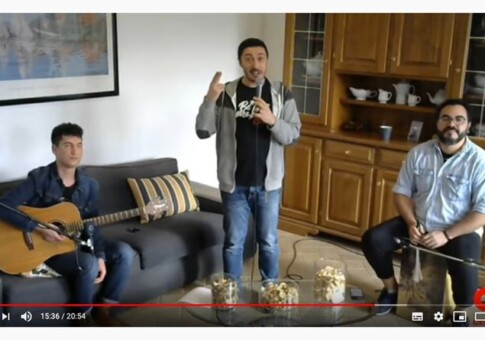 How did the idea of live streaming come about? “It began because we wanted other people to know that we are close to them during this time – close to the people who are giving their own lives each day as they try to save others and close to the thousands of people we have met at our concerts. We also wanted to share something positive and beautiful during this time of almost total isolation. I think that all of us, at least once, will have asked ourselves: ‘Why is this happening?’ It’s not easy to give answers, but we have sung ‘We believe in love’ so many times. We believe that love is behind everything that is happening.” Your broad and varied audience confirms the universality of your message. “The essence of our message is love, unity and a culture of sharing. It is a message that has no labels, it’s universal and everyone can understand it. We would like the people who watch us to experience the good and the longing for happiness and unity that there is in each one of us.” Your audience interacts with you a lot during streaming: which message has impressed you the most? “We get a lot of messages from people who work in hospitals: here are three of them. ‘I work in Covid Resuscitation. Our faces scarred by the masks, our eyes are our only recognisable feature and we no longer have timetable to follow but we are not giving up.. Please continue to bring us joy. My colleagues and I promise you that we will do all we can and persevere to the end.’ ‘A huge thank you to Gen Rosso. I saw them today before I left for my shift at the hospital here in Asti. It was a breath of fresh air for my soul.’ ‘I’m a Covid ICU nurse and I listen to your CD in the car on the way to work. It gives me the energy and inner peace to get through the shift… Thank you!’ Your new single “NOW” is coming out: can you give us a foretaste? How did it begin and what is it about? “Actually it’s not just a single, we’re planning a whole new album but we want to release it song by song over the next two years. ‘NOW is a song that blends the most current electro pop sounds with the vintage sounds of the funky 70s. The lyrics of the song, in English, express our belief that even if we make serious mistakes, we can always start again, because the voice of God-the-Father who is Love can be heard. On April 15th the single ‘NOW’ will be released on the most popular digital stores like Spotify, iTunes, Google Play, etc.”. The next live streaming appointment is April 8th 2020, at 16:00, Italian time, with some songs and special greetings on the @YouTube channel. Here is the link: https://www.youtube.com/watch?v=o17WFM3tos4&feature=youtu.be Don’t miss us! #Distantiuniti
Lorenzo Russo
6 Apr 2020 | Non categorizzato
Dialogue with Vincenzo Buonomo, Rector of the Pontifical Lateran University; Luigino Bruni, an economist; Amy Uelmen, a lawyer and professor at Georgetown University. https://vimeo.com/402934400
4 Apr 2020 | Non categorizzato
In these times of the coronavirus, often it is no longer possible for us to visit relatives, friends or acquaintances that we know are in need. The media seem to be the only way to express our concrete love. The following text shows us another way in which we can respond. It is wise to spend the time we have by living God’s will to the full in the present moment. Sometimes, however, we worry about the past or the future. We are concerned about situations or people for whom we cannot do anything at the moment. This is when it becomes difficult to steer the ship of our lives. It takes great effort to keep to the course that God wishes us to have in that particular moment. At such times we need strong willpower, determination, and especially trust in God, sometimes to a heroic degree. “Can I do nothing to resolve a certain complex situation or for a dear person who is sick or in danger? Then I will concentrate on doing well what God wants from me in the present: study, homemaking, prayer, taking care of the children … God will take care of the rest. He will comfort the suffering and show a way out of that entangled situation”. This way the task is being done by two in perfect communion. It demands from us great faith in God’s love for his children. And in turn it gives God a chance to trust that we do our part. This mutual trust works miracles. We will realize that Another has accomplished what we could not do, and that he has done it far better than we could have. Then our trust will be rewarded. Our limited life acquires a new dimension: we feel near the infinite for which we yearn. Our faith invigorates and gives our love new strength. We will know loneliness no longer. Since we have experienced it, we will be more deeply aware of being children of a God, who is a Father and who can do everything.
Chiara Lubich
Taken from: Here and Now, New City Press, 2005
3 Apr 2020 | Non categorizzato
How the many children who are members of the Focolare Movement are living this moment of global emergency. A new website designed for them goes online. “We have to stay at home at the moment, but we have a secret to stay happy: loving. So every morning we throw the dice and do what it says”. Gen 4, children who are members of the Focolare Movement, are not giving up. Even in isolation, they start each day with their ‘dice of love’. Each of the six sides bears one point of the ‘art of loving’ and they try to live it during the day. In some cities, the Gen 4 boys and girls have been busy writing letters and cards offering help to the older residents in their apartment blocks. They’ve drawn their parents into the activity too. “None of our neighbours has actually asked us for practical help,” explained one mother, “but it’s been a great opportunity to get to know each other and they’ve all been calling us to say thank you”. “What if some of the children here don’t have as many toys as we do?” reflected Niccolò and Margherita, two Italian Gen 4. So they filled a box and left it in the hallway of their apartment block, with a sign saying: “Ciao! We found these toys at home and we’re not using them. You can take them if you like and keep them. Courage!” While it may be true that “home” in these times is coming to signify “limits”, in Rome the Gen 4 have welcomed a proposal to build their own small houses out of cardboard and fill them with accounts of their acts of love. As the cardboard houses fill up with notes and pictures, the adults confined with them are learning how everyone can fill their home with small acts of love. The Gen 4 are present all over the world. As the pandemic spreads to all countries, it’s natural for them to feel solidarity with those who are suffering the most. Two Gen 4 in Asia sent a video-greeting with the image of a rainbow, as they called out “Courage Italy!”. Another greeting from Africa encouraged everyone “We can get through this together!” Alongside the children, Focolare animators are actively accompanying them through this delicate period. From Brazil to Congo, new ideas are springing into action. In Bilbao, Spain, they wrote, “We had the idea of holding meetings for the Gen 4 and their families every week via the web. We share how we are living this new situation, highlighting our acts of love. We encourage each other by promising to pray for peace, for the sick and for all who are suffering”. A group in Portugal is preparing a video about each Sunday’s Gospel reading which they share on social media every week. Being part of a network is proving valuable at this time. And a new website (https://gen4.focolare.org/en/) from the international Gen 4 Centre has just gone online, for children and their educators, offering material and formation programs in the Focolare spirituality, designed for this age group. The timing is significant. On 29 March 1972, Chiara Lubich gave life to the Gen 4, as the youngest generation of the Focolare Movement. A few years later, comparing the whole Movement to a large tree, she defined the Gen 4 as “the buds of the tree. (…) Something so very precious, very precious. It is the very future of the tree” .
Anna Lisa Innocenti
