31 May 2015 | Focolare Worldwide, Senza categoria
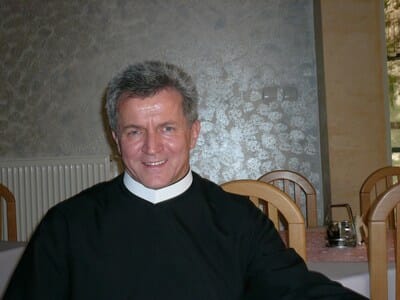
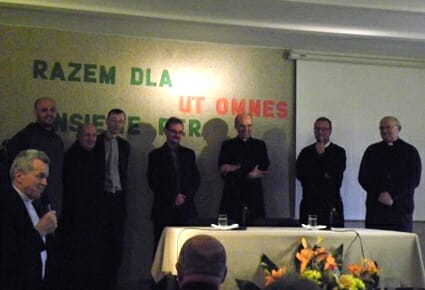 While visiting Poland, Maria Voce and Jesús Moran, President and Co-President of the Focolare Movement, respectively, held a meeting on 26 May in the Mariapolis Fiore (Poland) with a group of priests and religious who were bound in various ways to the Focolare. Fr. Zdzislaw Klafka, a Redemptorist, recounted his encounter with the spirituality of unity and the positive effects in living his specific vocation in a more radical manner. «I feel so grateful to Chiara Lubich for having been God’s docile tool in bringing about in the Church, a spirituality that has helped me face the difficulties in life: When I was nominated the Superior of my congregation, I found a challenge before me. I was in Rome and before returning to Poland, I asked her to suggest a phrase of the Gospel that could enlighten my path. She answered: “No one has greater love than he who gives up his life for his friends.” I was then 29 years old and that phrase became the compass that showed me the way. In living the spirituality of unity I started to look up to my founder, St. Alphonse, in a new way. This was how I rediscovered not only my roots but the evangelical force that lies within every other charism of the Church. Someone asked me whether my adhering to the spirituality of the Focolare was not time stolen from my duties as a Redemptorist. The fact is, and I have experienced it repeatedly, that when I return from my meetings with the religious of other orders, I feel the desire to live my own choice of God even more radically.»
Fr. Zdzislaw Klafka
30 May 2015 | Focolare Worldwide
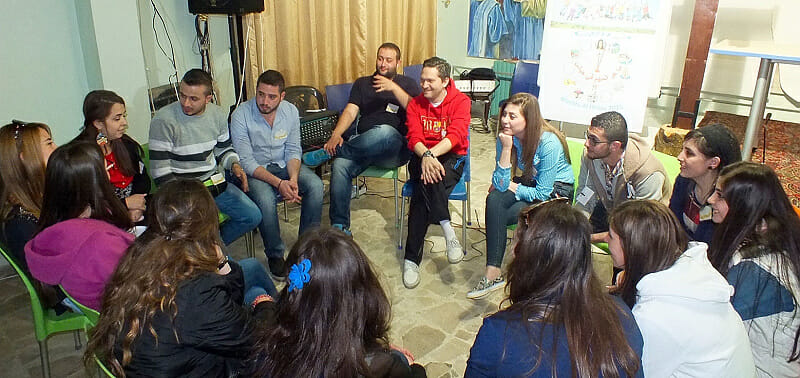
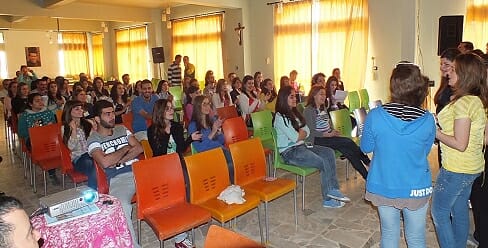 They arrived from: Damascus, Aleppo, Homs, Banias, Kfarbo and Tartous. Who would have ever imagined spending a week-end with the youth from all parts of Syria. Is this pure madness? The organizers asked themselves. Maybe so, but it became a reality. The number kept growing day after day, until it reached a total of 67. «This is how our adventure began,» they recounted. «We chose a safe place which all could reach, even if the trip took 10 hours. The idea was to spend three days together to live, share, pray, cry, and play, immersed in nature but with mutual love among us.» «What matters most in my life?» was the title of the week-end, a question that echoed even more in an uncertain situation like that of the young Syrians. They divided into four groups that focused on different themes: “A special bond with the Father,” “With Jesus every day,” “the Love that makes us free,” and “Love for Mary,” which they deepened with passages of the Holy Scriptures, the Popes and saints, accompanied by true stories of other youth who had preceded them along the path towards sanctity. When I arrived for the week-end I was tired of the war – confided Fatima – and I felt that life was stagnant, but then once again I experienced God’s presence in my life and his Love for us through the love of the others. Now when I undergo difficult moments, I just need to think that someone is praying for me and is trying to live in the same way, and this gives me a great inner peace. I have understood that the most important thing is to live life … loving Jesus in every neighbour.» On the first day they delve d deeper into one of the main tenets of the spirituality of unity, «God who is Love.» Tracing the story of the beginning of the Focolare in Trent during the Second World War, in the destruction of all, they traced also the reality of Syria today. «Everything passes, only God remains,» someone said, and so: «What matters most in my life?». One of them said: «Living Christianity in a radical way.» On the second day, through a discourse of Chiara Lubich to the youth in the 1970s, «Jesus the Master,» their choice of God emerged. «We even sang, danced and played in the evenings, and it made us all feel like a true family,» Murad and Lina wrote. Upon leaving, some said: «I thank Jesus for all the moments of joy and pain.» Haashim said «I experienced God’s caress once again – I feel the responsibility of bringing this grace to all around us.» Unforgettable days. «During the week-end – Samir wrote – «we made our fill of peace and serenity that have given us the strength to return to living in this dramatic situation.» And Nahda concluded – «Despite the absurdity of the war, I no longer feel alone.»
28 May 2015 | Focolare Worldwide
“My current parish is found in one of the neighbourhoods of Bratislava, the capital of Slovakia,” says Fr Ludovit. “The city has about 4,300 inhabitants, of which 3,500 are Christians, and the numbers continue to grow. When I arrived here in July 2009, I knew my first task was to love people with the love of Jesus. Now I can say that I’m happy because a beautiful community has sprung up between people of different ages and social status, from different Slovakian cities, who have discovered a new relationship with God, not just through the Bible and prayer, but also through the community and various parish activities. They have found here the joy in the faith which is worth living for. When I first arrived, there were no young people: the government had banned the construction of new buildings, so many young couples had moved elsewhere. Furthermore, there was no program of formation in the faith for the few teens there were. I met three young people who had the desire to help me, but they were immersed in their own work and studies. At that time I invited the teens and the young people who had recently been confirmed to a barbecue. They came as a sign of respect, but they never returned. “We’ve already received Confirmation, so there’s no need to go to Mass anymore,” they told me. In this situation, I entrusted everything to Jesus. Since September 2009, I have been teaching Catechism in all of the elementary and middle school classes (about 150 children and teens). At the same time, I started a Sunday Mass for families. I tried to take advantage of every occasion to build relationships: greeting people on the street, visiting others in their home, exchanging a few words at the shops, in the office, or at school. And again: invitations to a barbecue and to play sports on the parish grounds. Little by little people began to participate. Gradually a community was forming; there were children who didn’t want to miss out, young mothers who discovered a common bond because their children were the same age, dads who invited one another to help with various odd jobs in the church or in the parish house, but also to play tennis or have a beer together. Even the mayor and some members of parliament began to participate. One day, Jesus also sent me Blanka, who is now the choir director and the leader of many events.” “Many say that ours is ‘a live parish’,” affirms Blanka. “In spite of our individual differences, we constantly search for what unites us, and we always return to the fount of unity, of love, and of forgiveness, which is Jesus. We parents try to create the practical conditions so that many activities can be carried out. Often they are to the detriment of our time, our rest or housework, but it is truly wonderful to see that everyone supports not only their own children, but all of “our” children. This is the case with Michael, an autistic boy who is now adolescent. I am very glad to see that the other teens are open towards him inviting him to join them and considering him their equal. And Michael loves them a lot and feels that they all are part of his big family.” “I am an allergist/immunologist and I work in a non-government capacity at the Pediatric University Hospital of Bratislava,” continues Dagmar. “The Pastoral Center and the parish Nursery School which were constructed have become ‘poles’ of different activities for our children, teens, and young people, of which the number is constantly growing. One day, in May 2012, Fr Ludo asked me if I were available to participate as a medical doctor at a summer camp for teens in our parish. I immediately said no. But then, I remembered the faces of the teens that I knew. In the end I said yes, and now it is already my 4th year! I have become more sensitive to the suffering of the children and to their fears for their health when they find themselves without their parents. This experience has helped me to understand the deeper significance of service to others.” “A very important meeting occurred last year in Benevento (Italy), organized by the Parish Movement,” concludes Fr Ludovit. “Our young people came away with ‘an encouragement, a spiritual strength, a closer relationship with God,’ they said, ‘and above all, the desire to live “committed to love,” because whatever we do, if it does not have love, loses its value and significance.’ For me it was a confirmation that the community had not only been born and consolidated, but that it rests on the faith of the young people. The future, therefore, is secured.”
27 May 2015 | Focolare Worldwide
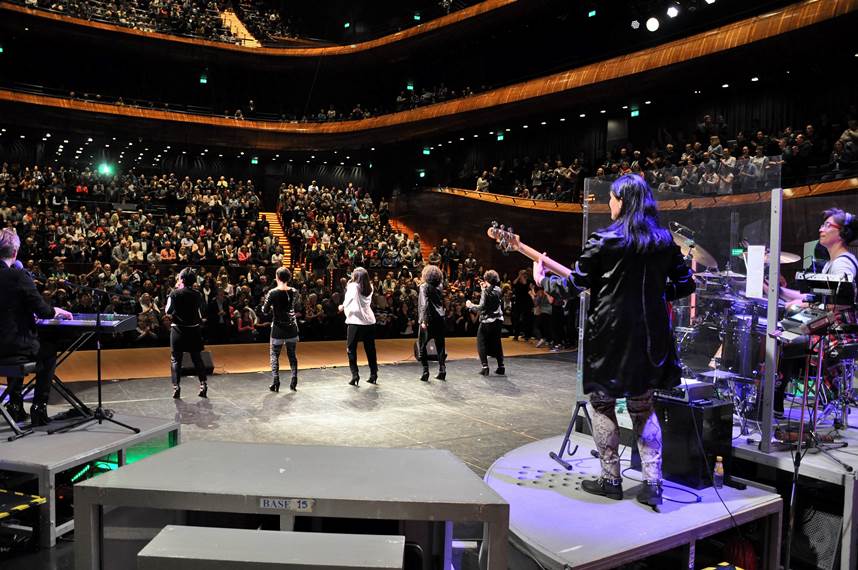
 Also called the City of Dialogue, Katowice – in the south of Poland, is a mining city par excellence – because it is one of the Polish municipalities that has the most numerous interreligious representatives. It boasts a Centre for Islamic Culture dedicated to prayer and education, and the Doha Centre for Dialogue and Culture dedicated primarily to dialogue, which will celebrate on 29 May, the «3rd Day of Christianity among Muslims» focused on the theme “Jesus – brother of each one of us,” as seen from the Christian and Muslim perspective. Also Maria Voce and Jesús Morán, President and Co-President of the Focolare, respectively, will participate, and who also will be travelling to Belarus and Poland to visit the communities of the Movement. In retrospect, there has been for some time now in Katowice, a network of fraternal relationships and cooperation among Christians of various Churches, Jews, Muslims, the academic world and civil institutions. On the occasion of the 150th anniversary of the city’s founding, the international Gen Verde band was invited to bring a message of fraternity with its music. The band has for some years now, brought to the public an educational artistic project implemented through workshops that feature onstage the youth who have attended their workshops of various disciplines: dance, singing, theatre, percussions on various instruments and even “body percussion.” About 140 boys and girls attended the workshop in Poland and contributed with their talents to the show staged with the band. But what really stirred up interest is the fact that the project also saw the participation of young Muslims, Jews and Christians of various denominations. The posters announcing the event drew the attention of so many that only six hours after the opening of the box office, the 1,450 tickets were already sold out. A Muslim girl who participated in the workshop and the show, thanked the group since she had never “felt so warmly welcomed.” This fact impressed all especially against a background of the recent terrorist acts. Upon returning from Poland, Gen Verde wrote: «We worked with 140 marvelous young people, who were the expression of an open, profound and sensitive people, forged by a faith that has been harshly tested by great suffering. They said that they experienced unity and trust that transformed them and made them fly.» «The show was held in the NOSPR, the new auditorium built over the old mines and for the first time in history, this temple of symphonic music, opened out to our rock music. Every corner of the auditorium was filled to the brim with the public that vibrated with us right from the start, in a crescendo. On hearing the first Polish words we sang (the refrain of two songs) they burst into a moving applause, and at the end of the concert, immense joy pervaded.» A little show within the show unfolded when the mayor, a representative of the Catholic community, a representative of the Jewish community and an Imam, appeared on stage in a spiritual and ideal embrace to testify to a true fraternity that was nurtured through the years. A priest remarked: “We are testimonials to something short of a miracle. If we have these young people among us as we saw today, the world will not die. With this method of dialogue you can save the world. ” The Rabbi then added; “We do not fear the future because… we are together.”
![Economy of Communion: a path for Africa?]()
26 May 2015 | Focolare Worldwide
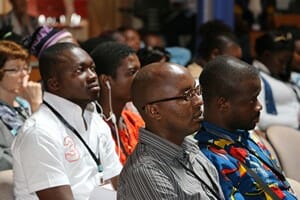 «We are a new generation that wants to take the helm of the Economy of Communion. We are well aware of our inexperience and immaturity but we are also glad to feel that this is precisely our strong point, and we do not want to stop dreaming.» Liliane Mugombozi, a journalist in Kenya, picked up the voice of a young Cameroonese among the participants of the international Economy of Communion (EoC) school, underway from 22 to 26 May at Mariapolis Piero, the Focolare town close to Nairobi, Kenya. «Upon entering that conference hall – she wrote – you could feel the energy of such a young population: vigorous, and full of expectations, hopes, aspirations and dreams that seem almost unthinkable amid all the challenges their continent is faced with.» They were students in economics, development, social sciences, entrepreneurs and followers, coming from all the Sub-Saharian regions, Lebanon, Egypt, Italy, Hungary, Argentina, Brazil, Chile, Mexico and Australia. Amidst all the greetings from various parts of the world, applause broke out when they heard the message of the Dean of Cagliari University, and when Prof. Maria Del Zompo recalled the painful event of the massacre of the young students of Garissa, to remind the youth present of the importance of educational structures, and encourage them in their desire to live and diffuse the ideals of the EoC. Vittorio Pelligra, one of the teachers, presented the method, the roadmap set for these days: applied reciprocity. «It is a special school of dialogue and communication, where we can share our intuitions, doubts, projects and dreams. We are all protagonists, and are ready to give all and receive all from everyone!»
  After tracing a brief history of the EoC, its birth and growth from 1991 up to today, a question arose: Is the EoC a path for Africa? The dialogue between teachers and participants transformed the auditorium into contagious enthusiasm. «How can we influence our youth?» each one asked. «We, as the youth, are tired of being exploited by politicians as the target in their manifestos. Not only we expect new methods of relating with one another, so does the world… the EoC is one of the solutions, and we feel it.» The aspect of the challenges and resources of the continent’s youth obviously could not be overlooked: the identity crisis in globalised society, poverty, conflicts, enlarged families, the brain drain of the continent, unemployment, and education which is increasingly internationalised without considering the actual educational needs of society around us. These are just the first steps of the school, Liliane Mugomobozi remarked, «but the youth present, upon discovering the new economic categories, already foresee a better future and cannot wait to return to their countries to spread it to as many people possible.» The teachers also recounted their own life stories that had led them to make daring choices in life. A deep dialogue ensued: teachers and students sharing their dreams, frustrations, discouragement, but also small and big success stories. Topics ranged from the great themes like “climate change” to international relations. The youth coming from the mining region of Katanga (DRC), proved to be well aware of the drama that had struck them.
  And a big dream is taking shape: the young and very young people, enthusiasts of life, strongly believe in the ideal of a United World shared with many other youths from the whole world. It is nothing less than “the dream of God,” as Chiara Lubich once said precisely to the youth. It is a dream that they will not give up even when confronted by important choices in life, as has been such with the university faculty, in order to have an impact on society and to actualize in practice, and not in words, a just and dignified society for every human being. The school, to end on 26 May, will be followed by the EoC international Congress: businesses, entrepreneurs and workers will come face to face, and the ideal will turn into business practices, challenges going on in the employment world, and creative choices. Among the themes to be discussed are: creativity and communion, the culture of communion, business and employment, poverty and wealth and saying yes to an Economy of Communion. These themes will turn into workshops in politics, microfinance and poverty, and startups, involving young scholars and researchers, management, networks of entrepreneurs and the EoC in dialogue with the African cultures. Facebook Pages on the event Live streaming event: http://live.focolare.org/eoc/ on 27 May, 3.00 – 6.30 pm (Kenyan time, 2.00 – 5.30pm CET), and then morning sessions of the scheduled program 9.00am -12.30pm Kenyan time. Programma eventi

25 May 2015 | Focolare Worldwide
Her name is Mardiana. Though short and simple, it is a name which could also pass as a surname also in documents, as often occurs in Indonesia. She is currently national Vice-President of an important multinational assurance company. The Indopost journalist, Heryanto, singled her out recently as one of the most successful women of Jakarta, in one of his interview columns. Her most interesting story centres around a key strength which is a deep spirituality, lived with simplicity and conviction ever since she encountered the Focolare Moviment as a young girl. She achieved her Degree in Economics in 1997 at Medan University (isle of Sumatra), and the following year married Mulianta, also a follower of the spirituality of unity. They wanted to form a family with deep Christian roots, and later had two wonderful children. At a certain point the assurance company Mardiana was working for closed down, but then a new opportunity came up to join Reliance Insurance, another assurance company with branches throughout the world. Often Mardiana had to go to the capital, Jakarta (isle of Java), to attend business meetings. It was a great sacrifice for her, since she wanted so much to stay with her kids. But Mulianta gave her encouragement and support, and helped in taking care of them. Following a promotion, Mulianta was offered a key position in Jakarta, which he refused to be able to remain with his wife and children, and with his outstanding entrepreneurial spirit opened his own business in Medan. Six years passed during which Mardiana’s agency reaped a good turnover resulting also in the well-being of its employees. This was when Mardiana was asked to relocate to Jakarta to assume the position of Vice-President of Reliance Insurance Indonesia. Mulianta and Mardiana reflected on the option to refuse the offer. After all, things were also going ahead in Medan. “But – they said – we must not only think of ourselves. We have to ask ourselves what mission God wants to entrust us with.” And it was precisely Mulianta who pushed Mardiana to accept, despite the fact that he had to leave his business in Medan and find a new job in Jakarta. In the first six months Mardiana continued to go on business trips in order to turn over the work to the new manager and ensure that the Medan market would not suffer any drawbacks due to the change in management. “I am really grateful to God for giving me such an incredible husband!,” Mardiana confided to the Indopost journalist – If he hadn’t encouraged me, I wouldn’t have made it,” and continued, “We have faced everything together– above all the commitment to put evangelical love into practice, which leads us to see each person as a brother to be loved. And so, we do not discriminate anyone, whatever religion they belong to, or position they cover; we are all equal. Whatever is the colour of their skin, ethnic group or religion, they are all brothers for us.” She then recounted a personal experience to the journalist. “Our domestic helper who has been with us for some time now, is Muslim. Besides being honest and hardworking, she is intelligent. So I made a proposal – which she gladly accepted – to send her to university. Many around us said: when she reaches a good position, she will leave and forget you. But love, to our mind, means giving others opportunities and thinking of their future. She will always be part of our family, and we must not think that a household helper has to remain forever as such. The same goes for our driver who has to have a better future.” The journalist, a Muslim, made a very meaningful remark in one of the two articles published on the Indopost: “For Mardiana, being branch manager of Reliance was part of God’s design, even though it is a stressful role with problems of all sorts. But she manages to handle them serenely because her life is founded on love that she learned from the spirituality of the Focolare Movement and of which she and her husband are part. Of course, though she places all her trust in God, it does not mean that she just looks on, but rather, carries out her job with great commitment, as she has always done since she was a working college student.”
