25 Mar 2015 | Focolare Worldwide
Working here
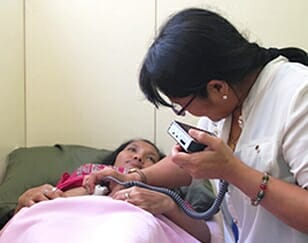
“Being doctors here in the Philippines where there is widespread poverty, my husband and I set up a modest private medical clinic in our small house. It’s certainly was not easy thinking of our colleagues who all have careers in the West. At times we ask if we did well to stay here. But the thought of so many needy people among our own people – children in need of medical care, married couples in need of guidance, the elderly with terminal illnesses. . . The Gospel motivates us to give a personal contribution towards improving society beginning from our own land.” L. R. – Philippines
Moses drawn from the street
“A large family: six children and one on the way, who then died before birth. The mother was saved, but for several days she lingered between life and death. During those days, some military had taken to the hospital in which she was being care for, a newborn that had been abandonend on the street. After some treatment, he recovered but was in need of a family. He immediately found it in that mother who had lost her child. His new parents named him Joseph-Moses, because the hospital is called St. Joseph’s, and Moses because he had been abandoned and found.”H. E. – Congo
I wanted to have my revenge
“I lost my mother just eight days before my marriage. She had been hit by a car, and I decided to have my revenge. I took a bus to the place where the driver lived. On the way, I recalled some words about love of God and neighbour and, little by little, my anger faded. When the other person saw who I was, he turned pale, but I calmed him: I was there only to find out how the accident had happened. After listening to his story, which he shared amidst tears, I tried to put him at peace and the joy promised by the Gospel accompanied me on the return trip.” F.A. – Rome
Source: The Gospel of the Day – March 2015 – Città Nuova editrice
24 Mar 2015 | Focolare Worldwide
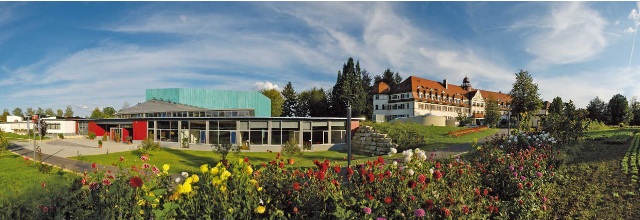
The “Haus Schoenblick” (Schwaebisch Gmuend) Evangelical Training Center
150 heads of evangelical movements and free churches, within the multi-faceted reality of the evangelical world, and with representatives of Catholic movements, posed the query: how to remain faithful to one’s own charism in times of great change?
It is the situation of how various movements that arose over the last century can face the situations today and how they can respond to the various challenges facing Christian ideals, and their searching for new answers, adapted to the times we are living in, though remaining faithful to their roots.
At the “Leaders Convention” Gerhard Pross, moderator and one of the more renowned figures of Together for Europe (network of Christian movements that work together for the benefit of the European continent) and who wanted Focolare President, Chiara Lubich, to be present, as the first successor of Chiara Lubich and as the leader of the Movement.
Maria Voce’s reflection helped to understand the difference between the foundation phases and the “charismatic period,” “full of new, dynamic, luminous surprises,” and the phase of maturity, the “period of creative faithfulness” of a movement, in which, to “grow, develop and multiply” with originality, the inspirational ideas and established by the founder. She went on to recount the Focolare’s commitment to live a widespread leading role of those who live the spirituality and share its aims, and above all, to “go out” more in the “various environments of life and society,” without limiting themselves to living and testifying to unity within the movement, but bringing the spirit and experience of unity to the entire world, “so that all may be one” (John 17.21), the specific aim of the Focolare. “We cannot therefore think of ourselves, Maria Voce affirmed, “we have to “go out” and give of ourselves.” To be able to go beyond ourselves, we need to choose Jesus Forsaken who in his abandonment went beyond himself to unite man once again with God, and unity is one of the main points of the spirituality of unity.
There were members of the evangelical Church, Pentecostal and charismatic movements,
each of which are involved in different way or in social works or on the front of evangelisation, education, political commitment. The “Leaders’ Convention” was created in 1974, well before John Paul II launched in 1998 the communion between movements within the Catholic Church This experience of sharing has therefore continued for some years now. A significant moment which all remembered was in 2000, when with Chiara Lubich at Rothenburg a step forward towards reconciliation was made. In fact the long standing misunderstandings that had developed along the years were cleared up during the “historic moment of mutual forgiveness,” Maria Voce recalled, and which became «a founding experience for communion between movements and communities of different Churches, which later came up with the project “Together for Europe.”
A common step which all look to is the Munich 2016 event, when the “Together for Europe” network will meet for a congress and public manifestation, and will be in turn a step towards the 500th anniversary of Luther’s Reform, offering itself as a prophetic sign of a reconciled and united Europe. On her return from Germany on 4 March, Maria Voce participated in the audience with Pope Francis together with the Bishop-Friends of the Focolare, and conveyed to him the greetings of the 150 representatives of the evangelical movements and their hope in the common commitment for unity. “Very well,” Pope Francis said, when he thanked them. «Your work on the ecumenical front is very important».
21 Mar 2015 | Focolare Worldwide
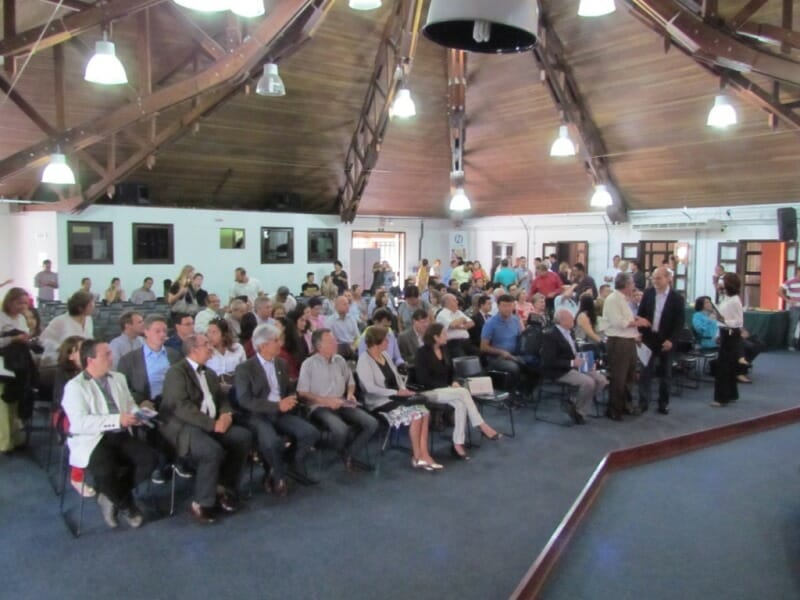
Saturday 14 March. The “Salão dos Atos” hall immersed in the greens of the Curitiba Barigui Park, was filled with Federal and State Deputies, Mayors, Councillors, Public Officers, youth and academics who came from the Amazon, the Northeast, Brasilia and other cities of Brazil.
Unusual words echoed in the meeting hall: politics was presented as the “ love of loves” which urges Public Administrators to create projects that respond to the demands of the communities and gives citizens the possibility to achieve their own aspirations.» They all were reminded that «power that enforces but it is love that confers authority.» The word “fraternity” was often repeated, not only as the ethical principle of politics but as “its very substance.” These were the central points of Chiara Lubich’s thought which Maria Voce, President of the Focolare, cited in her message and which were deepened in the various speeches.
This vision of politics that Chiara herself had proposed years ago in the parliaments of the various countries, appeared today like a light in the crisis tunnel Brazil is undergoing. It stirred up new hope, because many testimonials testified to its implementation not only in Brazil, but also in other countries. An innovative panorama, presented in a documentary-video at the start of the event promoted by the Political Movement for Unity (MPPU) of the Focolare, on Chiara’s
The meeting took place simultaneously with two popular manifestations of opposite beliefs and many of the interventions underlined the political, economic and ethical crises, stressing the growing lack of faith in the institutions. «We have come as mediators, called to change this situation through dialogue and fraternity,», said Sergio Previdi, National President of the MPPU.
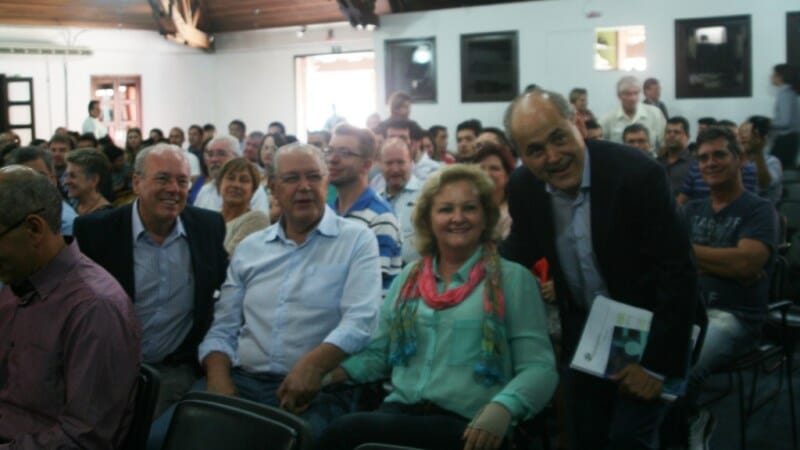 «This is a great challenge. Democracy is not only a technical fact, but needs a soul, We have to re-think politics in order re-humanize it,” affirmed Gustavo Fruet, Mayor of Curitiba. And he cited the innovative political culture of Chiara, which inspired the 2010-2030 programme to make Curitiba “a global innovator city,” already recognised as a model of sustainable planning and as the city of fraternity ».
Many of the speeches of Councillors and Deputies of various political parties that try, not without effort, to actuate a politics that goes against the current, testified to how they draw from MPPU a “new strength and new commitment.”
«Fraternity means implementing a strategy of unity, seeking dialogue between the majority party and the opposition between institutions and societies, in the mutual effort to achieve common good», affirmed the Mayor of Sorocaba, Antonio Carlo Pannunzio.
Julio Carneiro of MPPU Brazil, mentioned the citadels founded by Chiara Lubich (more than 20as of today), as model-structures of a city, to testify to the impact fraternity has on civil coexistence..
«A new political culture that calls for new men and women», affirmed Prof. Marconi Aurélio Silva, highlighting the urgent need to train the youth in active citizenship, based on fraternity: «given that we are by nature relational beings and not isolated individuals » And he spoke of the many results achieved by the Civitas School in many states of Brazil and the world.
For further information consult: www.mppu.org.br – www.focolares.org.br
20 Mar 2015 | Focolare Worldwide
19 Mar 2015 | Focolare Worldwide
It is more than ten hours by plane from the Mongolian capital, Ulan Bator, to Daejeon, South Korea, but both cities belong to a single diocese. Outside the capital, the population density of Mongolia is two inhabitants per square kilometre. Christians comprise 2% of the population in a land with a Buddhist tradition of thousands of years (53%) and widespread atheism (29%).
As the local church was wondering how it would care for the few Christians, it turned to the New Famlies of the Focolare Movement for help, finding that several Korean families were willing to share the Gospel message along with their witness to the spirituality of unity as it is lived in families. The parish of Ulan Bator has a social centre that welcomes children and teenagers for after-school programmes, a community farm and a free clinic. This is where the Focolare carries out its main mission. Let’s see what that mission is.
Two or three couples from Korea travel regularly to Mongolia, to visit parishes and meet with families. The main topic is families and how they apply the Gospel to their daily lives. This has brought about the transformation of couples and families in that land as well. They also meet with young people.
“Once, we brought medicines,” Cedam recounts. “The joy of the reverend sister was indescribable when we handed her the package: they were exactly the medicines she had been looking for, since her own had run out. Winter lasts for half the year in Mongolia. For months the temperature reaches -40°C, and so it is quite difficult to leave one’s home in search of the necessities. As the day approaches for our visit to Mongolia, the other families in the community gather provisions that can be taken along. One time we thought of taking footballs and basketballs so that the boys could play on the wide plains, but we needed to buy them and then there was the problem of geting them on the plane. . . One family had placed a money box in its shop to collect funds for the Mongolian families, and so we were able to buy not only balls, but also the equipment for inflating them.”
“The bishop is our driver,” Andrea continues. “He welcomes us at the bishop’s house, drives us to the parishes and encourages us to give with open hands our experiences as Christian families. We find that this is what families are most waiting to hear. The more we visit them, the more affection they express when we go back again. They also want to share how they have been living the Gospel. During one homily, in the presence of several congregations of sisters, the bishop said that we had been sent by God as misionaries and, calling us each by name, he described us as: my friends. Whenver we leave Mongolia, we feel like we are leaving a piece of our hearts behind. Because every time it’s like an experience of what the first Christian communities must have been like.”
18 Mar 2015 | Focolare Worldwide, Senza categoria
Lara Abou Moussa and George Zahm
