9 Apr 2015 | Focolare Worldwide
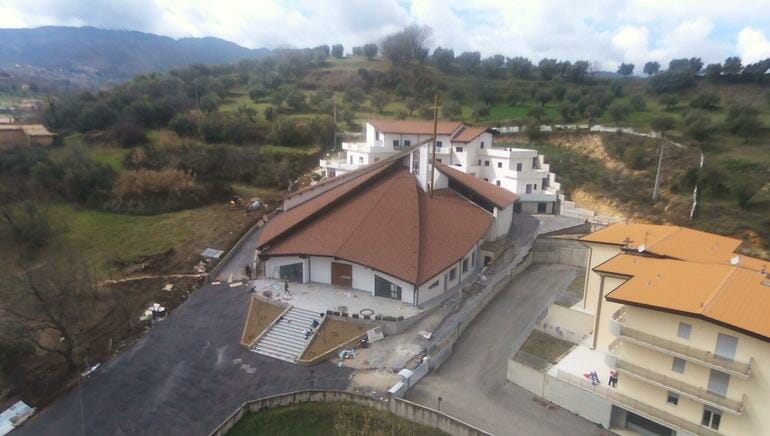
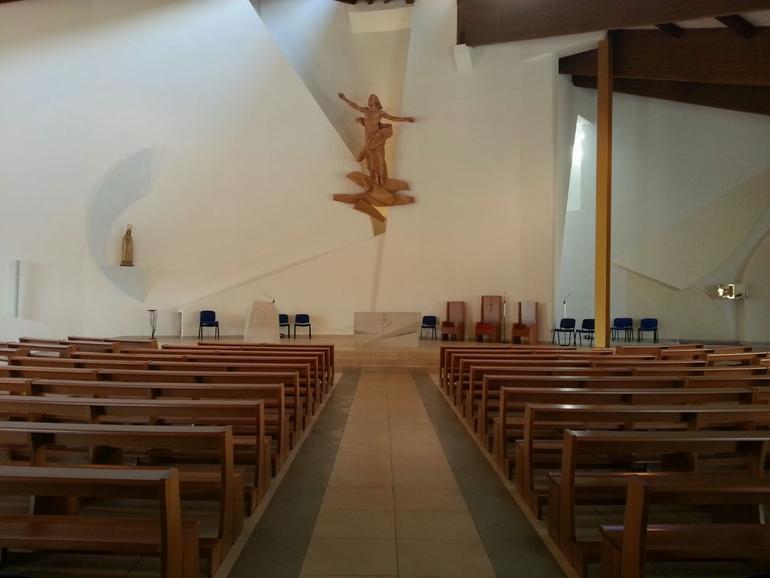
On 20 March the new parish church, dedicated to Christ the Saviour, was inaugurated in Mendicino, in Cosenza, Italy. The event was celebrated on the anniversary of Msgr. Nunnari and it fulfilled the dream of the entire parish community, composed of 10,000 inhabitants, which now enjoys a place of worship of an extremely unique structure. It comprises about 15 rooms for catechism lessons, a meeting hall and presbytery. The project, carried out by means of technical support by local experts, was designed by The Ave Arts Centre in Loppiano, which designs are inspired by research done through the years by a team of architects who work in the little town of the Focolare.
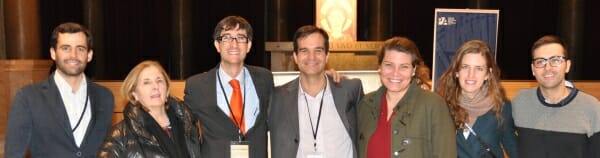
 Apart from its constant internal reflection, this group aims at building a relationship of synergy also with architects in other parts of the world. Last December, for example, they participated at an international conference organised in Barcelona, Spain, by the Association of Catalonian Architects, on the theme of sacred patrimony. The team of architects took part not only as representatives of the Arts Centre in Loppiano, but also as part of the “Dialogue in Architecture” inundation of the Focolare Movement, which is composed of scholars and professionals whose main focus and interest revolves around the theme of architecture.
During this conference in Spain, three of the architects, Mario Mario Tancredi and Iole Parisi from Italy, and Tobias Klodwig from Germany, were asked to do a presentation entitled: “Flexible Christianity – Community Life and Sacred Spaces”. The approach that was presented greatly interested the 150 architects from Spain and other European countries who attended the conference.
The three speakers started off by explaining how forms and spaces in the field of architecture change according to the experience of different Christian communities. This generated a discussion and a reflection on the fact that architecture is always enriched by elements that are “intangible”, by what the very concept of “sacred” can assume in various cultural contexts: the strong social values perceived in Latin America; the prophetic ancestral signs found in Africa; the value of symbolic expressions contained in European cathedrals and churches in globalized metropolises. They pointed out a few concrete examples to illustrate this: the Church in Loppiano called Maria Théotokos, which is an expression of a contemporary charism, the Church of St Claire in Fontem, Africa, which communicates the values of the local culture, and some projects where disused churches in Germany had undergone a transformation.
With regards to the cultural research that “Dialogue in Architecture” aims to develop, it’s in continual evolution, driven by the need to bring together – precisely because it has to do with the Absolute One – continuity and innovation,and this is achieved by means of a dialogue which is evermore constructive both with the clientele and the academic world.
8 Apr 2015 | Focolare Worldwide
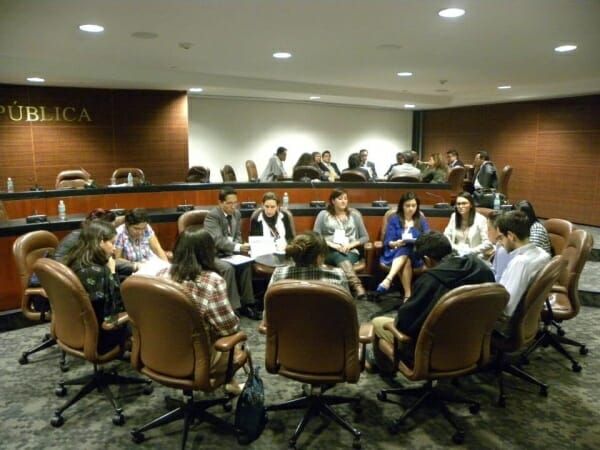
“Hi, my name’s Abraham, and I come from Mexico: a population of noble and deeply religious people, with their arms spread out to the world.” These were his opening words to an audience of 300 young people in a hall of the Italian Parliament, who gathered to pay homage to Chiara Lubich and her prophetic vision of politics. Abraham has brought along his background in a country torn apart by narcotrafficking and the lords of death. He himself had lived the experience of having a gun pointed at his head by the police who mistook him for a drug pusher while the real one was standing beside him, forced by poverty to take that path. “In 2006,” he continued, “the battle against narcotraffic was a war that in eight years had left on the field more war victims than in Vietnam, among which were many innocent people who struggle every day to maintain their civil commitment: journalists, activists, etc. Often the people protested against the Government which has been losing its credibility amid a strong social and economic crisis”
“I live in Mexico City where every day, we are faced with a new challenge; despite this I believe in a united world and in the ideal of a united world and universal brotherhood. But I know that change has to start from myself, without expecting it from the others and not even from the authorities.”
“If I were you, who are so concerned for the common good in Mexico,” affirmed Luigino Bruni addressing the youth – I would try to look at the causes of this disease, among which is financial capitalism that increases the inequalities. These are types of wealth that are no longer inclusive.» «The first step to take when one wishes to change a country is to love it,» the economist underlined again, spurred by the testimonial of Abraham. «Every country has its vocation to beauty, its own genius, and identity, though ambivalent.» And then an advice: study more, learn a profession! «Are you a minority? It does not matter. Just a handful would suffice, few but really very motivated. It is the prophetic minority that changes the world. And do not stop believing that a different world is possible. The first battle to fight when we are young is to not lose faith in the ideal. We have to believe in the impossible in order to have a good possibility.“
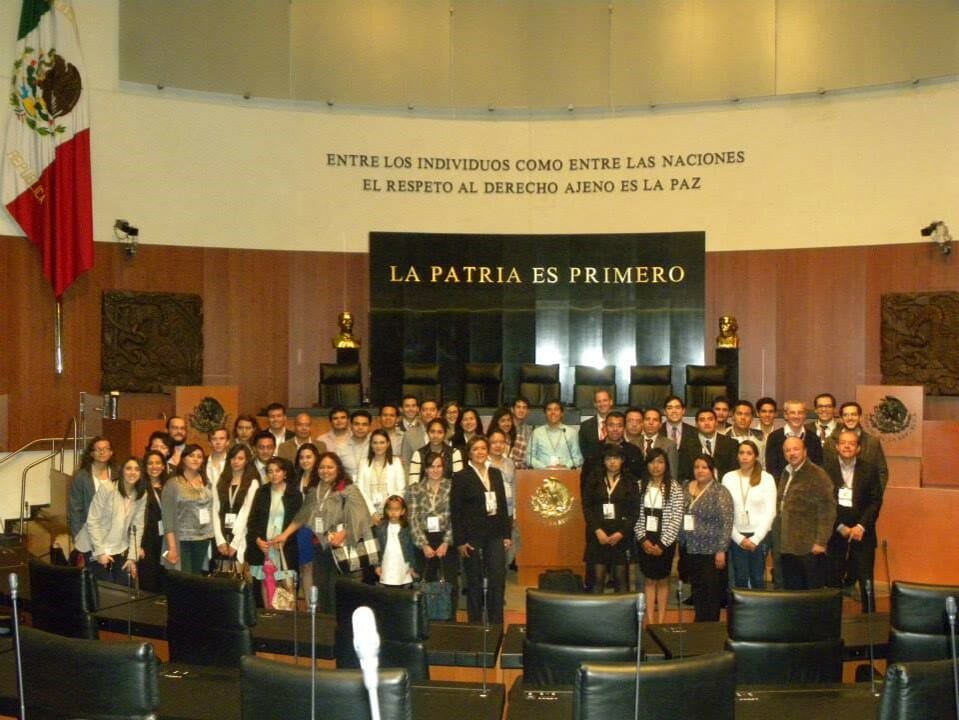
At the Mexican Senate
“Some offered me drugs many times, others robbed me,” continued Abraham, “Some time ago while going home after school, a boy approached me asking for a cigarette. At the same time the police arrived to arrest us. He had drugs in his pocket while I only had books in my backpack. They started to beat him up while the other policeman held a gun at my head, asking me where the drugs were. When the police left, I helped this boy to his feet and gave him the little money I had. He embraced me and said: “You know, I feed my family with these few coins?” I realised how a small act of love really releases great strength and we never know how far it will go. Despite my feeling so helpless, I want to try and see my neighbours and the people I meet on the street with new eyes, and with other friends I want to give a concrete contribution.
“In my desire to a greater commitment for the good of my country, despite the many difficulties and discouragement of many, on 20 March the youth of diverse organisations met in the Mexican Senate for a day’s event with politicians on dialogue, which is very important in a world that is awaiting the answers to bigger challenges.”
7 Apr 2015 | Focolare Worldwide
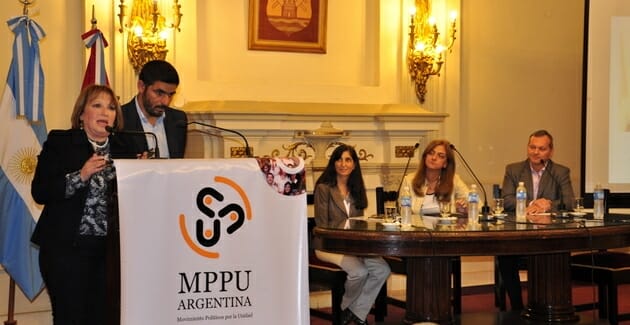
“Chiara Lubich has brought understanding and gentleness, but basically what she has given to us, through her simplicity, is a great current of love towards the other person. To live in community, to know how to share, to work for the common good and to succeed in building fraternity also through diverse political viewpoints, this in summary is her message.” So stated Alicia Monic Pregno, Vice-Governor for the Province of Cordoba (Argentina), in the context of this international acknowledgement of the inheritance transmitted through the thought and life of Chiara Lubich. During its session on 25 March 2015, the House of Representatives in the Province, approved the posthumous decree in recognition of the Work of Focolare Movement founder.
The ceremony was held in the same parliamentary hall in the presence of a huge crowd which included members of parliament of different political parties, representatives of Comipaz (Interreligious Committee for Peace), young political students of the Movement of Politics & Policies for Unity, university professors, members of social organisation, and others.
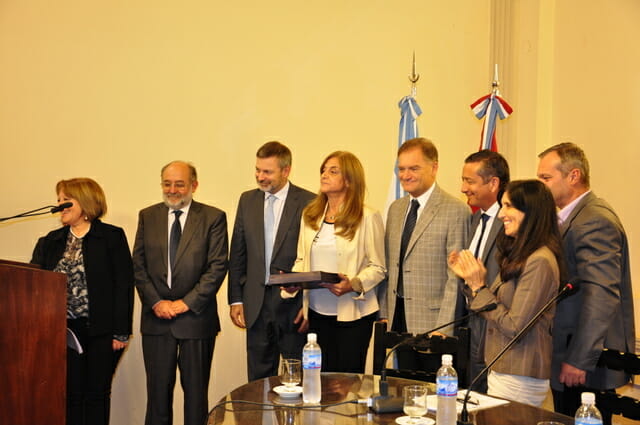 The delegates of the Focolare Movement in Cordoba presented the figure of Chiara Lubich and immediately afterwards the Vice-Governor invited politicians from different political parties to carry out the symbolic gesture of consigning to them, all together, the decree and the commemorative plaque.
Alicia Monica Pregno then went on to explain the motivations for the award: the contribution towards the building up of a community which promotes the “spirituality of unity”, adding that “Lubich’s message raises many questions which lead us to reflect on the reason behind all the conflicts, on why we are not always able to think things out together.” She said, “I believe that the world is called to journey towards a better destiny, and this is achievable in the measure that we lay aside our personal interests and are open to resolve issues through a shared outlook. This is a great challenge in these times characterised by much individualism.”
Pastor Raffa, representing Comipaz, then spoke. He emphasised the contribution of the charism of Chiara Lubich to the “birth of this commission right from the beginning”; and Soher El Sucaría, political activist, shared how through an experience lived within the Interreligious Committee for Peace, the value of this service became more and more evident.
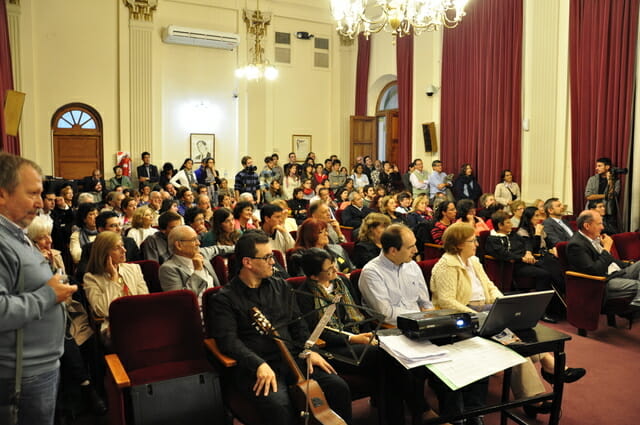 Several testimonies by individual citizens then followed. They told stories of personal transformation and their commitment to local politics: from joining forces with neighbours in order to resolve the problems of their neighbourhoods, to assuming political commitment on a regional and national level. This part of the program was conducted through two round tables. The first, entitled “Fraternity, Seed of Social Transformation”, included the participation of Estela Daima (Director of a Caritas Department in Rio III which conducts a break-making activity involving 40 women), Paola Chávez, Secretary of Fazenda de la Esperanza association (who presented the testimony of Agustina, a reformed juvenile criminal), and Ricardo Galli, economist and entrepreneur of an Economy of Communion project.
In the round table entitled “The Contribution of Fraternity to Politics: Experiences and Challenges”, Laura Blanco, a socialist, presented the Schools of Politics organised in Parliament House, as well as her commitment to live fraternity in the political arena. Other speakers included Julio Bañuelos, Mayor of Mina Clavero, and Guillermo Castillo, member of the Christian Democratic Party and public administrator.
In all those present there was the certainty that when fraternity is lived as a political goal, it provides answers to the challenges of today which call for a society that is more just and all-embracing.
In conclusion, the Vice-Governor expressed her appreciation that the Parliament of Cordoba is the centre for the Schools of Politics for young people and underlined the efforts which are being made in living the concept of fraternity within Parliament itself.
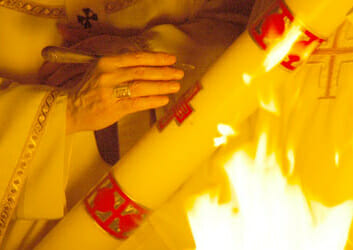
3 Apr 2015 | Focolare Worldwide
“Oh, there’s a light with nails on it!
So exclaims a child in front of the Paschal candle.
We can feel the nails.
But can we see the Light?
And what about us … do we give out light?
We are nailed
to ourselves and to others;
to our time and our responsibilities.
The Holy One has allowed himself to be nailed to our cross.
And it was from there that he come down.
He was nailed right up until he died.
In this way he became light for everyone;
that light which penetrates closed doors.
He is risen
and shows the signs of the nails.
Light which was nailed.
We feel the nails.
But can we see the Light? And what about us … do we give light?
(From a pastoral letter on the occasion of Easter 1984)
Klaus Hemmerle, “La luce dentro le cose”, Città Nuova, Rome 1998, p. 109.
30 Mar 2015 | Focolare Worldwide
“Everyone would like to see the Economy of Communion project expand in Africa, out of love for Africa, in order to understand its cultures and practice reciprocity and communion,” said Luigino Bruni, international coordinator of the EoC project, as he looked ahead to the upcoming international gathering in May. That gathering will take place in Kenya, Nairobi, with international representatives from the EoC who will share ideas, innovations and production, but also work, microcredit, inequality and poverty. The African businesses which, from this year, have begun to share their profits with the poor of the world have grown to ten businesses, while twelve businesses are heading in that direction. This is all thanks to a growing spreading of a culture of economy of communion in Africa.
This was demonstrated with the recent international conference (February 9-13), which was hosted by Cameroon University, the Catholic University of Buea (CUIB) at the request of the university’s Rector, Fr.. George Kkeze, and by the Bishop, Emmanuel Bushu.
Speakers included Benedetto Gui, currently a professor at Sophia University Institute (Florence, Italy) and Brice Kemguem, National Director for Central Africa in the international ngo named AHA (African Humanitarian Agency). They were accompanied by Steve William Azeumo, from the EoC Commission of the Central African area, Winnifred Nwafor, from the EoC Commission of Fontem, Cameroon, Isabel Awungnjia Atem and Mabih Nji, both graduates of the Sophia University Institute in the role of local facilitators at CUIB.
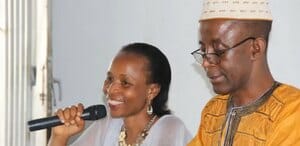 The topics included in the programme have ranged from contemporary economic issues that are dear to the Social Doctrine of the Church and that we find in the values and principles of the EoC, to the great economic and social problems of our time and the shortage of drinking water, epidemics and armed conflicts with weapons of mass destruction.
Thanks to the video conference connection, it was possible to get to know experiences from around the world. A connection made with the Sophia University Institute facilitated an exchange between the students of the two institutions. After that, two EoC entrepreneurs shared their experiences: Alberto Ferrucci, managing director of a company that produces software for refineries emphasized various aspects of an economy of sharing, a new proposal to solve the economic problems of our age. Teresa Ganzon (manager of the Philippine Rural Bank Bangko Kabayan) reminded participants of the principles of good corporate management that led her to resume her studies in adulthood in order to acquire the necessary knowledge and skills to manage the bank, helping the increase of activity of rural microfinance (micro-credit to farmers and small traders) in the area.
Some Cameroonian experiences were also shared, such as that of chief Fobella Morfaw and his wife, who founded a school in the town of Dschang in 2003 which today consists of a kindergarten, primary and secondary schools; or that of the Civil Engineering Studio at BSE (Bridge Structure Engineering Consulting) that thanks to the great experience of a ‘senior’ partner has now got to the point of getting by and managing well in the midst of a very fierce competition. The studio benefited from the financial and moral support of the Gimou couple; in the days immediately preceding the school Mrs. Marie Madeleine Gimou left this earth and this has deeply moved the participants of the conference. Her husband M. Victor Gimou who has been an engineer for over 23 years continues to support the young studio and to offer access to his library collected throughout his more than 30 years of work.
A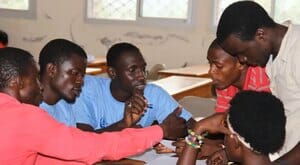 n important part of the program was composed of the workshops in the afternoon, aimed to discuss cases of companies and to prepare projects of micro-enterprises: these had a high attendance and caused amazement because of the quality of the papers presented in the plenary sessions; the best EoC business plan was awarded in the concluding session.
If we want to make a small balance: we were treated to a very fruitful week, thanks to the preparatory work done by the University and the very positive attitude of the young people who volunteered to participate, also encouraged by a recognition of university credits in exchange. There was a very sympathetic register and a cheerful atmosphere throughout the conference: the intervals were often filled with fun activities, a little dance or music. The evening of celebration was simply breathtaking, with songs and dances organized by the young people, with that “little extra atmosphere” that was created by the light of the phones, because there was a sudden blackout.
Participants had very positive impressions: many of them admitted that, in addition to proposing a style of enterprise management, the EoC is also a “proposal of life” that you can put into practice immediately, and many declared they wanted to follow it. In short: a lot of positive vibes and desire to do and work for a better world.
Edc online
Video of the Conference:
https://www.youtube.com/watch?v=RxwKXsEvmn0
26 Mar 2015 | Focolare Worldwide
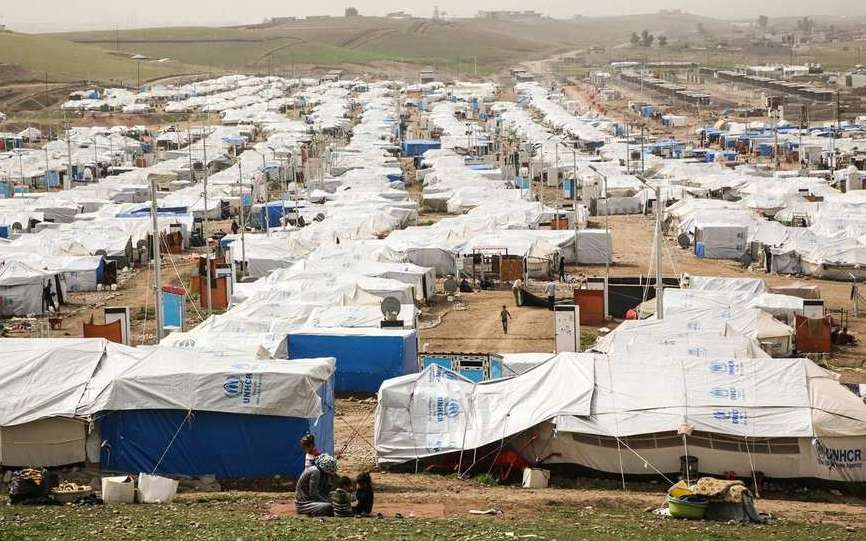
“I live in Erbil, northern Iraq, where I began a school for Kurdish children in 2010,” says Malu Villafane, who born in the Philippines. For the past few years I have been working in a local sanctuary, organising activites and projects. Last August, the shrine was turned into a refugee camp. The cities of Sinjar and Mosul, along with adjacent villages like Qaraqush, Aaramlesh, Bartalla and others, had been invaded by ISIS. The inhabitants fled leaving everything behind, and they took refuge in Kurdistan, with us. There was a very heavy atmosphere in the camp, so much pessimism, children lost and abandoned. Together with the people in charge of the centre, we started up some activities for the teenagers and children, which also involved some of my colleagues from school.”
Over the years, how have Christians, Muslims, Yazidis and other ethnic groups coexisted, such as the Kurds, Turkmen, and so on?
“They respected each other, and did everything together. I work with the Kurds, Turkmen, Arabs and other foreigners. During the crisis many Kurds hosted refugees in their own homes. The Kurdistan people don’t condone this massacre.”
When did the refugee crisis begin in Erbil? Where did they settle? What will they do over the next few months?
“The crisis which caused this forced migration already began in June 2014 and worsened at the beginning of August. The people lost everything: home, work, school. Many of them first took refuge in empty buildings, churches and on the streets. When they could, they stayed with relatives in Erbil. Many non-profit organisations, along with the Church, had to respond to the crisis without any time to prepare. They were in need of everything! Working together we were able to collect a lot of basic necessities. During that period, the temperature rose above 50°C, infernally hot. Now, during the winter it is quite cold. There are not enough tents to house the thousands of families. There are camps without food and water for extended periods of time. Yet, after a few months, the children began to smile and play, to experience something outside the camps, like visiting the swimming pool or public park. The parents see their children’s joy, and rediscover hope. They’ve begun to clean the camp, to cook and give a hand.
After living in this dramatic situation with them, my life was turned upside down. My stay in Iraq took on a very deep meaning: I was living for universal brotherhood.
But does it make sense to work for brotherhood? What pushes you to go on working in the camp?
“If I look at the situation from a human point of view, I become discouraged and feel like escaping. But, if I look at it with the eyes of a hope based on faith, I’m able to go beyond all the suffering I see. I think of the words of the Gospel: “When I was hungry, you gave me something to eat; when I was sad, you comforted me. . .” These words give me strength to face the daily difficulties that I encounter in the camp. It’s not easy to describe all the suffering there is; many of them have lost hope, lost everything. This experience has expanded my heart to welcome everyone as a brother, a sister. It has enabled me to come out of my own comfortable little world and serve others. I want to live for universal brotherhood not because it solves problems, but because, one step at a time, it’s like planting a seed. Peace mostly grows from the small things we do for one another each day.”
What can we do from where we are, to be near to these people?
“I think we need to begin by confronting the topic of “disinformation.” Even though the emergency continues, hardly anyone speaks of it. Spread a culture that welcomes and listens, especially amongst the different races and religions of your cities; promote activities and projects that break down the walls. I thank all of you for your help, and may we continue to believe that Peace is possible.”
Source: Umanità Nuova online
