Focolare Movement
Paris: New Responsibilities for Peacebuilders

Paris: New Responsibilities for Peacebuilders

   “In the face of the dramatic events that took place in Paris last night, in addition to those in many other areas of the world, we stand in mourning with those who have lost loved ones and with those who believe that the unity of the human family is possible. As we stand in dismay and in the firm condemnation of such acts against human life, a question becomes very clear: have we taken every step and every action possible to build the necessary conditions for preventing violence and terrorist acts – including the encouragement of equality, of more solidarity, more communion of goods? In the face of events that appear perverse, it is obvious that there is no single answer. But it is also obvious that an uncontrolled reaction to violence will not deter those who want to destroy the life forces of peoples and their aspiration to coexist in peace. Paris_02 The conviction that the world can walk towards unity, and overcome confrontation and armed violence, remains alive in the spirit and in the actions of those who have love for every person and the future of the human family at heart, and want to bring it about through political action, through the right use of economy, and the rule of law. The Focolare Movement, while it weeps with those who weep, continues to believe in the path of dialogue, of acceptance and of respect for the other, whoever that may be and from whatever background, religious belief, and ethnicity. Therefore, together with all those working for peace, in various posts of responsibility and often at risk to themselves, the Focolare renews its commitment to intensify and multiply acts and gestures of reconciliation, opportunities for dialogue and communion, for encounter and sharing at all levels and in all parts of the world, so as to embrace the cry of humanity and transform it into new hope.”          
The Church in Italy and the Courage to Be Human

The Church in Italy and the Courage to Be Human

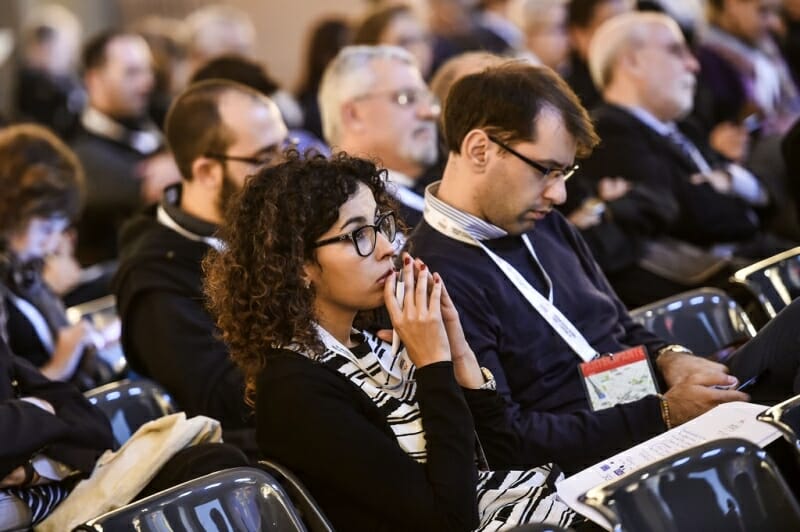
The Fifth National Ecclesial Convention in Florence, Italy, (November 9-13), Foto: Cristian Gennari/Siciliani

The convention in Florence has ended. “A New Humanism in Christ Jesus”. How are we to read the deeper significance of this event for the Church in Italy? “It could be read in many ways, but I think it was a decisive and historic moment for the Italian Church: first of all, because of the strong message that Pope Francis delivered to the 2000 delegates in the presence of the entire Bishops Conference. The event occurs in the heart of the pontificate, in a moment when reform is pressing and concrete. With Pope Francis’s desire for reform as its mirror, the Church in Italy is inexorably called to reform itself. The Pope’s speech is above all a call to conversion at every level: conversion of people, of communities, of structures. . .” What were the main points the Pope made in his speech? “The first was the image that the Pope presented: the Ecce Homo (Behold the Man): A Christ who has been stripped down, who does not entrust himself to procedures, nor to organisations; who does not pretend to occupy places of authority, but who takes on the sufferings of humanity. That is Jesus in his true essence, in his mission as the one sent by the Father for the salvation of all. This was the first point. Then, the Pope invited the Italian Church to be more in keeping with the Gospel, to be more as the Holy Spirit wants it to be at this moment in time. As he put it, only a Church that is able to be humble, disinterested, and reflect the Beatitudes can resemble this Teacher, this Ecce Homo, and present itself to society as love.
20151114-04

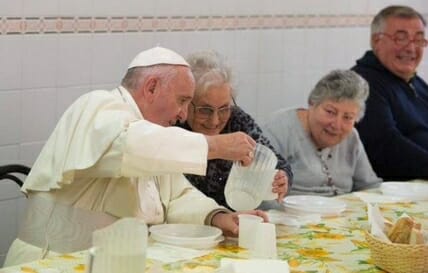
Pope Francis having lunch at the soup kithen. Photo: Ansa
On the other hand, the Pope radicalised Christian humanism while warning of the two risks that he mentioned: the risk of Pelagianism, which is the temptation to want to do it on our own, trusting solely in our own ability, in our own tools, in our power and in the ability to programme. He also warned of the risk of Gnosticism, the risk of disembodiment, of one’s own non-incarnation. That would be presenting a Jesus whom you cannot touch with your hands, whom you cannot hold on to. The actualisation of Christian humanism must begin from Jesus. It must be centred in Him, not in our strengths. It must be incarnated, embodied. It cannot be left in the documents, in the proclamations nor even in the beautiful works of art that we have seen here in Florence. Christian humanism has to be incarnated in the life of the people.” Fifty per cent of the people attending the event were laity. That indicates a force of the Church that wants to join the game. What was new in the work groups? “One of the novelties in Florence was methodology. The day and a half devoted to work groups made it possible for more people to participate actively, to give themselves. But if, out of 2000 people, a half is still clergy, then it is not yet sufficient, because Italian society is not like that. There are women, yes, but still too few; young people, but still too few. Let’s hope that we continue along these lines, towards better representation.” Any hot impressions after having attended the Convention? “There was a beautiful climate of openness, cordiality in the deepest sense where everyone mixes in with everyone else, bishops and priests sitting down and having lunch with the participants…. That in itself created a great family atmosphere and therefore enthusiasm, happiness, sharing and communion, a deep desire to listen that makes us hope.”

Migration: A signal from Malta

Migration: A signal from Malta

VallettaSummit

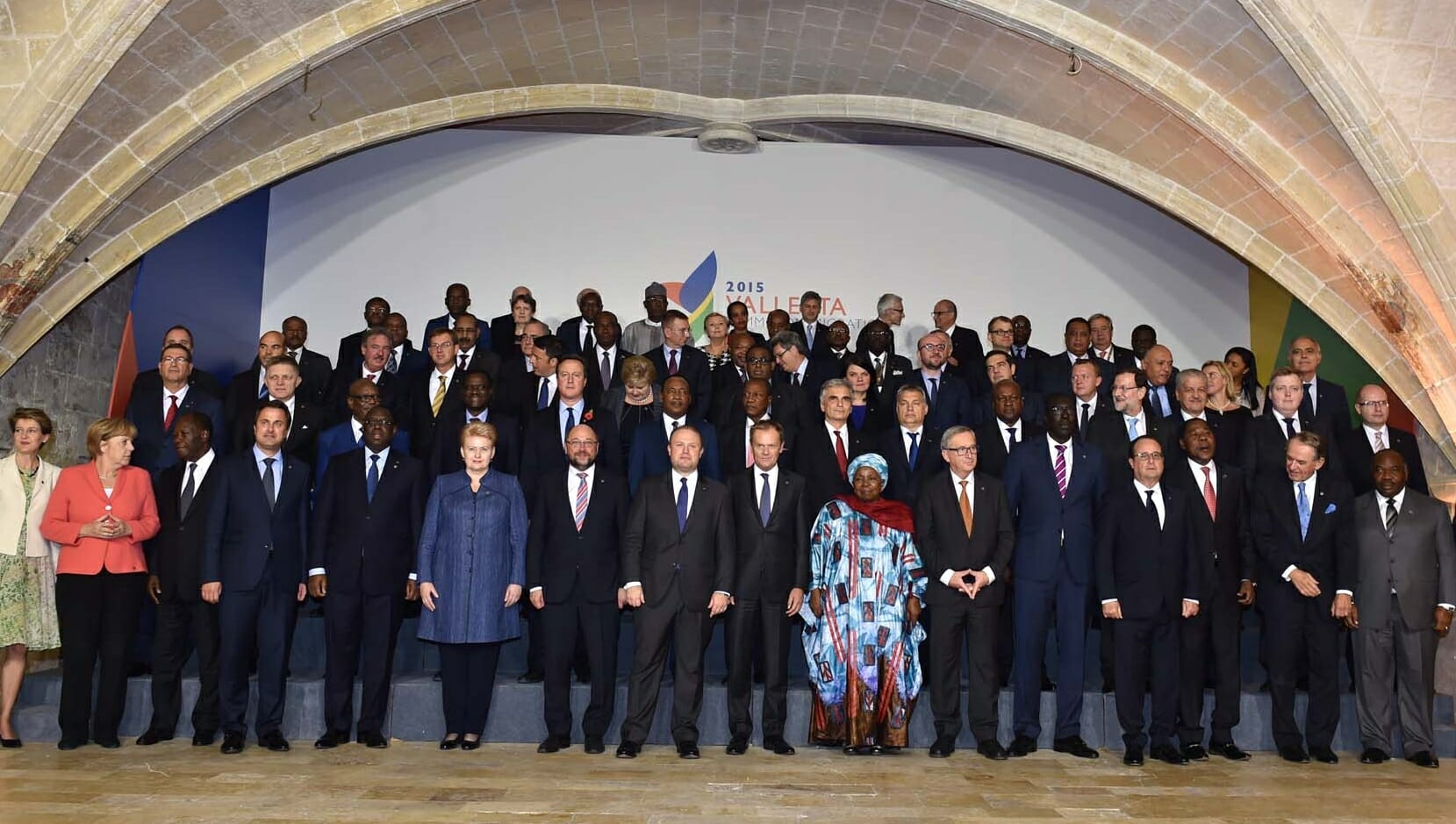
European Union and African nation leaders present at the Valletta Summit on Migration (Malta, 11-12 November 2015)
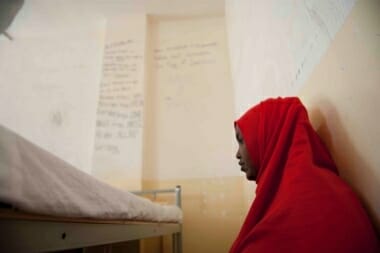
On November 11-12, Malta hosted the Valletta Summit on Migration promoted by the European Council, during which 28 countries of the European Union met with 35 African countries and representatives of the United Nations. Its goals, as expressed on the Council’s website, include “addressing the root causes by working to help create peace, stability and economic development; improving work on promoting and organising legal migration channels; enhancing the protection of migrants and asylum seekers, particularly vulnerable groups; tackling more effectively the exploitation and trafficking of migrants; working more closely to improve cooperation on return and readmission.” But, meanwhile, it was the Maltese themselves who stepped up and dealt with the situation, also becoming involved in welcoming the migrants. Anna Caruana Colombo, a Volunteer from the Focolare Movement, told New City Magazine how she and her friends engaged over thirty people in a process of learning about the conditions and the needs of the migrants – thanks to the Jesuit refugee service – and then visiting the welcome centres where people who have already obtained refugee status can find lodging. 20151113-03In one centre they held English classes; provided useful information about Malta; and simply spent time with the migrants. In another centre that welcomed families, they provided child care and tried to meet the basic needs of the little ones. Later, when they received permission, the Volunteers also went into the detention centres, Anna recounted: “The refugees were in rooms with bunk beds, even twelve per room, and there was not enough room for everyone. At first they were shocked, but seeing that we only wanted to befriend them, they overcame their mistrust. From English lessons we also moved on to more enjoyable moments with music and dance; and the guards remarked that they had never seen them so happy.” The young people of the Focolare Movement also became involved, inviting the refugees to events for teenagers such as the Run4Unity; and to the Mariapolis for a few days of meetings with Focolare friends and sympathisers. “Our project is beginning to gain visibility,” Anna concluded, “and we were asked to present our experience to the other Ecclesial Movements.”

Solidarity with the Central African Republic

Solidarity with the Central African Republic

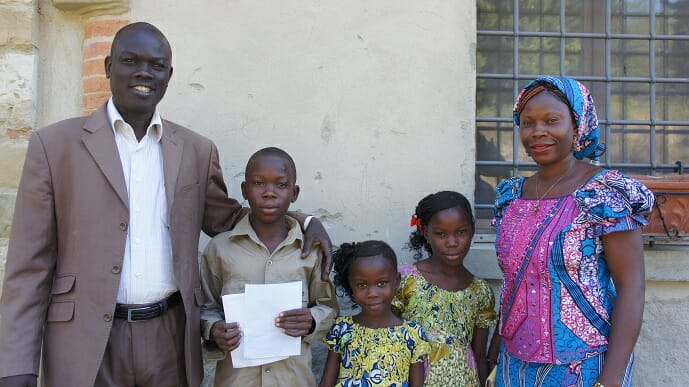
The Molu family

The escalation of serious political-military uprisings has not changed the programme of Pope Francis. An authentic messenger of peace, he announced in his sermon on All Saints Day that on 29 November he will be visiting that troubled country which has been experiencing one of the many war hotspots of the planet, for more than three years. The International Community seems to have ignored these fratricidal, forgotten wars. It all began in 2012 with the occupation of vast areas of the country by a segment of the group of rebels, who destroyed not only the institutional offices but also all that bore the mark of Christians: a new factor for the prevalently Christian Central African Republic, with a minority of Muslims and people of traditional religions who peacefully coexist. There were outright profanation of churches, and raids of social work centres, schools, hospitals, dispensaries, shops and homes of Christians, leading to a n immense food and health emergency situation. Out of a population of five million inhabitants, 820,000 have had to leave their own homes. Construction works can no longer continue, children cannot be sent to school, and farming activities have stopped. Even that parcel of community land, which an Italian Foundation had bought a few years back for the families of the Focolare, forcedly remains uncultivated and still consists of a fenced lot, a well, the keeper’s guardhouse and year by year, resources for the acquisition of seeds. A project that has helped to feed the families and also earn something through the sales of some products, have all gone. What remains active is the AFN (www.afnonlus.org) which gives support from a distance to children and adolescents. But the subscriptions total 89, and are like a drop in the ocean. In 2013 Petula and Patrick Moulo, with three kids and two adopted ones, hosted 34 people in their home, sharing with them all they had. Even if the food, space, and blankets were limited, love made up for what was lacking, making all experience that “A piece of dry bread shared in peace, is better than abundance amid strife” (Prov. 17,1). Among these was also a Muslim woman with her small children. Also the other families of the Focolare opened out their homes and hearts. The population is trying to keep a peaceful attitude of non-resistance, with the hope of lightening the repression. But this is not so. When it seemed that all had been resolved – with the so-called “liberation” of December 2013 – the warfare sparked up again, leaving a trail of devastation behind it. Many bodies remained unburied. After two months, bodies of the tortured and killed people were still seen flowing down the rivers. There are those who take refuge in the field, in the cold and without food. Every family has suffered the killing of one member. This is a hidden, deceitful war that has caused more than 5,000 victims, overwhelming the entire population with hunger, diseases, insecurity, and delayed salaries. At the start of 2015 there was a truce, but the recent bloodshed of 26 September and 29 October reignited the terror: deaths, wounded, and burnt homes. In a night all the refugee camps that had been slowly emptying out were again filled up. In the Focolare “camp” 96 adults sleep in the open while their children are placed in the tiny guardhouse of Irene and Innocent, the project keepers. The Focolare community puts together the little it has: clothes, food, and blankets to be shared with those who have lost all their belongings, also helping the evacuees gathered in the various centres. The people are at the end of their tethers. Pope Francis will soon be in their midst “to represent the solidarity of the Church in prayer (…) and to urge all the Central Africans to be always testimonials of mercy and reconciliation…” We will all accompany him with our prayers, together with our small but concrete, gestures of solidarity.

From Congo: the stories of two women

From Congo: the stories of two women

20151110-a

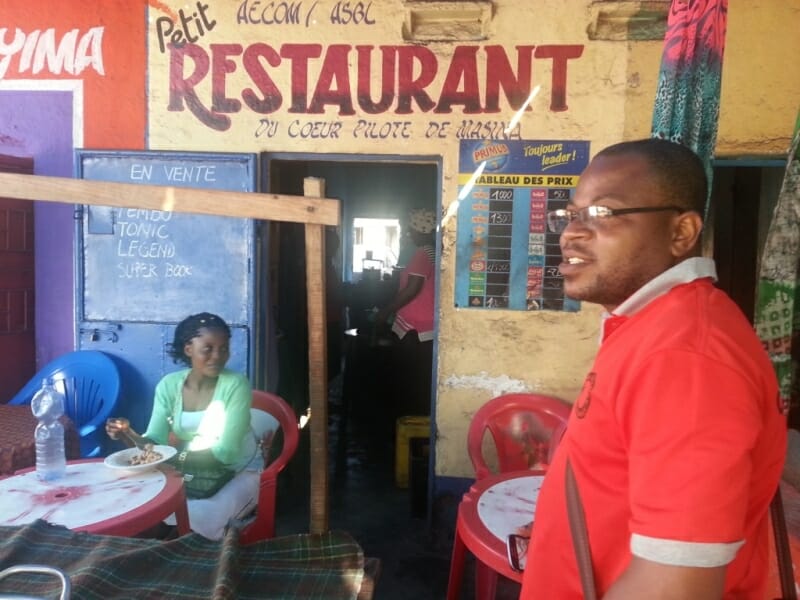
The bar and restaurant run by Émerence Kibimbwa Zolakio
She herself is unaware of how she managed. The fact is, Émerence runs a soft and alcoholic drinks shop in Kinshasa, the capital of the Democratic Republic of Congo. Business is doing well as to revenues, expenses, income and gains. Émerence thus began to familiarise with these terms and saw her business grow day by day in absolute transparency with suppliers and clients, and also with the tax bureau. The drive engine of all this is the Economy of Communion (EoC) from which she learned that people come before profits and that as a business woman her focus should not be money but the poor. She thus decided to invest the profits for the benefit of the poor and opened another snack bar also for the poor – who often do not have kitchens or cutlery – and where they can buy cheap ready-to-eat foodstuffs. This business certainly did not help in raising her capital, but the opposite. But like all entrepreneurs who join the EoC project, also Émerence knows she can count on the ”invisible” partner – divine Providence. In four years, without having ever asked or sought it, two freezers arrived (second hand but in good condition), and so did two stabilizers for electricity, 52 chairs and 14 tables,besides a stock of beverages. Her employees are mostly girls at risk or single mothers in whom she places her trust, keeping them updated on the company’s business trend and also on the extraordinary interventions of the ”secret” partner. “Once, Émerence recounts, “I had given away some clothes and food to a single mother. Her mental health at that time was not good but it seemed that she was slowly recovering. She asked to work and so I hired her.” Émerence put her trust in her and taught her the ins and outs of the job, and after two years, not only did the girl fully acquire her equilibrium, she was able to open her own business. The other girls also did the same, and have also become small entrepreneurs of cooked food, and are still in contact with Émerence who is their permanent advisor. The other woman who merits attention is Albertine, also from Kinshasa and mother to six children. Albertine teaches in a nursery school of the Petite Flamme project, a social centre run by the Focolare and financed by AFN’s support from a distance (www.afnonlus.org). “Some years ago – confided Albertine – my husband left the house without any reason and we still do not know where he is.” You can’t imagine how difficult it is for a woman to raise a family of six by herself. As a second job, Albertine decided to sell shoes which she buys thanks to a loan of the social centre where she teaches. “The price of the shoes I sell is not exorbitant and because of this I have God’s blessing!” she affirmed with conviction, and with the income from this activity she manages to pay the rent and the bills. Her children can therefore, continue their studies, and two of them are already in university. “Every day I renew my choice of God and He gives me the strength to go on –Albertine recounted. I try to promote around me the human and social values taught by the Gospel. And in this manner we will be able to transform society.And if Albertine with her micro shoe business manages to give a decent lifestyle to her kids, recently Emérence saw that her activity had been included in the list of the two big brands of beverage suppliers of the Democratic Republic of Congo (Bralima and Bracongo). This makes us think that the ”invisible” partner is as active as ever.

Japan, 70 years after the war

Japan, 70 years after the war

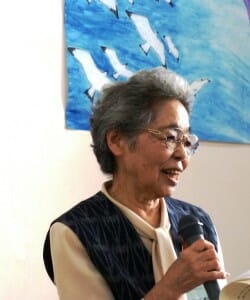
Tsuhako-san-2-250x300“On August 22, 1944, I lost my only sister in the Tsushima Maru naval disaster.” The passenger ship was sunk by an American submarine. More than 1,400 civilians lost their lives, including 700 children. “Up until the day of her death at the age of 96, my mother continued to say: “The war ate her on me. . .” Mrs Toshiko Tsuhako spoke from the bottom of her heart as she recounted her story to us. Her city, on Okinawa Island, had been the theatre of the only land battle in Japan through the months of April, May and June 1945, leaving 150,000 dead. “I was just an innocent child when I found myself thrown into the tragic experience of war, in contact with painful wounds that it inflicts on the bodies and the spirits of people. The war ended when I was 12 years old. My mother had a fragile constitution and, since I was the only daughter now, I devoted all my strength to trying to support and alleviate her afflictions. At the age of 16 I met the Christian faith and received the grace of Baptism.” As an adult she came into contact with the Focolare spirituality: “I was quite surprised when I heard that the foundress, Chiara Lubich, had come to understand, in the midst of the Second World War, that God loves us immensely and that we are all brothers and sisters who aspire to a united world, because this coincided exactly with the great dream that I carried inside me from when I was a young teenager.” “Although I was aware that everything that happens is in God’s hands, countless times I would wonder: ‘Why are there still such cruel and painful wars?’, while I continued on dreaming of a ‘global Family’ where the people live mutual gratitude and communion.” “I think that God is in need of our collaboration in building a truly peaceful world. It is true that we should cultivate hearts that love their own lands, but more than anything we should cultivate sensitive souls that devote themselves to the good of others, souls that know how to love.” “On this anniversary of the termination of the war,” Toshiko testifies, “I renew my trust in God and my commitment to continue along the path of peacebuilding.”