18 Nov 2020 | Non categorizzato
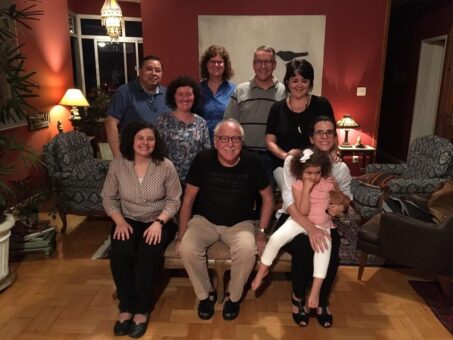
Originally planned as part of the centenary year of Chiara Lubich’s birth, this event was postponed due to the pandemic, and the funds raised distributed to people in need. It’s now being launched on social media by the Focolare Movement in Brazil, with the original content but communicated in a completely new way. The physical exhibition was originally scheduled for August 2020, then shifted to November and finally arrived at its destination on the web. Dedicated to Chiara Lubich to mark the centenary year of her birth, the exhibition is now accessible through Focolare Brazil @focolaresbrasil (Facebook, Instagram e Youtube). Photos, videos and articles will be published daily throughout the month of November 2020. It’s even better than originally planned, because it’s open to a wider public online and it’s been enriched by the contributions of an intergenerational team. We spoke with Josè Portella, one of the exhibition curators. How did you decide to replace the physical show with a virtual one? Who is part of the team and tell us something of how you’ve worked together? There are 16 of us in the team, young and older, all members of the Focolare Movement in different vocations: youth, Volunteers of God and Focolarini. We’ve been working together since early 2019 to curate a version for Brazil of the original Chiara Lubich centenary exhibition launched in the Gallerie in Trento, Italy. When Covid-19 took hold, we realized that the most important way for us to “celebrate” Chiara’s centenary was to help those suffering from the effects of the pandemic. So, in agreement with the benefactors who had already donated money to fund the exhibition, we distributed all we had received to those in immediate need. After we had decided to do this, we learned that the Trento exhibition was planning to make some of its resources available online. We understood that in order to engage deeply with the reality of Brazil, it was not enough simply to translate the material from Italian into Portuguese. We asked ourselves, why don’t we create something online specifically designed for our own country? Working with experts from the younger generations who joined our team, we split into three groups to adapt the original Trento material, prepare videos and assess the financial implications. It was an experience of unity among generations. The main challenge was to maintain faithfulness to the narrative of the Trento exhibition while incorporating a Brazilian approach and the language of social media. What can online visitors expect from this exhibition? Firstly, four promotional videos and a launch video of the exhibition. Then, we meet Chiara Lubich and her charism through three main themes: being – the story of Chiara Lubich; influence – testimonies of people who know and live the spirituality of unity; action – the many and varied realities born through the charism. What do you think is Chiara Lubich’s message for Brazil today, in the context of the global pandemic we are living through? When she visited Brazil in 1991, Chiara Lubich seeing the inequalities present in our society, had an intuition of an Economy of Communion. She foresaw that the Movement in Brazil was called to engage in a communion of goods on a global level. Today, in the context of the pandemic, living this charism in practice means taking care of each other, not only sharing material goods but dedicating our lives in service of others, not asking ourselves ‘who is my neighbour?’ but rather ‘who am I a neighbour to?’. As Pope Francis has written in his Encyclical “Fratelli tutti”, we are called as a people to act in fraternity, following the example of the Good Samaritan. Only in this way will “new men and women” (of the Gospel) emerge to build a more inclusive and fraternal society.
by Anna Lisa Innocenti
16 Nov 2020 | Non categorizzato
In the spirituality of unity a person not only seeks God in the depths of their own soul, but discovers His presence in the space that opens up when two or more people love one another in the spirit of the Gospel. The image that Chiara Lubich uses to describe this reality is that of a castle: not an interior castle, but an exterior one. For those who follow the way of unity, the presence of Jesus in the midst of their brothers and sisters is essential. Despite our personal inadequacy, we must always keep this presence alive. It is precisely this that characterizes the charism of unity. Just as two poles of electricity, even when there is a current, do not produce light until they are joined together, likewise two persons cannot experience the light of this charism until they are united in Christ through charity. In this way of unity, everything — in our work, study, prayer, striving toward sanctity or the spreading of Christian life — takes on meaning and value, as long as we keep, with our brothers and sisters, the presence of Jesus in our midst, for that is the norm of norms for this way of life. In this spirituality we reach sanctity if we walk toward God in unity. … St. Teresa of Avila, a doctor of the church, speaks of an “interior castle”. It is the soul with the divine majesty dwelling at its centre, revealing and shedding light on everything throughout life, allowing it to overcome every sort of trial. Even though St. Teresa drew all her daughters into this experience, it is a height of sanctity that is primarily personal. But then came the moment at least so it seemed to us, of discovery, of shedding light upon and building not just the “interior castle” but “the exterior castle.” But if we consider that this new spirituality God is giving the Church today has reached leaders in Church and society, then we see that this charism … tends to make an exterior castle also in the whole body of the Church and of society. Pope John Paul II, speaking recently to some seventy bishops, friends of the Movement, said: “The Lord Jesus … did not call his followers to individual discipleship but to a discipleship that is both personal and communitarian. And if that is true for all the baptized, it is true in a special way … for the apostles and for their successors the bishops.” 1 So this spirituality, like all charisms, is for the whole people of God whose vocation is to become ever more united and ever more holy.
Chiara Lubich
Taken from: “A Spirituality of Communion” in Chiara Lubich: Essential Writings, New City Press, Hyde Park, New York 2007, pp. 31-32. 1) Insegnamenti di Giovanni Paolo II, XVIII [Teachings of John Paul II] (1995) 1, Città del Vaticano 1997, p.382.

14 Nov 2020 | Non categorizzato
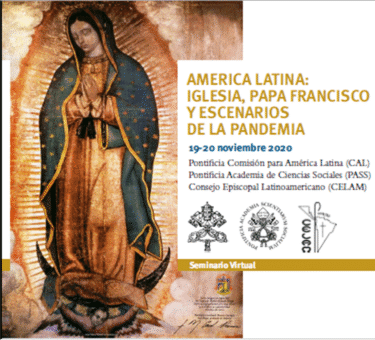
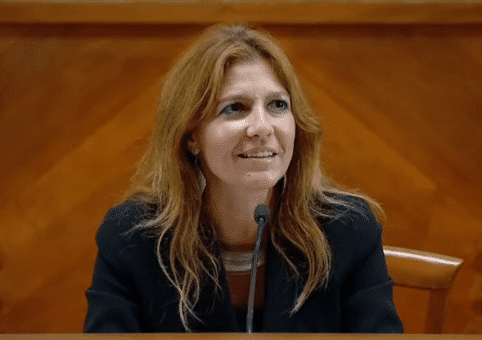
Open to all, a Webinar promoted by the Pontifical Commission for Latin America to reflect and analyse the impact and consequences of COVID-19. The social, economic and political implications along with the thought of Pope Francis. The virtual seminar entitled Latin America: Church, Pope Francis and the pandemic scenario will take place on November 19th and 20th 2020 and will be open to all those interested in this part of the world, which is also heavily affected by the virus; a situation already problematic due to many areas of poverty and marginalisation. The event aims to reflect on and analyse the pandemic situation on the Latin American continent, its consequences and, above all, the proposals of action and of aid from governments and from the Church. It is organised by the Pontifical Commission for Latin America, the Pontifical Academy of Social Sciences and by the Latin American Episcopal Conference (CELAM), The Pope will contribute with a video-message. Contributions will also be made by Card. Marc Ouellet, President of the Pontifical Commission for Latin America, Mgr Miguel Cabrejos Vidarte, President of CELAM, Carlos Afonso Nobre, Nobel Peace Prize winner in 2007, the economist Jeffrey D. Sachs, Director of the entre for Sustainable Development at Columbia University and Gustavo Beliz, Secretary for Strategic Affairs of the Argentinean Presidency. The introductory note to the seminar explains that to date, on the Latin American continent, as in the rest of the world, it is impossible to calculate the damage of the pandemic: “In many cases, the negative effects of border closures and the consequent social and economic repercussions were only the beginning of a spiral of damage not yet quantified, and even less a medium-term solution”. For this reason, the seminar will be an opportunity for the missionary and pastoral work of the Catholic Church and the contribution of various specialists from the world of economics and politics to meet and dialogue in order to strengthen a cultural and operational network and thus ensure a better future for the continent. Pope Francis will also participate at the presentation of the Task Force against Covid-19, established by him and represented at the seminar by its head who will present the work of the Task Force. In times of uncertainty and lack of future, the Church looks to the “continent of hope” and seeks shared instruments that can transform the crisis into opportunities or at least find a way out. For the programme of the event sign in here
Stefania Tanesini

13 Nov 2020 | Non categorizzato
The Global Compact on Education, suggested by Pope Francis, invites all people to adhere to a Pact. This was discussed this with Silvia Cataldi, a sociologist and professor, who lectures at La Sapienza University, Rome. The protagonists are the ones who hope in a world of more justice, solidarity and peace. The Global Compact on Education, suggested by Pope Francis, speaks of youth as being, at the same time, both beneficiaries and agents in the field of education. Together with their “families, communities, schools, universities, institutions, religions and government” they are called “to subscribe to a global pact on education” and to commit themselves to a more fraternal and peaceful humanity. This was discussed during the meeting entitled “Together to look beyond”, held at the Pontifical Lateran University, in Rome on October 15. In a video message, the Holy Father urged all people of good will to adhere to the Pact. Silvia Cataldi, sociologist and professor at La Sapienza University in Rome commented on the Pope’s words In recent years we have noticed the youth’s sturdy protagonism where important current affairs are concerned. The educational model that sees them as passive subjects seems to be obsolete… “Often, educational models limit themselves to think of culture as a concept. The pedagogist Paulo Freire speaks of the “banking model of education”, where knowledge can be poured or deposited as if in a container. However, this knowledge has two risks: that of remaining abstract and detached from life, and that of assuming a hierarchical vision of knowledge. With respect to this, the Pact strikes me as an educator, because it invites us to listen to the cry of the younger generations, to let ourselves be questioned by their questions. We must realize that education is a participatory path, and not a unidirectional one”. So, what does to educate mean? “The term culture stems from colere and it means to cultivate, a verb which indicates that one needs to dedicate time and space, by starting from questions and not from providing answers. But it also means to take care, to love. This is why I am so impressed by the Pact, because it strongly affirms that “education is above all a matter of love”. When we speak of love we think of the heart, of feelings. But love has an eminently practical dimension, it requires hands. So, we educators do our work only if we manage to understand that education is care. Daily care is revolutionary because it is an element of criticism and of transformation of the world. Hannah Arendt explains this well when she says that “Education decides whether we love the world enough because it leads to its transformation”. How can we make sure that the Pact does not remain just an appeal? The call to universal brotherhood – the core of the Pact – has important implications, but to have a transforming power it must promote a change of perspective that leads one to welcome diversity and heal inequalities. The French sociologist Alain Caillé says that “fraternity is plural”, and this means that if in the past brotherhood was only among peers, relatives, in a class or in a group, today it requires recognition of “the specificity, beauty, and uniqueness” of each one. Moreover, if we are all brothers, then our way of conceiving reality changes, because we look at it from a specific perspective, which is that of the least ones, and we are pushed to act, as for example, to protect the fundamental rights of children, women, the elderly, the disabled and the oppressed”.
Claudia Di Lorenzi

11 Nov 2020 | Non categorizzato
The commitment of the young people of the Ho Chi Minh City Focolare Movement in Vietnam for people in difficulty: to take care of their needs by distributing 300 parcels of goods to families and 370 small gifts for children.  In July 2020, some gen2 and youths of the Focolare in Ho Chi Minh City, Vietnam wanted to do something concrete for #daretocare – the focolare youth Campaign to “take responsibility” for our society and the planet -, to help people in the community who are in need. They chose to go and share their love to Cu M’gar district, Dak Lak province. It is a place with the widest coffee area and the people come from another ethnic group. It’s 8 hours’ drive from HCMC. “We started to pack and sell fruits, yogurt, and sweet potatoes online. We collected used clothes for adults and kids, we received some donations and at a certain point the restrictions for COVID19 was over so we were able to sell goods as “fundraising” at the parish. During the preparation, it was a big challenge for us to see things together, misunderstanding and disagreements were not lacking. But knowing that there will be 300 families who are waiting for us we continue to go ahead with love, patience and a little of sacrifice. On the 17 – 18 October with 30 energetic and enthusiastic youths, we made a meaningful trip. We were able to distribute 300 parcels of goods to the families and 370 small gifts for the kids. During the trip, we realized how lucky and happy we are compared to the situations of these families. We shared what we have brought to show our love but at the end we received more LOVE through their smiles… In fact, every time we approach them it seemed like we have known each other for a long time. During the trip some of the youths brought their friends. We found ourselves being together from different parts of Vietnam. There was a joy to know each one, to laugh and to work together like brothers and sisters without any distinctions. Thank you for this project #daretocare, a good excuse to work together and build this fraternal brotherhood among us”.
Gen and youth of the Focolare Movement in Vietnam
9 Nov 2020 | Non categorizzato
A communitarian spirituality also involves a communitarian “purification”, as Chiara Lubich explains in the following text. Just as loving our neighbour according to the Gospel brings great joy, so too a lack of relationships and of unity with others can cause suffering and pain. Since communitarian life must be fully personal as well, it is our general experience when we are alone that, after loving our brothers and sisters, we become aware of our union with God. … So it can be said that when we go to our brothers and sisters … by loving as the gospel teaches, we become more Christ, more truly human. And, since we try to be united with our brothers and sisters, in addition to silence we have a special love for the word, as a means of communication. We speak in order to become one with others. We speak, in the Movement, in order to share our experiences of living the Word of Life, or of our own spiritual life, aware that the fire that does not grow is extinguished and that this communion of soul has great spiritual value. Saint Lawrence Giustiniani said: “Nothing in the world gives more praise to God and reveals him as worthy of praise than the humble and fraternal exchange of spiritual gifts….”[1] When we do not speak, we write: we write letters, articles, books, diaries to advance the kingdom of God in our hearts. We use all the modern means of communication. … In the Movement we also practice those mortifications that are indispensable for every Christian life. We do penance, especially as recommended by the Church, but we have special regard for those penances that a life of unity with others entails. That is not easy, for the “old self,” as Paul[2], calls it, is always ready to find its way back into us. Fraternal unity is not established once for all; it must be renewed continually. When there is unity and through it Jesus is in our midst, we experience great joy, as promised by Jesus in his prayer for unity. When unity is compromised, the shadows and confusion return and we live in a kind of purgatory. That is the kind of penance we must be ready to practice. Here is where our love for Jesus crucified and forsaken, the key to unity, comes in. We must first resolve all our differences out of love for him, and make every effort to restore unity.
Chiara Lubich
Taken from: “A Spirituality of Communion” in Chiara Lubich: Essential Writings, New City Press, Hyde Park, New York 2007, pp. 30-31. [1] S. Lorenzo Giustiniani, Discipline and perfection in monastic life, Roma 1967, p.4. [2] The old self: in the Pauline meaning of a person imprisoned by their selfishness, cf. Eph: 4:22.

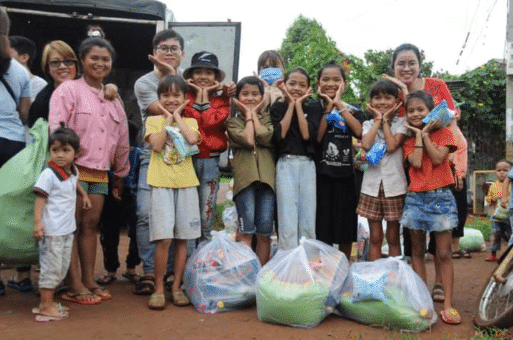
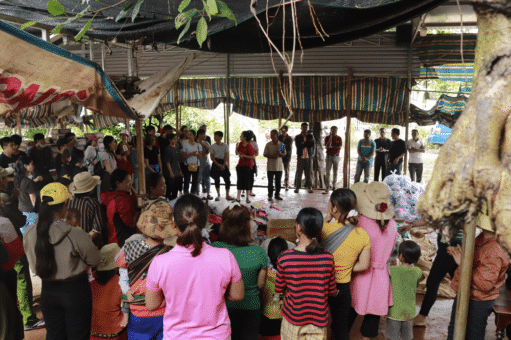 In July 2020, some gen2 and youths of the Focolare in Ho Chi Minh City, Vietnam wanted to do something concrete for #daretocare – the focolare youth Campaign to “take responsibility” for our society and the planet -, to help people in the community who are in need. They chose to go and share their love to Cu M’gar district, Dak Lak province. It is a place with the widest coffee area and the people come from another ethnic group. It’s 8 hours’ drive from HCMC. “We started to pack and sell fruits, yogurt, and sweet potatoes online. We collected used clothes for adults and kids, we received some donations and at a certain point the restrictions for COVID19 was over so we were able to sell goods as “fundraising” at the parish. During the preparation, it was a big challenge for us to see things together, misunderstanding and disagreements were not lacking. But knowing that there will be 300 families who are waiting for us we continue to go ahead with love, patience and a little of sacrifice.