15 Aug 2020 | Non categorizzato
Raul and Mitali are dancers from Mumbai, India, they’re married with two daughters. They show us how dance can become a powerful instrument of mutual knowledge between different religious traditions. By Marcello Vaz.
13 Aug 2020 | Non categorizzato
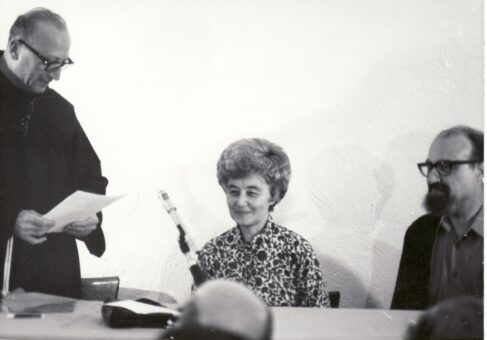
At 100 years of age, Father Bonaventura Marinelli OFMCap has died. He was the first member of a religious order to follow Chiara Lubich’s spirituality. Father Fabio Ciardi looks back on his life. On July 15 we celebrated the feast day of his namesake, Saint Bonaventure. On August 1, Fr Bonaventura Marinelli left us for heaven, where he could celebrate the centenary of his inseparable contemporary, Chiara Lubich. What a deep and faithful friendship they shared! In the years 1942 to 1946, as a young priest studying theology while living in the Capuchin monastery in Trento, he was, as he loved to say, “an eye-witness, albeit at a distance” of the beginnings of the Focolare Movement. At a distance, because in those years, no close contact was permitted. But eye-witness because he saw for himself the way those “extraordinary Third Order Franciscans” were living. “After the bombardment of 1944,” he recalled in an in-depth interview, “Chiara and her companions were always in our sight. They came to Mass, not in our church which was bomb-damaged, but in the sacristy which was even smaller and so we were brought even closer together. I remember what a deep impression they made on me every time I saw them. I’m rather shy by nature and find it hard to talk to people. But I can still remember how throughout the summer of 1943 and afterwards, when I was out almsgiving among the people, it became easier and easier for me to meet with families, children and others. This new way of seeing people came not from my nature, but from the life I saw in Chiara and her companions. In 1946, a year after I had been ordained a priest, my superiors sent me to a university in Switzerland. For the first few months I regularly received letters from my companions with whom I’d made a pact of unity. Then, suddenly, nothing, silence. The Vatican’s Holy Office (now known as the Congregation for the Doctrine of the Faith) had started investigating the Movement, but I didn’t know. Personally, I found myself slipping into unutterable desolation. Until 23 April 1948, precisely. I’d returned to Trento to vote in the elections, and that morning, before leaving to go back to Switzerland, I met Chiara. She brought joy back to me, but in a much deeper way than before. I understood that what matters is to love. I felt I was touching heaven with my fingertips. When I arrived back in Fribourg I wrote to her. That was the first letter”. So began a correspondence through which Chiara communicated what she was living in that period. It’s thanks to Fr Bonaventura that today we have such a priceless patrimony of writings, some of which have become very well known. For example the letter dated 30 March 1948, in which she confides, “the book of Light the Lord is writing in my soul has two aspects. One page shines with mysterious love: Unity. The other shines with mysterious suffering: Jesus Forsaken”. The letters demonstrate the deep relationship which sprang up between them. 11 May 1948: “Your letter confirmed for me the impression I had of your soul, so beloved of the Lord. And immediately, without delay I would like to give you all that is mine, all God has built in me, using my nothingness, my weakness and wretchedness. (…) What I wish to write to you today is that we mustn’t break the unity God has made. (…) Saint Francis will not be happy until you revive it in yourself and also in your brothers. So make a start. You can do it”. 8 September 1948: “Your letter gave me such joy. Jesus is present. I found Him in your thirst for ‘life’, in the optimism it contains, overflowing through the pages, and above all in the peace that comes from your desire to love Him more and more. You can be very sure, as long as I’m never parted from Jesus (and how could that ever be? In Paradise I’ll have Him even more), I’ll never stop following your soul with a vigilant eye and fraternal care”. 27 January 1951: “You can’t imagine how your soul is ‘penetrating’ my own (almost literally, as if I could almost feel the effect on me!)” I remember the joy whenever they met and spontaneously started talking in their Trentino dialect. They were the same age, but he felt he was a disciple and she was his mother. In one of their first letters, Chiara signed herself “s.m.”, which Bonaventura straight away interpreted as “sua madre” – “your mother”. So he replied, signing his name as “s.f.” (“suo figlio” – “your son”). And Chiara herself understood. A Focolarina remembers hearing Chiara greet him in 2000 with the words, “this is my first son who is a religious!” Fr Bonaventura lived a long life. A Professor of Sacred Scripture, a translator of German biblical commentaries, bearer of various roles of responsibility in his Order including Provincial, Formator, and in the General Definitorium. He was then invited by Chiara to lead the international Centers of Spirituality for Religious men at Castel Gandolfo, near Rome and at Loppiano, the Focolare Movement’s small town in Italy. Self-effacing and extremely humble, he knew how to witness unostentatiously and sincerely the Ideal Chiara had transmitted to him. He was, in the words of one of his confreres, “a true child of the Gospel, in wisdom and simplicity of life”. I have my own personal memories of Fr Bonaventura, from the time in 1978 we went to Canada together for a whole month, to animate a formation school for religious men. Later I lived in community with him at Castel Gandolfo. I found an entry in my diary for 10 November 1999, when he had already left to take up a new posting and came for a visit. I wrote, “Bonaventura arrived and there was a really festive atmosphere, as usual”. I was struck by that “as usual”. Perhaps my most beautiful moment of all with him was on 18 March 2008, at Chiara’s funeral in Rome, in the Basilica of Saint Paul Outside the Walls. At the end of the ceremony, he asked me to help him approach the coffin, despite infringing official protocol. He was an old man by then, and he had difficulty bending down. But he managed to kneel down in order to hug and kiss the coffin. So I too knelt down and kissed the coffin (but actually for us, it was embracing Chiara not the coffin). And with that, everyone started to surround the coffin to kiss it. But with Bonaventura it was a unique gesture of a son towards his mother. I too always felt his love for me. In one of his last letters, he wrote, “You’re in my thoughts and I’ll always remember you with gratitude. I hope to have the joy of meeting you once more in person. This morning I entrusted you especially to Saint Francis. A hug!”
Fr. Fabio Ciardi OMI

12 Aug 2020 | Non categorizzato
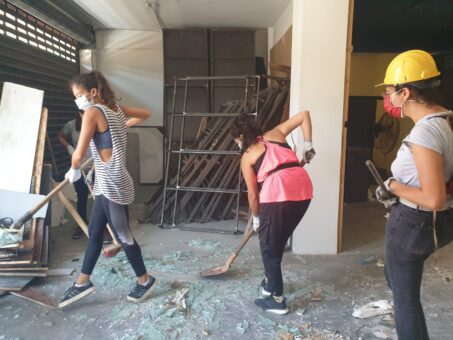
Grateful for the solidarity received and committed together with other various religious communities to help the country rise again and be a messenger of peace. We all know that Lebanon is still under a great shock. And Beirut is an unrecognizable city with apocalyptic scenes: destruction, high tensions, distress, anger and even violent episodes. A few days ago, a letter arrived from this country that has been hit with such widespread destruction. It comes from the Lebanon Focolare community and it is addressed to Focolare members worldwide. The letter reads: “With these words, each one of us would like to express a personal thank you to each one of you. We are deeply and immensely moved by the immediate closeness shown to us from all parts of the world, from old and young, far and near, through phone calls and messages”. Members of the Focolare Comunity continue to say: “Every morning, when we wake up and continue to discover the massiveness of the catastrophe, the material damage, the number of hospitals badly damaged and rendered unfunctionable, the polluted air we breathe, we feel like ‘survivors’. Each one of us could have been right there at the scene of the drama. And maybe some of us were, but a providential hand made them change place. However, we all feel that a new life has been given to us, as a young woman, just out of an elevator gutted with the explosion, said”. They continue to relate that in the streets, where everything seems to cry out despair, “many people from north to south, members of various religious communities, are working hard to clear the rubble. Each one, in his own way, is a living witness that the ‘resurrection’ will win over the death of the city, the country, the dreams of many”. They conclude: “Together with you, we want to move ahead so that a Lebanon that passes on a message of peace, unity and universal brotherhood and be a model of a united world, will be reborn”.
edited by Anna Lisa Innocenti
________________________________________ The Emergency Coordination of the Focolare Movement, which will intervene through the AMU and AFN organizations, has been activated. For those who want to collaborate, the following current accounts have been activated:
Azione per un Mondo Unito ONLUS (AMU) IBAN: IT58 S050 1803 2000 0001 1204 344 Codice SWIFT/BIC: CCRTIT2T Banca Popolare Etica
Azione per Famiglie Nuove ONLUS (AFN) IBAN: IT11G0306909606100000001060 Codice SWIFT/BIC: BCITITMM Banca Intesa San Paolo
PURPOSE: Emergency Lebanon ————————————————————– The contributions paid on the two current accounts with this purpose will be managed jointly by AMU and AFN. There are tax benefits for these donations in many countries of the European Union and in other countries of the world, according to the various local regulations. Italian taxpayers will be provided deductions from taxable income, up to 10% of the income and with the limit of € 70,000.00 per year, with the exception of donations made in cash.
11 Aug 2020 | Non categorizzato
The 100 years of Danilo Zanzucchi. A married Focolarino – one of the first in the wake of Igino Giordani – Danilo along with his wife Anna Maria, would soon become the couple leading New Families at a world level Chiara always had a predilection for that young engineer who, after having erected his first important buildings in the north of Italy (“all still standing” Danilo assures with pride), left a promising career to move to the capital, and as a family collaborate full-time for the purpose of the Movement. But Chiara’s esteem for Danilo is above all for having been able to grasp, in its entirety, the charism that the Spirit had given her. Among his first assignments was the collaboration on the construction of the Mariapolis Center in Rocca di Papa that would become the International Headquarters of the Focolare Movement. A married Focolarino – one of the first in the wake of Igino Giordani – Danilo along with his wife Anna Maria, would soon become the couple leading New Families at a world level; developing in the following decades an innovative and effective Family Pastoral Care appreciated at all latitudes for the rich spirituality from which it draws and for its openness to the demands of the contemporary world. The profound interior life of Danilo did not go unnoticed by ecclesiastical leaders who were struck by his brilliant presence, his skills. Diocesan President of Catholic men in Parma (Italy), when transferred to Rome he became consultant and, later, member of the Vatican department for the Family. These latter responsibilities, accompanied by Anna Maria, made him a guest several times in the home of Pope Wojtyla and also a testimonial of service to the Family in television broadcasts, also shown in world wide vision. When welcomed by Danilo during a visit (1984) to the International Centre of the Movement, the Polish Pontiff did not hesitate to promote him sympathetically as “Foreign Minister of the Focolare Movement “. A collaboration that also continued with Benedict XVI, and his request to the Zanzucchi couple to write the text for one of the Stations of the Cross (2012) at the Colosseum in Rome presided over by him was significant of this. Danilo is celebrating his 100th birthday with Anna Maria (90), his 5 children (two Focolarini and two married Focolarini), his 12 grandchildren and the whole Focolarino world. In particular with the countless families of the various continents for which with Anna Maria, he has been an example, a confidant, a guide, remaining a lovable and safe point of reference for each one. His psycho-physical condition remains excellent, despite the fact that many years ago Chiara herself, with all of us, feared for his health which has obviously been well recovered. He is able to go to Mass almost every day and it is not uncommon to see him participate in the periodic meetings of his Focolare and those of the Focolare-Families. Perhaps because he was invested with a special mission, the Lord preserved him in two particular episodes in the Second World War. He himself tells us that if it had not been for the providential shove of a comrade who pushed him elsewhere, he would have died under a bomb that was crashing right where he was standing. Another time, it was his knowledge of German that saved him from an already deployed firing squad . It can happen that Danilo, in order to dilute somewhat complicated moments, still decides to let everyone enjoy one of his mythical and resonant speeches in that language , putting everyone in a good mood for the various lexical licenses he grants himself. The gratitude of the entire New Families Movement for this century of Danilo’s life given to God and his brothers, goes to this great figure of a man of Faith and Works. Thank you Danilo for being a giant of righteousness and tenderness, an example of simplicity and wisdom, a temperament of leader and artist: a Saint who lives next door. Thank you also, Danilo, for having never stopped, not even now that you are a hundred years old, to impersonate the Evangelical Child that has always shone through your being, your speech, your good humour, your water colours, your countless cartoons often improvised on paper napkins, which masterfully capture and express the best that is in each of the protagonists to whom they are dedicated. HAPPY BIRTHDAY, DANILO! From the New Families website
10 Aug 2020 | Non categorizzato
The coronavirus pandemic is a trial by fire not only for healthcare systems but also for those engaged in politics, both locally and internationally. The following excerpt from a speech by Chiara Lubich can justifiably be called a “hymn to politics”. It is a challenge for politicians and can fill the hearts of ordinary citizens with gratitude towards all those who have to make courageous decisions on a daily basis. While most of the new movements take an active interest in all that is happening in the world, one of them, the Focolare Movement, has actually given rise to a political section known as the Politics for Unity Movement. Its specific aim is precisely that of promoting fraternity in politics. … First of all, we realized that a true vocation to politics exists. Believers discern the voice of God entrusting them with this task. People without formal faith also feel called to politics when, for example, they see social needs or groups of vulnerable people asking for help. Responding to the call to enter politics is, above all, an act of fraternity. In fact, people become politically active in order to work for issues that concern the general public, to help other people, wanting their good as if it were their own. In reality, the task of love in politics is to create and safeguard the conditions that enable all other types of love to blossom: the love of young people who want to get married and who need a house and jobs; the love of those who want to study and who need schools and books; the love of those who have their own business and who need roads and railways, and clear and reliable rules…. Hence politics is the love of all loves, fostering collaboration among people, bringing together needs and resources, and enabling people to trust one another. Politics can be compared to the stem of a flower that supports and nourishes the renewed blossoming of petals in the community. In the Politics for Unity Movement, we notice that, by living out our political choices as a vocation to love, we understand that other people, who have made political choices different from our own, can be motivated by a similar vocation to love. They, too, in their own way, are part of the same design, even when they become our political opponents. Fraternity enables us to recognize their task, to respect it and help them to be faithful to it – also through constructive criticism – while we remain faithful to our own. In the Politics for Unity Movement, we believe that we should live fraternity so well as to reach the point of loving the other person’s party as we love our own. We know that neither party was born by chance, but that each was the response to an historical need within the national community. Fraternity brings out the authentic values of each side and reconnects the whole tapestry of the political design of a nation. The initiatives of the members of the Politics for Unity Movement bear witness to this. They seek to create a fraternal relationship between the majority and the opposition, both on the level of the national Parliament and in municipal authorities. Their initiatives have been formulated into laws on a national level, or into local policies that have brought greater unity to the towns and cities where they were applied. Thus, those who respond to their political vocation by beginning to live fraternity, enter into a universal dimension that opens them up to the whole of humanity. They ask themselves whether the decisions they are about to make, while serving the interests of their own nation, might be detrimental to others. Politicians of unity love other people’s countries as their own.
Chiara Lubich
From Chiara Lubich, “A United Europe for a united world”. Speech given to the European Movement, Madrid (Spain), 3rd December 2002
8 Aug 2020 | Non categorizzato
A glimpse into the experience and everyday life of Somjit Suwanmaneegul, a Buddhist, from Chiang Rai in Thailand. From his meeting with John Paul II to today. By Stefania Tanesini and Lorenzo Giovanetti. https://vimeo.com/430658900