11 May 2020 | Non categorizzato
“With the day of interreligious prayer on May 14th, the Higher Committee for Human Fraternity reminds us that the current pandemic has marked a point of no return: our future will be secure only by looking to the common good, not to the good of one group or another, not to the interests of one side or another but to the good of all.” Thus, Maria Voce, president of the Focolare Movement, affirmed the Movement’s full participation in the day of prayer for humanity, which was proclaimed also by Pope Francis on Sunday, May 3rd, asking that: “On this coming 14th May, believers of all religions should unite spiritually for a day of prayer, fasting, and works of charity, to implore God to help humanity overcome the coronavirus pandemic.” “We are one big family – Maria Voce added – formed by Christians, by believers of various religious traditions, together with people without specifically religious beliefs. I encourage everyone to live Thursday, May 14th, in a spirit of prayer – according to their respective faiths and traditions – of fasting and concrete commitment to help those close to us, especially the weakest and marginalized. We will do this at the local level, as every community deems best, always abiding by the directives in force, and in a spirit of true and effective fraternity.” “We are certain that the prayers lifted up to God by his sons and daughters will be heard, for the good of the great family of humankind; and that the trial we are all experiencing will truly make us stronger in the shared pilgrimage of life.”
Stefania Tanesini
11 May 2020 | Non categorizzato
Our relationship with nature, whether as individuals, organisations or nations, is ever more the focus of attention. We have a duty to protect the environment and repair the damage already done. The pandemic we are currently experiencing has highlighted this duty of ours and also given the natural world some breathing space. Chiara Lubich’s spiritual experience leads us to the One who is at the root of all things: God. … While taking a short break, I watched a documentary on nature. Unlike some other TV programmes, that film had a great effect on my soul. Contemplating the immensity of the universe, the extraordinary beauty and power of nature, my mind rose spontaneously to the Creator of it all, giving me a new understanding of the immensity of God. It made such a new and strong impression on me that I felt like falling on my knees to adore, praise, and glorify God. I felt a need to do that, as though it were my vocation in that moment. It was as if my eyes had been opened, to understand as never before who it is that we have chosen as our ideal; or rather, who has chosen us. I saw God as so great and so immense that it seemed impossible he should think of us. This impression of God’s immensity stayed with me for several days. Now, when I pray, “Hallowed be thy name,” or “Glory be to the Father and to the Son and to the Holy Spirit,” it’s different for me: it has become a need of the heart. … We are all on a journey. When people are travelling, they are already thinking of the place they will be in on their arrival and getting ready to be in that environment or that city. We need to do the same. Up there in heaven will we be praising God? Then let’s start praising him right now. Let our hearts cry out with all our love to God and proclaim him, with the angels and saints: … “Holy, holy, holy.” Let our heart and our lips tell his praises. Let’s take the opportunity to revive some of our daily prayers which have this purpose. Let’s give God glory also with our whole being. We know that the more we empty ourselves (imitating Jesus Forsaken who made himself nothing) the more our lives cry out that God is everything, and in this way we praise him, glorify him and adore him. When we do this, our “old self” dies and out of its death the “new self” comes to life, the new creation. During the day let’s be on the lookout for many opportunities to adore God and praise him. Let’s do it during our meditation [or other prayer times]. …Let us praise him beyond nature or in the depths of our hearts. Above all, let’s live dead to ourselves and alive to the will of God, to love of neighbour. May we too, as Elizabeth of the Trinity used to say, be “praise of his glory.” In this way we shall have a foretaste of Heaven and make up for the indifference to God in so many hearts living in the world today.
Chiara Lubich
(Form a telephone conference call, Rocca di Papa, 22nd January 1987)
10 May 2020 | Non categorizzato
Cardinal Kurt Koch, President of the Pontifical Council for Promoting Christian Unity sent a video message for United World Week 2020. In these difficult times we’re living through, marked by the corona virus crisis, many people are confined to their own homes and forced to live in quarantine. The very word “quarantine” brings to mind the forty days of Lent, rather than the celebration of Easter. And in fact our liturgical services, particularly the most important Holy Week and Easter liturgies were affected by government bans and so took place behind closed doors in churches without the presence of the faithful and transmitted via streaming. This out-of-the-ordinary experience has brought to my mind a detail in the biblical account of Easter more vividly than I’ve ever experienced in the past. The evangelist John opens his account of the apparition of the Risen Christ to his disciples with the words, “When it was evening on that day, the first day of the week, and the doors of the house where the disciples had met were locked for fear of the Jews …” (Jn 20:19). Even though the Lord had already risen and was on his way to his disciples, they were still living Holy Saturday, as is evident from their fear and those closed doors. To this place, beleaguered by fear, Jesus comes and radically changes the situation, as the Gospel highights. “Then the disciples rejoiced when they saw the Lord” (Jn 20:20). Joy is the visible expression of the fact that Holy Saturday is transformed into Easter. And today too, in this moment afflicted by the corona virus crisis, we can rejoice because we know that the Lord does not leave us alone in our fears and worries, but he comes among us and gives us his presence and precious company. Christ is always among us, especially when we await his coming. Chiara Lubich never tired of repeating this message to us. When Jesus comes among us, he brings us a gift. It’s the same gift he brought to his disciples that Easter night. The Gospel narrates how Jesus came among them and said, “Peace be with you!” Peace is the first gift Jesus gave to his disciples after his resurrection. Peace is the true gift of Easter. Peace is the gift Jesus offers to us as well. It’s a peace we human beings are not able to create on our own; we can only receive it as a gift. Nevertheless, it’s the most important kind of peace, and all other forms of peace we aspire to are but reflections of that peace. In fact, only the peace that comes from Christ can give us the unity we desire so much: unity in our communities, in our Church, among all Christians and in the whole of humanity. Naturally, this peace cannot remain closed in on itself. The Gospel narrative continues after the greeting of peace, with Jesus telling his disciples, “As the Father has sent me, so I send you” (Jn 20:21).These words are also addressed to us. We too are called to transmit to others the peace we receive from Christ. In this way, particularly for those living in fear and anxiety, Holy Saturday can again be transformed into Easter. In this time of trial due to the corona virus, your motto “In Time For Peace” is true and indispensable. My heartfelt wish for a joyful and peaceful Eastertime for all of you. May the Risen Lord of Peace bless and protect you!
Kurt Cardinale Koch
9 May 2020 | Non categorizzato
The testimony of those who are on the front lines and those who stay at home: many ways of living for others. https://vimeo.com/402903328
8 May 2020 | Non categorizzato
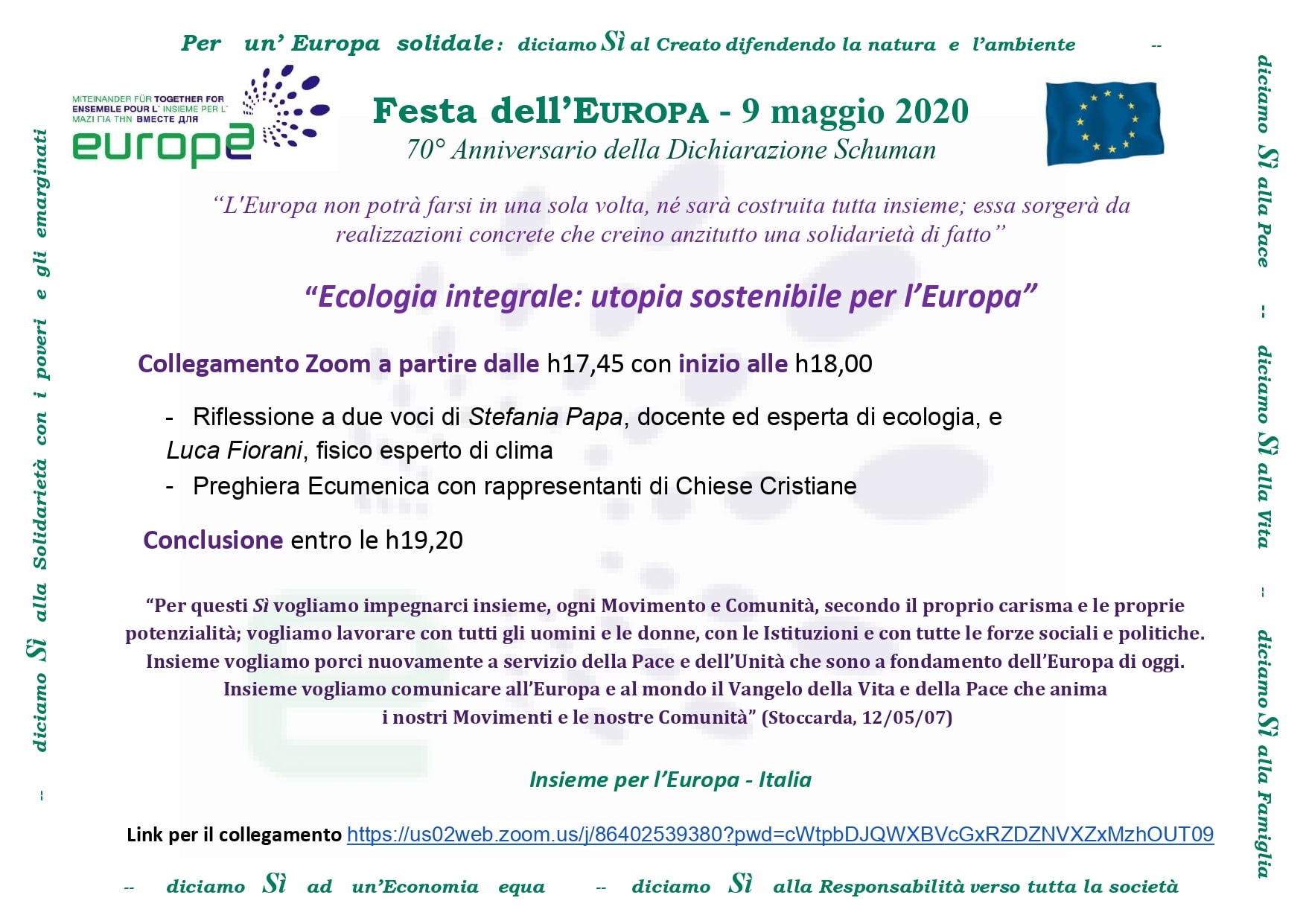
A day for communities, movements and countries to meet and witness peace and solidarity among peoples May 9 is the feast day of the European continent, celebrating peace and unity among peoples. This year the Covid-19 pandemic prevented people from seeing each other in church, city squares, gatherings or conferences and prayers. This does not mean that this day’s activities were cancelled. On the contrary: with a lot of creativity, digital conferences, prayers, discussion groups and online dialogues between communities, movements and political representatives were held, for example, in Utrecht, Graz, Rome, Lyon or Esslingen. This year’s events had the papal blessing, through a letter from Pope Francis that arrived on 22 April. The pope appreciates the service to the common good that the Together for Europe network operates through committed communities and movements, inspired by the values of solidarity, peace and justice. The Together for Europe network emerged from the historic signing on 31 October 1999 of the “Joint Declaration on the Doctrine of Justification” between the leaders of different Evangelical and Catholic movements and ecclesiastical communities from Italy and Germany. It has been a journey together to rediscover the old continent’s values of peace and fraternity. For the Feast of Europe, together with Graz, the Together for Europe committees in Italy organized and promoted an online event dedicated to a “yes to creation,” defending nature and the environment, entitled “Holistic Ecology: A Sustainable Utopia for Europe” on May 9. Through the reflections of Stefania Papa, professor and ecology expert, and Luca Fiorani, climate physicist, and a video of three messages from Pope Francis, Patriarch Bartholomew I and Antonio Guterres (UN) for the 50th World Earth Day, we are becoming more aware of how we can work together for a better present and future, respecting our Earth, in a culture of respect, cooperation and reciprocity. One of the objectives of Together for Europe, in fact, is a “culture of reciprocity”. In it, different individuals and peoples can welcome each other, get to know each other, reconcile, and learn to esteem and support each other. This includes many activities in favour of reconciliation and peace, the protection of life and creation, a fair economy, solidarity with the poor and the marginalized, the family, the good of cities and brotherhood on the European continent. Diversity should not be a reason for fear or separation, but rather a wealth that is developed and harmonized for a united, living, fraternal Europe.
For more information visit together4europe.org.
Lorenzo Russo
7 May 2020 | Non categorizzato
Message sent by Rev. Prof. Dr.Ioan Sauca, Acting General Secretary of the World Council of Churches. We would like to thank Rev. Prof. Sauca for his support and encouragement for this edition of United World Week. We make ours his urge to be always builders and promoters of unity in everyday life for the whole world. Greetings to United World Week 2020 Rev. Prof. Dr Ioan Sauca Acting General Secretary It is a joy for me, as the acting general secretary of the World Council of Churches, to greet and encourage you in your celebration of Unity Week with the resounding Easter affirmation: Christ is risen! He is risen indeed! The worldwide fellowship of churches stands in solidarity with you as we pray for healing and recovery of humanity and all of God’s creation, especially during this time of uncertainty and fear caused by the COVID-19 pandemic. In such circumstances, we realize all the more just how united we are as one humanity: we share the same fears, the same challenges, and the same yearning for the well-being of our one human family. Yet, in light of the resurrection of Jesus, we have cause also to share one hope for renewed life, working and walking toward God’s reign of justice and peace. Focused so clearly on uniting humanity, you, the youth of Focolare, reveal the true breadth and ambition of Chiara Lubich’s vision for the ecumenical movement: not simply to bridge ancient divides among Christians but also to live Christian discipleship in such a way as to heal the world. You are a gift to our communities. Your passion and desire to change the world inspire and motivate the rest of us as we confront the realities of today. In ways big and small, this generation is stepping up to meet the daunting challenges of climate change, economic inequality, the needs of migrants and refugees. And, as we see today, your generation’s digital expertise leads us in new ways of reflecting and reflecting on our common vision for Christian unity as expressed in Jesus’ prayer in John 17:21. There Jesus prayed “that all of them may be one, Father, just as you are in me and I am in you. May they also be in us so that the world may believe that you have sent me.” Jesus’ vision is not limited to our Christian family. Rather it is inclusive of all of humanity and of God’s creation. So, despite uncertainties and fear, ours is also a resurrection time of enormous opportunities to come together and serve one another, sisters and brothers. Jesus’ prayer reminds us that unity grows to serve a greater need. In John 20:23 Jesus appeared to his self-isolating disciples in a locked room. Jesus assured them, saying, “Peace be with you.” But he didn’t stop there. Imparting peace a second time, he added, “As the Father has sent me, even so I am sending you.” The task and call to work for peace are clear. As you begin this Unity Week series in different parts of the world, I invite you to reflect on the words of Jesus in the context of today’s need for unity and peace: how do we live out God’s unity in a hurting world today? As young people, how do we respond to the disparities and needs of the world, so that God’s peace resides in all of humanity and the entire creation? Geneva, 28 April 2020
https://www.youtube.com/watch?v=-p39HC8PmYM&feature=emb_logo