7 Mar 2020 | Non categorizzato
400 young people, 56 countries, 16 languages, 4 days: WeGENerate! Last January, myself and Luisa (a friend of mine from Brazil) spoke with 400 Gen (young people of the Focolare Movement) in Trent, Northern Italy. We asked them a question: did they want to be the United World Generation? Did they want to be the generation who will deliver a united world by 2050. 77 years earlier, Chiara Lubich and her friends made a phrase of the Gospel ‘that all may be one’ (Jn 17:21) the aim and mission of their life. When I was at the International Gen 2 Congress ‘WeGENerate’ last month, with a group of young people the same age as Chiara was when she said this ‘Yes’ to the Gospel, I thought for the first time that this Ut Omnes prayer might be a question, rather than a simple statement of prayer. A question, because, this prayer requires an answer. A question because they are not only nice words to pray, but they challenge the reader to live the answer. A question because ‘Ut Omnes’ is a questionable subject and it’s not ‘a given’ that it’s even possible. The question that Luisa and I asked last month (do you want to be the United World Generation?) was only, then, a reformulation of the question that Chiara Lubich answered in 1943. We put a date on the end of the question to see if we, the Gen, really wanted to answer this question. Instead of answering the question with words, the Gen decided to organise. On one of the afternoons, 400 Gen from 56 countries with translation in 16 languages planned local and global actions to fight corruption, lessen inequality, stop climate change, reactivate dialogue and prevent conflict. We answered this Ut Omnes question by planning advocacy training and global formation activities to protect democracy, prevent conflict, fight corruption and stop inequality. We answered this Ut Omnes question by promoting the #CleanPlate, #GreenDay #ClearPlasticJarChallenge and CarPooling campaigns to combat environmental problems. We answered this Ut Omnes question by imagining platforms and apps to unlock dialogue; by breaking down ignorance and building relationships. Mark from Syria answered this question by affirming his intention to return to Syria and help rebuild his country. Victor answered this question by challenging himself to be a living realisation of the charism of unity in Venezuela. Joelle answered this question by promising to bring this message of unity and love back to Lebanon. Contexts which are not dissimilar to the context in which Chiara answered this question in 1943. Many people, like Mark, Joelle and Victor, will make their way to Trent this year to encounter the city that shaped Chiara Lubich. They will visit the exhibition, they will take the tour of the city, they will encounter a community of people who are living to build unity in that beautiful city. They will travel to Trent hoping to understand the roots of Chiara’s story and the story of the Focolare Movement. From my experience at this congress, if you really want to travel to the roots of the story of Chiara Lubich, you need to ask yourself the question that she answered in 1943: that all may be one? And then ask yourself, do you believe it’s possible to be one? And if yes, what am I going to do about it?
Conleth Burns
4 Mar 2020 | Non categorizzato
We went to Great Britain a few days before Brexit, when the United Kingdom leaves the European Union. We met many people, including the community of the Focolare, to see what has happened and what their hopes for the future are. https://vimeo.com/389431416
2 Mar 2020 | Non categorizzato
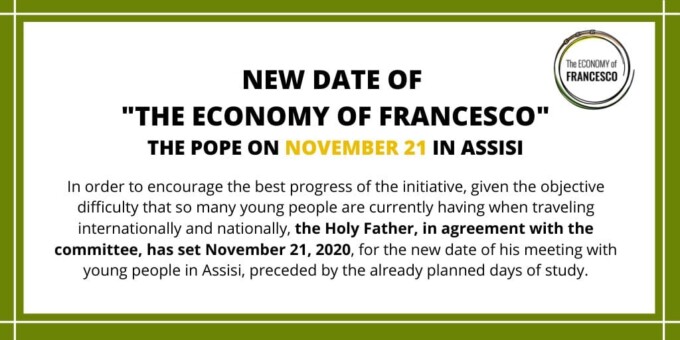
Luigino Bruni, economist and scientific director of “The Economy of Francesco” said, “Postponing the event will allow us more time to prepare. Young people from all over the world are responding with a great sense of responsibility and even more commitment. The setback could be a blessing.” In agreement with the Holy Father, we are going to postpone “The Economy of Francesco” to 21 November but the work of the scientific committee and of the young people involved in the organization does not stop. On the contrary, it proceeds with great commitment and enthusiasm as we read in the press release of 1 March. The decision was taken “given the travel difficulties for the approximately two thousand young people from 115 countries who are expected to participate” and because of the corona virus. The appointment, however, has only been put back and Pope Francis will be in Assisi in November to meet the young people who, during the preceding days, will take part in workshops, discussions and dialogue regarding new approaches to various economic issues. The general focus of the meeting was outlined in the letter that on 1 May 2019 Pope Francis addressed to “young economists, entrepreneurs and business men and women all over the world”, inviting them to “re-animate” the economy – in the literal sense of giving it back a soul – to be among those who respond to the cry of the poor of the earth and do not look the other way. “This is why I would like to meet you in Assisi,” wrote the Holy Father, ”to work together to promote, through a common “pact”, a process of global change engaging not only with those who have the gift of faith but also with all people of good will, beyond the differences of creed and nationality, united by an ideal of fraternity and attentive above all to the poor and excluded.” In a post on Facebook, Prof. Luigino Bruni, scientific director of the event, thanked the Pope for the new date. “We will be more prepared,” he said. “Young people from all over the world are responding with a great sense of responsibility and even more commitment. The setback will be a blessing. We must be realistic dreamers, and therefore live through the anxieties and crises of our time. We must do everything possible not to ‘ lose anyone” of the 2000 young people who have already been selected, many of whom have already bought air tickets. I was impressed that none of the young people have complained about the postponement – they just want to continue the race. We have already held 230 “Towards Assisi” events and these extra eight months will allow us to hold another three hundred.”
Stefania Tanesini
2 Mar 2020 | Non categorizzato
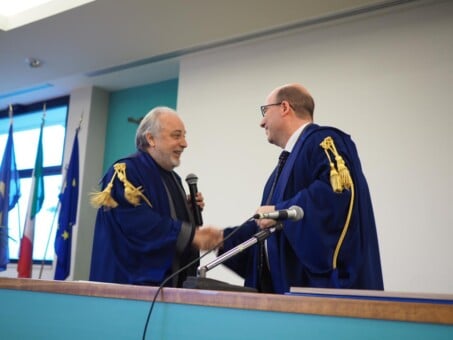
After twelve years of presidency, Prof. Piero Coda, who has led the Sophia University Institute since its foundation, passes the baton to Prof. Giuseppe Argiolas, Professor of Management at the same Institute. This is the first change of guard for the Sophia University Institute (I.U.S.), which also coincides with the attribution by the Congregation for Catholic Education of the title of “Rector” to the former Dean of the Institute. Therefore, Prof. Giuseppe Argiolas is the new Rector of Sophia. He succeeds Prof. Piero Coda who , since its foundation, has guided the Institute with wisdom and a spirit of prophecy. The election by the Academic Council of the Institute, took place on January 9th. On February 20th , 2020, the Congregation for Catholic Education, wrote a letter, appointing Prof. Giuseppe Argiolas Rector of the Sophia University Institute for a four-year term. This morning, in the Aula Magna of the Sophia University Institute, the ceremony for the inauguration of the new Rector was held. Argiolas was born in Cagliari in 1969. He has been a permanent lecturer at the I. U. Sophia since 2016, when he left his post at the University of Cagliari to dedicate himself to developing the degree course in Management and to directing the Institute’s Doctoral School. His research activity is mainly focused on topics of Corporate Social Responsibility and Organizational and Mission-Driven Business Management (see Biography). “First of all, I want to express my deep admiration for Prof. Piero Coda and a big thank you for what he has done so far – commented Prof. Argiolas – for my part, I will try to do my best to carry out the task entrusted to me, interpreting this responsibility as a service of unity”. He went on to say: “The founding phase ends and that of consolidation and development begins with the generational transition. But the charismatic dimension must remain. Sophia will continue to carry out, with creative fidelity, the mission for which it was founded by Chiara Lubich, travelling together with many companions – as Pope Francis told us – with always new “joy, vision and decision the journey just begun”. Professor Piero Coda, who leaves after twelve years of presidency, adds: “I am happy with this new stage in Sophia’s journey which begins under the expert and inspired guidance of Giuseppe Argiolas, the fruit of constant and consolidated maturation at all levels. The appointment no longer as Dean but Rector by the Congregation for Catholic Education comes unexpectedly and is welcome as a seal and further impetus. The occasion is propitious to renew with enthusiasm and joy with the Rector and with the whole academic community that pact of unity that qualifies the spirit that animates us and which is relaunched today with vigour by Pope Francis’ Global Compact on Education”. Maria Voce, Vice Grand Chancellor of the Institute and President of the Focolare Movement, expressed her wish : “I am happy to renew my congratulations to Prof. Giuseppe Argiolas, the new Rector of the Sophia University Institute. His election undoubtedly marks a change of generation and of academic scope compared to the outgoing president. I am sure that Prof. Argiolas will bring you the gift of his personal characteristics, remaining faithful to the charismatic origin of the culture of unity and updating it to respond in the best possible way to the questions of the present time”. Source: Ufficio Stampa Istituto Universitario Sophia

2 Mar 2020 | Non categorizzato
In Aachen, Germany, the Focolare presented the Klaus Hemmerle Prize to Metropolitan Anastasios Yannoulatos of Tirana, Albania  He is not a familiar face on newspaper front pages, this white-bearded, gentle 90 year old who received the Klaus Hemmerle Prize from the Focolare Movement on February 14 in Aachen, Germany. But Anastasios Yannoulatos, Greek Orthodox Archbishop of Tirana, Albania, is a well-known and respected figure, both at the international religious and political levels, especially in Eastern Europe. In his acceptance speech, Yannoulatos said he hoped for a “peaceful coexistence in a multireligious world”, and expressed his fascination with Albert Einstein’s phrase about the power of love: “Each individual carries within them a small but powerful generator of love whose energy is waiting to be released… because love is the quintessence of life.” Yannoulatos recalled that it was this same love that encouraged Bishop Klaus Hemmerle (1929–1994) to commit tirelessly to world peace and reconciliation. One can see this same commitment in the actions and life of Metropolitan Anastasios. Bishop Helmut Dieser, current Bishop of Aachen and successor of Klaus Hemmerle, welcomed the 300 guests to the imperial cathedral of the city of Charlemagne, presenting the award in honour of this “pioneer of faith and ecumenism”. Metropolitan Augoustinos Lambardakis, president of the Orthodox Episcopal Conference in Germany spotlighted the esteem that Metropolitan Anastasios enjoys in the Orthodox world, where his words are heard despite tensions between the various autocephalous churches. Focolare president Maria Voce emphasised Metropolitan Anastasios’s tireless commitment to dialogue between Christians and Muslims in her message for the occasion, thanking him for his ability to inspire communion, brotherhood and sharing. Cardinal Kurt Koch, president of the Pontifical Council for the Promotion of Christian Unity, paid tribute to Metropolitan Anastasios. He retraced his path from Greece through Africa to Albania, where Yannoulatos showed how “interreligious dialogue and missionary commitment did not have to be in conflict”. The cardinal also emphasised how Yannoulatos has been carefully committed to rebuilding and reinvigorating the Orthodox Church in Albania since 1992, helping to reduce strong tensions in the Balkans. Every two years the Focolare Movement in Germany honours key individuals in the field of dialogue between churches, religions and ideological beliefs with the Klaus Hemmerle Prize. Previous winners include the former president of the World Lutheran Federation, Bishop Emeritus Christian Krause (2006); Ecumenical Patriarch of Constantinople Bartholomew I (2008); Muslim doctor Noorjehan Abdul Majid of Mozambique (2016); and German Rabbi Henry Brandt of Augsburg, Germany (2018).
Andrea Fleming
29 Feb 2020 | Non categorizzato
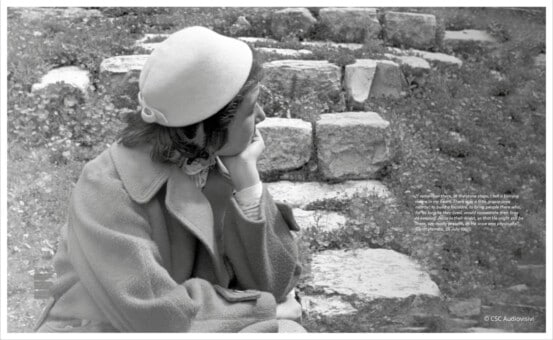
The “Chiara Lubich City World” exhibition has been inaugurated in the Holy City, the first of the exhibitions outside Italy to be opened. It includes a section dedicated to Chiara Lubich’s visit to the Holy Land in 1956. “I didn’t think Jerusalem and its Holy Sites would affect my soul like that (…) every stone said a word, much more than a word, so that, in the end, my soul was all bathed and entirely filled with the presence of Jesus” . Chiara Lubich’s diary expressed her profound experience during the only journey she made to Jerusalem and the Holy Land, in 1956. Several black and white photographs and a video journal recall that journey, but the greatest testimony is the active presence of the community of the Focolare Movement in this city, which on February 29th, 2020, inaugurated the “Chiara Lubich City World” exhibition housed in the Curia of the Custody of the Holy Land. The exhibition is open until March 14th, 2020. The exhibition reproduces the one currently open to the public at The Tunnels Gallery at Piedicastello in Trent (Italy), curated by the Chiara Lubich Centre in collaboration with the Trentino Historical Museum Foundation. It is the first of the international sections of the Chiara Lubich City World exhibition, which will also be held in Mexico City, Sydney, Mumbai, San Paolo, Algiers and Nairobi in the year dedicated to the centenary of Chiara Lubich’s birth. Jerusalem’s primacy is symbolic as the city-cradle of the three great monotheistic religions, and home to many peoples. The community of the Focolare Movement has been here since 1977 with the mandate to contribute to the fulfilment of the unity for which, in this very land, Jesus prayed to the Father. The Jerusalem exhibition reflects the original while being someone reduced and adapted. It conveys significant moments in the life of the founder of the Focolare Movement, her thought and work, through documents, handwritten texts and photographic material. But this edition has its own specific characteristics, available only to those who visit it here: a section dedicated to the relationship between the founder of the Focolare Movement and Jerusalem, as Claudio Maina, jointly responsible for the Focolare Movement in the Holy Land, explained. “We wanted to bring this exhibition to Jerusalem to make Chiara’s life, spirituality and work better known, but also to bear witness to her relationship with this city. Actually, Chiara only came to Jerusalem once, just for a few days. But from that visit a story began that continues today. Indeed, here in the Holy Land, there are people who have welcomed Chiara’s spirituality and are living it”. Part of the exhibition is dedicated to Chiara’s great dream for this city so deeply marked by divisions and historical wounds: to create a centre of spirituality, study, dialogue and formation to unity. “It’s a dream, an intuition that gradually took shape – said Terese Soudah – in the project for the International Centre for Unity and Peace, a project that we have been working on for years and that, despite many difficulties, is progressing and we hope to be able to conclude soon”. Dignitaries attending the inauguration included the Nuncio and Apostolic Delegate to Jerusalem, Archbishop Leopoldo Girelli, the representative of the Latin Patriarchate, Father Stéphane Milovitch, director of the Cultural Heritage Office of the Custody of the Holy Land, as well as Christian, Jewish and Muslim friends, who make up the Focolare family in the Holy Land. Due to the Coronavirus emergency, the Italian delegation was unable to attend, but sent video contributions. In this way, the President of the Autonomous Province of Trent, Maurizio Fugatti, wished every success to the exhibition; to bring to the world the message that Chiara Lubich gave to the Trentino Region and to Italy. The Custos of the Holy Land, Father Francesco Patton, expressed his hope that, through this exhibition, Chiara’s spirituality would remind this troubled land of the value of unity, the fruit of Jesus’ prayer, which is still so relevant today. In a video-message, Anna Maria Rossi and Giuliano Ruzzier, curators of the exhibition in Trent, along with Maurizio Gentilini, presented the exhibition itinerary: “We created a project that isn’t limited to the city of Trent, but, as happened in Chiara’s life, can reach the ends of the earth, encompassing all five continents”. At the ribbon-cutting ceremony, the Nuncio, Archbishop Girelli, recalled the extreme relevance of Chiara’s message: “Here in Jerusalem, we could invert the words of the exhibition’s title and call it: “Chiara Lubich World City”, because this exhibition has come from the world to the city par excellence, the Holy City, the city of unity, of fraternity, of dialogue among religions and among peoples”.
By Stefania Tanesini
