24 Jun 2019 | Non categorizzato
A report on a journey with Egilde Verì who came back to Syria after 14 years and after a terrible conflict. We travel to Damascus with her to meet and hear from the Focolare community there. https://vimeo.com/343238285

22 Jun 2019 | Non categorizzato
A strong appeal for a Europe that is open, inclusive and dialogic launched by the president and co-president of the Focolare Movement at Matera, European Capital of Culture 2019. Let the “city of the Sassi” be a living model for a more harmonious, just and fraternal coexistence – this was the challenge launched by Maria Voce and Jesús Morán during a conference held at Matera, European Capital of Culture 2019, this Saturday June 22, 2019. This conference entitled “Living time and space: the Culture of Unity at the service of the City” was organized by the Focolare community and the Elicriso di Matera Association. In their strong message, the president and co-president of the Focolare Movement invited the old continent of Europe to rediscover its mission: show the world that diversities can coexist without differences being suppressed and identities violated.  About 550 people participated in this conference, amongst them Antonio Giuseppe Caiazzo, the Archbishop of Matera-Irsina, and Giovanni Oliva, Secretary General of the Matera Basilicata 2019 Foundation. Maria Voce, who spoke about the “culture of unity” promoted worldwide by the Focolare community through the concrete aspects of city life, posed the question: how can we live “a culture of dialogue, hospitality, fraternity” today in the fields of economy and work, interculturality, social ethics, health and environment, art, human formation or modern means of communication? The president gave an answer to this question by quoting examples of cities where – even through the commitment of Focolare members – citizens discover their city’s “vocation” through generous love towards neighbour and community, through being “active and co-responsible citizens” and through living “together the art of participation”. Sulcis Iglesiente in Sardinia was one of the examples quoted. The Focolare community and other pacifist movements in this city set up a committee to work together for the reconversion of a company that produces weapons. Another example quoted was Poland. The public administrator in the Council of Upper Silesia speaks of a Poland that is neither closed nor sovereign and of cities where the collaboration between religious communities and non-governmental organizations helps Ukrainian immigrants to integrate. But increase in citizens’ participation is not enough to rebuild the 21st century cities, concluded the Focolari president. The politicians’ specific contribution is essential; they are called to practice “the love of all loves”, an expression used by Chiara Lubich to define political commitment. In other words, politicians are the first ones called to provide the means for individuals and groups to be fulfilled and to create spaces where their resources and initiatives can be gathered into the unity of a common design, just like the colours that compose the rainbow. Interviewed by RAI journalist Gianni Bianco, Jesús Morán explained in depth all about his commitment towards fraternal coexistence in our cities, particularly in Europe. The co-president of the Focolari declared his firm belief that Europe is called to be “a model for all the world unification projects”. Morán affirmed that to fulfil such a vocation, Europe needs to go back to its Christian roots, to a Christianity whose great prophecy is “universal brotherhood”. He continued to explain that universal brotherhood motivates “processes, that have their own roots and identities but are inclusive and open to dialogue, and so one discovers that people of diverse status, religion or ideology are able to participate in them”. The president and co-president of the Focolare Movement expressed their great aspirations for Matera: “The capital city of a culture of unity”, “a new city” that may able to contribute towards “recomposing in unity the project for our Europe and for the human family”.
Joachim Schwind
19 Jun 2019 | Non categorizzato
Following Jesus’ way of life means welcoming and sharing the experiences of all the people we meet in our families, at work, when we study and when we relax: we never lose sight of the goal we hold dear – universal fraternity. The Happiness Newsagent When my sister died, I inherited the newsagents that she had been running. It wasn’t my dream to become a shop keeper but I saw it as an opportunity to love because sometimes the people who come to the newsagents want to talk about their lives. The shop became a centre for community and friendship. I found space for a table and chairs and, when the weather is good, some people sit down to read and chat too. Someone suggested that I change the sign that says “Newspapers” to “Happiness Newsagent”. (M.R. – Italy) The Child Grandmother Due to illness, my mother has become a child again: she doesn’t speak and she doesn’t seem to understand anything. Until quite recently, we felt we were in a desperate situation and didn’t know what to do. Relatives and friends advised us to move her to a good care home. We spoke to our two sons to try to find a solution and we decided to take it in turns to stay with her in the house. My husband and I were worried about involving the children in this difficult situation because we felt it could be too much for them. However, as the days went by, the boys became more and more maternal towards their grandmother and saw her as someone who deserved respect and who had something sacred within that only love could penetrate. The relationship with her has become like waves that ebb and flow in a sea of love. (Y.O. – Japan) To Give One night, my brother was really ill and needed to go to hospital. We are poor so I had to run and ask if I could borrow some money from our neighbours. Then, my mother and I began to carry my brother to the hospital but before we had gone very far, we met a man who was begging. I was about to give him some money but my mother stopped me and said, “We will need that!” I said, “If we give then God will help us” and that is exactly what happened. At the hospital entrance, we met a doctor who knows us and, thanks to him, my brother received treatment totally free. My mother could not believe it. (M. – Egypt) The Example Our youngest daughter, Patty, had gone to Canada with her friend to improve their English. Shortly before the end of her stay, she telephoned and what she said hit me like a cold shower: she was expecting a baby. The father of the child loved her but she was not sure about marrying him. I didn’t know what to say but asked if she was going to come home. She agreed but felt embarrassed at the prospect of returning to a small village where our family is greatly respected. During the time we waited for her arrival, we began to accept what was happening and prepared to meet her without making judgements and to welcome her with an open heart just as she needed. When the baby was born, she was a ray of sunshine for everyone. Later, when the same thing happened to another family in the village, the parents confided in us saying, “Your example has encouraged us to do the same with our daughter as you have done with yours.” (M.J.S. – Switzerland) The day that began badly I had left the house feeling very agitated and, on the way to school, I thought the day would be a disaster. I thought of one of the people in my class who I don’t like and was sure that she would make the situation worse. However, when I got to the lesson, I really made an effort to be polite to her and she responded in a pleasant and welcoming way. The whole day seemed different. It’s really true that a tiny effort on our part to “go out of ourselves” can make a big difference. (M.S. – Hungary)
edited by Chiara Favotti
17 Jun 2019 | Non categorizzato
The May-June 2019 issue of the New Humanity magazine is entirely dedicated to the mystical experience that Chiara Lubich had in the summer of 1949: this is now known as “Paradise 49”. We asked Father Fabio Ciardi, head of the interdisciplinary study centre, the “Abba School” and member of the steering committee for the publication of Chiara Lubich’s writings to explain the reasons for this decision. Father Fabio, in this issue of the magazine, there is a previously unpublished text by Chiara Lubich from 1969 that refers to the period of spiritual contemplation lived twenty years earlier and there are also articles by protagonists and witnesses from this time. Why did you decide to write about this now? Seventy years have gone by since the summer of 1949 and it deserves to be remembered by our magazine. We have given space to Igino Giordani, Pasquale Foresi, Klaus Hemmerle, Marisa Cerini, Giuseppe Maria Zanghí and Jesús Castellano because they were the people who worked most closely with Chiara, reading and studying her writings from that period. They were part of that circle of scholars, the “Abba School”, that Chiara wanted around her precisely to help her to bring out the doctrine inherent in the experience of 1949. Their academic contribution is very clear in the articles that we include in the magazine, many of which are being published for the first time. At the same time their personal experience with Chiara also comes to light: they have been profoundly transformed by this. In this sense they are truly witnesses and protagonists of Paradise 1949. We have chosen them also because they have finished their earthly “holy journey” and we believe they are in that Paradise which is the focus of study for many people. For a long time there was a great deal of confidentiality regarding the period called Paradise ’49 and only recently did we begin to publish texts related to that time. Why? Because Chiara had the right to her own intimacy. It was a very profound and personal experience of God, even if from the beginning it was shared with those who lived with her. How many mystics have their writings made public before their death? It took 500 years to know the diary of Saint Ignatius of Loyola. There was also the danger that Paradise ’49 would be misinterpreted. Like any mystical text it needs to be introduced and, more importantly, the experience has to be shared by recreating the same conditions that gave rise to the event: otherwise it could remain just eloquent words. At that time, there was also a certain diffidence towards such a new Movement that included men, women, clergy, members of religious communities……. especially since it was led by a woman. That period of vision and understanding was very important for Chiara Lubich and for the development of the Focolare Movement which had only just begun at that time. Can you tell us more about this? And what is the significance of these texts today? The fact that those writings were not published in full did not prevent the experience they expressed being shared with others enabling them to live it too. Chiara Lubich has always been inspired by these writings in her teaching, sometimes citing them explicitly, even without indicating their origin. The entire Focolare Movement has been constantly nourished by the light that has sprung from that experience, indeed it has been shaped by it. We already have Paradise ’49 within us, more than we can imagine. Those texts mark the beginning of the entire Work of Mary – with its many expressions of life and its social and cultural initiatives. They are also a prophecy that still demands to be fulfilled in that they offer a vision of God’s plan for humanity and they point the way to his incarnation. During a time of bewilderment and uncertainty like the one we are currently experiencing, Paradise’49 can help us rediscover the profound meaning of our life, of the life of the Church, of society, of the whole cosmos, and direct us towards its fulfilment.
by Anna Lisa Innocenti
14 Jun 2019 | Non categorizzato
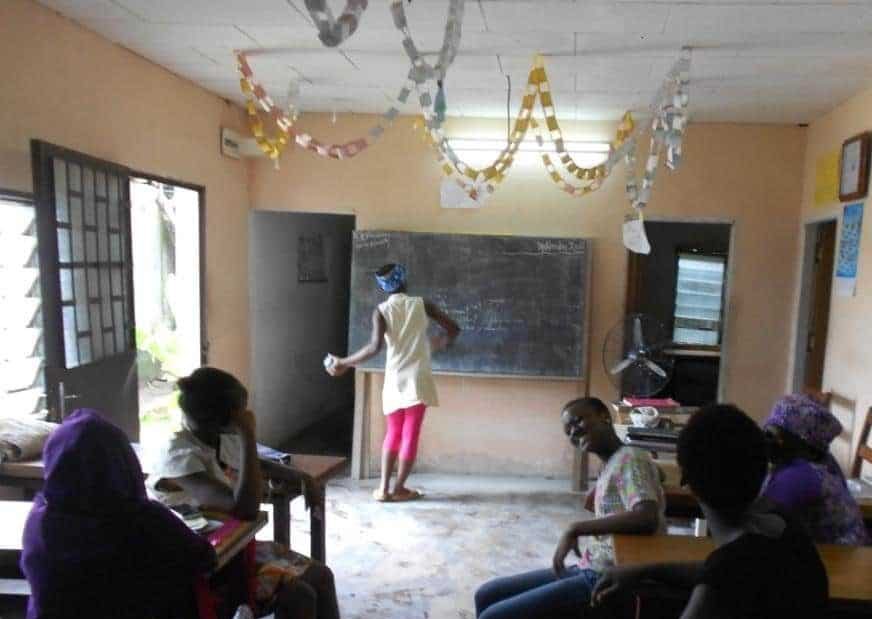
Sponsored by a group of Focolare Volunteers, a centre in Douala takes in girls who have been exploited, assaulted or abused, offering training courses that are both holistic and professional. “We looked around us, and, feeling pained and powerless at the dramatic situations that some teens go through in parts of our city, we asked ourselves what we could do.” This is how Albine Essene, from Douala, Cameroon, describes the spark of inspiration that brought her and a group of Focolare Volunteers to commit to caring for girls who have been victims of exploitation, assault and abuse. In 1998 they started the HUPJEFI social centre (Halte Utile Pour Jeunes Filles) in Douala. “Many are just teens,” she continues, “who each night are on the street, especially in front of hotels and restaurants, forced to prostitute themselves to get money to survive. Many are minors, so we’re talking about real-life abuse.” How did you begin? “One evening, one of us stopped with her husband to meet one of these girls and welcomed her into their home. They then contacted her parents so she could go back to her family. “This episode raised many questions in our hearts: How could we continue to help her? How could we help other girls? “What we needed was a centre to take them in and offer them holistic training. We put what we had in common; someone offered their house, another offered to take care of the girls, someone else gave their time to get information from social workers, and others put in money. “Our first location was in the city centre, where prostitution is quite widespread. We began with two girls, but it wasn’t long before the house was full. We then created three other centres for girls aged 14–22. “Our work includes listening to them, looking after their intellectual and social development, and even organising sessions on emotional and sexual training through the EVA programme (‘Life and Love Education’) “We then set up a professional training centre, with courses on writing, business law, haircutting, sewing – all activities aimed at helping them integrate socially. We are the only centre in the country with holistic training for them.” Over the years, you have come to know many girls, over 300. Are there some stories that you particularly remember? “I have many in my heart. I remember one girl who confided to us that she had problems relating to her mother, which led her to decide to marry a boy she was with. We asked her if she loved him, since marriage is an important decision, not a way to escape problems. “She listened to us without saying anything. The day after, in a letter, she explained that she didn’t love the boy. A week later she came back to thank us. She had found the courage to break her engagement and had asked her mother to forgive her. Peace had returned between them. “‘I feel so free now,’ she said. “Then there was another who always came late, explaining that each day, before coming to the centre, she was with a boy without her family knowing. He had promised her many things. “We put her on her guard, explaining to her that some men take advantage of financially vulnerable girls and abuse them. We tried to understand if she had weighed the consequences of these kinds of meetings (injuries, sexually transmitted disease, unwanted pregnancy, etc.). If the boy had good intentions, he should introduce himself to her parents. “She listened to us. A short while later she ended her relationship and started to attend a professional training centre for sewing. “There were some difficulties there as well. Not having any means of transportation, she always had to walk there, until one day she met a man who offered to give her a lift. He then started to make appointments for her in bars or hotels. “Feeling in danger, she came back to our centre to ask for help. Today she is highly regarded by all the teachers at the school she attends and is preparing for final exams.”
Anna Lisa Innocenti
13 Jun 2019 | Non categorizzato
The apostles together with all Jesus’ disciples are sent out as “witnesses”. Each Christian when they discover through Jesus what it means to be a child of God, discovers that they too are sent. Our vocation and our identity as children of God become a reality in the mission, in reaching out towards others as brothers and sisters. The wallet I work freelance so have no fixed salary. One day, just as I was about to go to my work studio without any money, I found a wallet on the ground. I picked it up and went to work. It contained a lot of money that I could really have used, especially because I had a child who is not well. For a moment I was tempted to keep it but then decided to look for its owner. To my surprise, I discovered it belonged to a neighbour of mine. As I stood in front of his door I was once again tempted to keep the wallet but then I rang the bell. He thanked me and I went to sleep at peace. The following day, completely unexpectedly, a considerable amount of money arrived at the studio! (N. – Egypt) Alzheimer’s At first, I thought it was all just symptoms of ageing but when we received the diagnosis of Alzheimer’s I started to become really anxious. The wonderful man I had married, the invidious father of our children, had become someone to be pitied. As the disease progressed, something was destroyed in me too: it was as if everything I did for my husband disappeared in the wind. Even the children, with their families and their problems, seemed distant to me. A priest advised me not to make comparisons with the past but to start life today. Something began to stir within me and my husband seemed to become more serene which the children felt when they came to visit us. After his death, the youngest hugged me and said: “You have always been our models, but especially in the last period”. (S.Q. – Portugal) Refugees Two hundred and thirty refugees arrived in our city, some with only the clothes they were wearing. Saddened by this situation, we decided to collaborate with Caritas, investing time and energy. Little by little we made friends with them and some of the mothers started to visit our homes. One day Pasa, a Muslim, saw how worried we were about our daughter who was seriously ill and promised to pray every day to Allah for her. It all reconfirmed to us how fraternity goes beyond cultural differences and religious faith. (U.R.J. – Germany) True sociality In our country, sole-traders, pedal-operated taxi drivers, teachers and government employees, because of their low salaries, are obliged to borrow money from moneylenders at very high interest rates. One day, a group of us decided to set up a credit union to fight this economic crisis. Our house became the official headquarters. We tried to live the Gospel as our only rule, listening carefully to every member to help solve their problems. We involved very wealthy people from the surrounding area, and thanks to their help the drivers of pedal-operated taxis have been able to buy their vehicles, many young people have been able to continue their studies and sick people have been able to pay for treatment. Some families have received help to build a house, others have managed to save money to go to work abroad. The wealthiest families became aware of everyone else’s needs and the poor overcame their sense of inferiority. The Gospel really teaches us how to live as a community. (M.T. – Philippines) On the bus A group of lads were sitting on the back seats of the bus playing their rap music very loudly and bellowing at the top of their voices. The other passengers would turn and look at them disapprovingly but it only made them shout even louder. At a certain point a middle-aged woman, smiling broadly, went up to the lads and invited them to sing more clearly so that the other passengers could hear the words of the songs better. After an embarrassing silence, a choir began. The boys began to smile, the words were understood and people began to applaud. The atmosphere in the bus had completely changed. (W.K. – England)
edited by Chiara Favotti
