2 Jan 2019 | Non categorizzato
Think big and begin small, look at the world but start from your own neighbourhood
All over the world, the
Teens for unity have started to come up with ideas and give life to
the project «Zero Hunger», with the support of the FAO who is encouraging especially the youth and teens to personally commit themselves to realize.
In Mumbai in India too the starting point was to identify the poor if the city. Poor not only of material things but also those poor in health, friendship. After meeting around eighty teens afflicted with Aids who are living in situations of dire poverty, the
Teens for unity wrote a letter to 600 families of various religions who live in the enormous condominiums in the area, explaining to them their dream of a world without hunger and proposing a used newspaper collection which would then be sold to generate funds. More than 50 families agreed to join the action expressing their gratitude for this project. The activity was repeated, encouraged precisely by the families in the neighborhood. Now other groups in many parts of India are repeating similar activities. If we are able to do an activity for an entire neighbourhood, why not involve the entire Town? This was the idea of three brothers from
Cesate in Lombardy, Italy, who presented their idea to the Mayor: to make Cesate a «Zero Hunger Town»! Together with her, they thought of activating a synergy among the Town, the parish and the school, extending the project also to nearby Towns. The teens talked to the parish priest and to the priest responsible for the oratory about Project «Zero Hunger» who were very happy about the proposal. They planned a strategy to reduce wastage in their refectories. With regards to the schools instead, a group of teens in Lebanonthey have planned that every year on October 16, the World Day of Nutrition, they will organize a «Zero Hunger Day» to encourage the reduction of wastage during meals.
It is precisely in synergy with the organizations in the city that this action brought ahead by teens from Lebanon started. In collaboration with Caritas, they gathered together more than sixty elderly who live in situations of solitude and financial difficulty. They prepared and served them lunch and organized dances and games. At the conclusion, one of the young girls asked the animator of their group if they could do this every week. «But we need a big budget to do this» she replied. «You adults – the young girl said – always think about big projects, but we must begin with small gestures». Involving one of her friends and other adults, they began a small activity: they prepare a meal together every two weeks which they bring to a family in difficulty, spending the afternoon with them.
Anna Lisa Innocenti
1 Jan 2019 | Non categorizzato
From an interview with Focolare President Maria Voce, originally published in the January issue of Neue Stadt magazine 1. What makes you laugh? Bloopers. For example I’m walking, I don’t see a step and find myself on the ground. I laugh so hard inside it’s difficult to get up! 2. What gets you mad? I don’t feel anger grow inside me. At the most I feel sorry – for something that’s happened, that’s been said to me or annoyed me. 3. What’s been the most important experience of your life? When I met a group of young people whose unity and witness fascinated me. They were consistent with the Christianity they lived, loving and being at the service of everyone, without ever judging anyone. This led to me getting to know the Focolare. My life changed the moment I truly listened to someone, thinking that he was my brother, that Jesus was within him. 4. What are your weaknesses? Curiosity. When I hear two people talking outside my door I can’t help but bend an ear. Each time I have to take a step and set that aside. 5. And your strengths? Optimism and trust. I trust in God and in others, even if I don’t know them, even if I realize that my trust is misplaced. This makes it easy to relate to others. 6. Where is your favorite place? I like the whole world. But in terms of a favorite place, I think of a comfortable house, where there are people with whom I can have true, deep communion. If possible, it would be a warm place with sun – on the shore! In my mind this house would be in a city, since I am a pretty social person. 7. What helps you rebuild your strength? A good sleep after having lived the present moment well and entrusted my worries to the Eternal Father. 8. What worries you? Everything that has to do with conflict and hostility: wars, family quarrels, unresolved problems. Many times there is nothing I can do about it, but if I can, I try to find a solution or help others find one. 9. What do you have at heart as you guide the Focolare Movement? For the movement to be an authentic witness of the charism of unity. There are groups all over the world who are living it this very moment. This gives me peace, it gives me confidence. This is where new ideas are born – new ways of incarnating. May they bring the charism of unity forward so that it achieves the goal Jesus prayed for: “That they may all be one.”
31 Dec 2018 | Non categorizzato
On the occasion of the 52nd World Day of Peace, and in support of the Pope’s message “Good politics is at the service of peace”, we publish an extract of Chiara Lubich’s talk during a meeting of Teens for Unity, the young people of the Focolare Movement, gathered at the Colosseum in Rome in 2002. What is the key to promoting peace? Living the golden rule for building universal brotherhood. https://vimeo.com/148206157 Peace. Is peace of such great interest today? Yes it is, of course, and perhaps more than ever before. Not only because dozens of wars are ongoing in the world today, but also because peace is threatened in a different, more insidious way. … The situation is serious. If this is how things are, it is not enough to oppose such great danger with merely human strength. We need to engage the forces of good with a capital G. You all know what this Good is: it is God and all that is rooted in him. It is the world of the spirit, of great values, of authentic love and prayer. … However, peace is so precious that all of us, adults and young people, leaders and ordinary citizens, must be actively involved in safeguarding it. … Naturally, in order to know what to do, we need to be familiar with the deepest causes of this dramatic situation today. You all know that justice does not prevail in the world, that there are rich countries and poor countries, where there is hunger. Instead, God’s plan for humanity is that all people should be brothers and sisters, in one big family with one Father. … Well then, how can we create greater equality, how can we bring about some sort of communion of goods? It is obvious thatgoods cannot move unless hearts are moved. Therefore, we need to spread love, the reciprocal love that generates brother and sisterhood among all. We need to invade the world with love! Beginning with ourselves, and with you, boys and girls. Someone here might ask, “Is love, loving one another, compatible with the lifestyle our cultures have handed down to us? Yes, it is. Look in your sacred Books and in almost all of them, you will find the so-called “Golden Rule”. The Christian text says, “Do to others as you would have them do to you” (Lk 6:31). Judaism says, “Do to no one what you yourself dislike” (Tobit 4:15). In Islam “None of you is a true believer if you do not desire for your brother what you desire for yourself” (Hadith 13, Al Bukhari). In Hinduism, “Do not do to others what would make you suffer if it were done to you” (Mahabharata 5: 1517). All these phrases mean, respect and love your neighbour. If you, a Muslim boy or girl, love, and you, a Christian, love, and you, a Jew, love, and you, a Hindu, love, you will certainly reach the point of loving one another. The same for everyone. This would already create a chunk/portion of universal fraternity. … Therefore, loving is one of the great secrets of our time. Loving with a special kind of love. It is certainly not a love directed only towards our relatives and friends. This love is directed towards everyone, those who are more or less nice, rich or poor, children or adults, from your own country or foreigners, friends or enemies… Towards everyone. We should be the first to love, by taking the initiative, without waiting to be loved. We should love not only with words, but also concretely, with facts; and we should love one another. … if you do this, if we all do this, universal brotherhood will spread, solidarity will grow, goods will be better distributed, and the rainbow of peace will shine over the world, a world which will be in your hands in a few years’ time. Chiara Lubich (Collegamento CH – 5th. december 2015)
31 Dec 2018 | Non categorizzato
Losing your job at 53 years of age, with three dependent children, would test anyone’s resolve. But Mirco didn’t allow himself to get discouraged. He went back to college and launched himself on a new career using dance to help people to connect and express their emotions. «Someone asked me, “Why don’t you transform your passion into your work?” And so began the challenge – far from easy – to create a new professional identity for myself». Today Mirco Castello is an Art Counsellor, but only after losing his “secure” job in the textile and fashion industry in 2008, after which it became harder and harder to balance the family budget. «I tried to listen to the advice people were giving me, but most of all to a “voice” inside of me which kept prompting me not to miss this opportunity. In fact, for many years I had dedicated my spare time to my real passion: mime, acting and dance. I started looking for ways of transforming this passion into a service which could meet the needs of others, particularly of children. I launched a dance and music play project in a nursery and primary school». As child psychologists maintain, dance has the power to help children find new balance and harmony within themselves. But a good idea and enthusiasm are not enough. To work in a professional educational environment, the right credentials are required. So Mirco went back to college, successfully studying for an Arts Counsellor diploma and a Masters degree in Family Mediation. He then contacted schools across Italy, in both the state and private sectors, he set up his own website (www.ledanzedimirco.it), and began offering training for teachers and sessions for children. «Since 2008 I’ve been managing – just – to make a living for my family, always hoping that no unexpected expense will crop up. But I have to say that we’ve never actually been lacking. With the profound relationship of unity with my wife, and with my friends in the Focolare Movement to sustain me, I’ve been able to entrust myself completely to God. I find He shows me the steps I have to take. Through my work, I can testify to the experience that He loves me and does not abandon me. I consider Him to be my new employer!».
Currently, Mirco is running a project in Italy and other European countries involving 2,000 children annually. «I engage children in play through music and can immediately recognise many forms unhappiness. How children suffer these days! So many are lacking in values, the security of boundaries and rules, their own autonomy, or are living through the separation or even conflict between their parents». Together with his wife, Mirco also runs a project for adults, facilitating «openness, assertiveness, understanding, forgiveness». And Mirco’s horizons continue to widen. «You know, for ten years, my wife and I could not even think about taking a holiday. Now, we’ve been invited to go to Kenya in January, to work with children in two schools and an orphanage. We’ve also received another invitation to go to Russia. Tell me, if this is not the love of my new employer!»
A cura di Chiara Favotti
29 Dec 2018 | Non categorizzato
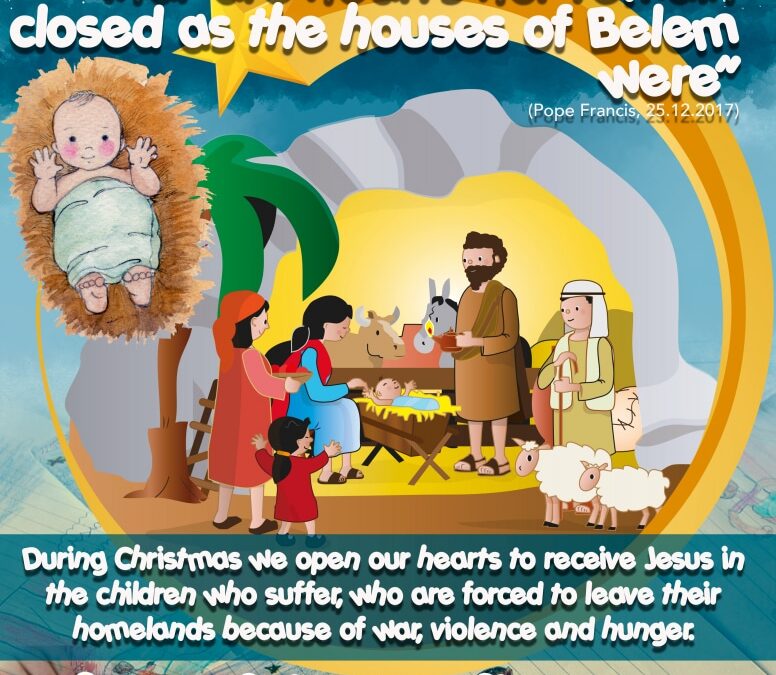
This year too as Christmas approaches there is a lot of buzz among the children of the Focolare Movement who are serious in sharing to others the invitation to welcome Jesus in those who are suffering
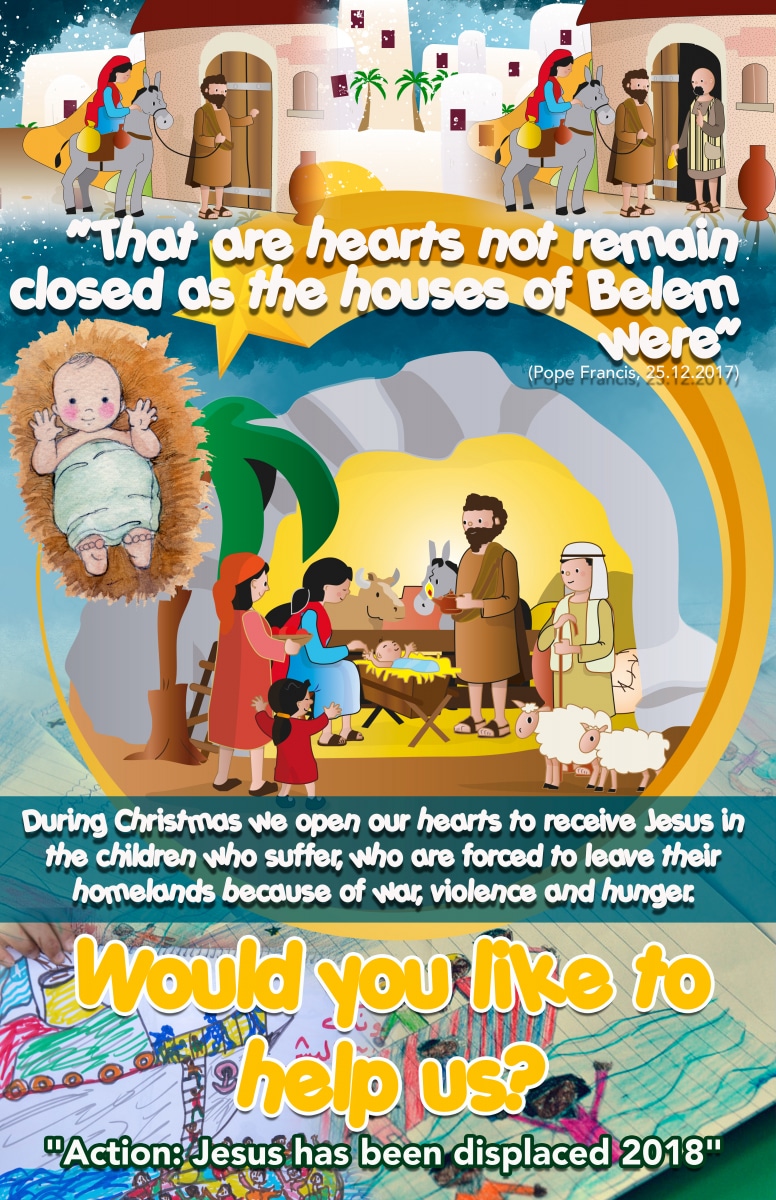 Pope Francis, during the Christmas of 2017, invited us to see to it that: «Our heart is not closed like the houses of Bethlehem were»1. Taking this invitation of the Pope seriously, with the support of their assistants, the involvement of their parents, teachers, classmates, their activity called «Jesus is left out!» (Hanno sloggiato Gesù) (HSG) is directing itself towards supporting projects of hospitality to help those who are marginalized or who suffer due to wars, injustices, those who are homeless or are forced to leave their homeland.
In this unique «framework» of hospitality, they have set-up small workshops to make little statues of Baby Jesus to offer in the streets, the town or city squares, in the most varied places so as to share with everyone that the real meaning of Christmas is Jesus who is born for everyone, today like yesterday, and that He is waiting for us to welcome Him in all those who are in need. The action of “HSG” conducted by the littlest ones, brings with it the profound values of Christmas: giving oneself, gratitude, unconditional love, generosity. This indirectly also reinforces these values in adults and in families. The production of the little statues promotes manual, creative and immaginative skills, collaboration, planning and self-expression. It develops in the children a sense of active citizenship, solidarity, fraternity, also through the fund-raising activities that provide concrete answers to the needs of children in different parts of the world. It stimulates the desire to give. Many people in fact, spontaneously leave a donation to support these initiatives. Experiences have been shared by adults who have received the message from the little ones on how, with love, they would like to find a home for Jesus at least this Christmas. «It is really life-changing to enter a supermarket and be welcomed by these children who smilingly offer you Baby Jesus», exclaimed a gentleman from Florence. «We think we can find everything in a supermarket but I never imagined that I would go home bringing Jesus with me!».
prepared by Rosi Bertolasso
28 Dec 2018 | Non categorizzato
A quarterly journal for those who work at all levels in the ecclesial ambit. The subheading “Pathways of Communion and Dialogue” describes the type of content that characterises it. Born in synergy between the Focolare Movement and the Città Nuova Publishing Group, this journal, in both printed and digital form, released its first issue in Italian, but articles in English are also foreseen. Other language editions are expected to be published in the near future. It is presented as an instrument of formation, as an aid for action and as a source of inspiration in the search for new ways and expressions to share the Gospel with the men and women of our time. It is aimed at pastoral workers and animators, members of religious organisations (consecrated persons and laity), people involved in parishes or dioceses, people belonging to ecclesial movements or associations, but it will also dedicate space to the relationship between different Churches and world religions, to the encounter between different beliefs and cultures, to the renewal of Church and society. Each issue will focus on a particular theme. “The Greek word ekklesía means ‘assembly’, people who know they are summoned and called together to be protagonists in the journey of a people,” reads the editorial of the first issue. “The subheading pathways refers to the experimental and in-depth nature of the publication; communion and dialogue defines the direction in which it is heading but also its style. We hope that the journal, in both printed and digital form, and in all its subsequent language editions, may express and be of service to the community.” The authors include: Piero Coda (theologian), Vincenzo Zani (Secretary of the Congregation for Catholic Education), Tiziana Longhitano SFP, Cardinal Giuseppe Petrocchi (Archbishop of Aquila), Gerard Rossé (exegete), Brendan Leahy (Bishop of Limerick, Ireland), Jesús Morán (Co-President of the Focolare Movement), Fabio Ciardi OMI (expert on consecrated life), Susana Nuin (communications expert from Columbia), Callan Slipper (Anglican theologian) and Stefan Tobler Evangelical theologian. More details and journal subscription: www.cittanuova.it Email: ekklesia(at)cittanuova.it / abbonamenti(at)cittanuova.it
