24 Nov 2018 | Non categorizzato
“If one day all people, not as individuals but as nations, learn to put themselves aside, to put aside the idea they have about their own country, … and if they were to do this as the expression of the mutual love between States that God wants, just as he wants mutual love among individuals, that day will mark the beginning of a new era. For on that day, Jesus will be alive and present among peoples. … Now is the time for every people to go beyond its own borders, to look farther. Now is the time to love other countries as our own, to acquire a new purity of vision. To be Christians it is not enough to be detached from ourselves. The times we live in ask something more of the followers of Christ: the awareness of Christianity’s social dimension. … … We hope that the Lord may have mercy on this divided and confused world, on peoples closed within their own shells, contemplating their own beauty – so special to them – although it is limited and unsatisfying. With clenched teeth they hang on to their own treasures, those very treasures that could help other peoples, where many are dying of hunger. May the Lord cause the barriers to fall, and charity to flow unhindered between one land and another, in an endless stream of spiritual and material goods. Let us hope that the Lord brings about a new order in the world. Only he can make humanity one family and cultivate the distinctive characteristics of each people, so that the splendour of each, placed at the service of others, may shine with the one light of life. By making each earthly country beautiful, this light will make each one a foretaste of the eternal Country”. Chiara Lubich
Excerpt from “Mary, bond of unity among nations”, Summer 1959 – Published in “Essential Writings”, New City Press, New York, 2007. pp. 231-2
23 Nov 2018 | Non categorizzato
A tri-monthly magazine for those who work in all levels in the ecclesial ambit, in synergy with between the Work of Mary and the Città Nuova Publishing Group. What is it about? «Pathways of communion and dialogue» is the subtitle that reveals the style that characterizes the contents. Their aim was bold and daring: to give life to a new magazine that would express and be at the service of an ecclesial commitment, not just of some branches but of the whole Movement. It will be Ekklesía. Sentieri di comunione e dialogo (Pathways of communion and dialogue) which will be out at the end of this year. This new magazine from the Città Nuova Publishing House is aimed at being a «source of inspiration, an instrument of formation and an aid to action» not only for those who know the Charism of Unity, but also for many people committed to a Church that is going out, in tune with the Second Vatican Council, with the guidelines of the pontificate of Pope Francis and with the ecumenical experience. Carlos García Andrade, Hubertus Blaumeiser
23 Nov 2018 | Non categorizzato
The “International Day for the Elimination of Violence Against Women,” instituted by the UN in 1999, is celebrated each year on 25 November, as an invitation to the governments, international organisations and nonprofit Associations to undertake campaigns to raise public awareness and bring about change. Much has been done, but there is still a lot to do. There is no need to go to faraway countries to see cruel violence still practiced on women, even in our own environments and in the most sordid silence. The words of St. John Paul II still echo forcefully in the apostolic letter, Mulieris dignitatem (MD, 15/08/1988), which underlines that “God created man and woman to his image, not only as singles, but in their common humanity, as a “two-fold unit.” Woman and man therefore, are essentially equal, and are both persons, called as such to participate in the intimate life of God and live in mutual communion in love, based on the model of God who is Love, which is unity in the Trinity, and to reflect in the world the communion of love in God (MD 7).” It is a goal which we can refer to daily, as individuals and as a society.
23 Nov 2018 | Cultura, Focolari nel Mondo, Non categorizzato, Spiritualità
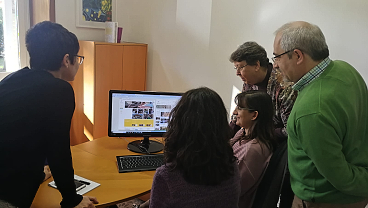
Innovation is on the horizon for focolare.org users. The Focolare website will soon appear in a restyled format and with additional navigational features. This is a project which the International Centre of the Focolare Movement in Rocca di Papa (Rome) has been developing over the last two years. The project aims at integrating the communication networks, carried out up till now by four separate publishing sectors (Website, Information Service, Mariapolis Newsletter, and Collegamento CH Worldwide Linkup), thus creating a unified “Communications Office”. Already operating since last February, this Office gathers news about the life of the Movement worldwide and transmits them through various media. Among its main objectives is to promote activities of the Focolare Movement, to communicate its life to a broader audience, and to contribute to a greater sharing of news among the various Focolare communities worldwide. The development of new communication technologies and trends called for the restyling of the website which includes a new graphic layout, significantly more minimalist in structure, and an upgraded navigational logic. The use of new applications will also allow for greater integration with the social media, and will enable users to access content in different and personalized modes. The new structure will, in fact, be mobile-friendly and as such will take into account the use of smartphones and other mobile technology in our daily life. It will focus on content that is brief and varied, available in different formats (text messages, infographics, video clips, etc). The contents of the current site, however, will not be lost. The static content will be published as an e-Book and in the future the news articles will be accessible through searchable archives. Also envisaged is a space, entitled “Mariapolis”, dedicated to news regarding many aspects of the life of the Focolare Movement. It bears the same name given to the traditional summer gatherings of the Focolare held around the world. The current print edition of the journal “Mariapolis” will be discontinued after December 2018. The digital version aims to be a virtual “community” open to anyone who wants to visit. A system of notifications will allow the users to choose when, which themes and channels, and the preferred device (PC, tablet or smartphone) they would like to receive the information on. Every two months, a “Mariapolis” newsletter in pdf format will deliver a summary of the main highlights. Happy surfing! Joachim Schwind
![Home of the nations, family of peoples]()
22 Nov 2018 | Non categorizzato
Beatriz Lauenroth
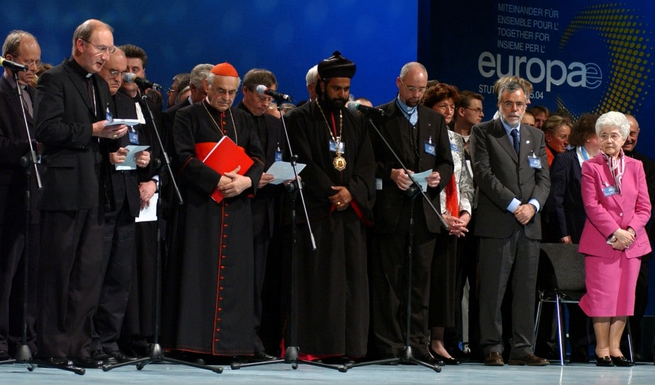 It was a historic event for the ecumenical path: “That same evening, many had gathered not far away in Ottmaring, seat of the ecumenical town of the Focolare. Chiara Lubich was there with other representatives of the movements, like Andrea Riccardi of Sant’Egidio, and also other Protestants like Helmut Nicklas, head of the YMCA of Munich (Ecumenical Association of Christian Youths). They said: let’s join up, get to know one another, and start working together!” That first tract of the journey lead subsequently to the big “Together for Europe” events of 2004 and 2007, held in Stuttgart, and later in 2012, contemporaneously in 152 cities with the fulcrum in Brussels, and in 2016, in a main square of Munich, Germany, with 36 round tables and forums to share experiences, good practices and perspectives regarding Europe. In November 2017, the meeting of the friends of “Together for Europe” reached Vienna, the city bridge between East and West. On those days, this free forum of Christian movements and communities got together in Prague, on the occasion of the anniversary of the start of the so-called Velvet Revolution, the nonviolent revolution which in 1989, toppled the Czech communist regime:
  “It is a coincidence that strongly challenges the friends of ‘Together for Europe,’ to renew our common commitment of bringing the spirit of Christian humanism to post-century culture, thus offering our contribution in giving life and form to a more united Europe.” Beyond all the fears and prejudices, we wish to testify that the journey towards a Europe which is “home to the nations and family of peoples” is not a utopia. The Prague convention opened with the speech of the Czech theologian-philosopher, Tomáš Halík (Templeton-Prize 2014), a personal friend of Vaclav Havel, the first president of the newly constituted Czech Republic from 1993 to 2003, and then of Jaroslav Šebek, a member of the Historical Institute of the Science Academy of the Czech Republic, and of Pavel Fischer, Czech senator. The directors and representatives of the various Movements,
  Communities and Associations intervened to recall together another Europe, that of the big hopes and promises that arise from the rich heritage of an ethnic, social and cultural multiplicity, and that tends toward communion and dialogue. The Prague event has thus become an important step in the history of Together for Europe that continues to commit itself to a more united and fraternal Europe. “Often we mention ˗ Beatriz concluded ˗ the Founding Fathers of Europe, Schuman, De Gasperi and Adenauer. The youths say to us: let us work with you, so that the Europe of the fathers can also become the Europe of the sons and daughters.” Source: UnitedWorldProject
21 Nov 2018 | Non categorizzato
A disabled daughter A parent never expects to have a disabled child. When this happened to us, my wife, already psychologically fragile, fell into a depression. I found myself taking care of the family in an unexpectedly new way. The first month, full of queries, I was isolating myself from friends and relatives. One day, at the staircase of the condominium, I met a couple who seemed to be very serene despite having a daughter with the Down syndrome. When I asked them how they managed to be so, their answer amazed me: “Our daughter is the biggest gift we could ever receive. She has brought us back to reality and the whole family benefited from it.” My wife and I went to visit them often. We learned about their faith, and day after day, thanks to them also we rediscovered the values we had neglected. (A. e G.F. – Italia) An unexpected gift Some relatives who had distanced themselves from us for inheritance reasons, accepted our invitation for them to stay with us for a few days. But when they told us the date of their arrival, it was not the best moment: we were having financial difficulties and I had no time to prepare the house as well as I would have wanted. Then I thought that the new found peace was the biggest gift and with the entire family we decided to do our best to make their stay a happy one. We would have liked also to give them a gift, but for want of anything better, our youngest son prepared a drawing and the oldest one, a welcome poem. The day before their arrival, in my husband’s company, the employees received a bonus package. When we opened it, there were two watches, a lady’s and a man’s watch: the unexpected gifts for our relatives. (R.H. – Germany) Another chance One of my sisters-in-law asked me the favour of taking her in our house for a period and to sign a bank loan she needed. Our house is small but we welcomed her sincerely. I saw that my husband however was very worried about the loan, considering that a few years back we had lent her a sum which she never returned. I told him that I would accept whatever decision he made, adding however that everyone should be given a chance to redeem himself. Doesn’t God himself do so with us? We signed the guarantee for the loan, which my sister-in-law is punctually paying back, even if at times not on time. As to me, I feel I have to continue helping her, and at times we have long talks during which she opens out to me as if I were a sister, overcoming the barriers that divide us. (M.D. – Paraguay) Totally at service After the death of our first girl, at only14 months, also the other two sons that arrived started to show the same symptoms. My wife and I were with bated breath, and the house became like a small hospital. However, trying to love one another, our children grew full of peace. How many times was I converted upon looking at them! Returning home after work, I tried to leave all my worries and problems behind, so as to be totally at their disposition. It could only work out this way, otherwise we would have been crushed by anguish and worries for the future. We concretely experienced that God is all powerful, and can give us a taste of paradise even in such a difficult situation. (G.M.B. – Italy)
