12 Oct 2018 | Non categorizzato
Women can symbolize today’s civilization. In magazines and movie screens, in advertising and art, they reign like queens. Yet it is easy to see their royalty as artificial: divas who hold court today are forgotten tomorrow. In contrast, from this perspective the biographies of Christianity’s greatest female saints and their teachings once again become current. Teresa, the reformer of Carmel during the Protestant revolution, under the suspicious gaze of the kings and lords of Spain, faced with the threat of the Inquisition in her country, achieved her freedom through poverty. It is the unique freedom of God’s children. She remade her existence into an eminent adventure to overcome human with divine. She brought beauty, the poetry of holiness, back to the center of our individual and social existence. At the time there was a form of self-righteousness that you might just as well have called misogyny. Catherine of Siena had already suffered it and had been silenced because she was a woman – she who never stopped urging men, including the high and mighty, to not behave like little girls. St. Teresa gave herself entirely to God and inspired other women to do so. The obsession of our modern days lies in a continuous, frenetic demand for recognition and riches. Teresa taught us to free ourselves from this slavery and recover our serenity and peace. In her writings she explains her reasons with evidence, a light that enchants souls – even those of men today who are in the clutches of business. She is a strong woman who speaks only to serve God with energy and perseverance. She knew of the influence that a woman consecrated to God can have on society. Her life and writings demonstrate the essence of the Gospel revolution, in our hearts and in the people, uncovering yet again the essentials of love that, through our neighbors, opens access to God. It puts God in the spirit, in the law, in institutions, in customs. Teresa, with the grace of a mother and teacher, taught to speak continuously with God, a conversation that everyone can carry out within the temple of their souls, even while on the road, even surrounded by noise. I believe that day after day the number of women and men who are guided by Teresa’s wisdom will increase. They will rediscover their reason for being, going back with her to the source. Action will blossom more and more from contemplation. Yet here – we could say with the saint – Martha and Mary almost always align, since the interior works on the exterior … When exterior works come from these roots, there are admirable, sweetly scented flowers that blossom from the tree of divine love. Teresa was a courageous astronaut of the divine, as well as also a practical woman who knew the world. And because she knew the world, she stood out in heaven. If her teachings were to expand even to our own homes, unions, politics, factories and the world, it would become a sort of Carmel, where Teresa took on the feminine royalty of she who was blessed among women. Igino Giordani, Fides, n.7–12, 1962, pp.185–187.
9 Oct 2018 | Non categorizzato
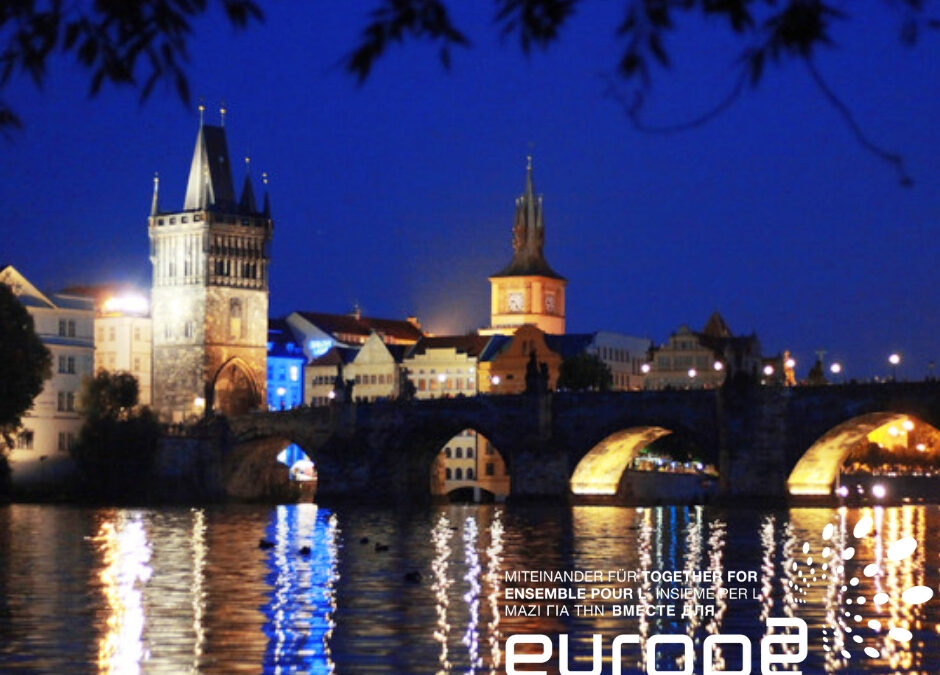
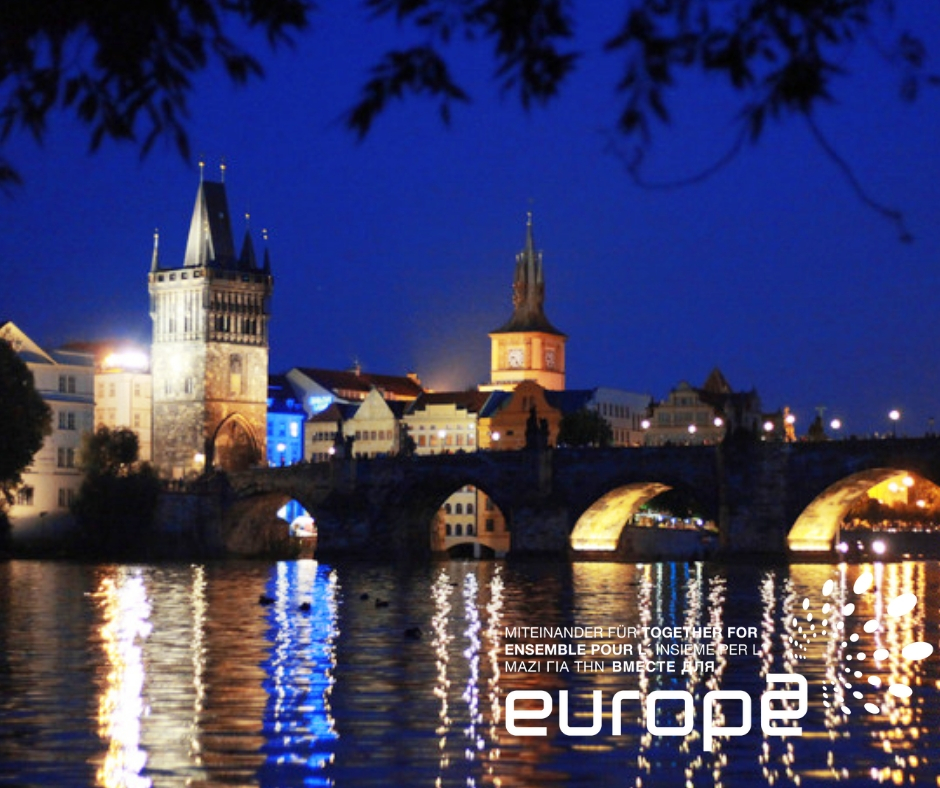 The great history of Central Europe, in particular of the Czech nation will serve as a backdrop for a new stage in the journey of Together for Europe, which promotes dialogue between divergent cultural and political identities. In November 2017 the European meeting of Friends of Together for Europe took place in Vienna, a bridge between Eastern and Western Europe. This year, we will have the opportunity to take another step to the very heart of Central Eastern Europe – Prague, with a singular desire to face challenges, prejudices and fears which weigh on the collective conscience of EU member states and beyond. Through the life of the Gospel, nourished and enlightened by the presence of Christ in the Christian communities, we wish to witness to the fact that the path towards Europe as a House of Nations and a Family of Peoples is not a utopia. The enduring legacy of the “Velvet Revolution” On 17th November, the Czech Republic commemorates the anniversary of the “Velvet Revolution” (so called due to its peaceful nature) which transformed the Czech Republic into a co-protagonist for the ongoing process of European reunification. The presence of the Friends of Together for Europe in Prague on this very day, urges us to renew our shared commitment: to bring to a post-secular culture the spirit of Christian Humanism, and in so doing contribute to building a more united Europe. The renowned Czech Philosopher and Theologian Tomas Halik, friend of the late Vaclav Havel, Jaroslav Sebek of the Historical Czech Academy of Science, and Pavel Fischer an emerging Czech politician, together with leaders and representatives of different Movements, Communities and Associations will be present. Their contributions will reinforce the daring objective of this meeting: to recall a Europe of hope and promise, a Europe which stems from a rich heritage of ethnic, social and cultural diversity and calls out for communion and dialogue. In this way, the Prague event will become a fundamental phase of Together for Europe which continues its commitment for a more united, brotherly and just Europe. It will also be a unique opportunity to prepare together for the upcoming elections for the European Parliament. The meeting will conclude with an open evening, in which Movements and Communities from different churches and which are present in the Czech Republic will be represented. Address: Mariapolis Centre, Mladoboleslavská 667, 190 17 Prague 9 – Vinoř, Czech Republic – Tel. +420 286 007 711; Email: cmpraha@espol.cz; www.centrummariapoli.cz Beatriz Lauenroth
9 Oct 2018 | Non categorizzato
In the month of October, Pope Francis explicitly invites all the members of the Catholic Church worldwide to pray and fast in penance, together as the people of God, to ask the Holy Mother of God and St. Michael Archangel to protect the Church from the devil, the main architect of division among men and with God, and make it also more conscious of the faults, errors and abuse committed in the past and present. He invited all to conclude the recital of the Rosary with the ancient invocation “Sub Tuum Praesidium” – which says: “We fly to thy protection O holy Mother of God. Do not despise our petitions in our necessities but deliver us always from all dangers O Glorious and Blessed Virgin” – and with the prayer to St. Michael Archangel, composed by Pope Leo XIII, which says: “St. Michael Archangel, defend us in battle, be our protection against the wickedness and snares of the devil.”
5 Oct 2018 | Non categorizzato
“Seeing what the Holy Spirit has done with us and with many other spiritual and social “enterprises” that are at work the Church today, I cannot but hope that He will continue to act now and always with the same generosity and magnanimity. And this holds true not only for brand new works that will arise from his love, but also for the development of those that already exist, like our own. Meanwhile, I dream that the atmosphere in our Church will be more suited to her identity as the Bride of Christ; a Church which can be seen by the world as being more beautiful, more one, more holy, more charismatic, more akin to Christ her Spouse. I dream of her being a beacon for humanity. And I dream of seeing in her a holiness of the people, never seen before. I dream that the lived siblinghood, that is gaining momentum today in the consciences of millions of people, will be practised more widely across the globe, so that in the third millennium it will be a general, universal reality. Consequently, I dream of fewer wars and conflicts, less hunger, and the reduction of the thousand other evils in the world. I dream of an ever more intense dialogue of love among the Churches so that the formation of the one Church is seen to be close at hand. I dream of a more living and active dialogue among people of the most varied religions linked to one another by love, by “the Golden Rule” present in all their sacred texts. I dream of greater encounter and mutual enrichment among the various cultures in the world, so that they may give rise to a world culture that highlights those values which have always been the true wealth of individual peoples, and I dream that these values will be seen by all as global wisdom. I dream that the Holy Spirit will continue to enrich the Churches and strengthen the “seeds of the Word” beyond them, so that the world may continually receive new light, life, and works which He alone can is able to give. So that ever-greater numbers of men and women may set out towards straight paths, converging on their Creator, and putting their hearts and souls at his disposal. I dream of Gospel-based relationships not only among individuals, but also among groups, movements, religious and lay associations; among peoples and among States, so that it becomes logical to love other people’s countries as our own; and logical to tend towards a universal communion of goods, at least as a goal to reach. [..] In a word, I dream of already witnessing the new heavens and new earth, as far as this is possible here on earth. I am dreaming of many things, but we have a millennium to see them come true.” Chiara Lubich Extract from: “Attualità. Leggere il proprio tempo”, Città Nuova, Rome 2013, pp. 102-103
4 Oct 2018 | Non categorizzato
Also the scientists say that smiling does us good. It lengthens life, reduces stress and brings people closer. At times it can also change your life. The World Smile Day created by Harvey Ball has been celebrated every first Friday of October since 1999. He was also the creator of the “smileys” that inspired the emoticon. Giving a smile is not always easy, but necessary. “I do not know of any other sign of superiority in man except that of being kind,” Beethoven affirmed. And according to Plato: “Every person you meet is fighting a battle you know nothing about. Be kind, always.” Hunter Doherty Adams called “Patch” is a doctor, activist and writer who is known worldwide for his practice of and support for clown therapy. Strongly convinced that joy and creativity are integral parts of the therapeutic process especially for children, Patch and his colleagues fight against suffering and disease by wearing a red clown’s nose, now the distinctive element of a new way of practicing the medical profession. Adams dedicated his life to the study of the human being under ever aspect and in the creation of a healthcare system within everyone’s means. His philosophy of healing starts with the mind, and the action which stimulates in the patients the construction of positive thinking that can make our lives better.
2 Oct 2018 | Non categorizzato
Economy is a Greek word that directly refers to the home (oikos nomos, rules for running a house), on the family. But the modern economy, especially contemporary economy, is governed by other principles, distinct and in many ways opposed to the ones that govern a family. A founding principle of the family, perhaps the primary one that underpins all the others is gratuitousness, which is the farthest from a capitalistic economy that is more familar with the surrogates of gratuitousness (discounts, philanthropy, sales). These serve the purpose of immunizing the markets against true gratuitousness. The family, in fact, is the main place where we learn from childhood on and for the rest of our lives, what Pavel Florensky calls the “art of gratuitousness”. It is especially in the family that we learn as children to work, and that no work can be done well without gratuitousness. But our culture associates gratuitousness with “for free,” the discount, the half-hour of overtime without pay, the zero price ( Saint Francis instead told us that gratuitousness is an infinite price: it can’t be sold or bought, because it’s unpayable). Gratuitousness means giving freely; it is a type of behaviour and a lifestyle that consists in approaching others, oneself, nature, God and things – not to use them in a utilitarian way for one’s own advantage, but to acknowledge their “otherness” and in their mystery, to respect them and serve them. To say gratuitousness means, therefore, to recognize that a certain way of acting done because it is good, and not because of recompense or sanction. […] If the family wishes to cultivate the art of gratuitousness as it should, it should be careful not to import into the home the logic of incentive which is rampant in today’s world. […] One of the tasks of the family is the formation of a person’s work ethic, which is precisely the result of gratuitiousness. If, instead, you begin to practice the logic and culture of incentives, and money becomes the reason for doing things, children will not be good workers when they become adults, because the work well done of tomorrow will always depend on the gratuitousness that is learned especially during the first years of life and especially in the home. The absence of gratuity in the economy also depends a lot on the absence of a feminine gaze. […] Women look at the home and at the economy and first see the connections of human relationships that that are happening. The first goods they see are the relational ones and the communal goods, and within these they also see the economic goods. It is certainly not by chance that the Economy of Communion was the result of the vision of a woman (Chiara Lubich), nor that the first theoritician of the common goods was Katherine Coman (1911), or that Elinor Ostrom was the only woman so far to receive a Nobel Prize in ecomony because of her work on common goods. And there are two women at the root of the theory on relational goods: Martha Nussbaum and Caroll Uhlaner. When the feminine gaze is missing from the economy, the only relations that can be seen are instrumental ones where it is not the relation that is the good, but where relationships with people and with nature are seen as the means used for obtaining goods. If the feminine gaze and genius of the home (oikos), had perhaps been present in the theoretical foundation of modern economy, we would have had an economy that was more attentive to the relationships, to the redistribution of revenue, to the environment and perhaps to communion. Communion is the great word that the family has to pass on to the economy. The prophetic role of the family in today’s world, to be believed, must take on the form of the children and the form of the economy and, therefore, of sharing, welcoming and communion. Because the children and the economy are nothing more than the ordinary life of each and of all, which is the only place where prophecy is nourished and grows. Source: www.avvenire.it, “Così lo sguardo femminile può cambiare l’economia”, 23 August 2018.
