24 Jan 2018 | Non categorizzato
House Arrest December 2016 I received a telephone call from a desperate mother who asked help for one of her sons. The lawsuit against him had been heard in court and he was sentenced to 11 month under house arrest. She couldn’t take him in because she didn’t have a house and nobody else wanted to have him. I was her only hope, and I just couldn’t look the other way in front of this request. What to do? Three days later when I was about to make a few phone calls to find somebody who could help me out, someone knocked on the door. It was someone who comes often to see us. I welcomed him in, made him a cup of coffee and we began to talk. Then he asked me: “What were you doing just now?” Something inside me made me tell him about the situation. And he says: “But couldn’t I do it?” He had a small apartment, but he would sleep in the living room and leave his bed to the boy. The next day he took care of all the bureaucratic matters. The months flew by. We took food to them twice a week, since he wasn’t very well-off financially. And all it took for God to perform veritable miracles was a yes from me. (N.C. – Italy) I could look him in the eyes One day, while I was on my way to school, I was mugged by a group of boys in an underpass. They kicked me and punched me and threw me on the ground. They wanted my cell phone. When they finally went away, I couldn’t get up because of the pain in my body and in my soul. I wondered: “Why me?” My anger and resentment mounted. I told some friends at school about the incident, but none of them appreciated my pain, and that bothered me. The next few nights I couldn’t sleep, almost crying with anger as I watched that scene in the underpass playing out over and over again in my mind as if in a film. It was only some time later that I was able to talk about it with some friends who, like me, are trying to live the Gospel. Confiding it to them helped me to do what at first seemed impossible: to my aggressors. When I went to court to identify them at the trial, I felt I had forgiven them in my heart without any difficulty, I could look them straight in the eyes. (From T. Minuta’s blog) Appearances can be deceiving I had to go downtown to do some shopping and didn’t have much time. Suddenly I heard somebody asking me for money. I generally don’t give money. You can’t help everyone, and they might spend it on drugs. The boy’s head was shaven, and he had a dark gaze. I had the feeling he was one of the boys who had mugged me years before. I walked faster. But, a block later, I began to wonder: How can I think I’m cultivating union with God and, at the same time, neglect this boy who asked me for help?” I turned around and looked for the boy. “What is it you need?” I asked him. Totally surprised, he told me that he was thirsty. I invited him to have a seat in a coffee shop. He answered all my questions with a dry “yes” or “no”. I thought I might tell him about my own experiences and effort at getting used to a new country. He didn’t seem interested, and I was a bit discouraged. When I stood up to go, he said: “Why don’t you keep on talking? No one has ever told me the story of their life? It’s a new experience for me, and I have to get used to it. Tell me about your country. Why did you come here?” I ordered another hot chocolate and we sat there for another two hours. In the end we gave each other a hug. On my way home I entrusted to Jesus that kid whose name I didn’t even know. (U.K. – Argentina)
23 Jan 2018 | Non categorizzato
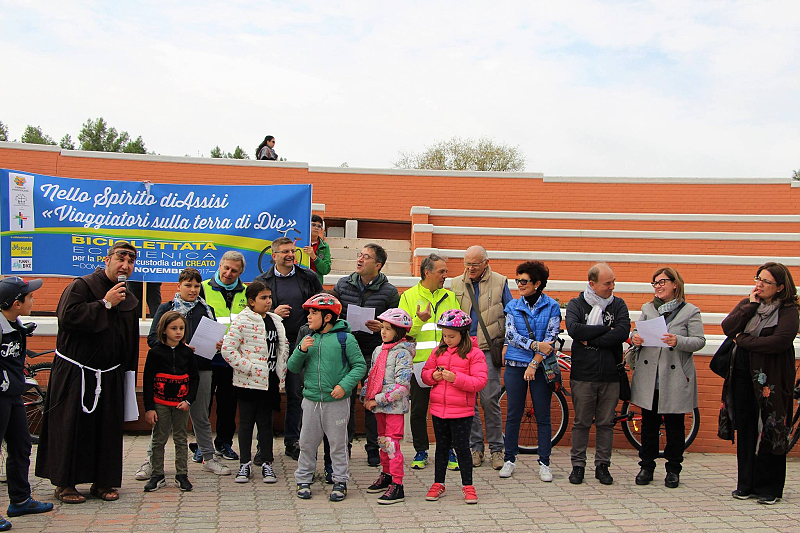 In Foggia, a commercial city in southern Italy an amazing flow of bikes crossing the city’s roads aroused the curiosity of passersby. Many citizens, also due to the sunny day, were on the road on their traditional Sunday outing, while the ladies catering to the feast day lunch watched from the balconies. Family bikes equipped with children’s chairs, tandems with blind people onboard as second paddlers, two wheels equipped with mikes, loudspeakers and banners, bikes of all shapes and sizes, a long trail of hard hats and helmets and a joyful bell: this was the ecumenical biking event organised by the Ecumenical Council of Foggia together with the Franciscans of the parish of Gesù e Maria, and the Group of Lay Associations joined by the Focolare Movement, the Fanny Bike Association and the Bike-lovers’ Association, on the occasion of the anniversary of the Spirit of Assisi and the Day for the Protection of Creation. The initiative which took place some months ago was the occasion for the city of the Puglia region, together with men of good will and the faithful of various religious confessions, to reflect on the importance of protecting creation, the gift of God entrusted to mankind for the good of all, and raise the awareness of citizens in assuming more ecological lifestyles starting from their own daily lives, and make the municipal administration commit to undertake political decisions that would allow the healing of the city, making it more beautiful, liveable and less polluted. The bike itinerary started symbolically from the Square where the Archbishop’s Curia is situated, with the delivery to the Mayor of a pact made between citizens and the administration, containing the mutual commitment. According to the competences of each, inspiring motifs were created for the event, with the route that made stopovers at the places of worship of all the Christian confessions existing on the territory, which adhered to the initiative: the Church of San Domenico for the Greek Orthodox community, the Church of Gesù e Maria for the Romanian Orthodox community, the ADI Evangelical Church, and the Waldensian Church. The event ended up with a brief moment of ecumenical prayer at the San Felice Park, the green lung and meeting place of the city..
22 Jan 2018 | Non categorizzato
20 Jan 2018 | Non categorizzato
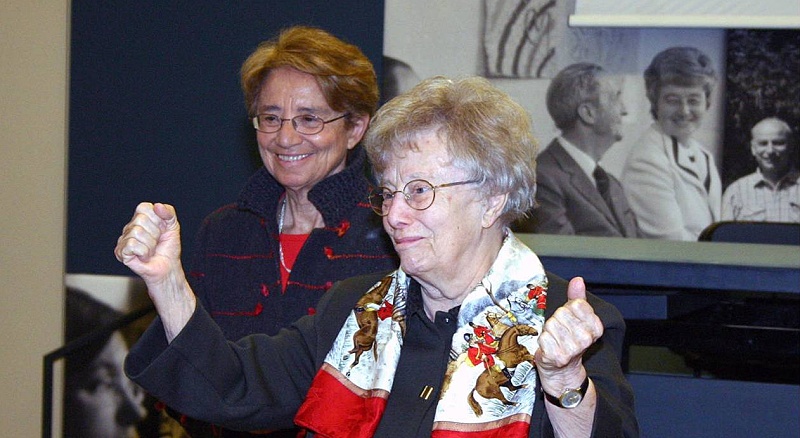
With gratitude for “her example of heroic faithfulness to God’s plan for her,” Focolare president Maria Voce, informed Focolare members around the world of her death following a long life spent in its entirety for unity. “Even in the pain of this huge loss,” said Maria Voce, “we are forever one heart and one soul with her.” Gisella Calliari had been born in Lavis, Trent, Italy on April 18, 1920. She was simply known as Gis, one of the first young women, along with her sister, to follow Chiara Lubich in the “adventure of unity,” which led to the starting of the Focolare Movement and its expansion around the world. She was the youngest of three sisters and met Chiara in 1944 in that tiny apartment that lodged the first hearth in Piazza Cappuccini,Trent. The next day, she decided to follow Chiara along the same path. The first hostile reaction from her family was softened when her mother met Igino Giordani who hired Gisella to be his secretary in Rome. During her long life, Gis spent more than 40 years living with Chiara. After living in several focolares in Italy – in Trent, Rome, Milan and Florence, she took charge of the women’s section of the focolarinas. Then, she worked alongside the foundress and Oreste Basso in following the development of the Work of Mary worldwide. This provided her with the opportunity to visit Focoare communities around the world. Her whole life was very profoundly linkded to the charism of unity, to which she was faithful until the last. Focolare.org will soon publish a more extensive biography.

20 Jan 2018 | Non categorizzato
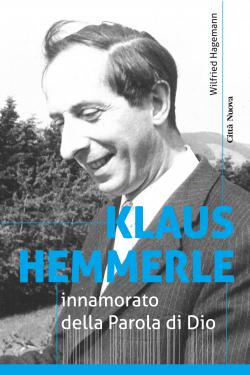 “There’s only one way to be able to have the most unity and communion possible among us right here and now, and I for one can see no other. This way coincides with […] us, you and me, all of you and me and all of us together, day by day, in all the situations of our life and in every situation that comes between us, staying anchored in His Word.” (266) “The Word of God goes beyond the barriers between us and creates communion. […] Nobody can take this away from us. Nobody can prohibit us from doing it. We can never turn back now. This is the essential point where the road opens for us to move on. […] If we live the Word to the extreme and in a spirit of reciprocity so that what you live and what I live are the same Word, both of them His Word, then the unity between us grows […] We can ask ourselves: But how are we to live in the one Spirit which is the deepest and most intimate reality of God, and the deepest and most intimate reality of me? It’s because of the Spirit whom I seek in you with patient endurance, the gifts of the Spirit that lie in you, a believer and a Christian like me. I question you at great length until I find the Spirit in you. I’m never content myself with compromises saying: ‘Deep down you’re not bad, nor am I. I’m able to find a halfway point where we can meet!’ I don’t even say: ‘I take something of yours and something of mine to come up with a formula that we can both agree on without having to change any fundamentals.’ Rather, I ask myself: ‘Where is the Spirit in you?’ The insistence in my questioning never constrains you, limits you, but it frees you, so that you can offer me the gifts of the Spirit in you. I’m prepared to let myself be interrogated by you to extreme, so that, trusting in the Spirit, I can also offer and give to you my gifts as gifts from God. Giving our gifts to one another, discovering in reciprocity the gifts of the Spirit in one another – this is the only path for the one Spirit.” (265, 266) (June 15, 1979, From a dialogue with Evangelical Lutheran pastor Lukas Vischer) Anyone who has been living the spirituality of unity for a long time can never stop and say: Is what the other saying to me appropriate? What isn’t appropriate? In what way is what they are saying compatible with my thinking? And with regard to what isn’t compatible? I try to make myself one with the other person, I try to have the other person as my starting point, not as a way to deny what I affirm with certainty based on Christ, but in the sense that in front of the person, I ask: What light are they trying to convey to me? So, I look at myself from the perspective of that other person. I make myself one with the other, trying to re-read my truth through the light of the other.” (268) (Extracts from dialogue session during the Ecumenical School in Ottmaring, Germany) Winfried Hagemann: KLAUS HEMMERLE, innamorato della Parola di Dio (Città Nuova 2013).
19 Jan 2018 | Non categorizzato