7 Jul 2023 | Non categorizzato
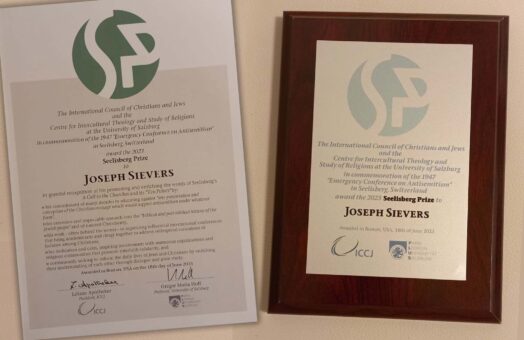
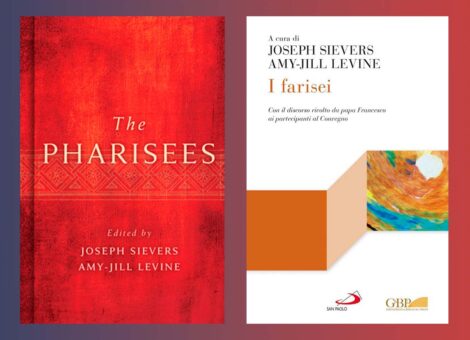
As part of the opening event of the International Conference of the International Council of Christians and Jews (ICCJ) in Boston, USA, on Sunday 18 June, Prof. Joseph Sievers was awarded the 2023 Seelisberg Prize. Our interview on his return to Rome. The Seelisberg Prize is inspired by and intended to commemorate the ground-breaking gathering that took place in the small Swiss village of Seelisberg from 30 July to 5 August 1947 to address Christian teachings regarding discrimination against Jews and Judaism. This event is widely recognised as inaugurating the transformation in relations between Jews and Christians. 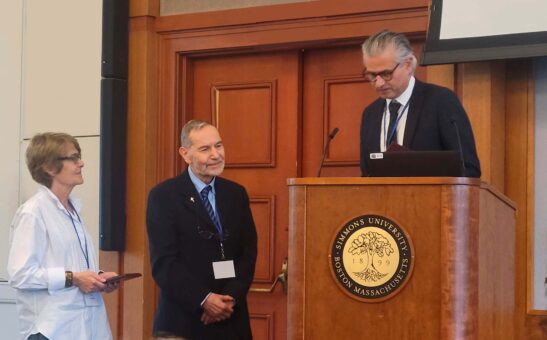 The Seelisberg Prize is awarded annually (since 2022) by the International Council of Christians and Jews (ICCJ) which originated from the Seelisberg conference, and the Centre for Intercultural Theology and Religions at the University of Salzburg. It honours individuals who have played important roles through their scholarship and teaching in promoting rapprochement between Jews and Christians. Prof. Dr. Joseph Sievers (Seelisberg Prize 2023) was born and raised in Germany and began his studies at the University of Vienna and the Hebrew University of Jerusalem. He holds a PhD in Ancient History from Columbia University (1981) and a Lic. Theol. from the Pontifical Gregorian University (1997). He has taught at CUNY, Seton Hall Univ., Fordham Univ. and other institutions in the US, Italy and Israel. From 1991 until 2023, he taught Jewish history and literature of the Hellenistic period at the Pontifical Biblical Institute in Rome, where he was a full professor. In addition, from 2003 to 2009 he was Director of the Cardinal Bea Centre for Jewish Studies at the Pontifical Gregorian University. Since 1965 he has been a member of the Focolare Movement, with whose Centre for Interreligious Dialogue he has collaborated since 1996. He has published several books and numerous articles, primarily in the areas of Second Temple history (in particular Flavius Josephus) and Christian-Jewish relations. With Amy-Jill Levine, he edited The Pharisees (Grand Rapids, MI: Eerdmans, 2021; Italian translation Milan, San Paolo, 2021; German translation planned for 2024). Professor Sievers, what does it mean to you to receive this award? It was a great surprise and when I was asked to say something about my experience, I felt a great gratitude looking back, thinking about all the moments, all the people I met, the situations in which I was able to be there and sometimes be of help. A great gratitude and, at the same time, a responsibility for the present and the future. In his speech at the award ceremony you said: “Difficulties can help us understand one another better. Difficulties can unite us”. In your long experience of this dialogue, what have been the most difficult and also the most surprising moments where you were still able to say “Anything’s possible”?
  There have been various difficult moments, but one that I particularly remember is when we had to organise a meeting for dialogue in Jerusalem in 2009. It took place a few weeks after a conflict which had left many people dead or wounded. At the same time there was the situation of Bishop (Richard Nelson) Williamson denying the holocaust. There were difficulties on all sides that made open dialogue very difficult. However, we still managed to hold the meeting. We went ahead and they were very strong, spiritual moments of communion, beyond all the problems. And then you also ask me the things that were possible, despite the difficulties? It certainly was not easy to organise a conference on the Pharisees and then publish a book. There were several points where I felt the way was barred, either for financial reasons or because someone did not agree with what we wanted to do, or because it seemed impossible to have an audience with the Pope, for a conference of this type… Instead, by collaborating – and it really was a collaboration, especially with a Jewish colleague, but also with others – it was possible to solve these problems and give something that was based on serious studies but also addressed to concrete situations in churches and parishes. Certainly there was success that did not have an immediate effect everywhere, but for example one bishop wrote to me saying “now we need to change all our teaching on the Pharisees and Judaism in the seminaries”. That is already something. How has your membership of the Focolare Movement affected this experience? Without the Focolare Movement I probably would not have entered this field. The Movement gave me the impetus to study the languages of the Bible and everything else followed from that. I entered the focolare on 28 October 1965. It was a Thursday. I arrived in the focolare in Cologne (Germany) with my bicycle that I’d brought by train with my two suitcases on the same evening that the Council in Rome was approving Nostra Aetate (Declaration on the Relations of the Church with Non-Christian Religions). This has always meant a lot to me, linking commitment to the Movement with commitment to dialogue. You were also called to officially collaborate in the Catholic Church’s dialogue with the Jews… Yes. Since 2008 I have been a Consultant of the Commission for Religious Relations with Judaism, a commission of the Holy See. And I have participated in various meetings of the ILC in Buenos Aires, Cape Town or even Budapest, Madrid, Warsaw, Rome … And are steps forward being made? One step is already being open to meet and talk to each other and to overcome difficulties along the way. Sometimes it is better to face everything over dinner together than with fiery letters. Steps are being taken and certainly there is much more to be done, the network needs to be expanded. I mean, most Christians and most Jews are not involved. Sometimes they don’t even know that there are these relationships or that we are on this journey together. There is still a lot to be done to make this known and apply it. One thing I have learned a lot from my relationships with Jews is that the questions are sometimes more important than the answers. That is, I do not and cannot claim to have all the answers. So I cannot approach the other person as someone who has found all the answers and approaches him or her from a position of superiority. My position is to be a seeker together. It is this – most dramatically when dealing with the subject of the Shoah, the Holocaust – that has to be faced together sooner or later. One thing that is essential is to look at, to be as sensitive as possible to each other’s commitments and needs. And then also to be open, and if you make a mistake you can always start again if the intention is right, tiptoeing into the other person’s environment, not with the attitude of someone who says “I know everything”. Lastly, in receiving this award, apart from feeling grateful, does it inspire Joseph Sievers in any other way? Yes, indeed. For example, there are some open questions and this stimulates me to tackle them more. And maybe it even gives me some authority to address them with certain people. I don’t know if this will happen, but it is also an incentive to continue this work, which is not finished, which will never be finished, but where some steps can be taken together.
Carlos Mana
5 Jul 2023 | Non categorizzato
A theological seminar on the theme “Participate/Preside/Decide – sacramental root and communal dynamic in the journey of the people of God on mission” was held on Saturday 24th June 2023 in Loppiano (Incisa Valdarno, Florence). Over thirty academics responded to the invitation of the Evangelii Gaudium Centre (CEG) of the Sophia University Institute, to develop a proposal to revise canon law in order to rebalance, as urged by the working document (Instrumentum laboris) of the XIV Assembly of the Synod of Bishops, the “relationship between the principle of 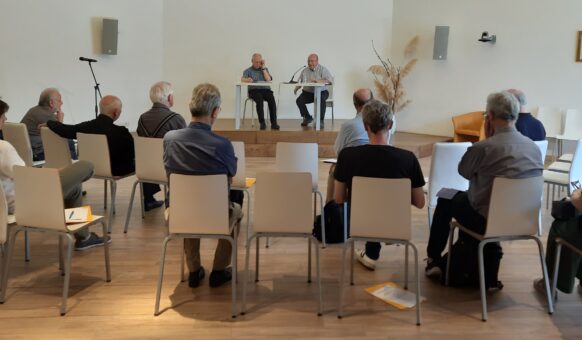 authority, which is strongly affirmed in the current legislation, and the principle of participation”. Pope Francis assures us “not all discussions of doctrinal, moral or pastoral issues need to be settled by interventions of the magisterium” (Amoris Laetizia, no. 3). It is therefore crucial to listen to the sensus fidelium of the entire People of God (clergy and faithful) with all its variety of cultures. In this way, the dialogue between theology and law is motivated by a sincere process of inculturation without which there is a real risk of laying the foundations for a practical non-observance of the general principles enunciated by the Church. Prof. Vincenzo Di Pilato, academic coordinator of the CEG commented, “The point is precisely this: how to make the active participation of all the faithful within our synodal assemblies effective? Will it just be advisory? Or will it also be deliberative? Will this mean reaching a negotiation for a juridical “concession” or “recognizing” the decision-making capacity of the collective subject of ecclesial action as it emerges from the ecclesiology of Vatican II and the post-conciliar magisterium? And therefore, will it be necessary to update the Code of Canon Law?” In his initial greeting to the participants, Card. Mario Grech, Secretary General of the Synod, highlighted how the synodal journey is entering a new phase: it is called to become a generative dynamic and not simply one of many events. We cannot listen to the Holy Spirit without listening to the holy people of God in that “reciprocity” that constitutes it as the “Body of Christ”. In this communal bond, the particular methodology of conversation in the Spirit, well described on the occasion of the presentation of the Instrumentum laboris, takes shape. Hence the need, referred to several times by Card. Grech, to better articulate the principle of restitution. In other words, this means that the unity of the synodal process is guaranteed by the fact that it returns to where it started, to the local Churches, and this is an important moment of the “recognition” of what has matured in listening to what the Spirit is saying to the Church today. The synodal journey seems to stand, therefore, as a significant moment in ecclesial life, capable of stimulating and activating the creative impetus and evangelical proclamation that comes from the rediscovery of the relationship with God that innervates the relationship between believers, and also as a sign for a cultural context in which it houses a silent cry of fraternity in the search for the common good. If in Prof. Severino Dianich’s report “The problems of synodality between ecclesiology and canon law” the recovery of the Pauline ecclesiology of the being-body of Christ and the enhancement of the dynamic co-essentiality of hierarchical and charismatic gifts emerged, for Prof. Alphonse Borras, this turning point requires a canonical clarification, which outlines a flexible procedural practice, capable of accompanying decision-making and participation processes through the various bodies already envisaged (episcopal council, presbytery, diocesan and parish pastoral programmes …). Cardinal Francesco Coccopalmerio, former president of the Pontifical Council for Legislative Texts, seemed to agree with this line in his speech, “Ecclesial Synodality: is a rapid transition from the consultative to the deliberative conceivable?”. In his opinion it is possible to find in canon law a clear definition of synodality, understood as “communion of clergy and faithful in carrying out the activity of recognizing what is the good of the Church and in the ability to decide how to implement such an identified good”. At the end of the seminar, many participants expressed the wish to see the speeches of the seminar published. The CEG is working to do this by September as a further contribution to the upcoming Synod.
Antonio Bergamo
4 Jul 2023 | Non categorizzato
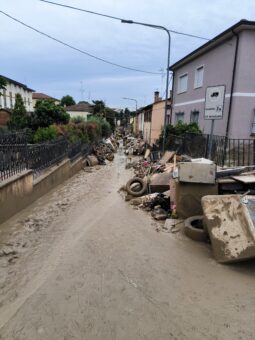
Almost a month and a half after the floods that hit the regions of the Marche and Emilia-Romagna (Italy), here is the story of the personal experience of Maria Chiara Campodoni, a married focolarina, a teacher and a former municipal councillor of the Municipality of Faenza, who was a victim of this disaster. The flood that hit the Marche and Emilia-Romagna (Italy) about a month and a half ago caused the loss of 15 lives, thousands of displaced people and the flooding of 23 rivers. To date, flooding has occurred in about 100 municipal regions. Numerous landslides have affected small producers, tens of square kilometres of agricultural land and farms have been destroyed by the power of water, along with bridges and roads. The contributions collected by the Emergency Coordination Committee of the Focolare movement, AMU and AFN have reached 182,000 euros. In collaboration with APS Emilia-Romagna, a social welfare association, a local emergency committee was set up to identify areas of priority intervention which include: Cesena, Sarsina, Faenza, Castel Bolognese and Ravenna. The needs of the affected populations were assessed, especially through personal contacts and through the compilation of forms in which each person declared the damage suffered and the request for assistance. Maria Chiara Campodoni, a married focolarina, teacher, Councillor for Sport from 2010-2015 and President of the Municipal Council of Faenza 2015-2020, was severely affected. She told us about the misfortune of this experience but also expressed her hope for the future. Maria Chiara, what happened to you and your family? There were two floods in Faenza. On 2nd May, the water came into our house for the first time, to a depth of 30 cms. It was in the afternoon, in daylight. My son and I were in the house. At first it was like an adventure, my husband had gone to collect the other two children from sports activities. That night we decided that they should not come home because there was much more water outside than inside and we only have windows and doors on the ground floor. Getting them back into the house would have meant letting a lot more water in. So they went to sleep with their grandparents and the two of us tried to take some things upstairs, we ate something in the bedroom and went to bed. Even the firefighters who had passed by had reassured us, telling us that the situation would not get any worse. The next day the water level between inside and outside was the same and then we decided to leave the house. A fortnight later the authorities started advising people to evacuate the ground floors because it was going to happen again. The whole city went on alert and realized that it had to get organized because something even more serious was going to happen. And what happened the second time? 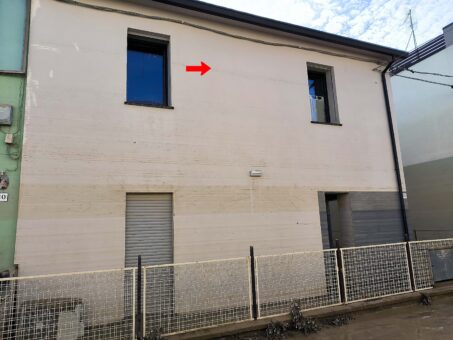 The second flood, the one from which we had to escape, came in the evening. Around 8.30 pm, the river bank just above our house collapsed. Until that moment, since we obtained a pump for inside the house, we hadn’t gone outside convinced that we could control the flow with the pumps and keep the water level down also with the help of sandbags. But within 20 minutes the water had reached the first floor, up to 3 metres in a very short time and suddenly we found ourselves trapped. We called the rescuers who immediately responded saying that they would arrive, but in the meantime, that afternoon, the Savio River in Cesena had also flooded, so the civil protection workers and the firefighters, who until the day before were all in Faenza, were already spread out in the various areas. Moreover, in my street the current was so strong that the motor vehicles only managed to get in at 04:00 at night and we would not have been able to resist until then. The firemen told us to go to the rooftops, but we don’t have a skylight, so it meant going outside, floating. The situation was really dangerous. (In the photo, the arrow indicates the level reached by the water). At one point a cousin of my husband, who saw on social media that the river had broken through the embankment beside our house, called him and asked him if we were already out. Just from our voices he could tell that we were in danger and since he is an athlete, as a boy he was a surfer, he put on his wetsuit, took his surfboard and threw himself into the current. He swam to our house and pushing the surf board, one at a time, he loaded us on it and took us to safety, to the city walls, 500 meters from our house. What did you see outside? Immersed in the current, the whole perspective changed. The water had already surpassed the street signs, so you no longer knew if you were on the street or in the garden of a house. We passed over gates, over garages and we were so high that at one point he asked me to cling to what looked like a bush, but in reality, now that I can see it, it was a tree. I was the last one to be saved. We were welcomed into the house of a lady who knows us. We were soaking wet. She gave us clean clothes. That night was very cold, terrible conditions and it was raining. We warmed up and then we were able to go the 6 kms from the city where my mother-in-law lives. We were really lucky because we were among the first to get out. We did not experience what many told us afterwards was a night of real terror in the city. Were the children aware of the danger? Yes. I have three children aged 10, 8 and 6. At one point, the youngest kept running down the stairs because we could see the water rising step by step and he said to me: “I can only see 5 steps, 4 four steps. Let’s go to the terrace, we have to run away” and we said “we need to stay here at the window, because it’s raining outside. The police are coming.” They realized and slowly had to process what was happening, especially the oldest. We feared that in just an hour we wouldn’t make it. When we arrived at grandma’s they were calmer even though when they got there they began to realize that we had lost everything. They were saying, “Mum, we don’t have schoolbags anymore, we don’t have books, now what?” I explained to them that many would help us. And so it was. How were those first days? Where did you find shelter?
 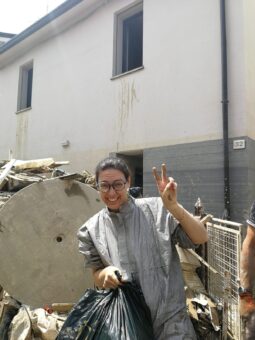 We stayed with my mother-in-law for a few days because we couldn’t move around town. Then, later, we were welcomed by an aunt of a friend of my son who lives abroad and who lent us her house in the centre for a month. It was 10 minutes’ walk from where we lived so we were able to go to our house and start clearing it. It was a tight fit, but it really was a great gift which I realized even more later, when I started hearing other people’s stories. Volunteers also began to arrive throughout the city. Because of the Focolare Movement and my husband’s contacts, we always had help. People came from Parma, from Piacenza, from Veneto even including people who themselves have been through the earthquake in Emilia some years ago. There was a beautiful atmosphere of concrete help, and it was in this climate that, slowly, I began to throw everything away but I was really serene. Shovelling mud is an all-encompassing thing at the beginning, you try to do your best, with all your strength and then you realize that it’s not the things, the objects that make up your life, but everything else. Your husband has a restaurant… Yes. He could see from the cameras that fortunately the water didn’t get in but he wanted to see in person. One day he left at six in the morning thinking of taking the motorway but even that was closed. We came up with an idea: “let’s call the deputy mayor, and let’s tell him that if the civil protection can bring you to the restaurant, you could start cooking for everyone in need.” The idea was willingly accepted because there were already many displaced people., Luckily they had been able to bring many disabled and elderly people to a hotel which is very close to my husband’s restaurant, but which does not have working kitchens. So my husband and two employees stayed the whole day at the restaurant and made 700 meals between lunch and dinner. There were 100 displaced people and then firefighters, civil protection personnel and since the restaurant is located right on Via Emilia, an access point, many of the people who had been stuck in the street, who had slept in the car without eating, came to the restaurant asking for help. The whole area of Cesena and Forlì was paralyzed. What are you going to do now? At the moment we have left that small house that we were using. We will move into a house that we have by the sea for a while and then we have rented an apartment for 18 months while we are waiting to fix up our house. The idea is to return to it in September 2024. But there are many questions, first of all to understand if there will be companies that can renovate all these houses, because there are so many of us. We’re talking about 12,000 people who are out of their houses. There are 6,000 families in our city alone and some houses, the oldest, have been declared uninhabitable. Now the houses have to dry out. We’ve already destroyed everything. We had parquet floors which we had to remove. The false ceilings on the ground floor came down on their own when the water came in. We had help to disconnect the toilets. Now every morning we go to open the windows and in the evening we go to close them and to turn on the dehumidifier. Luckily it’s summer, if this had happened in the autumn, it would have been an even greater disaster. Is help still coming? Absolutely yes and in many ways. For example, at the beginning we had thought of looking for an already furnished house so as not to have to have a double move, but we realized that people started to give everything: wardrobes, mattresses, furniture, and sofas. We decided to take an empty house so that we can begin to redecorate with this providence and then, in 18 months, bring everything back to our home, also because then there will certainly be other needs. People are really happy to help and I have to say that for me it was a lesson. I remember that one day, after the first flood, the house was upside down and the washing machine was broken. I said to myself, “I’ll prepare three bags, one of white clothes, one with coloured and one with dark ones, and then I’ll go to work. To the first colleague who asks me ‘how can I help you?’, I’ll say ‘would you be able to take all these clothes to wash’”. I was still at the door of the school and the bags were already taken. In these cases there is a stronger bond with people and above all I wasn’t too proud to ask for help. We accepted what was given to us and I feel that it is also a way to be honest about my needs and say okay, we love each other like this, just as we are. We also had a good relationship with our neighbours. We have lived there for four and a half years but I had never entered so many neighbour’s gardens, because life is hectic, we’re always in a rush. Whereas, now you go in, you greet each other, you help each other. What stage is it at now? The second phase has begun, that of establishing citizen committees to begin communicating with the municipal administration. I would immediately have excluded myself for various reasons, especially because in the past I held certain roles but then I realized that without taking on too much, by listening, by staying in the chats, by helping those responsible for these committees, I can do my part. I owe it to my children who still ask me “but do we have to go back to live there? Will we build an external staircase to the roof for the next time?” We need an active citizenship to keep an eye on the situation. I felt that I had to use my experience in the right way, building as many connections as possible, because now, as always happens with reconstruction, the greatest fear is to remain alone. Are you hopeful? Yes, absolutely. The other day we wanted to give a gift to the lady who offered us her house for the first month and, since Faenza is a city of ceramics, I bought a plaque to hang on the wall with the sentence, “The beautiful things of life are messy”. I thought, this was a huge, huge mess. We will need time to get back on track and we will make it, but I feel that I would never have had certain experiences without having gone through this difficult moment. I really feel that I have reached that point where you look at the essentials, at what really matters. It was terrible, but I can’t just think about the disaster, that the water took everything away and that was the end. There is much more to it than this.
Maria Grazia Berretta (Interview with Carlos Mana – Photo: by Maria Chiara Campodoni)
30 Jun 2023 | Non categorizzato
In Japan, a group of women of different religions has set up the ‘CommuniHeart project’, a suicide prevention project that focuses on self-awareness, communication and community support. The CommuniHeart project is organised by Religions for Peace Japan (World Conference of Religions for Peace). https://youtu.be/NPs9U3pfLZs
27 Jun 2023 | Non categorizzato
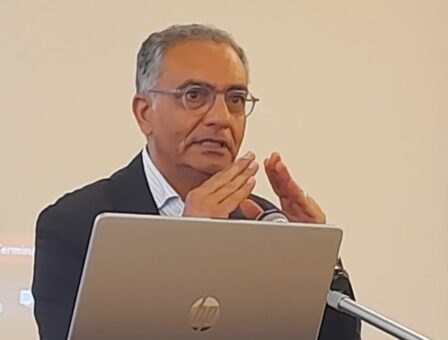
The level reached by artificial intelligence poses new ethical questions: how can technological development be progressed on a human scale? A Call to Action for developers and innovators in the digital world. A horizon that concerns us all. June 2023, Sophia University Institute: on the screen of the Aula Magna a digital hostess elegantly opens the seminar “Towards a Digital Oath”. We are crossing a threshold: the preparation began a long time ago, but the acceleration of recent times says something new. 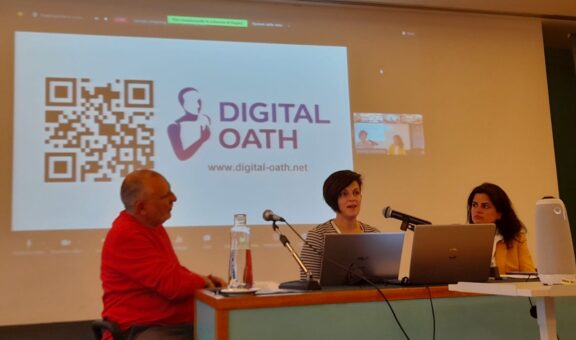 Promoted by a platform of protagonists: the Sophia Global Studies Research Centre, the Political Movement for Unity, NetOne, New Humanity and Digital Oath, the aim of the seminar is to address the pressing issues of the digital world according to different perspectives: philosophical, technological, ethical, social and political, leading up to a discussion about the proposal of an “oath”, that for professionals in the digital world would be equivalent to the Hippocratic Oath for doctors. Where does this idea come from? What are the goals? The technological world tends to change rapidly, faster than our ability to adapt. The complexity of the machines and systems that structure reality affects not only the way we live, but also the way we see the world and think about the future. The level reached by “AI – artificial intelligence”, alongside enthusiasm for its operational capabilities, presents a general concern about the new possibilities being opened up by these systems and the effects that can result from their malicious use. The recent spread of ChatGPT (November 2022) and all its spin-offs has brought AI massively closer to our daily lives, giving rise to new questions of meaning related to the understanding of what is human and what is not. In the world panorama, the evolution of these devices has produced a kind of disorientation, not only because their use appears within the reach of everyone, but above all because they
 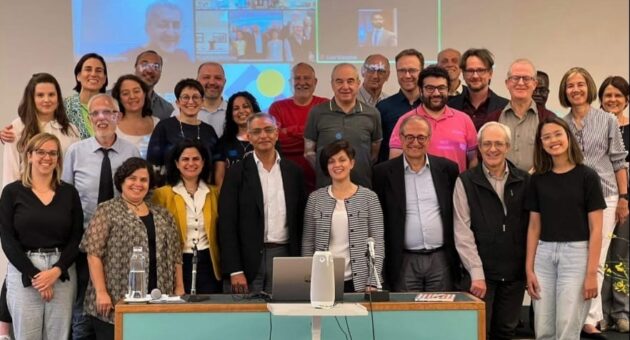 demonstrate that they do something that was previously the prerogative of human beings, with quantitatively superior capacities. The fact that we are faced with systems that are not “intelligent” in the human sense of the term and that manage their knowledge base through statistical calculations does not change the final result: the feeling of no longer being the authors of fundamental choices, of being challenged by machines that are less like “tools” and more like “colleagues”. The “Towards a Digital Oath” seminar added an important theme to these issues which is that questioning the ethics of technologies means questioning what is human. Many people consider technological development as the human activity that characterizes us most. Digital technologies, and in particular AI, are those that most accurately reflect our way of being and of understanding our existence. The crises of the last century (of values, environmental, social and political) are closely related to them and indicate that technological development must be accompanied by an equally determined educational commitment, so that every form of progress can be guided by a deeper ethical awareness. The “oath” for the digital world goes precisely in this direction. The programme of the first days of June convened a range of experts (link to the programme). After an initial broad overview of today’s digital technologies, the discussion explored the risks and regulations related to their use in Italy, the EU, the US, Brazil and China, intertwining technological solutions with political issues, philosophical reflections and social phenomena. Fadi Chehadé, former CEO of ICANN (Internet Corporation for Assigned Names and Numbers), promoter of the “oath” for an ethics of the digital world and visiting professor at the Sophia Institute, said, “We need to make a concrete and universally shared commitment to which developers, technicians and users of digital technologies can adhere and firmly anchor their work on a human centred approach”. Fadi Chehadé has been involved in this project since November 2019, when the first group met in Trent (Italy) to shape the project. Subsequently, the group involved scholars in various countries and participated in the UN-sponsored public consultation for the Global Digital Compact 2024. The purpose of the Digital Oath is precise: to suggest guidelines and ethically motivate developers and innovators of the digital world to put the dignity and quality of life of people and communities, the sense of human existence and respect for fundamental rights and the environment, at the centre. The proposal to “translate” the Hippocratic Oath for the digital world has already emerged in various international studies, which underline the urgency of the issue and the responsibility of those who create and manage digital services and administer data. It includes not only the new neural networks but also social networks and cryptocurrencies. Our work adds to that of other networks: now we need to join forces to establish a coalition between universities, the private sector and organizations committed to writing a code of ethics, a self-regulatory protocol that can benefit people, society and the environment. There is an initial wording of the oath on the new Digital Oath website and it is attracting support; suggestions and changes to the text are welcome and it will be progressively developed. The recordings and documents of the Seminar will soon be available on the website. The road is certainly uphill but there are many of us on the journey: it is a horizon that concerns us all.
Andrea Galluzzi
23 Jun 2023 | Non categorizzato
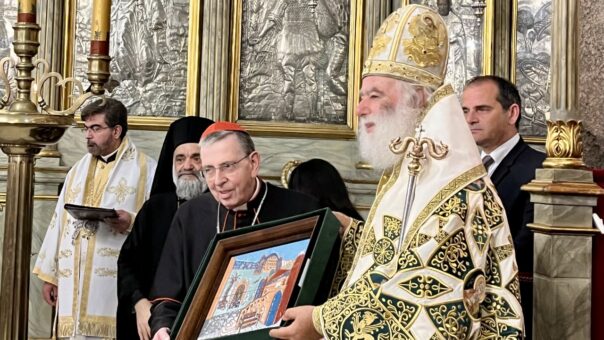
The Joint International Commission for Theological Dialogue between the Catholic Church and the Orthodox Church held its fifteenth plenary session from 1st-7th June 2023 in Alexandria, Egypt. It was hosted by the Greek Orthodox Patriarchate of Alexandria and All Africa. Agreement was reached on a new document entitled “Synodality and Primacy in the Second Millennium and Today”. We interviewed theologian Piero Coda, who attended the meeting. Fr. Coda, can you tell us how it went, who took part and what was the main objective? It was the 15th plenary session of the “Joint International Commission for Theological Dialogue between the Catholic Church and the Orthodox Church” which was held in Alexandria, Egypt, under the chairmanship of Metropolitan Job of Pisidia (Ecumenical Patriarchate of Constantinople) and Cardinal Kurt Koch (Dicastery for the Promotion of Christian Unity), with the cordial hospitality of Patriarch Theodoros II of Alexandria. It was a question of completing the stage of dialogue inaugurated by the document of Ravenna (2007). After developing the theological framework shared by Orthodox and Catholics about the interdependence of synodality and primacy in the life of the Church, it provided an historical examination of the situation experienced in the first millennium, proposed by the document of Chieti (2016) and reached a description of the situation experienced in the second millennium, which was the object of the document approved in Alexandria. Due to the well-known vicissitudes which torment the Orthodox world, the Patriarchate of Russia left the work of the Commission. There were no representatives of the Patriarchates of Antioch, Bulgaria and Serbia at the meeting in Alexandria, while the remaining 10 delegations of the other Patriarchates (Constantinople, Alexandria, Jerusalem, Romania, Georgia) and the autocephalous Churches (Cyprus, Greece, Poland, Albania, the Czech Republic and Slovakia) were present. In what terms is it possible to speak of Synodality in the ecumenical sense and what considerations emerged also taking the past into account? The theme is illustrated in the Introduction: “The present document considers the troubled history of the second millennium (…) It strives to give as far as possible a common reading of that history, and it gives Orthodox and Roman Catholics a welcome opportunity to explain themselves to one another at various points along the way, so as to further the mutual understanding and trust that are essential prerequisites for reconciliation at the start of the third millennium.” The result is a clearer and more shared understanding of the reasons that have led, not infrequently for reasons of a historical-political rather than theological nature, to encourage a distance that has not only prevented attempts at reconciliation made over the centuries from coming to fruition, but has exacerbated the polemical interpretation of the other party and the apologetic stiffening of its position. The enhancement of openness to a new situation marked by the rapprochement that occurred in the twentieth century must be noted: it favours a more pertinent assessment of the actual meaning and theological weight of what still prevents full and visible unity. What are the future prospects? The document emphasizes that the “return to the sources” of the faith and the strategy of the dialogue of charity between the “sister Churches” promoted, in the wake of Vatican II, by Paul VI and Patriarch Athenagoras, are significant. The Catholic Church’s commitment today, tenaciously desired by Pope Francis, to rediscover and reactivate the principle of synodality also stimulates hope. What lies ahead? The document states that, “The Church is not properly understood as a pyramid, with a primate governing from the top, but neither is it properly understood as a federation of self-sufficient Churches. Our historical study of synodality and primacy in the second millennium has shown the inadequacy of both of these views. Similarly, it is clear that for Roman Catholics synodality is not merely consultative, and for Orthodox primacy is not merely honorific”. Therefore, the interdependence between synodality and primacy, this was the firm point which was achieved, “is a fundamental principle in the life of the Church. It is intrinsically related to the service of the unity of the Church at the local, regional and universal levels. However, principles must be applied in specific historical settings (…) What is required in new circumstances is a new and proper application of the same governing principle.” This perspective paves the way for the continuation of the journey and the opening of a new phase.
Carlos Mana e Maria Grazia Berretta (photo: ©Dicastero per la promozione dell’Unità dei cristiani)
