21 May 2017 | Non categorizzato
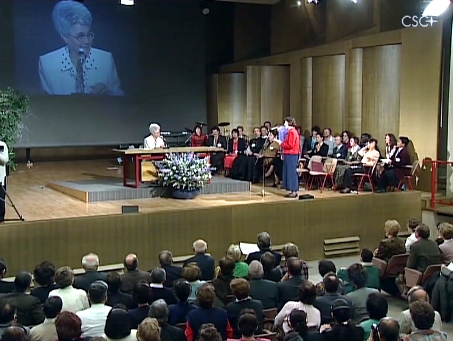
In this 500th anniversary year of the Reformation, there has been new drive towards Christian unity, from the historic meeting at Lund in Sweden to the Pope’s recent journey to Egypt. The Focolare Movement is increasing its commitment to what is known as the “dialogue of life” or “dialogue of the people”. This was reaffirmed in the Ottmaring Declaration (21.02.2017) and its outworking happens daily in the efforts of thousands of Christians throughout the world. The 59th “Ecumenical Week” ended recently at Castel Gandolfo (9th-13th May) with 700 participants from 69 countries and many parts of the world. 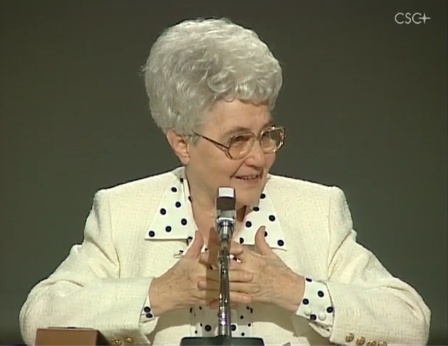 Chiara Lubich was asked about this kind of dialogue on the 4th April 1997 in the context of an ecumenical gathering and she replied spontaneously: “Veronica, an Anglican focolarina from Great Britain asks what our specific contribution to the unification of the Churches could be. Our contribution should be seen in the context of the whole field of ecumenism. We know that there is the dialogue of charity, which is very important. It probably goes back to the times of Athenagoras, when Pope Paul went to visit Athenagoras and Athenagoras went to see Pope Paul. The dialogue of charity helps us to feel that we are brothers and sisters and that we help one another. Then we pray together, which is a dialogue with God, a dialogue that goes through God. This too is very important especially during the Week of Prayer for Christian unity. In addition, you all know that there is the theological dialogue, carried out by experts; that too is going ahead despite the fact that some people say ecumenism is not going ahead. Instead, it is going ahead. We bring a new kind of dialogue. It is the dialogue of the people. It arose out of the spirituality [of unity] that we live in all the various Churches; there are members of 300 Churches who are in the Movement. This dialogue was generated by our spirituality because it is communitarian, it binds us to one another; it brings us together. If I love you and you love me, what is established between us? Jesus in the midst. But then Jesus unites us, as St Paul says, “What can separate us from the love of Christ?” (Rm. 8:35) Likewise, we say, “What will separate us?” Charity unites us. Christ himself unites us. No one can separate us if we go ahead with our spirituality. Therefore, by living this spirituality in the various Churches – Catholic, Anglican, Lutheran, Methodist, and so on – without even thinking about it, a people was born. It flowered from this spirituality, which generates a people. Then what happened? What happened was that by living the spirituality together, by getting to know one another, by loving one another and growing in our mutual love, we discovered that we have things in common, that we are already one family, that we are already a Christian people. I have baptism, and so does Veronica, and so do you. I have the Old Testament and you do too. I have the New Testament and you have it too. Then we have the Councils and many other things in common. If we have all this in common, why don’t we come together into one family and into one people? This is our characteristic contribution, which is essential. On the other hand, we are not the ones who bring it. It is a charism from heaven for our times, which are ecumenical times. It is the charism of unity, which has very much to do with ecumenism.” Source: The Chiara Lubich Centre
17 May 2017 | Non categorizzato
Since 2005, World Telecommunication and Information Society Day, instituted by the United Nations Telecommunications Agency (UIT), is celebrated every year on 17 May. The goal is to enhance the contribution that such tools as the Internet and information technologies can give to society, to the economy, to the progress of humanity. Depending on the way they are put to use, these tools have the potential to enrich global society.
17 May 2017 | Non categorizzato
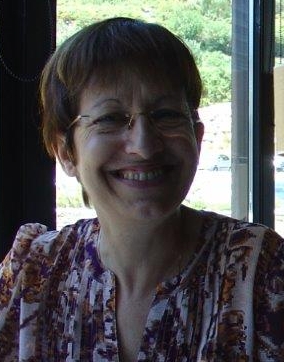
“There are questions in life that are truly difficult to answer: why does death, war, violence, separation or the gap between rich and poor exist? I would often talk with my university friends about these. I studied languages and literature at the University of Porto, in the north of Portugal – but no one seemed to be able to ease my concerns.
One day someone mentioned the Gospel and proposed I try living it. I couldn’t believe what I was hearing and objected. I know a lot of people who profess their Christianity, like I do. But after 2,000 years, things haven’t changed much. Yet given that finally someone was actually listening to me, I vented my doubts and judgements and went on for a bit. When it was time to say goodbye, the person only had space to say ‘Try it!’
In Porto I live in an apartment with other girls. That day I was the only who stayed home because I was studying for an exam. A poor lady knocked at the door. My first reaction was to get rid of her quickly, but I was held back by that ‘try it,’ which would pop up and challenge me every once in a while. We didn’t have much at home, but I found something to give the woman. “A bit later my mother called. She was in town for her medical checkup, and wanted to see if I was around: she had a bag of fruit and meat for us. My heart was full of joy, not just because that God-given food would feed us for a whole week, but because this confirmed that the Gospel is true. That small thing that I had just given to that woman had just come back to me hundredfold, just like the promise, ‘Give and you will be given.’
And so my new relationship with Jesus began, and got stronger every time that I tried to recognize him in each person I found myself next to. For my birthday I received a pair of fur gloves. I was hoping to get them for some time, since it gets icy at times here. Then I saw a woman shivering from the cold on the bus – what if I gave her my gloves? I did what I was thinking. This time I was jumping ahead a bit, since Jesus had already given me a hundredfold with that gift, so I could give my gloves to someone who needed them more than I did.
I was going to class when a lady carrying a baby stopped me. She was crying. I didn’t want to be late, I thought to myself, trying to get going. But inside I thought, ‘How can I say I love a God I don’t see and not love my neighbor that I do?’ (Jn 1:20). I looked at my watch and resisted the urge to leave. I stopped and got interested in her situation: she told me she had just left her child in the hospital doing quite poorly. She and her husband were living in two squalid rooms with their eight children.
I couldn’t do much right then and there, but I promised her I’d visit. That same day I told other young people and families from Focolare how I had gotten to know her. Each of them offered to help in whichever way they could. Together we provided the basic necessities (food, clothing, things for the house) and organized turns to help the children with their homework and play with them so their mother could be with their brother at the hospital.
At the same time we tried to understand how to let the city know about the situation and request better living space. A couple of weeks went by, and finally the much-awaited town truck arrived to move them to public housing. The privilege of taking the youngest child to their new home fell to me, and I will never forget that bus trip. The little one slept peacefully in my arms, unaware of the changes I’ve been seeing ever since I started living the Gospel.
Now those big questions, which are still there, have found some answers. I know now that taking the first step not only involves other people giving of themselves, but can even influence society.”
