29 Mar 2017 | Non categorizzato
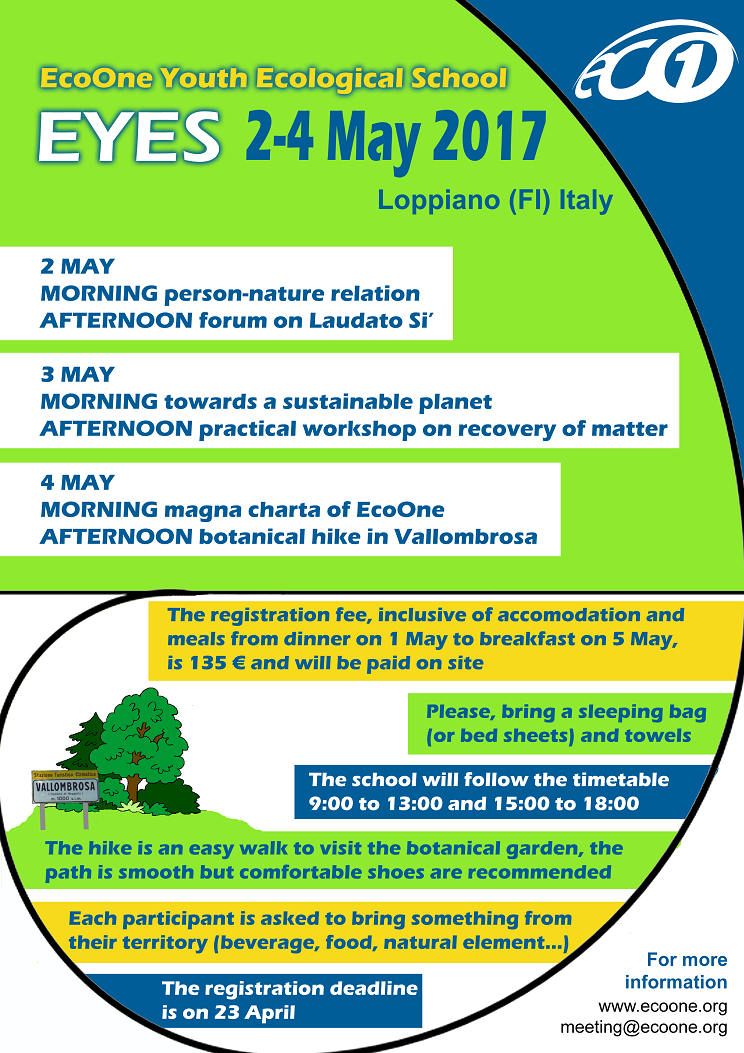 The Earth, our common home, is protesting. It seems to be turning more and more into a huge garbage dump. Its temperature is dramatically increasing and the depletion of natural resources makes it impossible to sustain the current level of consumption by the richest countries. Bio-diversity disappears and the quality of human life deteriorates. What is happening calls for an urgent need to undergo a bold cultural revolution. No one wants to regress to the neanderthal era, but it is essential to change direction and to work out a new model of development. The International EcoOne cultural initiative invites you to an ecological school to be held 2-4 May 2017 in Loppiano, Italy. It is aimed at young people, but open to all those who wish to look with new eyes at the relationship between human beings and nature. To subscribe please fill out the online form You can find more information in the attached flyer. The EcoOne Committee
28 Mar 2017 | Non categorizzato
The University Institute will be organising two open days at its international campus during which courses are presented in managerial skills in a changing world. Loppiano (Italy), 31 March and 30 April 2017
28 Mar 2017 | Non categorizzato, Word of
https://www.focolare.org/gb/files/2017/03/201704Wol.mp3
Word of Life for ages 4-8 | for ages 9-14 | for ages 15-17 | MP3 Audio | Print
This was an invitation two travellers made to a stranger, having met him on their way from Jerusalem to the village of Emmaus. The stranger had come upon them while they were ‘talking and discussing’ all that had recently happened in that city, and he seemed to be the only person to know nothing about it. So the two of them welcomed him to walk with them, and they told him about ‘a prophet mighty in deed and word before God and all the people’ (Lk 24:19). They had put their trust in him, yet he had been handed over by the chief priests and the leaders of the people to the Romans, condemned to death and crucified. It was an immense tragedy, and they could make no sense of it. As they walked, the stranger helped them understand the meaning of what had happened, based upon Scripture. It rekindled hope in their hearts. When they reached Emmaus, they urged him to join them for supper: ‘Stay with us, because it is almost evening.’ While at table together, the stranger blessed the bread and shared it with them. This gesture opened their eyes to who he was: the man once crucified and dead was now risen! The two of them immediately changed their plans. They went back to Jerusalem to find the other disciples and tell them the great news. We too can be disillusioned, appalled, disheartened by a terrible feeling of powerlessness in the face of injustices done to the innocent and defenceless. Our own lives have their share of pain, uncertainty, darkness… How we would like to transform it all into peace, hope, light for ourselves and for others! Do we want to meet Someone who can understand us to the core of our being, Someone who can shed light upon our journey through life? Jesus, the God-man, freely accepted to experience the tunnel of pain as we do, to meet each of us in the depths of our situations. He felt physical pain, but he also felt inner pain: from betrayal by his friends to the point even of feeling forsaken by that very God he had always called Father (see Mt 27:46; Mk 15:34). Through his unshakeable faith in the love of God, he overcame such immense pain, entrusting himself once more to the Father (Lk 23:46), and from the Father he received new life. Jesus has brought all of us onto this same path, and he wants to travel with us. In the April 1999 Focolare Word of Life, Chiara Lubich wrote, ‘He is there in anything that hurts us … Let’s try to recognize Jesus in all the distress and the tough situations in life, in all darkness, in our personal misfortunes and those of others, and in the sufferings of the world around us. They are him because he has made them his own. It would be enough … to do something practical to lessen “his” suffering in the poor … for us to … find … a new fullness of life.’ A seven-year-old girl shared her experience: ‘I was very sad when my daddy was sent to prison. I loved Jesus in him, so when we went to visit, I didn’t cry in front of him.’ A young wife said: ‘I accompanied my husband, Robert, through the last months of his life, after the doctors gave him no hope of recovery. I never left him for a moment. Seeing him, I saw Jesus. Robert was on the cross, really on the cross.’ Their love for one another became a source of light for their friends, who were drawn to compete in solidarity, never letting up and spreading to many others, giving rise to an association for social development called Abbraccio Planetario (‘global embrace’). ‘What we experienced with Robert,’ said one of his friends, ‘inspired us to follow him on a real journey towards God. We often ask ourselves the meaning of suffering, illness and death. I believe everyone who had the gift of sharing a part of the journey alongside Robert now has a very clear answer.’ This month all Christians celebrate the mystery of Jesus’ death and resurrection. It is a chance to rekindle our faith in God’s love, which allows us to transform pain into love. Every detachment, separation, failure, and death itself, can become for us too, a source of light and peace. Sure of God’s closeness to each of us, in any situation, let’s repeat with trust the disciples’ prayer at Emmaus, ‘Stay with us, because it is almost evening.’ Letizia Magri
28 Mar 2017 | Non categorizzato
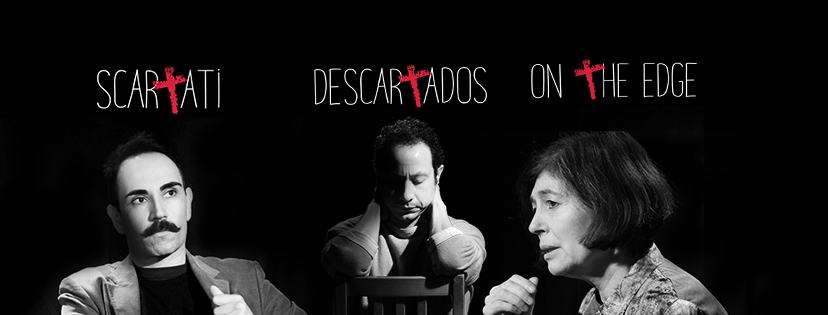
Discarded, outcast, crushed, seemingly with no escape: in their stories lie the inspiring sparks for this CSC Media production – a 20 minute video which recounts three true stories while maintaining anonymity. The protagonists who at the height of their pain come across a person – or rather the Person: Jesus. He too cried out in his abandonment on the cross, discarded by heaven and earth. They experience passing from death to life, from pain to love as expressed by some passages from Chiara Lubich which are included in the stories It is a project which was created thanks to a host of contributors. Featuring: Alessio De Caprio (Italy), Rafael Reyes Loyo (Mexico), and Sarah Finch (UK). Music by Sandro Crippa. Artwork by Roberto Cipollone (Bottega di Ciro, Italy). See trailer and more details at www.focolare.org/scartati. The video is available in three languages: Italian, Spanish and English.
27 Mar 2017 | Non categorizzato
The international network HDC – Health Dialogue Culture (formerly known as MDC – Medicine Dialogue Communion) promotes a Congress in Sao Paulo, Brazil from 7 to September 10, 2017 entitled: Promoting Global Health: strategies and actions on the individual and collective level
Rationale of Congress:
Nowadays, it is accepted that biochemistry and genetics are not enough for an insightful understanding of health and illness. Both personal and sociocultural context should be taken into account and underpinned. As health contributes remarkably to economic growth and social well-being, the determinants of health should be considered as strategic. Health systems, then, have to look at patients in their wholeness and to respect their complexities and experiences. The relationships between health professionals and health managers and between them and users of health services are key elements of the healthcare system. Spiritual dimension too cannot be ignored and can have a substantial influence on quality of life, satisfaction and outcomes of personal health. The Congress aims to focus on those aspects in the endeavour of better understanding them and to share experiences and good practices.
27 Mar 2017 | Non categorizzato
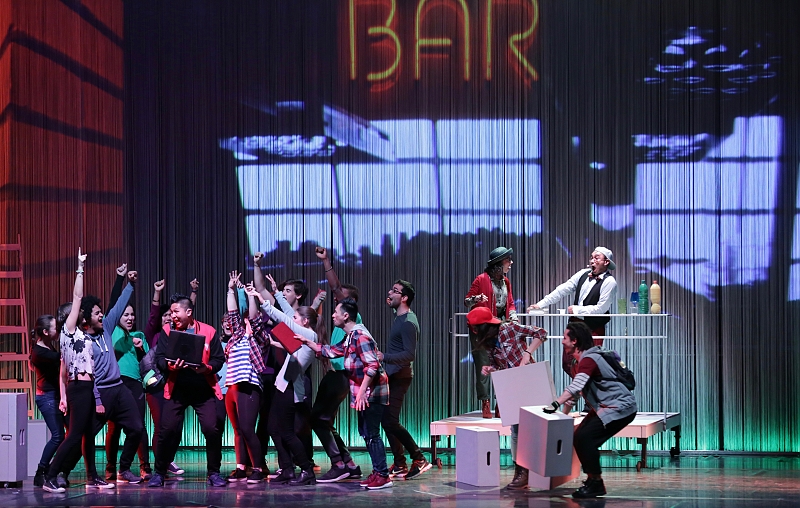
On stage is a triumph of diversity. This is how Campus: the Musical, which played March 18 at the Mandela Forum in Florence, Italy, can be described. The show is a unique genre, in which people of various levels of disability, mostly young people, gather around professionals that make up the international performing arts group Gen Rosso. The troupe has been around since 1966, when it began from an idea inspired by Chiara Lubich’s charism. The choice of venue could not be more perfect. The sports arena at the center of Florence, where there are public events, sports, concerts and debates, in 2004 was changed to the Nelson Mandela Forum to bring high-caliber cultural events to the community, as well as a sense of openness, exchange and the happy meeting of diversity of all kinds. “The purpose of freedom is to create it for others,” Mandela used to say. For those whom freedom means moving and singing to the rhythms and textures of African ethno, samba, jazz, rock, pop or rap, it may get taken for granted. But for those who have a more difficult daily routine in a wheelchair, or who find it difficult to navigate a sidewalk, or who live with the limits of a psychological disability, it can seem like a dream. This is a dream that “Uniti senza barriere” (United without barriers), an association that works in the world of disability in that area, wanted to make reality, thanks to meeting Gen Rosso and collaborating with other associations and agencies that are active in the social sphere. Campus is inspired by true events, taking advantage of the palette of colors and decibels that the band uses to give voice and soul to the peaceful weapon of dialogue (which was so dear to Mandela). It is set on a university campus, where the stories of nine teens of different nationalities cross, young people searching for their way, with a weighty past behind them and an unknown future ahead to create. The musical has a global current running through it, supported by a narrative that points to the heart of challenges today, thanks to its universal language and a sound that is definitely live. The project has reached the stage after a long period of reflection on the key issues of our time: culture clashes, the struggle against terrorism of every kind, and migration. Rather than just respond, it proposes solutions that are tangible, such as the “Italia per” project (Italy for…), which the international group promotes with workshops and shows dedicated to specific problems. At the Nelson Mandela Forum, after many hours of rehearsals, disabled youth and children, and even four small infants with their mothers, made their debut dancing and singing a dream of unity and fraternity. Proud to take on their roles, emotions in their voices and faces ran high as the professional artists took a step back to leave them the stage and the applause (from close to 1,000 attending). Campus has certainly hit one of its marks: overturning traditional understandings of disability. It also shows what the true limits of our existence are: when we build up material and cultural barriers that divide us, or relate to someone disabled and think that we have something more to teach or show them. “It always seems impossible until it’s done,” Mandela would have said.
