28 Jul 2016 | Non categorizzato, Word of
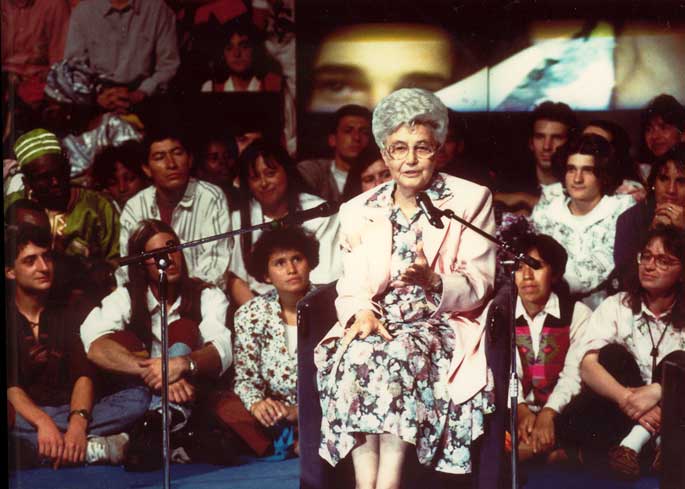
The words of the Gospel shape our lives and give us God’s own life, if we live them. If we share what we experience with others, it does not only nourish them, it gives us life too. By now we have been living the Word of Life for seventy years. The text comes to us and we read the commentary. But what we hope will remain is the sentence that is offered, a word of Scripture, often from Jesus. The ‘Word of Life’ is not simply a meditation, but Jesus speaks in it. He invites us to live, always bringing us to love, to make a gift of our lives. It was an ‘invention’ of Chiara Lubich, who speaks of its origins like this: ‘I was hungry for truth, and I studied philosophy. Indeed, more than that: like many other young people I sought truth and I believed I would find it in study. But then came one of those great ideas from the early times of the Movement, which I immediately communicated to my companions, “What point is there in looking for truth when it lives incarnate in Jesus, the God-man? If the truth attracts us, let’s leave everything, let’s look for Him, and let’s follow Him.” And that is what we did.’ They took the Gospel into their hands and began reading it word by word. They found it completely new. ‘Each word of Jesus was a burst of brightly shining light, all divine! … His words were unique, eternal … fascinating, fashioned with a divine form … they were words of life, to be translated into life, universal words in the midst of space and time.’ They discovered them not to be stuck in the past, not a mere memory, but words that He continuously speaks to us, as He does to each person in every time and place.[1] Yet is Jesus truly our Teacher? We are surrounded by many proposals for our lives, by many teachers of thought, some of them twisted that even lead to violence, while others are straight and enlightening. And yet the words of Jesus have a depth and an ability to attract and move us that other words, whether they be of philosophers, politicians, or poets, do not have. They are ‘words of life’; they can be lived, and they give us the fullness of life; they communicate God’s own life. Each month we focus on one, so that, bit by bit the Gospel penetrates our spirit, transforms us, makes us acquire Jesus’s very own thought, so that we are able to respond to the most widely different situations. Jesus shows himself to be our Teacher. At times we can read the Gospel together. We would like Jesus himself, the Risen Lord, living in the midst of those who are gathered in his name, to explain it, to make it current for us, to suggest how we can put it into practice. The really new thing about the ‘Word of Life’, however, is that we can share our experiences, the graces given when we live it, just as Chiara explained when speaking of what happened in the early times which are still with us now: ‘We felt we had a duty to communicate to others what we had experienced, also because we were aware that by giving it an experience remained and built up our inner life, while, if we did not give it, bit by bit our soul was impoverished. The word was therefore lived intensely all day long and the results were communicated not only among us, but with those who joined the first group…. When it was lived, it was no longer I or we who lived, but the word lived in me, the word lived in the group. And this was the Christian revolution with all of its consequences.’[2] It can be like this today for us too. Fabio Ciardi ______________________ [1] Scritti spirituali, vol. 3 (Rome: Città Nuova, 1979), p. 124. [2] Ibid. pp. 128, 130.
23 Jul 2016 | Non categorizzato
(C) CSC Audiovisivi
20 Jul 2016 | Non categorizzato
«What a great support for the Way Carmen has been. What a strong woman! I have never met any other person like her». With these words Kiko Argüello announced the death of Carmen Hernández in a letter to all the wayfarers, those who have adhered to the Neocatechumenal spirit, He furthermore wrote that Carmen represented a «marvellous event» and reflected the ideal «woman, her great genius, her charism, and her love for the Pope, and above all, the Church.» Together with Kiko Argüello and Fr. Mario Pezzi, Carmen Hernández was a leader of the Way worldwide. The funeral will be held on 21 July, in the Madrid Cathedral, to be presided by Archbishop Carlos Osoro Sierra. Over 30,000 neocatechumenal communities in 120 countries will commemorate her, in the presence of Bishops and Cardinals who are close to the Neocatechumenal movement. Born in Olvega, Spain, Carmen lived a long life, always in communion with the Spirit which had led her, after her studies in chemistry, to discover the missionary vocation she had felt in her youth.. Then came the stint in a missionary institute, studies on the liturgy within the context of the profound council renewal, and a two-year experience in the Holy Land. Lastly, in 1964 her encounter with Kiko amid the slums of Palomeras Altas, at the outskirts of Madrid: it was there that she felt the evangelical spirit was leading her towards a new form of commitment with the Christian community that was starting amongst the poor. The presence of Carmen offered a solid theological and liturgical basis to Kiko’s forceful catechesis, and their action became a real post-baptismal formation. She played a fundamental role in the drafting of the Statutes of the Way, which was approved by the Holy See in 2011. In 2015 she received the Honoris Causa Doctorate in Sacred Theology from the Catholic University of America in Washington, as an acknowledgement of her great contribution to Christian formation throughout the world. «You have received a great charism, for the baptismal renewal of life,» she had said to Pope Francis in her speech before the followers of the Neocatechumenal Way last 18 March, the last time she appeared in public. But the Holy Father spoke to her personally on the phone last 1 July during a private audience granted to Kiko Argüello and Fr. Mario Pezzi. The Focolare Movement joins the prayers and thanksgiving, in keeping alive the communion between the ecclesiastical movements ratified in the Pentecost of 1998 when Pope John Paul II met the Movements and New communities for the first time, each of which is the particular fruit of a charism endowed by the Holy Spirit to the Church and humanity, to respond to the needs of our time. Maria Chiara De Lorenzo

10 Jul 2016 | Non categorizzato
Photo: Nitin Dhumal
Chiara Lubich
Source: Chiara Lubich, L’unità, compiled by Donato Falmi and Floernce Gillet (Rome: Città Nuova, 2015), originally published in Chiara Lubich, Frammenti, (Rome: Città Nuova, 1963 and 1992), p. 53-54.
5 Jul 2016 | Non categorizzato
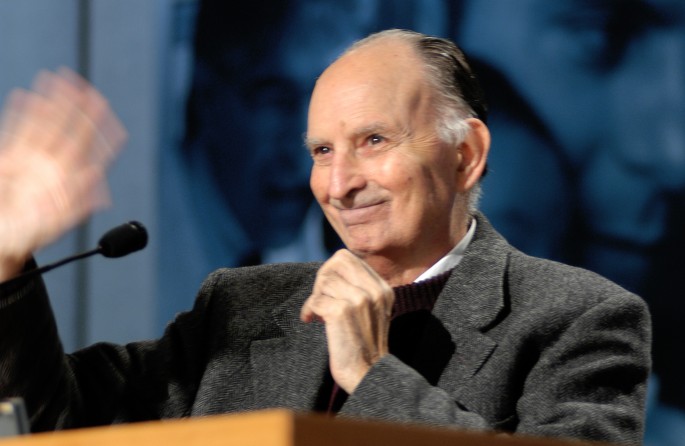
Pasquale Foresi (July, 5 1929 – June, 14 2015)