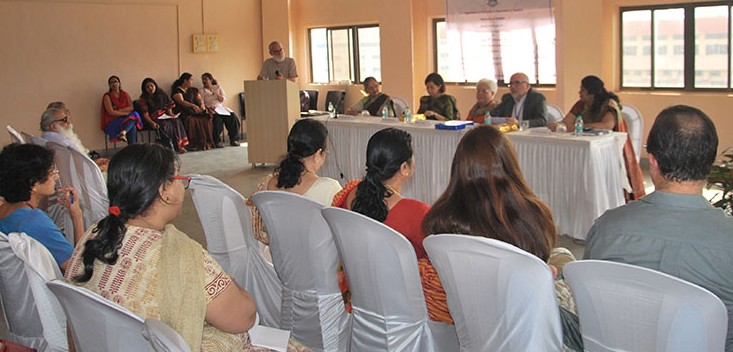
“Dialogue is a true sign of the times, but it also represents something that we need to deepen in all senses. In the wake of John Paul II and of other contemporary thinkers, Chiara Lubich had described out times, at least in the West, with the image of a “cultural night”, not a permanent night, but a night which, according to Lubich, hid a light, a hope. We could therefore say that within the cultural night, which is also a “night of dialogue,” a light is hidden, namely the possibility of all of us together elaborating a new culture of dialogue. To do this – in my opinion – the first step is to rediscover that it is so rooted in human nature that in every culture we can find what I would call the “ sources of dialogue.” These sources are contained in the great Scriptures and are basically two: the source that rises from the religious experience and the source that rises from the philosophical research of humanity. In this line we should have to talk about Biblical, Koranic, Vedic, Buddhist sources, and so on. Last century in the West a real dialogical thinking developed from Jewish and Chrisitan roots. I draw particularly on the latter to offer you several principles of an anthropolgy of dialogue. First. Dialogue “is written in human nature” to the point that you could say that it is the very definition of man. Second. Through dialogue “every person is completed by the gift of the other;” that is, we need one another in order to be ourselves. In dialogue I give to the other my otherness, my diversity. Third. Each dialogue “is always a personal encounter.” Therefore, it is not a matter of words or of thoughts, but of giving our being. Dialogue is not mere conversation or discussion, but something that touches the interlocutors more deeply. Fourth. Dialogue requires “silence and listening.” This is decisive, because silence is important not only for right speech, but also for right thinking. As one proverb says: “When you talk, let your words be better than your silence” (Dionysius the Areopagite). Fifth. True dialogue “constitutes something existential” because we risk our selves, our vision of things, our identity. At times we feel that we lose our cultural identity, but it’s only a passage because, in reality, our identity is immensely enriched in its opening. We should have an “open identity.” (Fabris). This means knowing who we are: but also being convinced that “when I understand with someone else . . . I know even better “who I am”. Some further principles. Authentic dialogue “has to do with the truth” and is a deepening of the truth. For the ancient Greeks dialogue was the method for reaching the truth. This means that truth is always in need of being completed; no one posesses the truth, only she [the truth] posesses it. So we are not dealing with relativity of truth, but of “relationality of the truth” (Baccarini). “Relative truth” means to say that each one has his truth that is true only for himself. “Relational truth” means that each one takes part and puts in common with the others his sharing in the [one] truth, which is true for everyone. Our way of reaching the truth and how we share in the truth is different. This is why dialogue is important: to enrich us with the different perspectives. Through relationship each one discovers new aspects of the truth as if they were his own. As Raimond Panikkar says: From a window you see the whole landscape, but not totally. It is what we said earlier: We need to understand diversity as a gift and not as a danger. One of the great paradoxes of today is that in this globalised world we are fearful of diversity, of the other. Dialogue also “requires strong will.” Love for the truth leads me to seek her and desire her, and therefore I put myself in dialogue. Two final principles. “Diaolgue is only possible among true people,” and only love makes us true. In other words, love prepares people for dialogue by making them true [persons]. What makes the talk fertile is the holiness of the one that speaks and the holiness of the one that listens. This then is the full scope of the dialogue’s responsibility: it requires true persons and makes the persons more true. In conclusion: the culture of dialogue “knows only one law, which is reciprocity.” This dynamic of going and returning is essential for there to be true dialogue. Finally, today there is much talk about interculturalism. I think that true interculturalism is possible if we begin to live this culture of dialogue. No one ever said that dialogue would be easy. It requires something that today is difficult to pronounce: sacrifice. It requires men and women “mature for death” (Maria Zambrano), that is dying to oneself to live in the other.” Jesús Morán , University of Mumbai, February 5, 2016.
The news summary will be made available on the Collegamento CH website a few days before the Internet transmission. On the same website one can find all the previous linkups in various languages, as full editions as well as individual news video clips.
Why are these words of Jesus so dear to us and why do they come back time and again in the Words of Life we choose each month? Perhaps it’s because they are the heart of the Gospel. They are what the Lord will ask us when in the end we find ourselves in front of him. On these words will hinge the most important exam of our lives; and we can get ready for it every single day. The Lord will ask whether we have given food and drink to whoever was hungry and thirsty, whether we have welcomed the stranger, whether we have clothed the naked, visited the sick and the prisoner… It is a question of little acts, which yet have the value of eternity. Nothing is small if done for love, if done for him. Jesus indeed did not just come close to the poor and marginalized; he healed the sick and comforted the suffering. But he loved them with a preferential love, to the point of calling them members of his family, of identifying himself with them in a mysterious solidarity. Today too Jesus is still present in whoever suffers injustice and violence, in whoever is looking for work or living in a risky situation, in whoever is forced to leave his or her homeland because of war. How many people are in pain around us for all sorts of other reasons and call out, even without words, for our help! They are Jesus who asks for concrete love, a love capable of inventing new ‘works of mercy’ in keeping with new needs. No one is excluded. If a person who is old or sick is Jesus, how can we not seek what could give the necessary relief? If I teach my language to an immigrant child, I teach Jesus. If I help my mother clean the house, I help Jesus. If I bring hope to a prisoner or consolation to someone who is afflicted or forgiveness to someone who has hurt me, I build a relationship with Jesus. And every time the fruit will be not only giving joy to the other person, but I too will feel a great joy. By giving we receive, we sense an inner fullness, we feel happy because, even though we do not know it, we have met Jesus. The other person, as Chiara Lubich wrote, is the archway we pass under to reach God. This is how she recalls the impact of this Word of Life from the first moments of her experience: The whole of our old way of thinking about our neighbours and loving them collapsed. If Christ was in some way in everyone, we could not discriminate, we could not have preferences. Our human notions that classified others were thrown up into the air: compatriot or foreigner, old or young, good-looking or ugly, nice or nasty, rich or poor, Christ was behind each one, Christ was in each one. And in reality each brother or sister was ‘another Christ’…. Living like this we realized that our neighbour was for us the path to God. Or rather, our brother or sister was like an archway that we had to go under to meet God. We experienced this from the earliest days. What union with God in the evening, when we prayed, or when we recollected ourselves after having loved him all day in our brothers and sisters! Who gave us that consolation, that inner union that was so new, so heavenly, if not Christ who lived the ‘give, and it will be given to you’ (Lk 6:38)of his Gospel? We had loved him all day in our brothers and sisters and here he was now loving us.’1 Fabio Ciardi 1 Chiara Lubich Scritti spirituali, vol. 4, (Rom3, 1995), 204-5.
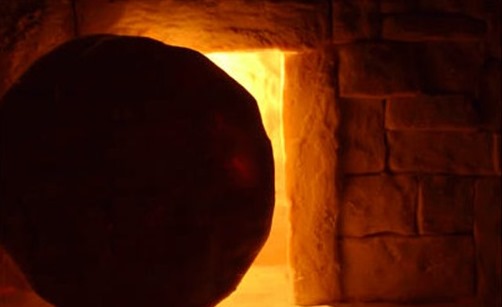
“A providential circumstance led me to examining in depth the reality of Jesus who, after his abandonment and death on the cross, rose from the dead. Not only, but I had the opportunity to meditate intensely with my mind and heart on many details of Jesus’ resurrection and on his life after the resurrection. I was dumbfounded (this is the exact word) at the majesty, the magnificence that emanated from this divine event, by the uniqueness of the risen Lord, by this supernatural fact which, as far as I know, is unique in the world. For this reason, I cannot help but highlight it again this time. … The resurrection is what most characterizes Christianity, what distinguishes Jesus, its founder. The fact that he is risen! Risen from the dead! Not in the way that others rose, like Lazarus, for instance, who then, when his time came, died. Jesus is risen never to die again. He continues to live, also as a man, in heaven, in the heart of the Trinity. Five hundred people saw him! And he certainly wasn’t a ghost. It was him, really him. He told Thomas, “Put your finger here and see my hands. Reach out your hand and put it into my side” (Jn 20:27). He ate with his disciples; he spoke with them; he stayed with them for as long as forty days. He had renounced his infinite greatness out of love for us and he had made himself small, a man among men, like one of us. … In rising from the dead, he broke, he surpassed, all the laws of nature, of the entire cosmos and, by doing so, he showed that he is greater than all that exists, greater than all that he created, greater than all that can be imagined. Consequently, even if we have just an intuition of this truth, we cannot help but see him as God. We cannot help but do as Thomas did and fall down on our knees in adoration before him, confessing in all sincerity: “My Lord and my God.” … And I saw with new eyes what he did during those fabulous new days on earth. After an angel came down from heaven, overturned the stone of his sepulchre and announced his resurrection, the risen Lord appeared first of all to Mary Magdalene, the former sinner, because he had become man for sinners. Then we find him walking along the road to Emmaus. Great and immense as he was, he becomes the first exegete and explains the Scriptures to the two disciples. Then we see him as the founder of his Church, laying his hands on his disciples to give them the Holy Spirit; we hear him saying extraordinary words to Peter whom he places as the head of his Church. Then he sends the disciples into the world to announce the Gospel, the new Kingdom he founded in the name of the Most Holy Trinity from where he descended and to where, with his coming ascension, he will return. … And, because he is risen, the words he said to us before his death acquire unique brilliance and express indisputable truths. First and foremost, the words announcing the fact that we too will rise. I knew it and believed it before, because I am a Christian. But now I am doubly sure: I will rise, we will rise. …” Chiara Lubich, In unità verso il Padre, Città Nuova editrice, Roma 2004, p.102-105
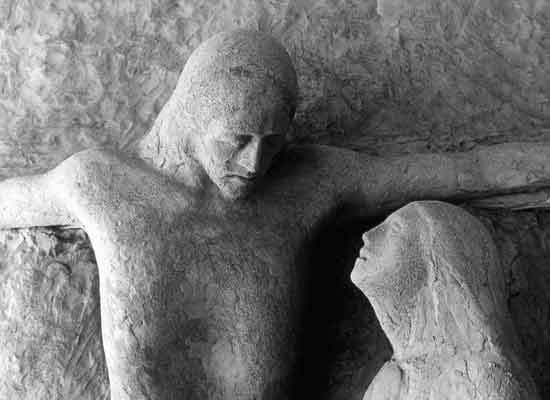
“The tragic mystery of the death on the Cross, when even Heaven and earth darken in horror and tremble, was poured forth upon the poor women beneath that gibbet.” The Father had abandoned the Son; the Son had abandoned the Mother: Everything crumbled into horror and darkness. Only that woman remained standing, and she was entrusted with abandoned Humankind. Our destiny was in Her hands just as it was on that peaceful day when She spoke her first fiat. When the Father turned his gaze on those horrific hills that had become the pivot point of the universe, He saw Humankind clinging to that woman, under the gory and bloody sacrifice of the man-God. “Martyr, and more than a martyr,” says Saint Bernard. Beneath the Cross, Mary. We can truly say that Jesus somehow needed Her not only to be born, but also to die. She was there in that moment on the Cross when, abandoned by every person on earth, He felt abandoned by the Father in Heaven. Therefore, at the foot of the Cross he turned to the Mother: the Mother who had never deserted Him and who had triumphed over nature so as not to fall in that trial under which any woman would have crumbled. As Goethe seems to sense in Faust, on Calvary Mary and Jesus were joined in a “single suffering.” Then, when the Son had died, the Mother continued to suffer. The dead Jesus was placed upon her lap: more helpless than when He had been a child. A dead God on His Mother’s lap! Right then, yes, she was queen. Since Jesus recapitulated humanity, [He] was all humanity of all times – guarded on the lap of Mary, who in that desolation appears as the Mother and Queen of the human family that walks the paths of sorrow. Her greatness was equal with Her anguish. But as we see, Her regality was nothing but a primacy in suffering: the only way for her to be the closest one, immediately next to the Crucifix. If you think about Mary’s torment beneath the Cross, about the pain of the Mother upon the destruction of Her Son, willing victim of the sins of the world and of all the sufferings of all humankind, you can sense the immensity of the tragedy she endured, a cosmic tragedy. And you can measure our narrowness when we dedicate to her only a few sentences, a few brief prayers, a few gritty words . . . It seems to us a waste of time to meditate on, to weep over [it]: and we risk Eternity. Since inserting yourself into that suffering is to include yourself in the Redemption. Let’s take our place with her beneath the Cross, choosing the role of a victim over that of an executioner, embracing suffering over the charm of wealth, the Cross over vice: so that we can then be with Mary in bearing on [our] lap, the bloodless body of Jesus, the Mystical Body that persecutions bleed to death. Always, during the hours when the Church is being executed and Christ suffers in Christians, you see Her again, Mary gathering the lacerated body to Her bosom. And since Christ recapitulates Humanity, he identified with Humanity, so that the Church appears as Mary herself who gathers in the peoples in the midst of wars.” Igino Giordani, Maria modello perfetto, (Rome: Città Nuova, 2001), p.124-129.

 The news summary will be made available on the Collegamento CH website a few days before the Internet transmission. On the same website one can find all the previous linkups in various languages, as full editions as well as individual news video clips.