Piero Coda: the new words of the Patriarch
Foto © CSC Audiovisivi

Foto © CSC Audiovisivi
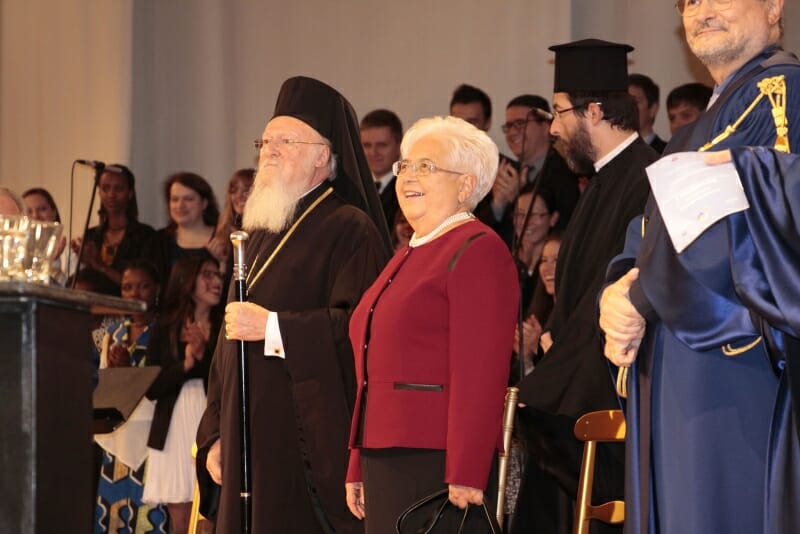
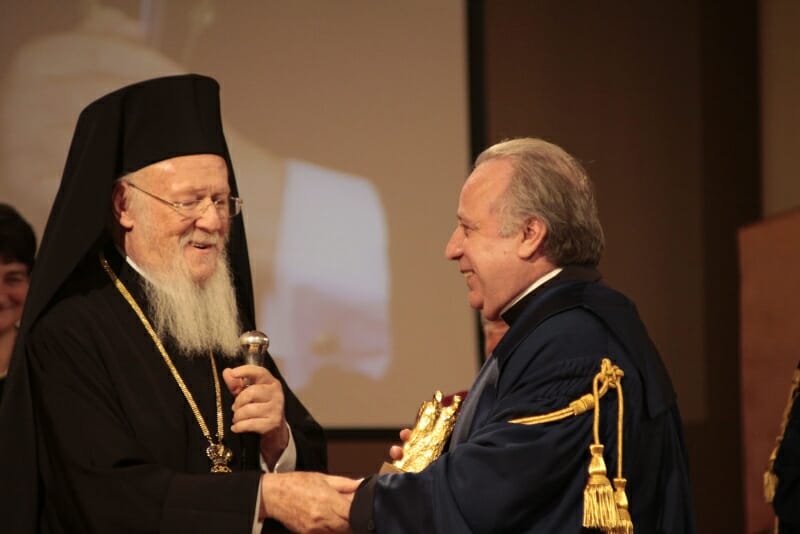
 “Everyone was so touched by the brotherly affection that joins the Holy Father Francesco to His Holiness Patriarch Bartholomew. The Pope recognizes the Patriarch’s commitment in the journey of unity, which he describes as our common journey. Not only that: he very courageously says that this Honorary Degree is a step ahead in that journey.” You know the Patriarch very well, you have lived and now live even more intensely, this moment in a long history of closeness between the Focolare Movement and the Orthodox Church and its Patriarchs. What are your views on this Patriarch and the significance of this recognition? “Patriarch Bartholomew is the heir of the great Patriarch Athenagoras who really possessed this passion for unity which, in him, was almost a prophetic vision that he was not able to realize. This passion was transmitted particularly to Patriarch Bartholomew who never misses an opportunity to press for unity in the heart of the Orthodox Church, so that they can talk to one another to the Church of Rome with a voice that is already in a certain sense synodal. He tries in many ways to emphasise how much this journey together is alive. I think we are truly at a happy moment because there is gentle pressure being given by two heads of our two Churches, and that cannot but produce fruit. There will be resistance as Pope Francis pointed out at the conclusion of the Synod, but in the end there is the Holy Spirit who will help us, who pushes the Church securely towards the unity of the Churches. We think that this is a happy moment and that this recognition might be an important step, a concrete step on this journey.” In his speech the Patriarch spoke precisely about what unity is and that it is different from union, which is different from uniqueness – diversity as richness, a concept that is quite present in the charism lived by Chiara Lubich. Could you explain to us a little more, in what way? “Chiara was always reminding us that the Church’s journey is guided by the Holy Spirit, and therefore He was surely maturing gifts in all the Churches of Christianity that would serve unity, that would serve if they were put in common. These gifts do not flatten but respect the diversity, precisely because they recognize a great richness in these diversities that only makes the Church more beautiful as Jesus wanted it. No uniformity therefore, but unity in diversity. Chiara would tell us that the highest model is the unity that joins the Most Holy Trinity where the Father is Himself because He is not the Son; the Son is Himself because He is not the Father; but the love that there is between the Father and the Son generates none other than the Holy Spirit who is the Third in this Trinitarian dimension, but is also the First since He links the Father and the Son. And this can happen because each of the Three Divine Persons of the Most Holy Trinity completely loses Himself in the other. This is precisely what is required for the Church’s journey; that is, that each one be able to completely lose himself in the other church; which means being able to reach all the way down to the bottom of one’s own richness and give it all to the other, to the others. Therefore, it requires knowing how to be love in order to build that Church of Christ in which each Christian, no matter what Christian community they belong to, feels like a sharer in the Body of Christ.” With this award, are there any new prospects that might open? “We were actually talking with the Patriarch himself about the possibility of eventually instituting a Chair at Sophia University Institute that would be part Roman Catholic and part Orthodox and would study such figures as Chiara Lubich and Patriarch Athenagoras, trying to sort out and understand the contribution they made and can continue make, through the encounter of their two charisms, to this journey of unity.” (From Vatican Radio)
 Their “ethical statute” defines them as people who are immersed in «the contradictions and difficulties of the present time, and who take on themselves the burdens and sufferings of the world of work …in the perspective of universal brotherhood.» In this tension one can see the signs of that essential “new school of thought” indicated by Pasquale Foresi (“life itself makes us comprehend”), co-founder of the Focolare Movement who affirmed: «work is not only a means of sustainment, but is something inherent to our human nature, and is thus also a means to get to know reality and understand life. » It was a working method revealed through the experience of the employees of the former CGlobal company of Pisa involved in one of the usual restructuring and delocalization of businesses, and the story of the “bonds of solidarity” trade union fund of Pomigliano d’Arco, Naples, created thanks to the Parish of San Felice in Pincis, to give mutual aid to a community on the verge of collapse due to the lack of jobs caused by the international division of work steered by the multinational corporations. This scenario was completed by the dissertation of Alberto Botto, Secretary General of the trade union Luz y Fuerza in Rosario, Argentina, on the resistance of the labour unions in a confrontation with the power of military dictatorships and the liberalist privatisation formulas that risked to dissolve their country.
  In the light of the paradigm of “this economy that kills,” to cite the Pope, precisely those who decided to take action in the trade union out of a “thirst for justice” are experiencing the fragility and limits of their organizational methods compared to the commercialization of all aspects of life. The three days thus aimed to create an “unarmed” zone, where each could express the reasons for his/her commitment. It was a mutual sharing that highlighted sharing sessions and moments of a challenging dialogue with Maurizio Landini and Marco Bentivogli, national secretaries of two Italian metalworkers’ unions (Fiom Cgil and Fim Cisl), and also with Giorgio Cremaschi of the radical, critical area. The programme included the confrontation with Cecilia Brighi who has worked years in the international employment organization of the trade unions, and with professors, Antonio Maria Baggio, Barbara Sena and Alberto Lo Presti, who presented the actuality of a fundamental text re-edited by Città Nuova (“Labour issues and Christianity,” by Von Ketteler).
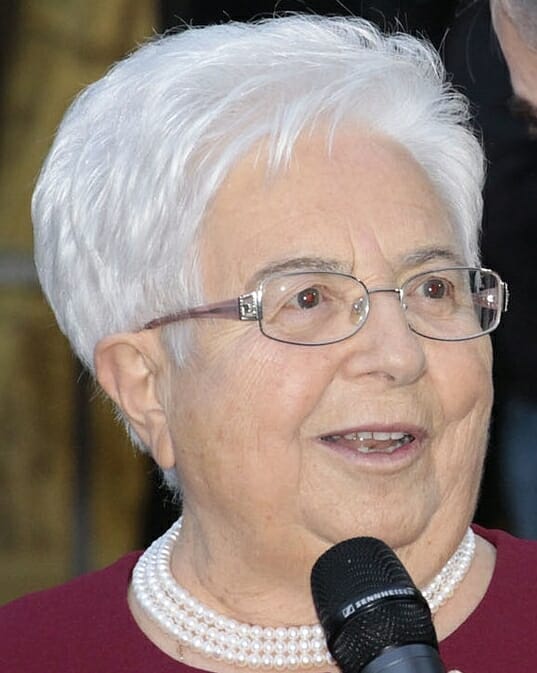
  The working sessions under the guidance of Antonella Galluzzi and Stefano Biondi, “Made in The World” contact persons and followed up by the Focolare Movement’s leaders of cultural dialogue, Caterina Mulatero and Joao Manuel Motta, saw the participation of the president of the Movement, Maria Voce, who remarked: «the truth is that jobs are not lacking. God did not leave us without work; just look around and see the needs and emergencies of civil society! What seems to be lacking is money. Where has it gone? Corruption and thirst for unlimited profits has created a gap between work and money, and its usage.» This is why we have to «take on the wounds of humanity together» with our “expertise” which is « universal brotherhood, reconciling man with man.» The participants departed with the great desire to share what they had experienced in order to promote opportunities for dialogue with other trade unions. «We understood that we are not alone – one of the Argentinean union members said – and that it is vital to remain united to give a spirit to the unionist struggle, in order to convey it to everyone.»
His Holiness Bartholomew I, Ecumenical Patriarch of Constantinople, a pioneer in ecumenical dialogue and a peacemaker, will be receiving the first honory doctoral degree in the Culture of unity conferred by the Sophia University Institute, situated in Loppiano (Florence) and founded by Chiara Lubich to deal competently and effectively with the cultural transition taking place. The theologian Piero Coda, President of the University Institute said: “Today, the world needs people who seek the unity of the human family, and the Patriarch is constantly rendering a valuable service towards a culture that aims at placing fraternity at the heart of human history”. […]. Diretta streaming See more: Patriarch Bartholomew I visits the Focolare’s little town of Loppiano
“God created the family, and he formed it in this way. He wants there to be love between husband and wife. If love is missing, there’s no marriage, no matrimony. Unfortunately, because of sin, this love has been spoiled to some extent. This love has been clouded over because sin entered humanity. So Jesus came and healed the situation, bringing a stronger love, a greater love, the very love that comes from God, the love which is God himself. So, we must take advantage of what Jesus brought, use this love in order to maintain natural love as well. For example, if you didn’t love your husband any more, you would have to love him because he is Jesus, because he is another Jesus, because you have to be the first to love, because you have to love everyone, because you have to make yourself one, because you have to love him as yourself. In other words, you bring supernatural love into the situation, with all that it means, in order to safeguard human love too. This is what to do and this way of doing things is the foundation of our New Families Movement.” Source: Chiara Lubich Center Video (italian soundtrack) https://vimeo.com/142517715
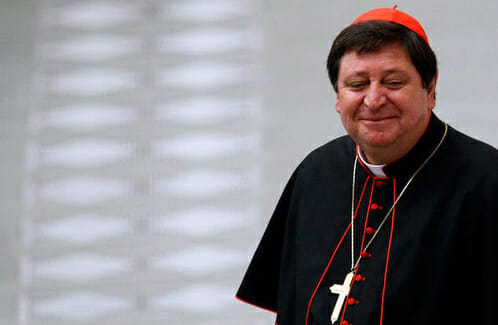
“It was the Son of God, Jesus Christ who revealed to us the true image of God and the true image of man and woman. God is Father, Son and Holy Spirit. We are, therefore, not dealing with three gods but one God in three Persons, as lengthily described in the doctrine of the Trinity. The Church has deepened and preserved this doctrine in all its integrity throughout the centuries. Besides finding the correct language in its profession of faith, the Church has always adored the Three Divine Persons. Up to the present, the spiritual Trinitarian doctrine has shown us the deep relationship the disciples of Jesus had with each of these Three Divine Persons. The Word of God does not present God only as a perfect Spirit, creator of heaven and earth, (as declared in the Christian Doctrine’s Second Catechism), but affirms that “God is love” (1 John 4,8.16). Saint Augustine tried to delve deeper into the path of love in God and reached the point of affirming that God is the Lover, the Beloved, and Love itself. However, he felt incapable of pursuing this path and bequeathed to us the deepening of this mystery in man and woman, in the three qualities of intelligence, memory and will. But what remained to be fully developed was the deeper understanding of the mystery of God who is Love. In our time, in which culture affirms the individual up to the point of falling into an exasperated individualism, and we struggle to make the synthesis between unity and diversity in the human relationships in this globalised world where human relationships are still re-evaluated in all senses, it would be opportune to seek in the Holy Trinity, that essentially Christian foundation, the path towards the fulfillment of love as a human identity. What is love? How can we understand and experience love? Our pathway must be found in the pathway of He who came to us from the womb of the Father, that is, the Son. To meet man, God who is love made himself nothing (Nazareth, Maria, Joseph, Bethlehem, the flight to Egypt. The Cross) (cfr text of Paul to the Philppians 2,5-11). Love passes through the incarnation and the mystery of the resurrection. Love makes itself nothing to be able to meet the other. This is the Kenotic dimension of love. Without this path it would be difficult for man and woman to find that relationship with God, but also with each other, whether man or woman. In this sense I think we could find the Trinitarian path of anthropology, not only theoretically but concretely.”