6 Oct 2015 | Non categorizzato
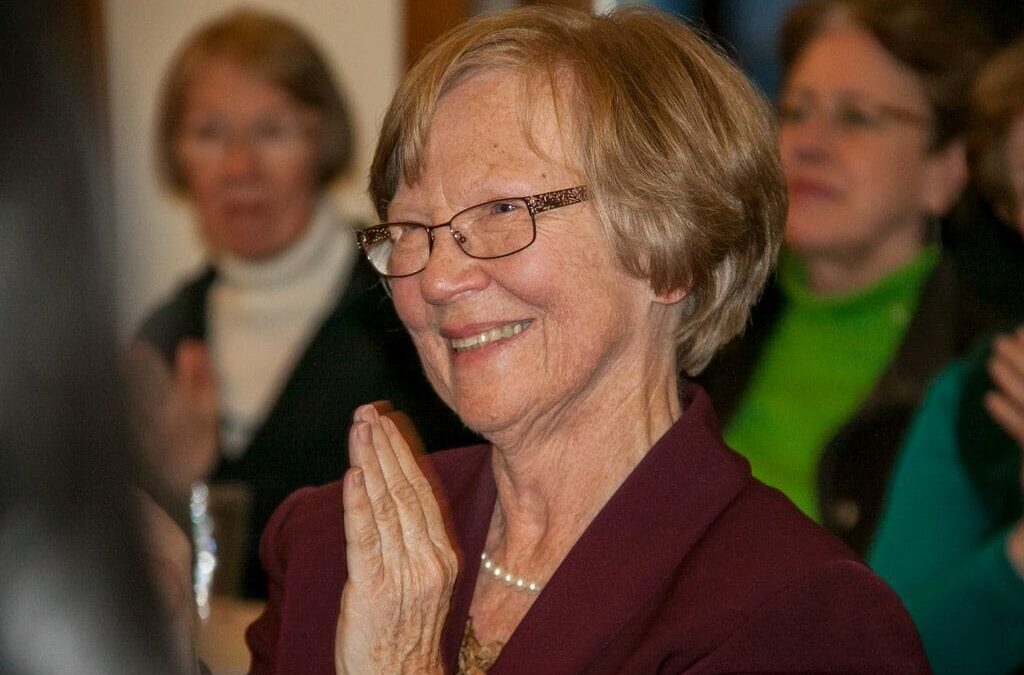
 Nancy O’Donnell has worked as a psychotherapist with drug addicts and was once in charge of a medical centre that helps alcoholic women and their children. The issue of the meaning of suffering is central to the lives of people especially during their illness. We would like to ask if it is possible to face the problem of illness and find hope. “Suffering is part of every human life and it would be very difficult to help those who suffer if we ourselves have not found meaning in our own suffering. The path towards hope lies in this effort. Science offers new treatments and new therapies to improve the lives of many. The danger is when we let ourselves be fooled, believing that we will find a way not to get old, sick or suffer. If we seek only the hope of healing, we run the risk of deceiving ourselves, and this may lead to desperation which is the opposite of hope.” What is the role of psychology in the experience of the sick people, and in helping them to find hope? “We could summarise it in four points: the role of the personality and the possibility to change it, the importance of healthy relationships in facing disease, the need to know and accept one’s own limits, and the human capacity to be a gift to others. Personality: being optimistic or having a positive attitude may reduce the risk of illnesses and chronic disorders. At the Davis University in California, they discovered that writing down each day the things you are grateful for helped to increase happiness. The results were more significant when compared with a group that was asked to note down instead, only the things that had provoked greater stress.
  The second point: relationships. From the moment we are born, we have the capacity to establish relationships. The mental health of every person depends on his capacity to “coordinate” himself and “tune in” with others. The human mind is healthy when it possesses some strategic relational skills that allow it to “open up” to a multitude of social realities, that is, with the ability to “perceive” the others and their diversity in an adequate manner. If our identity is relational, it would be logical in moments when nurturing hope becomes a challenge to find the support of people close to us and with whom we have built deep relationships which strengthen the positive energy we need to remain hopeful. Furthermore, not accepting one’s own limits is one of the most typical difficulties people have today. The limit appears through the person’s condition and his/her story, through those experiences that imply the risk of frustration. In a world that offers us a life “without limits,” the onset of illness takes on numerous expressions of that limitation which becomes a decisive transition towards achieving one’s own fulfillment. Lastly, being a gift for the others even when your physical strength is greatly reduced makes a person play an active role always. This is where you acquire a dignity that is born in the depths of our being.”
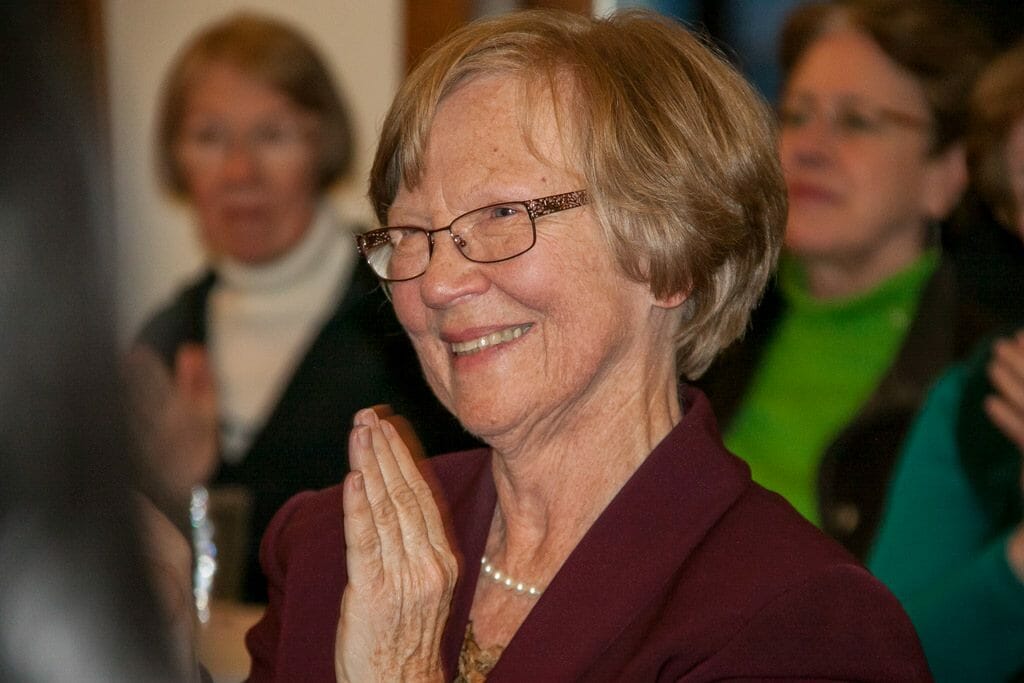
Dr Nancy O’Connell
5 Oct 2015 | Non categorizzato
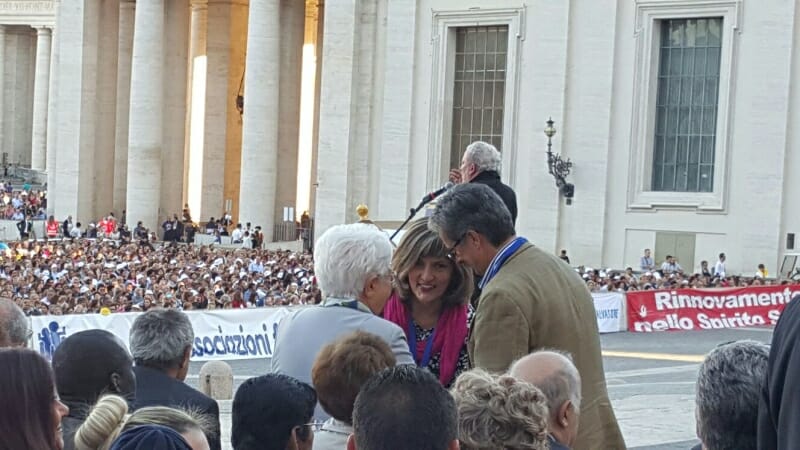
Maria Voce took part in the prayer vigil in St. Peter’s Square on Saturday, October 3rd where she gave a short talk. The journalist began by asking her: Why is this time of prayer so important? “It is because, as Christians, we believe it is above all the Holy Spirit who should be at work. This is a very delicate time when we hear many different opinions in the media. But it is only the Holy Spirit who can satisfy the great expectations, and do so as He wants and not how people think. So the most important thing is to pray for special help from the Holy Spirit, first of all for the Pope and then for all the Synod Fathers.” It helps us broaden our horizons a bit… “The family is the most wounded part of humanity at the moment. In a certain sense, it is like a sick daughter who the Church is watching over with a mother’s love, wanting her to get well. The Church is doing this act of pastoral conversion to care to one of its members who is suffering. I think all of us should have this attitude. I think we should disregard expectations for some kind of major changes from the doctrinal point of view or in the laws that govern the institution of marriage. I think that the greatest expectation is to ask ourselves as a Church what conversion is required of us towards these suffering brothers and sisters. The family is bombarded from all sides nowadays, by politics and by business lobbies; by those who want to take advantage of family issues as opportunities to pursue their own interests. The Focolare Movement has always had special concern for the family. One of its branches is especially dedicated to them and seeks to follow all the families in the world. They help prepare young people for marriage so that they can face married life with greater awareness. As far as possible they also help them find what they need (work, home, and so on) so as to start a family. And after marriage, they accompany these young couples on their new journey so that at the first signs of possible crises, which are natural, they may find a community ready to welcome and make them feel that they are not alone, that the love of the community is always present and caring. They do courses on addressing crises, with trained specialists. They help people who are separated and also those who are divorced and remarried, so that they feel, even in these circumstances, that they are members of the community and are loved and respected in their dignity as God’s children. They are helped to discover that being part of the community does not only mean sharing in the Eucharist but is manifested in living Gospel love together, sharing joys and sufferings, experiencing the closeness of God and the Church. The Synod asks all of us to make this conversion together, and this seems to me to be very important. However, I do not think that we should only focus on the divorced and remarried. The Synod is concerned with the family in its whole lifespan: widows, parents with young people who cannot find work, refugees, children, and so on. We need to look at the family as an icon of today’s society: it is humanity today that is suffering in the family. And humanity today must take on this suffering family and make this burden its own.” So the family is an encounter with the Church “going outwards” as Pope Francis continually urges us? “Absolutely! I believe it is the family that you can bear witness to the possibility of deep personal relationships, not only those you have by phone or on the internet. It is person to person relationships, with your children’s friends, and their parents, for example. Our role as laypeople is to be alongside everyone, to leave our own safe backyard so as to journey with them every day, in schools, at work, in the daily problems. This is why laity are at the Synod, and we too are very glad that a Focolare couple from Colombia were invited as auditors, Angelica Maria and José Luis from Colombia.” Last year, there was a couple from Rwanda, am I right? “Yes. I think that these married lay people at the Synod bring all the challenges that they too live and encounter, together with the others. Naturally, the Synod Fathers come with all the experiences, statements and sufferings that they have collected around the world. But this encounter between the ministerial Church and the laity is good. The Church is just one reality in which lay people and priests are together. The Church is the people of God on the move, taking care of all her children.” Listen to the complete interview of Radio Inblu with Maria Voce, 3 October 2015 (in Italian from 11’ 15’’)
4 Oct 2015 | Non categorizzato
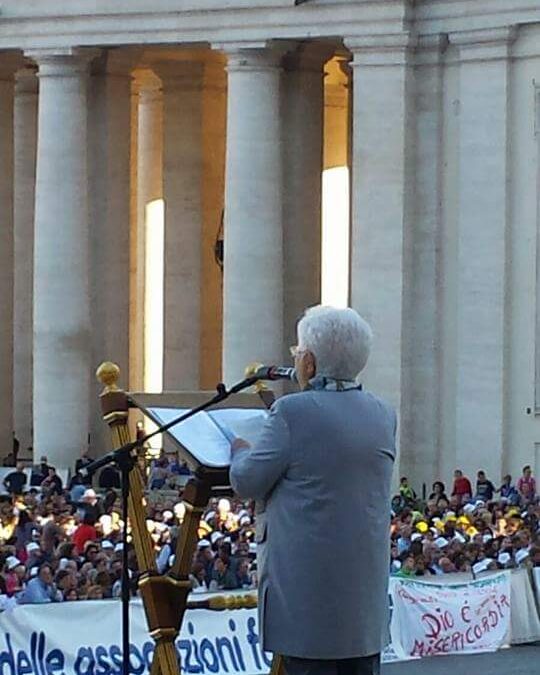
 October 4 will open the much-awaited Synod on the family, following the extraordinary, preparatory one held last year. Also this time, the Pope wanted to prepare for the Synod with a prayer vigil “to pray that the Holy Spirit will enlighten the Synod Fathers in their challenging task.” So on the evening of 3 October everyone was there: married couples, children, engaged couples, grandfathers, mothers, aunts, cousins, religious, single people……. will come to gather around Pope Francis. Many of them will come from faraway places, but will all be protagonists precisely because from the start, each felt involved in the reflections prepared by the two synodal sessions. It had never occurred, in fact, that upon proclaiming a Synod, the pope would want a double, popular consultation almost as if to say that the walls of the synod assembly hall had to be widened to be able to listen to those who live family lives or those who even anonymously, make sure that the family avails of all the support rightly due to it, inasmuch as it is the legacy of creation.
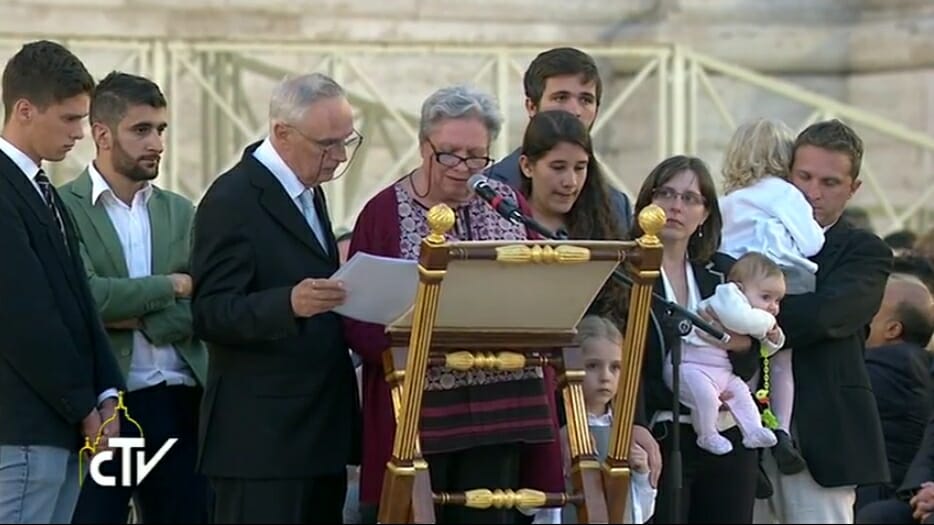
 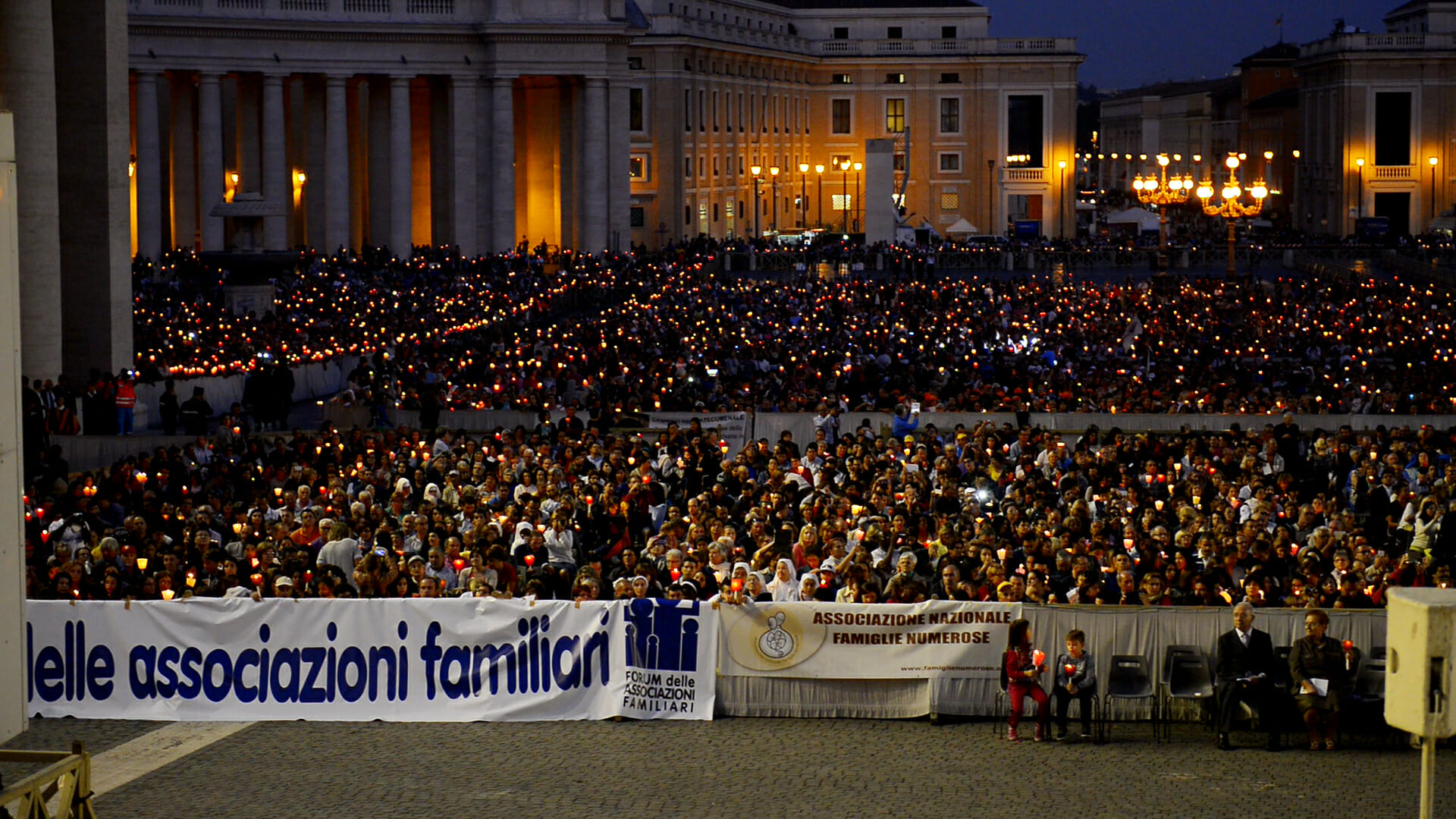 Each of the participants was holding a burning torch: many small fires that together will brighten the horizons of all the families, and of those which follow every day with renewed vigor, the trail of their original design, as of those immersed in darkness and no longer believe in love. Many torches will signify that the ‘till death do us part’ in Christ is possible, and that the grace of the sacrament of marriage heals every incapacity to love and gives spouses a splendid treasure: the presence of Jesus in their homes. The prayer vigil was also animated by songs – offered by various bands among which those of the Focolare – along with testimonies of families which are a different type of prayer, but likewise important and sacred. All these also highlight the beauty of the family, which often arises from a tiresome daily routine, imbued with gratuity, tenderness, and forgiveness which alone can give true joy. Testimonials to the sharing of life paths make all see that the family represents a gift to the world and a precious way of announcing the Gospel.
 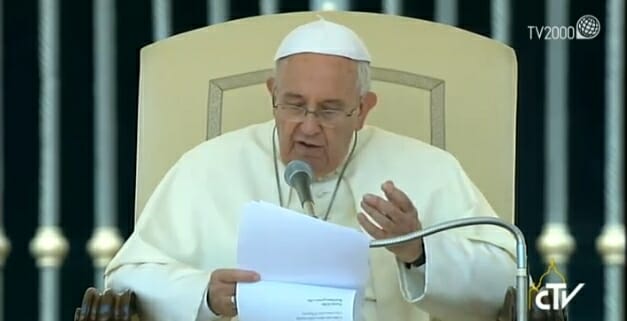 “May the Synod acknowledge, esteem, and proclaim all that is beautiful, good and holy about that experience,” the Holy Father prayed. “May it embrace situations of vulnerability and hardship: war, illness, grief, wounded relationships and brokenness, which create distress, resentment and separation.” The Pope continued, “Let us pray for a Synod which, more than speaking about the family, can learn from the family, readily acknowledging its dignity, its strength and its value, despite all its problems and difficulties.” He also expressed the desire that what is offered is “a Church which is a mother, ever capable of giving and nourishing life, accompanying it with devotion, tenderness, and moral strength. For unless we can unite compassion with justice, we will end up being needlessly severe and deeply unjust.”
 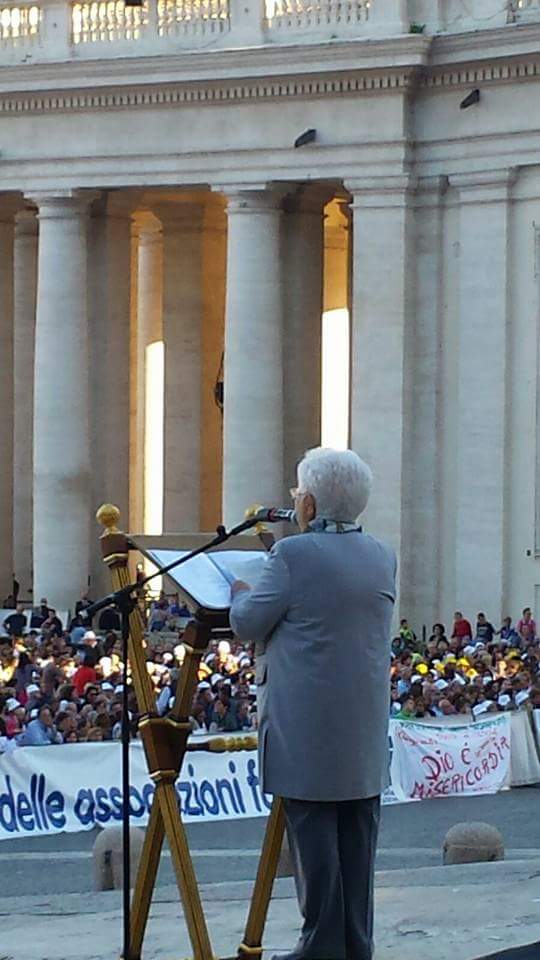 Maria Voce, who touched on the stories of those families who have decided to walk with the Resurrected Christ in their midst, affirmed that also they, like the disciples of Emmaus, “felt their hearts burn with the typical joy that the presence of Christ gives, experiencing the gifts of unity with God and among themselves, light, courage, missionary drive and furthermore”, the Focolare Presidente stated, “Jesus himself, will speak to the hearts of those they meet, and revive hope in them.” “The Pope,” continued Maria Voce, “spurs on the families to take the initiative in bringing this gift to the community. We want to accept this challenge, too, and do so in cooperation with our parishes and all the other movements and associations, especially in hosting the refugees who knock on the doors of our hearts. The Christian families have been entrusted with the task of human coexistence healed by mercy. They can show humanity the tenderness and force of God’s love and in this way, the Pope said, every day write a page of sacred history, not the one written only in books, but that which will remain forever in the heart of the Father.”
3 Oct 2015 | Non categorizzato
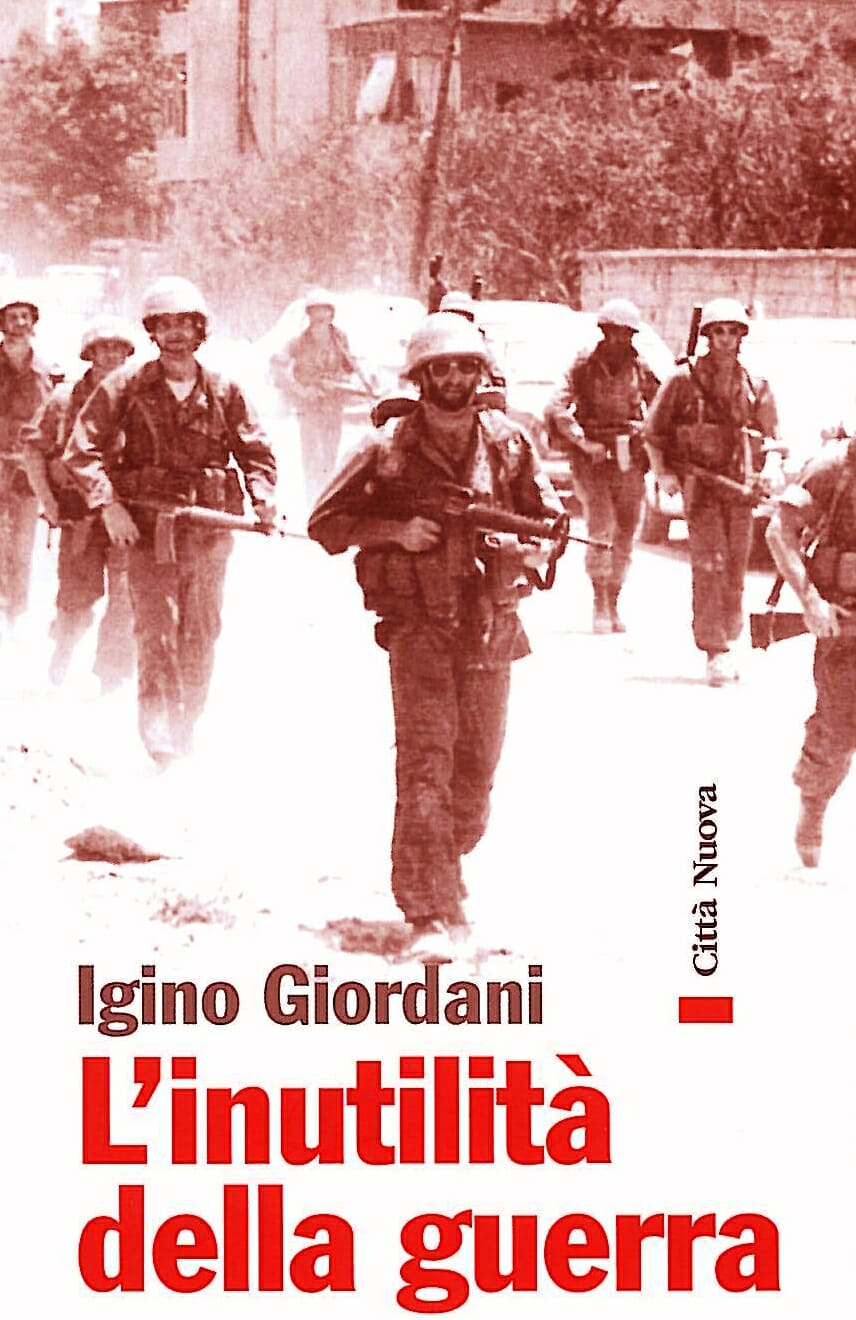 Peace is the result of fraternity amongst the peoples, solidarity with the weakest, mutual respect. This is how a more just world is built, this is how war is set aside war as a barbaric undertaking that belongs to a dark period of human history. Giordani knew war: he had taken part in the first world war. He received a medal after he had been seriously wounded on the Austrian front. But it is not only the horror of blood and death that should put aside war as a means of solving international problems. War can be seen as something quite natural to those impoverished minds that imagine humankind as a machine in thirst of power, ready to launch out against any enemy to satisfy its dreams of power. Yet, there is nothing natural about inflicitng suffering, misery and death. Wars never produce wins, only defeats. As history teaches, and Giordani reminds us: the great problems that all wars leave behind are far more distressing than the ones that meant to be resolved by engaging in conflict. This is why he suggest that we put aside our arms and military sentiments, and prepare a peaceful order. Moreover, for those who believe that human beings are God’s children any offence against a neighbour should be kept far from us. How can one love God by making attempts against the life of His children? A half century has gone by since Giordani wrote these texts, which are taken from L’inutilità della guerra (“The uselessness of War)”, but they could have been written for our own times that are threatened by such dangerous conflicts. “War is large scale murder dressed up as some sort of sacred cult, like the sacrifices of the firstborn to the god, Baal.The purpose of those sacrifices was to instill terror with their rhetoric and the interests that were behind them. Once humankind makes some spiritual progress, war will also be filed away along cruel pagan rituals, superstitions, wizadry and barbarity. War is to humanity what illness is to health, sin to the soul: it is slaughter and destruction, infection of body and soul, individual and collectivity.” “History confirms Christian reasoning, since the construction of weapons produces nothing but fear, mistrust and war. Those that say ‘If you want peace, prepare for war’ are false realists. You only need to open a book of history to see what the accumulation of arms and amunition leads to. Peace is difficult, but Christians are not naive: we want peace, not illusion. Peace is never going to just fall from Heaven all ready and nice. Peace is a patient process that we must carry out together. Peace is obtained with peace.” “Only the fearful defend war. War is made because of fear. The fearful resort to insult and shooting, because of an instinct to be free. It takes courage – rational courage – to reach lasting peace.” Alberto Lo Presti L’inutilità della guerra, Città Nuova ( 2003) p. 7; 71-72; 83.
30 Sep 2015 | Non categorizzato
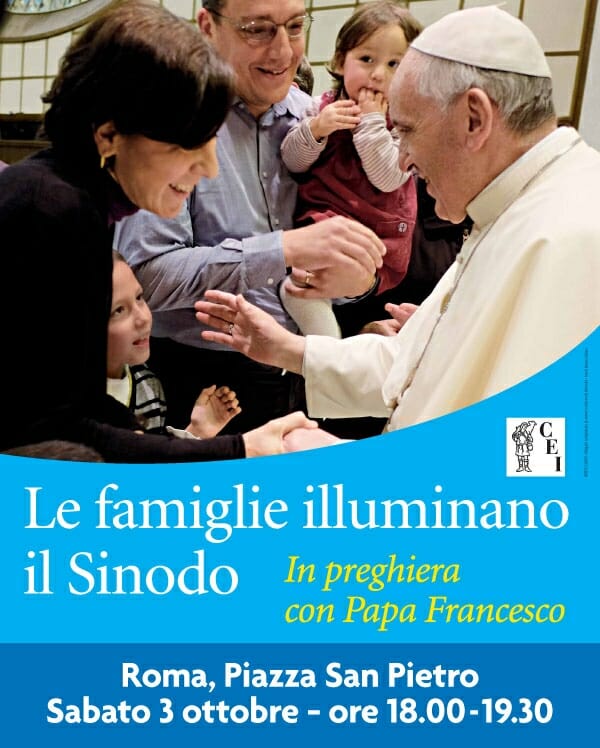
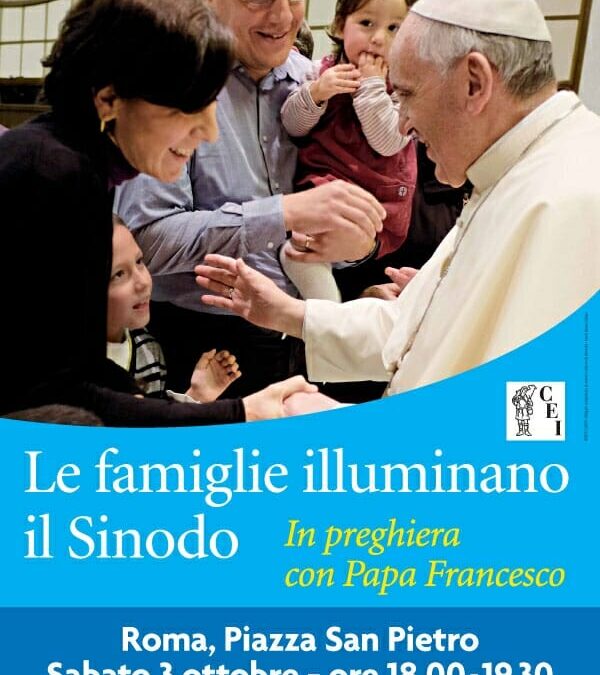
From 5:00 p.m. to 6:00p.m., testimonies by the ecclesial movements, among whom Maria Voce of the Focolare Movement.
This initiative is a people’s response to the Holy Father’s multiple appeals for prayer for the family and for the work of the Synod Fathers. Among the testimonies expected, from 5:00 p.m. to 6:00 p.m., will be those of the representatives of ecclesial movements, among whom Maria Voce, president of the Focolare Movement, Kiko Argüello, initiator of the Neocatechumenal Way, Julián Carrón, president of Communion and Liberation, Salvatore Martinez, president of the Renewal in the Holy Spirit Movement, and Matteo Truffelli, president of the Italian Catholic Action.
Prayer Vigil Booklet General Information
30 Sep 2015 | Non categorizzato
https://www.change.org/p/sign-up-for-a-global-petition-for-peace-now Confronted with the humanitarian drama of the refugees, the Focolare’s Youth for Unity step into action on many fronts, mobilising and appealing to international organisations, while joining in the efforts of the entire Movement.
- Reduce public funding of weapons
- Work at the root level of inequality, to counter misery
- Revise current models of governance
- Adopt a model of organised legality in opposition to criminality
- Guarantee universal primary education
These are the five main points of the appeal made by the young people of the Focolare’s Youth for a United World (YUW) to national parliaments, the European Parliament, the National Commissions of UNESCO and the United Nations. https://www.youtube.com/watch?v=om7WN06PMiU
