30 Sep 2015 | Non categorizzato
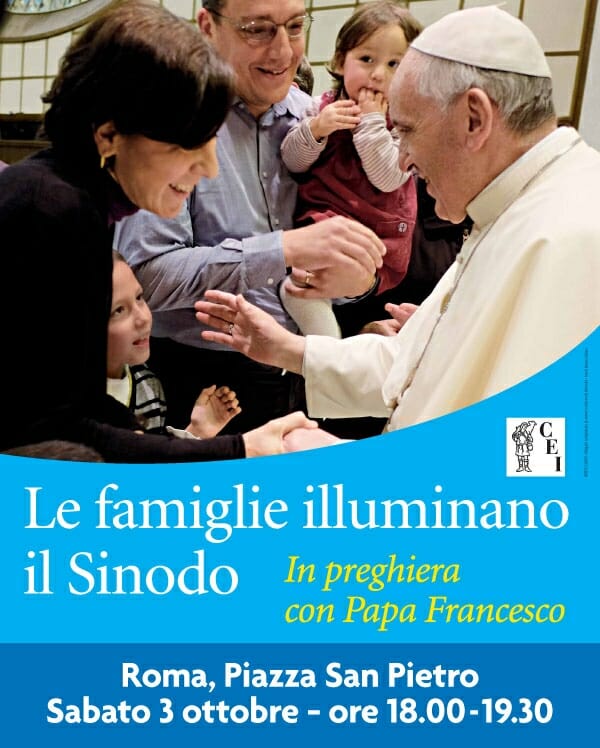
From 5:00 p.m. to 6:00p.m., testimonies by the ecclesial movements, among whom Maria Voce of the Focolare Movement.
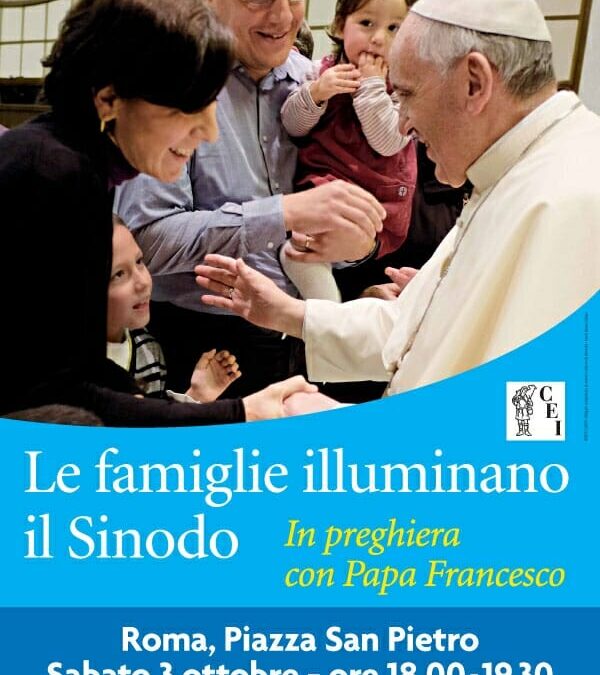
This initiative is a people’s response to the Holy Father’s multiple appeals for prayer for the family and for the work of the Synod Fathers. Among the testimonies expected, from 5:00 p.m. to 6:00 p.m., will be those of the representatives of ecclesial movements, among whom Maria Voce, president of the Focolare Movement, Kiko Argüello, initiator of the Neocatechumenal Way, Julián Carrón, president of Communion and Liberation, Salvatore Martinez, president of the Renewal in the Holy Spirit Movement, and Matteo Truffelli, president of the Italian Catholic Action.
Prayer Vigil Booklet General Information

28 Sep 2015 | Non categorizzato
“Real kindness is an exchange with essentially unpredictable consequences. It is a risk precisely because it mingles our needs and desires with the needs and desires of others...” A. Phillips e B. Taylor, On Kindness “Businesses and organizations are good places for a good and fulfilling life if and until they let non-economic virtues live alongside with the economic-business ones. It is a decisive co-existence that is not easy at all, because it requires managers to give up total control over the behaviour of people, to accept an element of unpredictability in their actions and to be willing to relativize efficiency, which is becoming the real dogma of the new religion of our time. Generosity is one of these non-economic virtues that, however, are also essential to every business and institution. The root of generosity lies in the Latin word genus, generis, a term that refers to race, family, birth – this is also the first meaning of the word gender. This ancient etymology – that is lost now – tells us important things about generosity. First of all it reminds us that our generosity has much to do with the transmission of life: with our family, with the people around us, with the environment in which we grow up and where we learn how to live. We receive it as an inheritance when we come into the world. It is a gift that our parents and relatives pass on to us. Generosity is formed inside the family home. The generosity we find in ourselves is very dependent on that of our parents, how and how much love there had been amongst them before we were born, the life choices they made and the ones they make when we start looking at them. It all depends on their faithfulness, their hospitality, their attitude to the poor, their willingness to “waste” time to listen to and help their friends, the love and respect they show towards their parents. This primary generosity is not a personal virtue, but a gift that becomes part of the moral and spiritual standard of what is called character. It is a capital with which we come to the world, which was formed before our birth and is nourished by the quality of relationships in the earliest years of our life. It also depends on the generosity of our grandparents, great-grandparents, neighbours, and that of many others who may not be contributing to our DNA but are still present, in mysterious but very real ways, in our own generosity (and non-generosity). My generosity is influenced by the poets who have nourished the heart of our family. By the prayers of my people, the musicians I love and listen to, by the storytellers in village festivals, by the speeches and actions of politicians, by the sermons of preachers. By the martyrs of resistance, who gave their life yesterday for my freedom today. By the generosity of countless women of the past centuries (there is a great affinity between women and generosity), that many times placed the flourishing of the family they gave birth to before their own – and still continue to do so. Generosity generates gratitude towards those who have made us generous by their own generosity. Living with generous people makes us more generous – and the same is true for prayer, music, beauty…. The cultivation of generosity produces many more effects than the ones we can see and measure – and the same goes for our non-generosity and that of others. The stock of generosity of a family, a community or a people is something like the sum total of the generosity of each and every member of it. Every generation increases or reduces the value of this stock, and the latter is happening today in Europe where our generation, impoverished in ideals and great passions, is squandering the wealth of generosity it has inherited. A state that leaves half of its young people without work is not a generous state”. (Read more) by Luigino Bruni published in Avvenire ( (Italian newspaper) on 23/08/2015
26 Sep 2015 | Non categorizzato
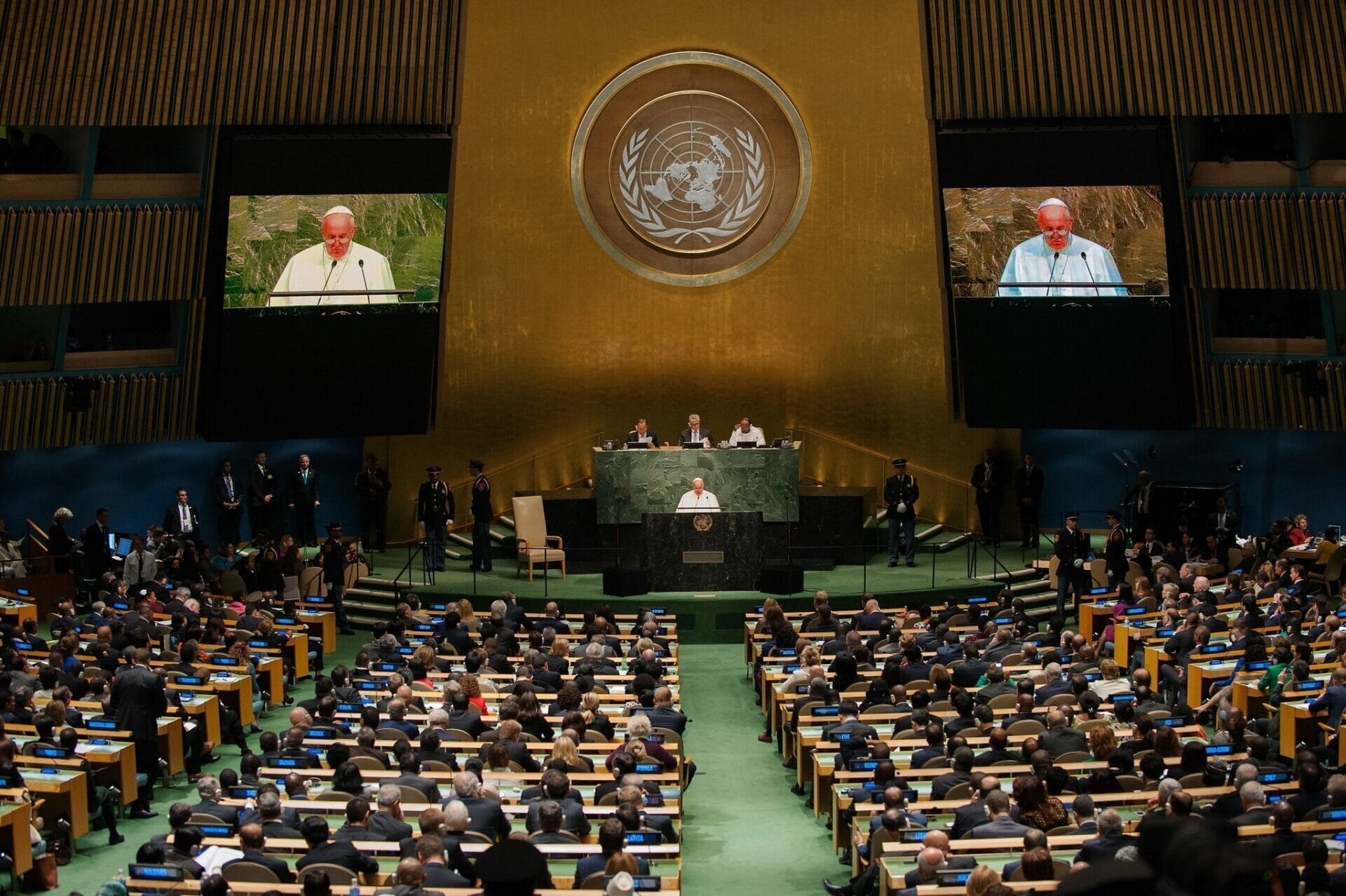 “Welcome, Holy Father” posters appeared all around the city already on Thursday. The taxi driver watching the Pope on TV was not indifferent: “So, you’re going to see the Pope tomorrow? Congratulations!” “Everyone finds the Pope appealing because he is authentic,” a non-Catholic man on the train said. He’s right: Francis does not need to attract attention or make himself appealing to all. And so he gave us a lesson before the UN’s General Assembly: on sustainable development, climate change and the issue of refugees: “We must not be appalled by the numbers… we have to look at their faces and listen to their stories,” he said in Washington. And at the UN: “Every man must be able to have concrete access to indispensible material and spiritual goods: a home, a dignified and well paid job, enough food, drinking water and religious freedom. ” He again strongly criticised drug trafficking, sexual exploitation of people, the arms rackets. In the same way as he had clearly denounced before the US Congress, he made another appeal to put aside divisions and antagonisms between political parties and to help the poor. The sacredness of each human being is a theme he strongly feels, and at the end of his speech, there were unending rounds of applause. He then left and greeted the people from his Fiat car which seemed so tiny amid the huge limousines.
 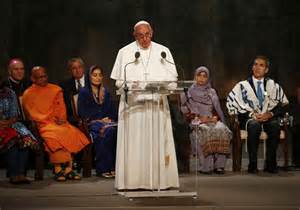 At Ground Zero, 500 representatives of various religions were all waiting to pray together for peace. Sue Kopp, a focolarina of New York who was able to participate in the rite, affirmed: “It was so meaningful also due to the diversity of this country. This place, which seemed so sacred to me, and marked by such immense suffering, has been transformed into a place of hope. The dream of a civilisation of love, is becoming a reality.”. Joe Klock, of New Humanity (an International NGO accredited at the UN) said; “The Pope underlined the importance of building unity in diversity, where peace and love reign among the nations and the hearts of all. This reality demonstrates that the world needs the spirituality of unity, which seems to be precisely tailored to this country!” Also in New York, the Pope visited some charitable organisations, among which a model school in Harlem. And then, in Central Park. The 80,000 lucky people were able to get entrance tickets, waited for hours, even to get just a glimpse of him. The Mass was celebrated at Madison Square Garden, where the seats are usually occupied by basketball stars and pop singers. The people waited for hours to enter but no one complained. Then the big surprise: Pope Francis arrived 20 minutes earlier than planned! The altar, the chair and the pulpit were simply handcrafted . Cardinal Timothy Dolan had the impression that the Pope would have appreciated this more than if the items were made by a designer. And here, Francis became the pastor of the immense city, recalling the reading from the book of Isaiah 9.1: “The people walking in the darkness saw a great light.”. He spoke about the difficulties of the multicultural cities where the light is absent due to so much smog. “But Jesus walks down our streets today,” he said and continued to invite all to go out towards the others, with the heart of a “merciful father waiting for his children to come home.” The church is alive in the cities, the Pope stressed, and so Christians have to bear witness to the light of the Good News. The applause went on and on. As in all the other countries, also in the USA the Pope has touched the heart of each one of us.
![Word of Life – October 2015]()
26 Sep 2015 | Non categorizzato, Word of
 Listen to the Word of Life
We can be like the first Christians and replicate their dramatic effect on society around them, if we live like them. For this we must focus on the Gospel’s core message and love one another in the power and the style of Jesus. Here we have the badge, the mark, the typical brand of Christians. Or at least it ought to be, because Jesus saw his community in this way. A fascinating text from Christianity’s early centuries, the Letter to Diognetus, recognizes that ‘Christians cannot be distinguished from the rest of the human race by country or language or customs. They do not live in cities of their own; they do not use a peculiar form of speech; they do not follow an eccentric manner of life.’ They are ordinary people, just the same as others. And yet they have a secret and it allows them to influence society profoundly, becoming as it were its ‘soul’ (see chs 5-6). It is a secret that Jesus passed on to his disciples shortly before dying. Like the ancient sages of Israel, like a father for his child, so too he, the Master of Wisdom, left as his legacy the art of knowing how to live and to live well. He had taken it directly from the Father: ‘I have made known to you everything that I have heard from my Father’ Jn 15:15), and it was the fruit of the relationship between them. It consisted in loving one another. This is his Last Will and Testament, the life of heaven that he brought to earth, which he shares with us so that it can become our very own life. He wants this to be the identity of his disciples, who should be recognizable as his followers by their mutual love: ‘By this everyone will know that you are my disciples, if you have love for one another.’ Are Jesus’s disciples recognized by their mutual love? ‘The history of the Church is a history of holiness’ wrote John Paul II. Nonetheless ‘history also records events which constitute a counter-testimony to Christianity’ (Incarnationis Mysterium, 11). For centuries, in the name of Jesus, Christians have fought endless wars with one another and their divisions continue. There are people who still today associate Christians with the Crusades, with the Inquisition, or who see them as the defenders to the bitter end of an outdated morality, and as opposing the progress of science. It was not like that for the new-born community of the first Christians in Jerusalem. People admired the communion of goods they practised, the unity that reigned among them, the ‘glad and generous hearts’ that characterized them (see Acts 2:46). In the Acts of the Apostles we read that ‘the people held them in high esteem’ so that more and more ‘believers were added to the Lord, great numbers of both men and women’ (Acts 5:13-14). The living witness of the community had a powerful attraction. Why today are we not known as people who stand out because of their love? What have we done with the commandment of Jesus? ‘By this everyone will know that you are my disciples, if you have love for one another.’ Traditionally, in Roman Catholic circles, the month of October is dedicated to mission, to reflecting upon the command of Jesus to go into all the world and proclaim the Gospel, to pray for and support those who are in the frontline. This Word of Life could be a help for all to put into focus the fundamental dimension of every Christian proclamation. It is not about imposing faith on others, nor proselytism, nor a self-serving handout of aid to the poor so that they will be converted. Neither is it primarily a matter of the challenge to defend moral values or a firm stand against injustice and war, even though such stances are a duty the Christian cannot evade. Before all else the Christian proclamation is a witness of life that every disciple of Jesus must offer personally. People in the modern world ‘listen more willingly to witnesses than to teachers’ (Evangelii Nuntiandi, 41). Even persons hostile to the Church are often touched by the example of those who dedicate their lives to the sick and the poor and who are ready to leave their homelands, going far away to the toughest places and offering help and solidarity to those in most need. But above all the witness Jesus requires is that of a whole community which demonstrates the truth of the Gospel. It must show that the life he brought really can generate a new society, where we live genuinely as brothers and sisters, helping and serving one another, collectively attentive to the most fragile and needy. The life of the Church has seen these kinds of witness, such as the settlements for indigenous peoples built by Franciscans and Jesuits in South America, or monasteries with the townships that grew up around them. Today too ecclesial Movements and communities give life to little towns of witness where it is possible to see signs of a new society, the fruit of Gospel life, of mutual love. ‘By this everyone will know that you are my disciples, if you have love for one another.’ Without abandoning our homes and the persons we know, if among us we live that unity which Jesus gave his life for, we can create an alternative way of living and sow seeds of hope and new life around us. A family that every day renews their will to live mutual love in a practical way can become a ray of light in the mutual indifference of a housing block or a district. An ‘environmental cell’, in other words two or more persons who agree to put into practice the demands of the Gospel with total commitment – in the field of their work, at school, in local government offices, in administrative buildings, in a prison – will cut through the logic of the struggle for power and create a collaborative atmosphere that favours the birth of true fraternity, a fraternity previously unhoped-for. Did not the first Christians behave like this at the time of the Roman Empire? Is not this the way they spread the transformative new life of Christianity? In our own day it is we who are the ‘first Christians’, called, as they were, to forgive one another, to see each other as always new, to help one another – in a word, to love one another with the intensity that Jesus loved us, in the certainty that his presence in our midst has the strength to draw others too into the divine logic of love. Fabio Ciardi

26 Sep 2015 | Non categorizzato
 A missing son “My son, in the critical age of adolescence, and probably due to bad company, disappeared without giving any news of himself. In the evening I would go and look for him among the vagabonds. My desperation created misunderstandings with my husband, and I was running the risk of neglecting not only him but also my two other sons. One day, I recounted that during my search around town, I had met many young people who were alone, and who had been reduced to living on the streets due to drug addiction. My other sons offered to come with me to take food and clothing. Since then, life in the family has changed. That tragedy was really an eye opener.” (M. J. – Switzerland) The hospital “The critically ill patient next to my bed confided to me that he was an agnostic and that he hoped to die soon. I listened to him lengthily and then I felt I had to say to him: ‘I think that our task as human beings is to value life at every stage, whether we are healthy (employed or with other commitments), or sick (with our therapies, pains, in our relationships with the nurses, relatives and the other patients). Death, however, may come, but we shall be what we have done in life and valuing the life we have received.’ The other patient seems to be serene now. In the evening, he who was always brooding even welcomed his daughter with a smile. I think he will sleep better tonight.” (D.B. – Trent, Italy) Prison visit “Rosa had to go the next day to teach in a military jail that was out of the way and did not have a car. I offered to accompany her, and moved some of my various commitments. The next day, on the way I tried to reassure my friend: I would make use of my time waiting outside the jail to say a prayer for her. So I did, while she was inside. After a few hours, I saw her come out all smiles due to the relationship she had established with the new students; she had felt my support through prayers. Now she goes to the jail on her own, but still treasures the experience we lived together.” (C. D. – Campania, Italy) The soldier of the Presidential guards “Corneille is a student at Kinshasha University. Last week he was there, in front of the faculty together with his friends, when a soldier of the Presidential guards approached them and begged for help for his child who was seriously ill. The students looked at one another, their hands in their pockets. Also Corneille put his hands in his pocket, and fumbled with: in the left pocket, the leaflet with the Word of Life, and in the right, some coins. After a moment’s hesitation, he offered the money to the soldier. When they were alone again, his friends said: ‘You must be mad, giving your money to him, above all!’ So Corneille gave them the Word of Life. They read it and one of them said: ‘You are really a coherent person. I like that.’ ((C. – Democratic Republic of Congo )
24 Sep 2015 | Non categorizzato
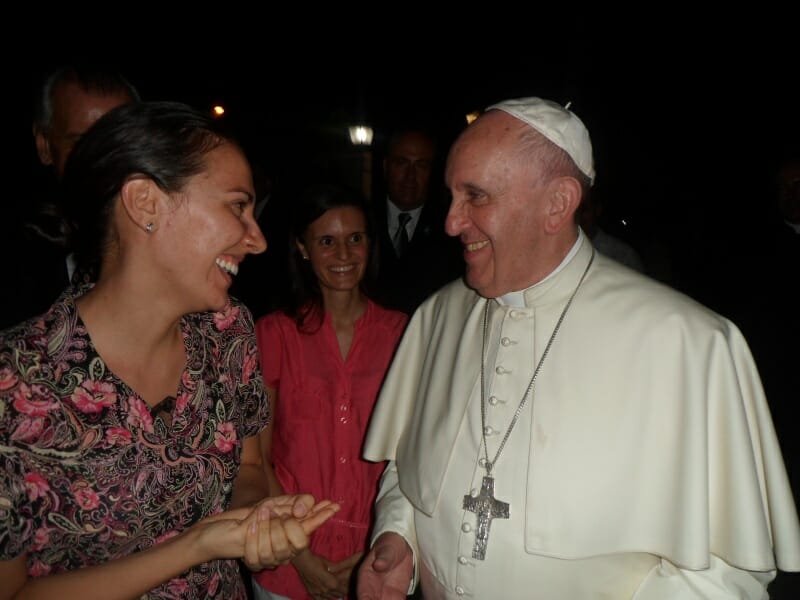
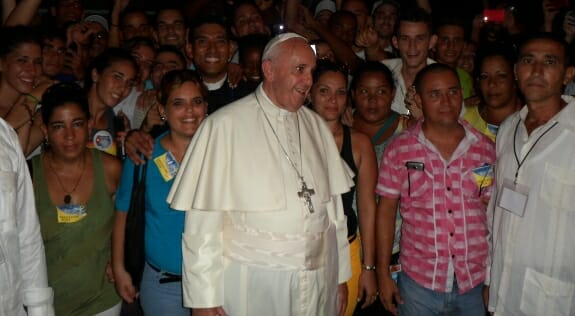 “We strongly felt the dream of a “united world” during these days of grace due to the presence of Pope Francis in Cuba. His visit literally left a trail of light! Already the preparations were full of enthusiasm and novelties. In the three dioceses he would visit, the entire communities of the Church started up various initiatives: in the churches and the “mission houses,” groups of young people held meetings in parks, and around the neighbourhood to talk about the Pope – in short, it was a happy and expectant Church! And, as never before, the means of communication (of the state) offered an extensive footage to prepare the Cuban people for this important visit – also from the political point of view, due to the known role the Pope played in reestablishing relationships between Cuba and the United States. The radios, TV stations and press continually announced the visit, with small “catecheses” on the Pope and the Church documentaries on his life, and also that of the other two Popes who had visited the Island. It was surprise and joy for a Church that had for years been isolated by the lack of the means of communication for so many years!» “The Pope arrived like a “missionary of mercy,” with simple words and gestures – often gentle but impressive – he told the Cubans and the whole world that without forgiveness, without practising the culture of encounter and dialogue, it would be impossible to hope for the future. With his very first words he immediately opened new horizons: “Geographically, Cuba is an archipelago that plays an extraordinary key role between the north and south and between east and west. Its natural vocation is to be a meeting point so that all peoples can be united by friendship (…). We are testimonials of an event that has filled us with hope: the process of the normalisation of relationships between two peoples, after years of estrangement. It is a sign of the victory of the culture of encounter and dialogue.” He invited all to “continue to progress on this path and develop all its potentials, as proof of the important service in favour of peace and the wellbeing of its people and the entire America, as an example of reconciliation for the whole world.” In the Mass in Plaza de la Revolución in Havana, he also said: “…authentic life is lived through the concrete commitment toward one’s neighbour, through one’s service,” recalling above all the service of the weakest among brethren. “We are all called due to our Christian vocation to serving others and helping one another not to fall into the temptation of practicing a service that exploits others,” he warned.
 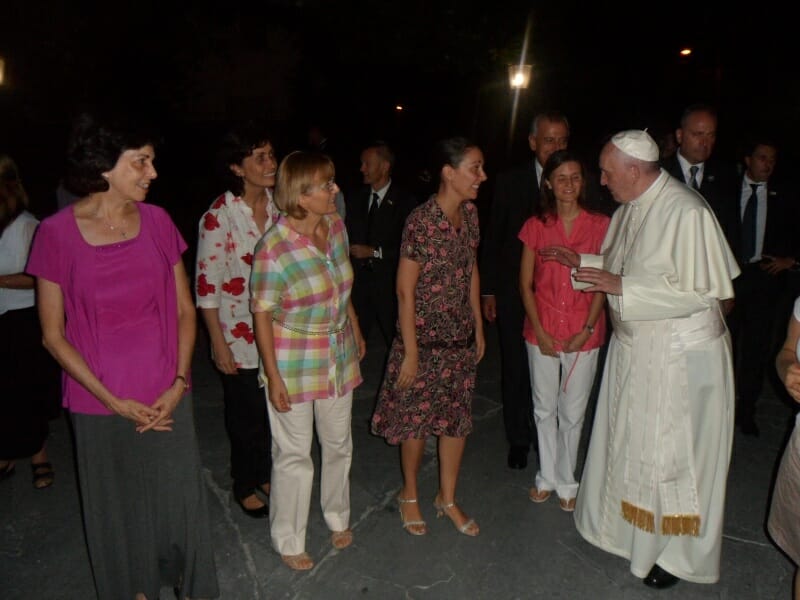 In his meeting with the youth, the empathy was immediate. To the wish expressed by one of them, of “not wanting to present only their dreams, but of requesting something special that could revive hope…,” Francis answered firmly, “Continue dreaming, because if you offer the best of yourself, you will help the world to be different. Don’t forget: go on dreaming! Dream and recount your dreams. Talk about them since the big endeavours have to be told!” “Many of us – they continued – had the chance to greet him personally, starting not only from the focolarine working in the Nunciature, but also the families, and the youth in the various cities he visited.” The Focolare has been in Cuba since 1998 and the service it tries to offer the Church and society is that of weaving a network of fraternity, bringing “social friendship” which the Pope presented to the youth and to favour “the culture of encounter,” to pursue as a journey of hope. “Many of us were part of the service staff, before and after the visit: some helped the media in organising the events, some gave interviews on the national and international media, or simply stayed in their places along the route the Pope would take, to greet him. In line with our vocation of unity, together with believers and agnostics, we lived and participated in these days of grace.” In the Sanctuary of Our Lady of Charit, Pope Francis left us with a programme: “We want to be a Church that goes out from its homes to build bridges, demolish walls and sow reconciliation. Like Mary, we want to be a Church that is able to walk with its people in difficult situations, committing ourselves with our lives, our culture, society, and not isolating ourselves, but walking alongside our brethren. All together, all together.”
