17 Sep 2015 | Non categorizzato
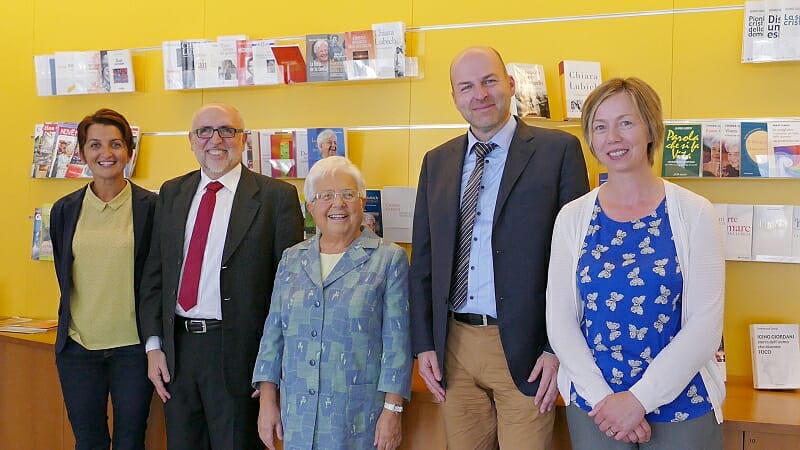
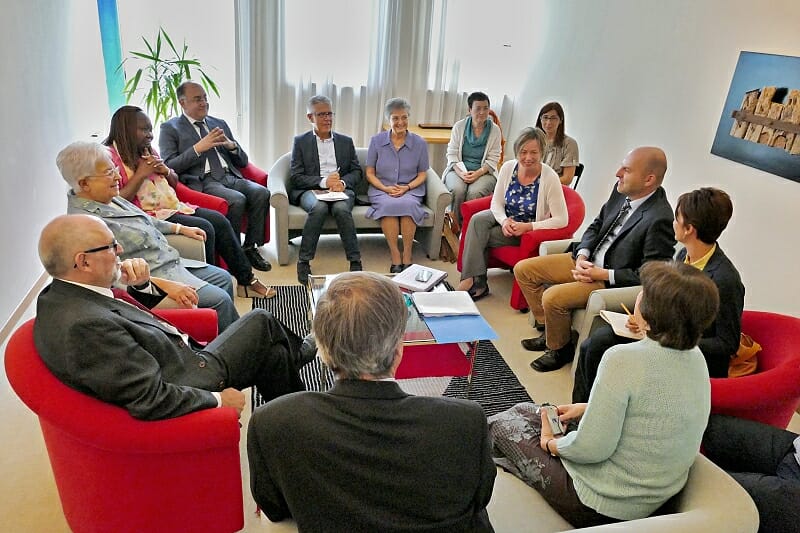
Bernd Nilles (second from right) at the Focolare’s centre in Rocca di Papa, Rome.
13 Sep 2015 | Non categorizzato
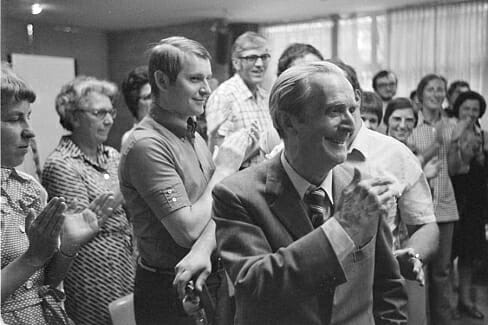
The document that will guide the sessions of the Synod of the Family in the Vatican from 4 to 25 October, cites: «still today, the family remains and will always remain as the fundamental and irreplaceable pillar of social life. In fact, in the family multiple differences coexist, through which relationships are established, and grow in the confrontation and mutual acceptance between generations. This is why the family represents a founding value and a resource for the harmonic development of every human society as affirmed by the Council: “The family is a school of a richer humanity […], and the fundament of society.” ( GS,52 )». The importance of the family and the spouses are thus underlined. To this regard Igino Giordani wrote:«The spouses have an explosive mission in the reform of society, and endow marriage with its original value as a generator of life – due to the sacrament – of both body and soul: the value of the most suitable tool that can revive the soul of society, to bridge the world and the Church». At another point, Giordani explains how the family implements this role: «The family does not retreat within itself, as in a fort, but expands like a cell that lives inasmuch as it co-exists with its brethren. From this communion which implies the obligations of apostolates, charity and justice towards society, we can see the extensiveness of the spiritual and social tasks of marriage.» Giordani continues to underline how only the family in its form and constitution can generate society and the Church: «The new society is born, from the natural and sacred source of the family, the human and divine features of which are briefly delineated in the Gospel. The family, structured according to Christian concepts, gives rise to the Church and the State, the city of God and the city of man: a dual citizenship that brings about the full maturation of the life of redeemed humanity.» Thus a fundamental bond unites society and the family. «Society today needs the family for its rebirth. Otherwise, it is doomed to a catastrophic future, because the maxim of love and unity is no longer put into practice.» Edited by the Igino Giordani Centre Excerpts from: Igino Giordani, La rivoluzione cristiana/The Christian Revolution, Città Nuova Rome, 1969; Igino Giordani, Family, Society, New City Publishers, Rome, 1990; Igino Giordani, Letter, 1967; Igino Giordani, Speech for the New Families 1974.
11 Sep 2015 | Non categorizzato
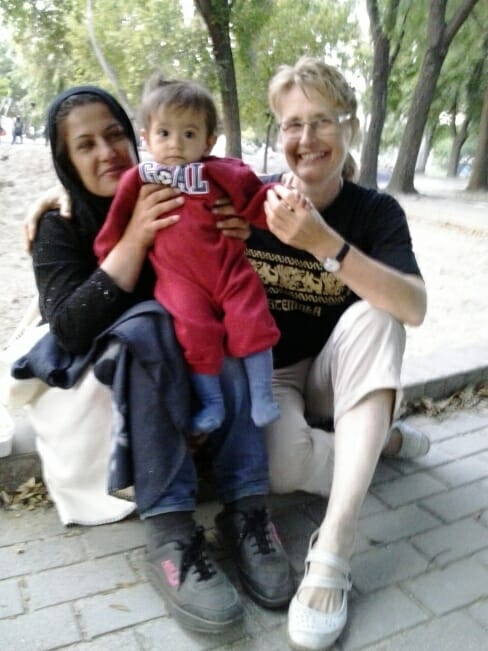 Viktoria Bakacsi and Laszlo Vizsolyi from the Focolare Movement in Hungary write: “Every day we encounter suffering under so many guises, right outside the doors of our homes. We listened to the words of Pope Francis and are now trying to put them into practice even more.” “For months,” they write, “there has been a continual influx of refugees. Some two thousand people arrive in Hungary every day: families with children, exhausted. Despite the general chaos, many people are stepping out and giving a helping hand, people belonging to civic groups and church organisations.”
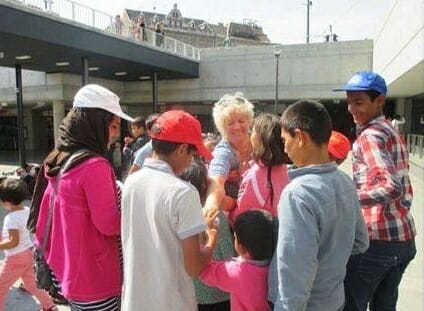
 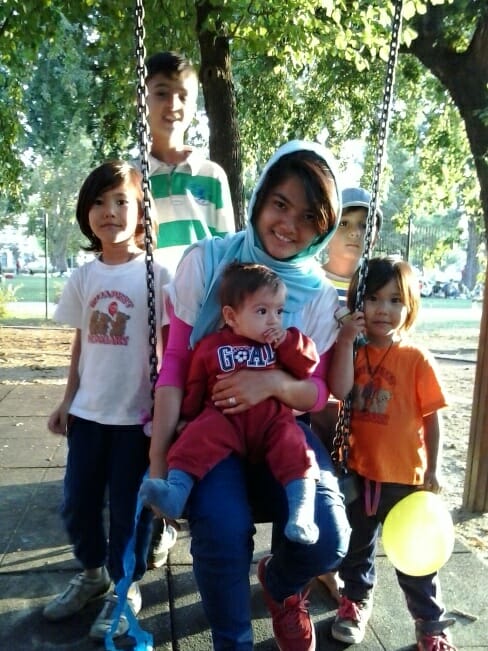 The Focolare Movement in Hungary has also gone to work. Viktoria and Laszlo continue: “We shared ideas and experiences and with the Apostolic Nuncio, Alberto Bottari de Castello, have become involved in gathering and coordinating efforts so that things can run more smoothly and efficiently. We are working closely with several religious orders, including the Jesuits who already have a program in place, and groups like the Community of Sant’Egidio, which not only has the infrastructure and experience, but also legal expertise. The work undertaken also aims at promoting openness and welcome through an educational program which we started during a summer camp with 230 young people. Focolare members who are active in parish life go every day to the Keleti Train Station. One of them writes: “I’ve been in the midst of refugees for two months. There are a lot of us helping. There are so many children, such desperate people… I try to see the face of Jesus in each one of them, and this gives me strength. They are so grateful for every little help they receive, and the children rejoice over even the smallest gifts.” A psychologist writes: “I try to share my professional skills by supporting the many volunteers.” A focolarino priest writes: “On Thursday we had our meeting with priests. After reading this month’s Word of Life, six of us went to the Station to help the people.” A young woman: “After the Youth for a United World Camp we went to the refugees to help care for the children. There were twenty of us. Around 70 children and families gathered around us, since we were dressed up as clowns. We played, drew pictures and found every way possible to communicate with them. Many of them don’t speak English, and many of them tried to teach us a few Arabic words. We will continue to go once a week.” “We especially noticed the difficulty in communicating and the lack of information available. A focolarina who works in collaboration with the Association of the Order of Malta, started producing signs with useful information. She finds someone who speaks Arabic to translate them. We are also continuing to help out in Szeged where refugees are continually arriving. Besides our regular collections, we have been brought several boxes of leftover fruit. One of us, a police woman, goes to help the women and children in the camps at the end of her workday.” “We realise that what we are doing is only a drop in the ocean,” they conclude, “but we wouldn’t want that drop to be missing.”
9 Sep 2015 | Non categorizzato
Consecrated men and women from all over the world (countries such as Iran, the Philippines, Ivory Coast, Zimbabwe) will be arriving in Rome to participate in the World Day of Young Religious. The event is organised by the Congregation for the Institutes of Consecrated Life and Societies of Apostolic Life within the context of the Year of Consecrated Life.
- Prayer vigil in St. Peter’s Square (15 September at 20.30)
- Meeting with Pope Francis during the general audience (Wednesday 16 September)
- Mass in St. Peter’s Basilica (19 September at30)
9 Sep 2015 | Non categorizzato
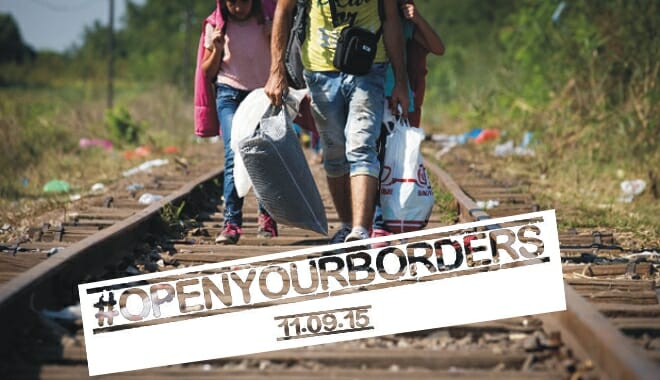
Reduce public funding of weapons; work at the root level of inequality, to counter misery; revise current models of governance; adopt a model of organised legality in opposition to criminality; guarantee universal primary education. These are the five main points of the appeal made by the young people of the Focolare’s Youth for a United World (YUW) to national parliaments, the European Parliament, the National Commissions of UNESCO and the United Nations. On March 12th of this year, 350 young people representing 39 countries presented their appeal to the Chamber of Deputies of the Italian Parliament. Their words have great resonance these days when faced by a humanitarian drama that can wait no longer for political reflections or national and international bureaucracies: “We are well aware of the global scene that is dotted by numerous conflicts, which cause migrations of people who are fleeing from violence, extreme poverty, hunger and social injustice in their own lands. These deep wounds concern all of us directly and urge us to find concrete solutions that are personally engaging.” They add: “Personal good will, will never produce universal brotherhood. We are convinced, in fact, that political action, directed at intervention into the causes of the conflicts and into the conditions that generate inequality, is required.” In their appeal the young people not only denounced these causes but presented explicitly clear requests. In these times when we are immersed in such a pressing humanitarian drama, the YUW also raises its voice to say: “We want peace and unity among the peoples of the world.” They invite everyone to spread the appeal, presenting it as soon as possible to international, national and local organisations (UN, UNESCO, Heads of State, Parliaments, mayors, religious leaders, etc.) They have chosen September 11th to “flood the social media with the Hashtag #OpenYourBorders.” They will also increase concrete activities and take part in those that are already underway through the United World Project. Photos, personal testimonies, events and videos in favour of welcome and peace can be posted on Facebook at ‘Dialogue to unlock’ or at info@unitedworldproject.org. The proceeds my be given to the local Caritas or else sent as a donation to the Youth for a United World Fund. https://www.youtube.com/watch?v=gcAv0Lr34bw
