9 Sep 2015 | Non categorizzato
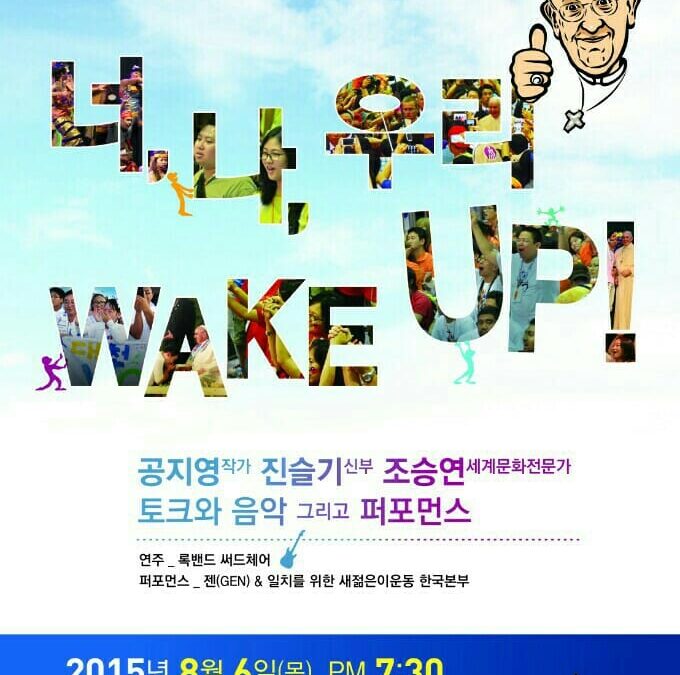
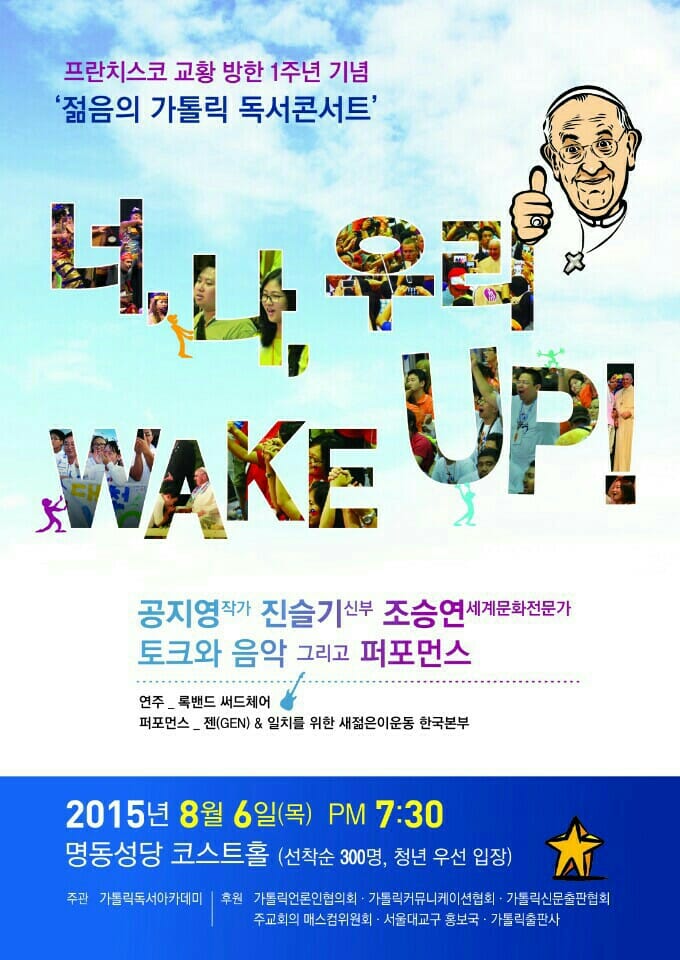
 The Book Talk Concert is an event supported by the Korean Bishops Conference. It began three years ago with the goal of spreading the faith through monthly cultural events with popular artists and writers, and also newcomers. In August the Book Concert offered a special edition for young people lifting up the message of Pope Francis to today’s Korean society: “You, me, us – wake up!” The event was held at the beginning of the month in the Cathedral of Myeungdong where the Pope had celebrated the 2014 Mass for the Peace and Reconciliation of the Country . The main guests included authors such as: Kong Ji-young, a favourite author the young; Father Jin Seul-ki, a young priest; and Cho Seung-yeon, a young expert in global culture. ”Wake up” was the heart of the Pope’s message to the Asian young people gathered in Korea last year, and this year’s message was: Wake up and rise, get moving in favour society and your neighbours, especially the suffering.”
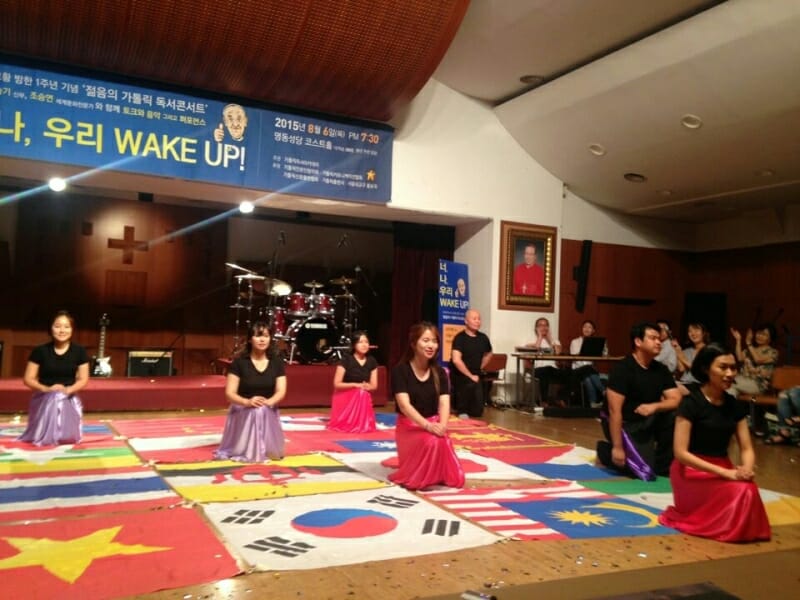
 The writers talked about their personal awakenings, as they responded to the questions of the young people on how to face and overcome problems of faith and everyday life. There was a concert by Third Chair, followed by discussion and experiences. There was also a deep moment of prayer for peace, using the words of Pope Francis. Twenty flags from several Asian countries painted a scene of brotherhood and the overcoming of age-old hostilities among nations. One young man from the Focolare recounts: “I worked on two teams, scenario and art. We performed what we had prepared for last year’s Asian Youth Day, which concluded the Book Concert. There were difficulties and tension at times, but we always aimed for an atmosphere of mutual understanding, also between generations, knowing that this was the only way the event could be a gift for the young people who had been invited.” Another young volunteer commented: “Through our often hidden service, we were able to relive last year’s visit of the Pope and to convey that experience to many other young people.”
8 Sep 2015 | Non categorizzato
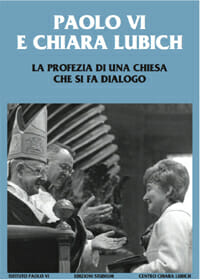
The presentation of the book compiled in co-partnership between Paul VI Institute and Chiara Lubich Centre and published by Stadium Press, will be held on September 27, 2015 at the Mariapolis Centre of Castel Gandolfo, Italy, Via S.G.Battisti da La Salle,. This date has been chosen because of its proximity to the anniversary of Blessed Paul VI, which is celebrated on September 26th. There will be two sessions in the programme. Following the opening remarks by Maria Voce, President of the Focolare Movement, and by Father Angelo Maffeis, President of the Paul VI Institute, a roundtable discussion will begin with Bishop Vincenzo Zani, Secretary of the Pontifical Council for Catholic Education; Dr. Giulia Paola Di Nicola and Bishop Marcello Semeraro, bishop of Albano Laziale, Italy; and Alessandro De Carolis moderator. Meditazione in musica sulla vita del beato Paolo VI.This will be follwed by a concert featuring the piano music of Chopin, played by Father Carlo José Seno, titled Open to the World. Musical meditations on the life of Blessed Paul VI.
8 Sep 2015 | Non categorizzato
More information:
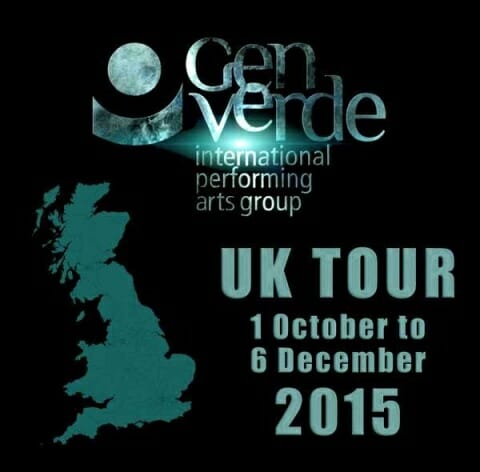
See Focolare UK website for schedules:
Gen Verde UK Tour Facebook:
GenVerdeScotland2015 https://www.youtube.com/watch?v=llkkHKzywrM
7 Sep 2015 | Non categorizzato
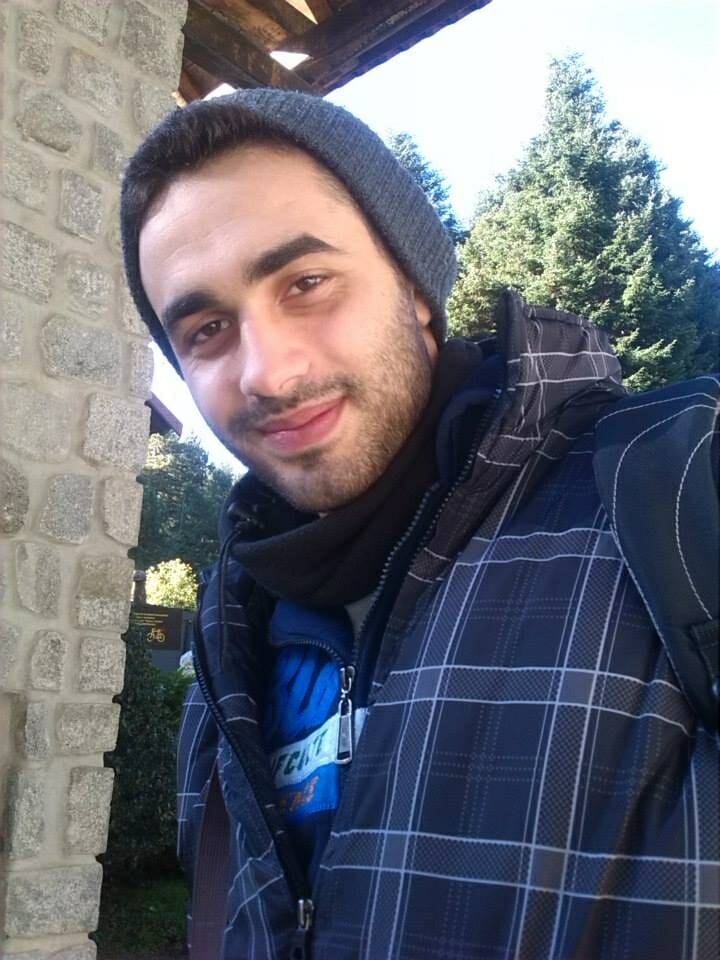 “For over 3 months now I have been doing my apprenticeship in pediatric oncology, in a ward where you never know if the children you are assisting today will still be there tomorrow. It is absolutely not easy to live in continuous contact with the suffering of the innocent, since it gets to the point of putting to the test one’s decision to study pediatric nursing. On the first day, I was ready for anything. But once I set foot in the ward, I came face to face with a beautiful little girl. She was afflicted by one of the worst types of malignant tumours, at the terminal stage. I had no idea at all of how I was to go about it. I had never ever felt so useless and incapable, and was convinced that there was nothing useful I could do for her. There are also other children in the ward, and the day seemed to pass very quickly, but every time I entered the little girl’s room I would feel the same sensation of helplessness and inadequacy. It was already 2 p.m.- time to end my shift. I felt I could not leave without doing something for her. But what? In trying to put in practice the spirituality of unity, I had experimented that what matters in love is to love. That you do not need to do sensational things, just start with a small thing, without expecting great results. I felt I had done all I could for that little girl. So why was I feeling I could do more? In the morning, upon entering the hospital, I had noted that there was a chapel. Perhaps, I thought, loving that child meant praying for her. So I sat on one of the last pews, but did not know what to ask for her. I just sat in silence, with a great, oppressing pain in my heart. Little by little I began to feel that Jesus was taking all my suffering onto himself. With a free heart I could then entrust the child to Him and then go once again to greet her and her mother, to make them feel my closeness and great support. From that moment on, I continued going to that chapel often. It was there that I found the light to face and also comprehend in some way, the mystery of the suffering of the innocent, which we so frequently encounter. And it is the Crucified and Risen Christ who gives me the strength and the right attitude with which to approach the children and their relatives. Often I do not understand what I should do for them, but then the answer never fails to come. One day a 10 year-old girl was interned. She had been tossed from one hospital to another. The suspicion was that she had a serious blood disease, which was confirmed, and all of a sudden, she and her mother collapsed as if they had been hit by the avalanche of a diagnosis that did not offer a way out. I felt the importance of standing by them and taking on their pain, helping them as I could, even if I had to stay a few hours more in the hospital. During the day I could not do much, but when I had some free time from my duties, I would go to their room, to listen to and reassure the mother and let the child play a bit. And every time I it seems like a veil of serenity returns to their eyes, a new hope in facing the trials awaiting them. I try to live this way in many other situations, taking every possibility to stay a bit with “my” kids, not only to administer their treatments but to see them smile and face with serenity their difficult paths.”
6 Sep 2015 | Non categorizzato
In April, a huge fraud by officials of the Tax Administration Service in collusion with senior level political leaders was uncovered. The close collaboration between the Public Ministry and the International Commission Against Impunity in Guatemala (CICIG) led to dozens of people being brought to trial for corruption, including the Vice President. It raised a wave of indignation among citizens, which continues to grow. In the midst of those events, Raúl e Cecilia Di Lascio from Argentina attended a meeting with local members of the Focolare community on the weekend of August 22-23. Raúl is an architect and Economy of Commuion business owner, and Cecilia is a member of the international commission of the Political Movement for Unity. During their discussions they delved into topics concerning politics and the economy in the light of the charism of unity. Meeting during a period of such collective effervescence, transformed the moments of discussion among citizens of all ages and backgrounds an opportunity to be open to a field that is generally looked upon negatively. Chiara Lubich’s vision of politics when she founded the Political Movement for Unity: the great values that political action manifests when it is seen as service in favour of the common good. Looking at politics through the lens of fraternity, which liberates courageous and socially committed attitudes, filled the hopes of the participants, supported by the exchange of experiences that are currently underway in several parts of the world. In the days that followed Guatemalan society held a mass protest demanding the resignation of the President – also requested by Catholic and other Christian church leaders – after connections to corruption were uncovered. Many businesses, schools and universities closed in order to allow people to take part in the protests, including the Mariapolis Centre and Fiore College. The large concentration of people in the Central Park of Guatemala became a solid mass: more than 100,000 people gathered in the time span of a day. Will states: “You can feel that there is a void in the heart of Guatemala that was not filled. We need to unite so that a change can come.” The fact of so many people peacefully demonstrating did not go unappreciated: “The nice thing is that even businesses closed, in order to allow people to take part in the demonstrations. As a Guatemalan I trembled as we cried ‘Guatemala, Guatemala’ or sang the national anthem.” Lina, a teacher states: “I saw a new sense of responsibility. We don’t want to allow the opportunity to change things, to pass us by, knowing that this time it’s possible.” For many it was encouraging to see entire families who were not afraid to bring along their children. “Rich families and poor families together,” Sandra remarks, “indigenous peoples, young people, children and adults – all of them together, and students prepared to resist violence in order to reach the common goal!” the goal that Alex calls: “a better country.” The latest news is that the President of the Republic lost immunity and resigned “for the good of society” and is now under arrest. On September 6 citizens will be invited to the election booths and all indications are that things will unfold in a peaceful and democratic way.
By Filippo Casabianca, Guatemala City
4 Sep 2015 | Non categorizzato
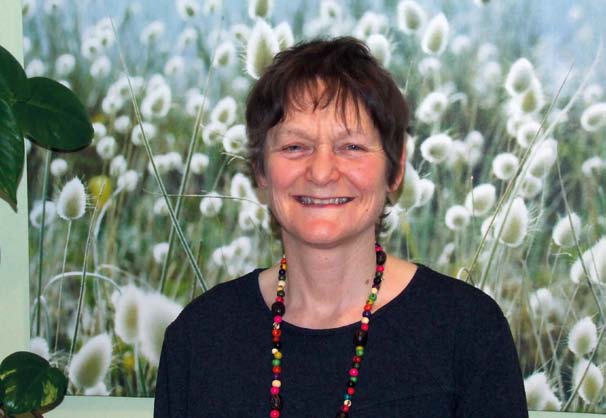
“Aboard the bus to the hospital in Harefield, Great Britan, where I was studying nursing, I was impressed by one my colleague’s way of acting. I was very shy then, but she started to make friends with me, and I was impressed by that. She invited me to breakfast, in spite of having some of her ‘wilder’ friends nearby. She didn’t make a distinction. I was trying to be a Christian but wasn’t very happy. I would go to church on Sundays more to salve my conscience than anything else. But she spoke of joyful faith, genuine faith that she shared with other young women like herself, faith illuminated by love. One day she arrived at the hospital with a guitar to celebrate with one of the nurses who was notorious for not getting on with people. I said to myself, if this woman is able to do so much, perhaps it would be worthwhile to find out what’s behind behind it. She told me about the spirituality of unity that inspired her. I began to visit the people at the focolare and every time I found new ways to give of myself: sharing some clothing or food with those in need, offering to do something practical like the washing, etc. These small gesture, which were the fruit of the Gospel that I had also begun to put into practice, made me feel much joy inside me. Even though I still didn’t know what the Focolare Movement was, I knew it was the place I had to be. I looked at the radical choice the focolarinas and thought I would love to have the courage to be like them. But they’re Catholics, and I’m Anglican. . . I felt this voice inside me saying, ‘But you can, you know. Why don’t you just say your yes to me?’ I felt like taking a step off a cliff by saying my yes to God. It was so unlike me, but I was happy to want to follow him forever. I became a nurse specialised in midwifery, because of a deep desire to bring a change in society. I thought that with this specialization I could go abroad, and I had already put some money aside for the trip. When I entered the focolare I gave that money to the poor and began my formation to become a focolarina. My first destination was the focolare in Leeds for five years. I worked in an area of the city with deep rooted social problems. I had came from a middle class backgound and had a romanticised idea of what poverty was. When one particular girl came to the clinic, she always had the same clothes on and her tights were full of holes. It was important for me to build a relationship with her, to get to know her so that she could tell me about her situation, where she lived, and so on. One day I visited her home. Her partner was standing in the doorway, very verbally aggressive towards me. I was so shocked by the man and the state of the house, that I could hardly talk. Then I noticed a big tank of fish on the wall, so I started to talk about the fish and the tension melted. On my next visit I brought along some dresses, and the third time I found her sitting on the window sill ready to show off her new clothes. I now live in the focolare at Welwyn Garden City and continue to work for the National Health Service (NHS). In recent years there was upheaval in the NHS and it’s not so easy to bring that change that inspired me at the start of my career. But even in this upheaval I strive to do everything as an act of love towards God and my brothers and sisters. Living in community with people who have made the same choice in life is an important opportunity also for my job; but also to grow together in the unity amongst us and in our faith in God-Love, giving ourselves to others whether they are Catholic or Anglican.”
