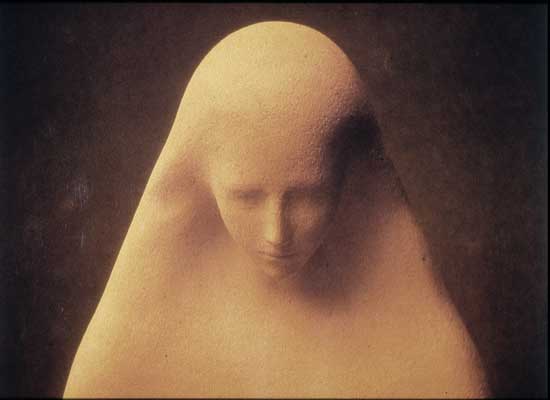
Mary, The Transparency of God
Ave Cerquetti, ‘Mater Christi’ – Roma, 1971

Ave Cerquetti, ‘Mater Christi’ – Roma, 1971

 «Working in the fields, and taking care of the life of the plants, in an immense silence marked by the solar and lunar cycles, and sharing the work of creation of natural life, are also like priestly tasks, and call for concentration and sacrifice: the courage to tune in with one’s own soul, and be one with the expectation of the universe, in contact with nature which is a miraculous nursery, feeling oneself, without fainting, in the presence of God.» (FIDES, July 1938) « Man needs beauty and purity that surpasses human ideals in order to rise up to the contemplation of Mary. She was the one who lifted him up: in contemplating this, the most beautiful aspirations of the soul blossomed, and tried to capture through expressions of art, the highest ever achieved. Maternity is womanly tenderness, the most beautiful passion, the moment wherein one is able to lift oneself beyond brutality, through a surge of divinization.» (FIDES, March 1938) «The Christian revolution came about without conspiracy and did not overturn institutions, nor did it kill tyrants, but penetrated into the obsolete organisations of the old world, into the worn family, in the decrepit juridical institutes, and into social relationships intoxicated by lust. It was love that was stirring up again, to regenerate all and by which suddenly, slaves were able to transform themselves before their masters, and woman assumed a new value in the eyes of man, and heathens and labourers bridged the immense gap between them and the Greeks and Romans. ». (FIDES, February 1943 «The aware Christian – the saint – is one who uses his time carefully and is able to achieve a lot in a short time, to honour the Head of the house, for the common good and wellbeing of his brethren. This activity and ability, in the current language is called apostolate. A Christian that does not act in the manner and time assigned, is a Christian who ignores his role in the Church: he is unaware of the Church that lives because it acts and produces action. We say it produces Catholic action. In a thousand ways, all are involved. A poet can do it and likewise a half wit, a hermit and a monk, the head of a family and a department head, the city wayfarer and the cobbler in his workshop. ». (FIDES, October 1938) Source: Igino Giordani Centre
https://vimeo.com/131558378
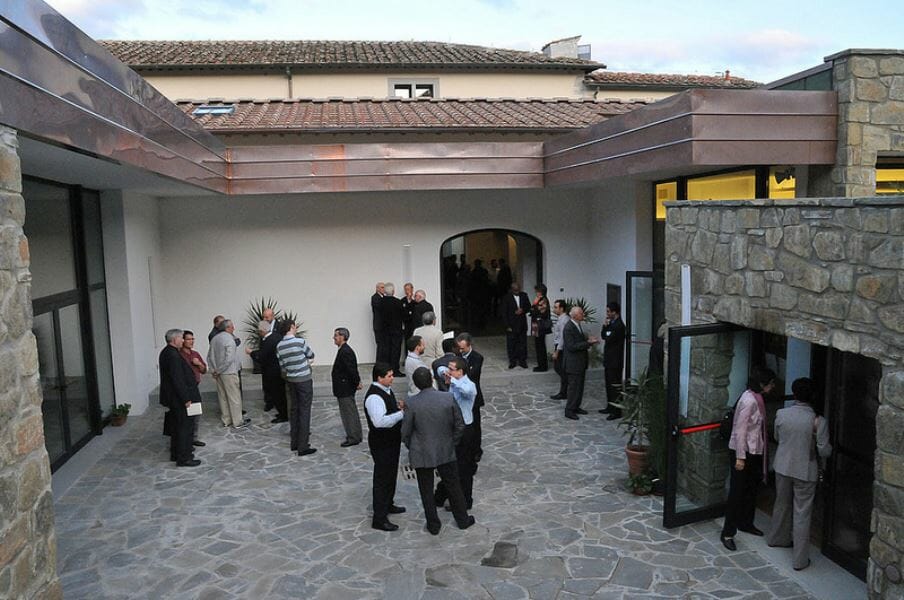
The 2014-2015 Course for Seminary Educators that ended in Loppiano, was attended by around 20 priests from Brazil, Kenya, Nigeria, Tanzania, Indonesia, Thailand, Italy, Holland, Spain and Malta. “In giving a comprehensive assessment of the course, I think I can say that the objective of enlightening the world of education in seminaries with the charism of unity was substantially fulfilled.” Some of the participants shared their impressions: “Attending the course has made me focus on the significance and value of my ecclesial service as an educator, especially within the perspective of the Church as communion, and also because of the fact that the Church of the future depends on the type of education given in seminaries.” “This course challenged me to live this model of life we contemplated on together and let myself be moulded by the circumstances and by my brethren, and change my way of praying and thinking. I will keep in contact spiritually and try as much as possible to concretely keep up a direct dialogue with the team that has promoted this event, and also with all the participants.” The course structure was divided into four weeks within a two-year period. The second half which was held this year dealt with the concrete aspects of education, divided into seven major parts: The Gift of oneself and communion; Openness toward the other: dialogue and testimonials; Union with God: interiority and sanctification; Life and the mystical body and corporeality; Personal harmony and building the community; Wisdom, studies and culture; and Communication and media at the service of communion. The course was guided by the keywords: prayer-life-thought. It successfully achieved the mutual involvement of participants and course supervisors. Similar courses were also held in Bangkok in 2013, with around 60 participants from Southeast Asian countries. Other similar courses have been programmed to be held in the Philippines, Kenya, Ivory Coast, Brazil and Colombia. Over the last eight years, there has been a total participation of about 200 seminary educators from about 30 countries of the four continents.
Love is the fulfilment of our life, the one secure guiding principle we can follow. The whole of Christian ethics is contained in these words. Human behaviour, if it wishes to be according to what God thought when he created us, and so genuinely human, must be animated by love. If our ‘walk’ (which stands for our life) is to reach its objective, it must be guided by love, the summary of the entire law. The apostle Paul is speaking to the Christians in Ephesus when he makes this exhortation. It is the conclusion and summary of what he has just written to them about the Christian way of life: going from the old self to the new self, being true and sincere with one another, not stealing, knowing that we are forgiven, doing what is good, in a word ‘walking in love’. It would be useful to read the couple of sentences that give us these incisive words which will be with us throughout the month: ‘Therefore be imitators of God, as beloved children. And walk in love, as Christ loved us and gave himself up for us, a fragrant offering and sacrifice to God.’ Paul is convinced that our every move must be modelled on God’s way of behaving. If love is God’s distinguishing feature, it must be also for his children. They must imitate him in this. But how can we know God’s love? For Paul it is extremely clear. God’s love is revealed in Jesus, who shows how and how much God loves. The apostle experienced it at first hand: Christ ‘loved me and gave himself for me’ (Gal. 2:20), and now Paul reveals this to everybody so that it may become the experience of the whole community. ‘Walk in love’ What is the measure of Jesus’s love which should be the model for our love? It, we know, has no limits, no exceptions, no partiality. Jesus died for all, even his enemies, those who were crucifying him, just as the Father in his universal love makes his sun shine and his rain fall upon all, good and bad, sinners and righteous alike. He knew how to care above all for the little ones and the poor, the sick and the excluded. He loved his friends with intensity. He was particularly close to his disciples… His love spared nothing and went to the extreme of his giving his life. And now he calls all to share in his same love, to love as he has loved. This call could scare us, because it demands too much. How can we be imitators of God, who loves everyone, always, taking the initiative? How can we love with the measure of Jesus’s love? How can we live ‘in love’, as this Word of Life asks of us? It is possible only if we ourselves have first had the experience of being loved. In the expression ‘walk in love, as Christ loved us’, the word ‘as’ can also be translated ‘because’. ‘Walk in love’ Walking means acting, behaving, which means to say that everything we do must be inspired and moved by love. But perhaps it is not by chance that Paul uses this dynamic word to remind us that we learn by loving, that there is a whole road to go before reaching the wideness of God’s heart. He uses other images to point out the need for constant progress, such as the growth of infants to adulthood (see 1 Cor. 3:1-2) or races in the stadium to win a prize (see 1 Cor. 9:24). We are always a work in progress. Time and constancy are required to reach our goal, without giving up in the face of difficulties, without ever letting ourselves be discouraged by failures and mistakes, ready always to start again, without giving in to mediocrity. Augustine of Hippo, perhaps thinking of his own painful journey, wrote: ‘You always dislike what you are, if you want to reach what you are not yet. In fact where you feel at ease, you stop, and you say, “That’s enough,” and like that you sink. Build up continuously, walk ahead always, go forward without ceasing; do not pause long on the way, do not look behind, do not leave the track. The one who goes not ahead, stays behind.’ ‘Walk in love’ How can we walk most swiftly upon the way of love? Since the invitation is given to the whole community (the word ‘walk’ is in plural form), it is a good idea to help one another. Indeed, it is sad and tough to go on a journey alone. We could start by finding the opportunity to declare to one another again (with our friends, families, the members of the same Christian community) our will to walk together. We could share our positive experiences about how we have loved, so as to learn from one another. We could share with someone able to understand us the mistakes we have made and our slips along the way, so as to be corrected. Prayer together too can give us light and strength to go ahead. United among us and with Jesus (who called himself the Way!) in our midst we will be able to travel along the whole of our ‘Holy Journey’. We will sow love around us and we will reach the goal: Love. Fabio Ciardi