
Smiling on the world; safeguarding creation
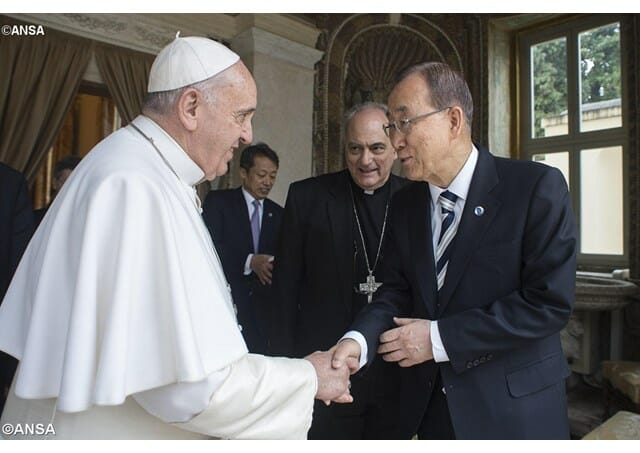
No anticipating the encyclical of Pope Francis on the Creation, but great expectation for the document that will be published at the beginning of June. “The world waits to hear his teaching and what he will say in the encyclical and in his speech before the United Nations Assembly on September 25, 2015,” said Jeffrey Sachs, director of the UN agency for sustainable development (UN Sustainable Development Solutions Networks). He is also one of the promoters of the summit, along with the Pontifical Academy of the Sciences and the Religions for Peace, which has Maria Voce as one of its co-presidents. Also in attendance: were General Secretary of the United Nations Ban Ki-Moon, president of the Italian Republic Sergio Mattarella, and president of the Republic of Equador Rafael Vicente Correa.
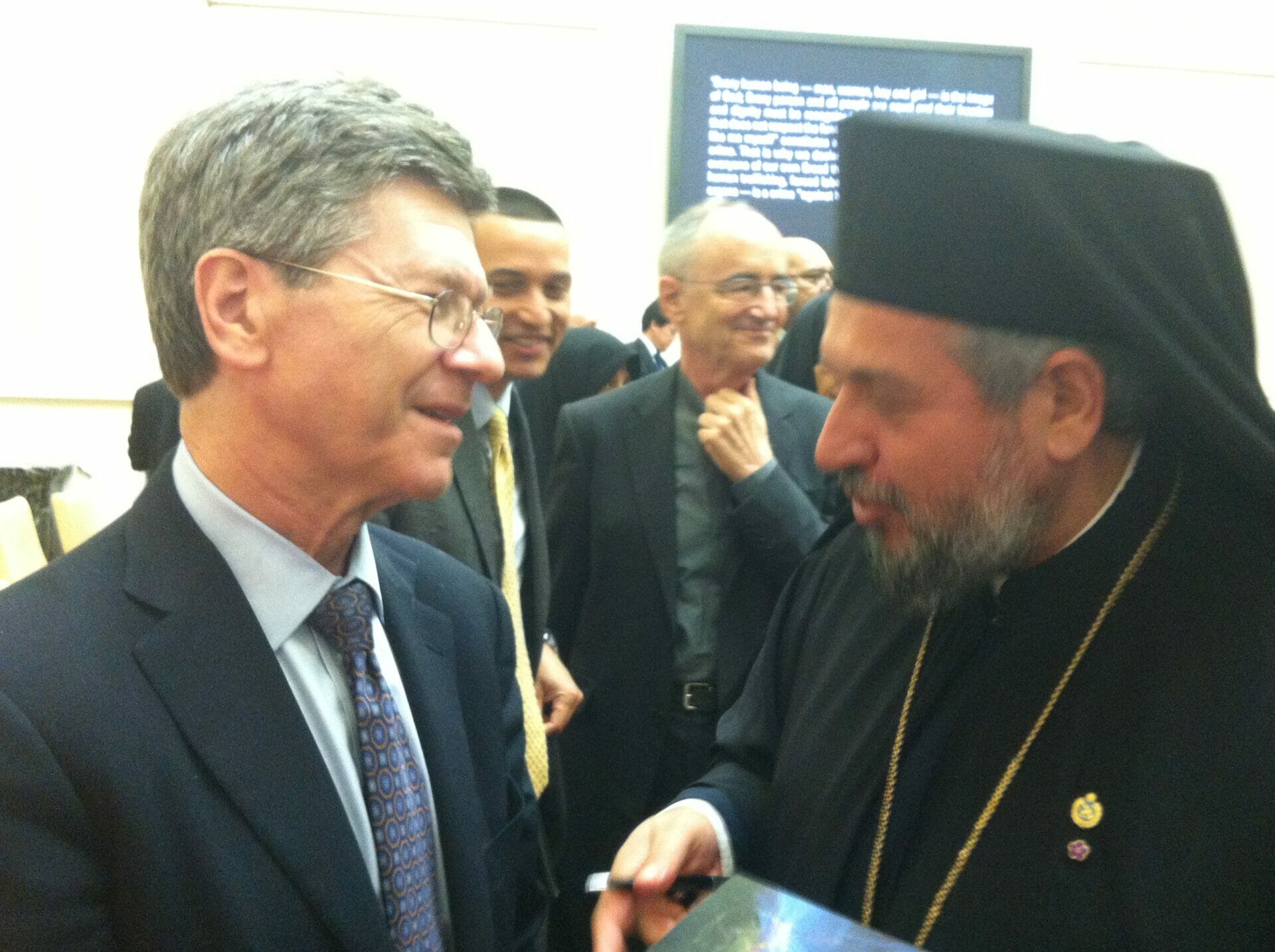
The conference brings together scientists, environmentalists, Nobel laureates, political and religious leaders to further the discussion on climate change and sustainable development in view of the encyclical on Creation. The day focused on the moral dimensions of the commitment to sustainable development. This is why the involvement of a wide diversity of religious communities seemed quite an encouraging novelty. For Maria Voce, what emerges from this summit is a “new awareness that, in order to obtain something positive, we must come together, because no one, by himself, has the recipe for getting out of these quite dramatic situations.
It reveals that the human race has within itself the ability to get out of the crisis, but it can be done if there is a synergy of all the components. What is emerging is the need for listening to each other, and acting together.”

Cardinal Turkson, president of the Pontifical Council for Justice and Peace proposed that the answers should not be merely technical, but should be based on the moral dimension and oriented towards the well-being of humankind. Technological, scientific and economic progress has introduced lifestyles that were unimaginable to our predecessors, but it also has “some dark sides and unacceptable costs.” “While global society is defined on the values of consumption and economic factors, the rich of today have grown numb in front of the cry of the poor.” “Out of the 7 billion people living the world, 3 billion are living in conditions of poverty, as an elite consumes the greatest portion of the resources.” The discussion ended on the topic of food, which will be at the centre of the Universal Expo 2015 in Milan, Italy. Turkson strongly denounced the exploitation of workers, the trafficking of human beings and the modern forms of slavery. Pope Francis deplores this “throw-away culture,” the Cardinal recalled, in the “globalisation of indifference.” “The Church is not an expert in science, technology or economy, but it is an expert in humanity. To win the challenge of sustainable development “the same conversion, personal transformation and renewal are needed that were invoked fifty years ago by Paul VI and encouraged by Pope Francis today.
“One concrete possibility is offered by a project inspired by the Eco One Project,” Maria Voce remarked during an interview. “It’s the Earth Cube. Its six sides have catchy phrases that can get us involved in supporting a healthy and sustainable planet: ‘Smile on the world!’ ‘Discover the beauty!’ It also teaches sobriety, taking only what you need as the trees do. It suggest daily actions, concrete gestures: ‘Don’t waste water.’ ‘Recycle!’ The last side says: “Now is the time!” Don’t wait until tommorrow. Simple projects such as these can help us to do what the Pope is inviting us to do.”
Word of Life – May 2015
With the tenderness of mercy our love can give witness to the reality of God’s love. We experience what we share with others. When the Lord God appeared to Moses on Mount Sinai he declared his identity as: ‘The Lord, a God merciful and gracious, slow to anger, and abounding in steadfast love and faithfulness’ (Ex 34:6). To indicate the nature of this merciful love, the Hebrew Bible uses a word (raḥămîm) that recalls a mother’s womb, the place where life begins. By making himself known as ‘merciful’, God shows that for each thing he has made he is concerned as a mother is for her child. He cares, is near, protects, looks after his creature. The Bible uses a further term (ḥesed) to express other aspects of this love which is mercy: faithfulness, benevolence, goodness, solidarity. Mary in her Magnificat too sings of the Almighty’s mercy that is from generation to generation (see Lk 1:50). Jesus himself spoke to us of God’s love, revealing him as a ‘Father’ close and attentive to our every necessity, keen to pardon, to give all we need: ‘he makes his sun rise on the evil and on the good, and sends rain on the righteous and on the unrighteous’ (Mt 5:45). His love is truly ‘rich’ and ‘great’, as is said in the letter to the Ephesians that give us our Word of Life: ‘But God, who is rich in mercy, out of the great love with which he loved us even when we were dead through our trespasses, made us alive together with Christ.’ What Paul says here is almost a cry of joy born of the contemplation of the extraordinary thing God has done for us. We were dead and he revived us, giving us a new life. The words begin with ‘but’, indicating a contrast with what Paul pointed out earlier. This was the tragic condition of humanity crushed beneath its wrongdoing and sins, prisoner of selfish and wicked desires, under the influence of the powers of evil, in open rebellion against God. In this situation it would have deserved God’s wrath (see Eph 2:1-3). In contrast God, instead of punishing – hence Paul’s utter amazement – gives humanity life again. God does not let himself be governed by wrath, but by mercy and by love. Jesus had already suggested that God acts like this when he told the parable of the Prodigal Son, the younger brother who was welcomed back by his father with open arms after he had sunk into an inhuman life. It was the same with the parable of the Good Shepherd who goes in search for the lost sheep and puts it on his shoulders to bring it back home. And the same can be seen in the Good Samaritan who cares for the wounds of the man who had fallen into the hands of robbers (see Lk 15:11-32; 3-7; 10:30-37). God, a merciful father, symbolized in the parables, has not only forgiven us, but he has given us life itself in his son Jesus, that is, given us the fullness of divine life. And this leads to a hymn of gratitude: ‘But God, who is rich in mercy, out of the great love with which he loved us even when we were dead through our trespasses, made us alive together with Christ.’ This Word of Life ought to make us feel the same joy and gratitude as Paul and the first Christian community. To each one of us, too, God shows himself ‘rich in mercy’ and of ‘great love’, ready to forgive and grant trust again. There is no situation of sin, of suffering, of solitude, where he does not make himself present, does not come alongside us to go with us on our way, does not grant us trust, the possibility of rising up and the strength to start again. At his first ‘Angelus’, on 17 March two years ago, Pope Francis started speaking about the mercy of God, a theme that has become characteristic for him. At that time he said, ‘God’s face is the face of a merciful father who is always patient… he understands us, he waits for us, he does not tire of forgiving us.’ He ended that first brief greeting with the words, ‘He is the loving Father who always pardons, who has that heart of mercy for us all. And let us too learn to be merciful to everyone.’ This points to a practical way to live the Word of Life. If God for us is rich in mercy and of great love, we too are called to be merciful towards others. If he loves those who are bad, who are his enemies, we too ought to learn how to love those who are not ‘lovable’, even our enemies. Did not Jesus tell us, ‘Blessed are the merciful, for they will receive mercy’ (Mt 5:7)? Did he not ask us to be ‘merciful, just as your Father is merciful’ (Lk 6:36)? Paul too invites his communities, chosen and loved by God, to clothe themselves ‘with compassion, kindness, humility, meekness, and patience’ (Col 3:12). If we have believed in God’s love, we too can love in our turn with that love which makes us draw close to every situation of pain and need, that forgives all things, that protects, that knows how to look after the other person. Living in this way we will be able to give witness to God’s love and help those we meet discover that also for them God is rich in mercy and of great love. Fabio Ciardi
Giordani’s Story of Light
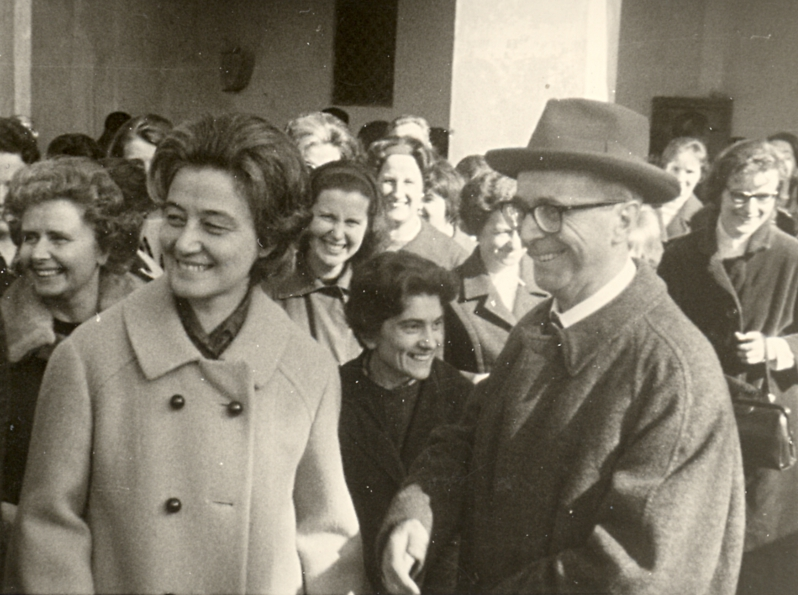
“This event, like all things of God, began from a humble seed. Silvia Lubich was the daughter of a wine merchant who the economic crisis of the Second World War had reduced to being a modest city worker. He was the husband of a housewife from Trent who, as a young woman, had worked in the print shop of Cesare Battisti. They were a Catholic couple like many others from Trent: simple and direct, without a lot of pretensions. They brought four children into the world, a boy, the firstborn, and three girls. The eldest daughter, Silvia, was born on January 22, 1920. They raised them all in the Catholic faith which since her infancy had shaped Silvia in a straightforward piety. It was straightforward in the sense that it did not allow any compromises: it didn’t allow her to divide her desire between God and the world; to think about good and evil; to show one thing while hiding another. There was God, and God was everything: so one had to belong totally to Him; to do His will like a ray of sun that leaped down from heaven to rest upon earth.” So begins the Story of Light, the story of Chiara Lubich written by one of the main protagonists of the events it describes: Igino Giordani, an eminent figure in Italian politics and culture, and also co-founder of the Focolare Movement. “It is never easy for a work to become a masterpiece,” Director of the Igino Giordani Centre, Alberto Lo Presti writes in the introduction to the first installment. “What then of a book that would contend for this position with a hundred other books written by Giordani? But Story of Light never saw the light. Not only that: it remained unknown even to those who have preserved it over the years. Giordani himself had asked them to wait – whereas most authors would have preferred the opposite; that is, to be recognized especially for their best works.” “Story of Light is not based on historiographic research. It could be described as a recounting of the miraculous intervention brought about by the Holy Spirit – visible in the person and actions of Chiara Lubich – in twentieth century history. In other words, it is comprised of a series of narrative portraits in which Chiara’s biographical sketch is intertwined with God’s plan for humankind, whose ideals had been afflicted and social systems divided and devastated by world wars. This is why, in the subtle interweaving of events in Story of Light, we recognize some of the basic elements in Giordani’s own complex personality. He experienced first-hand all the main dramatic events of the twentieth century, having been wounded in the war, having undergone exclusion because of his ideas, and having had to accept exclusion from civil society. He was a man of faith who worked both in Church and culture, aware that the radical evil would be defeated by a new Christian spirit that he set out to discover. He met Chiara Lubich in September 1948 and found in her the light he had been looking for. He followed her, placing at the disposal of the Focolare founder all of his intelligence and will. He never had doubts about the strength and pre-eminence of the figure of Chiara for the Church, society, current history, and the future. Therefore, even had he have wanted to, Giordani could never have written a complete, objective, methodologically flawless story of Chiara Lubich. His human and spiritual involvement could not allow him that.” “The author had written many volumes on great spiritual figures: Catherine of Siena, Ignatius of Loyola, Magdalene of Canossa, Contardo Ferrini, Francis of Paola, Vincent de Paul, Francis de Sales, Francis of Assisi, to mention a few of his works. They formed a gallery of extraordinary people from diverse times and backgrounds. The place of honor in this rich array was assigned to Chiara Lubich, whose story Giordani called his “masterpiece.” At the age of fifty four when history called him to meet Chiara, he did not enter into the relationship without a spiritual preparation. He knew how to measure the religious greatness of an ideal, just as he had the tools for testing the spiritual size and strength of a mystical intuition. For this reason . . .it is likely that Giordani felt a paramount duty of attesting to who Chiara really was. Moreover, he took on this particular role from the first moments of his visits with Chiara and the first small group of focolarine. With his learning, he was well able to reveal the importance and newness of the figure of Chiara to the young men and women who were her followers.” “Giordani lived through difficult moments during which Chiara Lubich and the Focolare were under the magnifying glass of the Congregation of the Holy Office. From that period – the 1950s – and for many years to come, a widespread attitude of prudent discretion was maintained around the figure of Chiara. It may have been necessary to hold back any sentiments of esteem and affection for Chiara, but for Giordani there was never any doubt that the truth about her had to be put in writing and handed on. Hence, Story of Light, his masterpiece.” Introduction to Story of Light (complete text) – Published by Nuova Umanità, gennaio-marzo 2015
Mediterranean crisis: Urgent political action needed
Photo: Francesco Pecoraro/AP
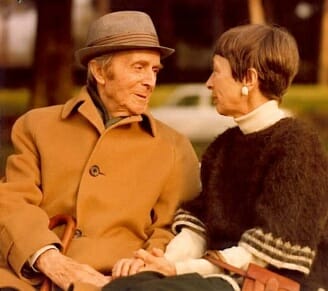
Igino Giordani and the perfection of love
“It is nearly impossible to put into words what Igino Giordani was for the Focolare Movement. He was a co-founder of the Movement. Being co-founder of a Work that the Church recognises as its own involves a multiple and complex activity of grace, true and varied impulses from the Holy Spirit, as well as actions on the part of the individual that are determining for the Work. These graces often come in the form of penetrating and prolonged suffering, often as light, graces and love that are not ordinary. It is better left to the history of the Church and the spiritual movements that embellish it through the centuries, to speak about such people.
A focolarino prays, works, and suffers in order to reach a goal: the perfection of love. Therefore, we feel it is our duty to confirm that Giordani reached this goal. In our judgement he reached the perfection of love.
He personified the name by which he was known in the Movement: “Fire” (Foco), that is, love towards God and towards neighbour, the supernatural and natural love which lies at the roots and is the summit of Christian life. He contributed in a unique way to keeping alive in our midst the reality of the Word of Life given to him when he entered the Movement: “Love one another as I have loved you.”
Those who knew Igino Giordani well are all in agreement that he had lived the Beatitudes. Exceptionally ‘pure of heart,’ he offered married people from around the world the possibility of a unique consecration to God while remaining in the matrimonial state, through spiritual virginity, the effect of burning charity. This purity refined and heightened his holiest sentiments.
He was ‘poor in spirit’ with complete detachment from his possessions, but above all from himself. He was full of mercy. In his company even the most miserable sinner felt forgiven, and the poorest pauper felt like a king. One of the most remarkable characteristics was that of being a ‘peacemaker,’ especially in his life as a politician.
He came to possess that meekness that leads to possessing the earth. He won over everyone who drew near to him. Everyone felt at ease with him, even the young were able to establish a relationship with him. Especially during his last years he seemed to radiate something supernatural when he spoke.
He “hungered and thirsted for justice” and fought for it all his life. Almost immediately he was persecuted for the sake of God’s name. So many sentences of the Gospel make us think of him.
From Giordani one learns the significance of that conversion which Jesus asks for when he says that we must become like little children. He was a fine Christian apologist and apostle. When it seemed to him that he had found a font of clear water flowing from the Church, he “sold everything’ to follow Jesus and to satisfy his thirst with that water.
He suffered because of the marginalization of the laity, and he aspired with that big heart of his to bring down the dividing walls between the people living in the state of perfection and the others – whom he would jokingly add – were living in the state of imperfection. In other words, he was very sensitive to the signs of the times; indeed, he himself was a sign of the times, of these times in which the Holy Spirit calls the entire People of God to holiness.”
(Taken from: Chiara Lubich, Igino Giordani focolarino, «Città Nuova»n. 9-10 – May 1980)